












This site uses cookies

Some are essential for the site to work. Others help us measure our audience and the effectiveness of our ads, and will only be set if you accept them. You can change your choice at any time. privacy policy · cookie policy.

NLP Practitioner · Certified by The Society of NLP · Certificates signed by Richard Bandler himself

You’re good at what you do. And you want to keep a clear head, make sound decisions and make yourself understood when the pressure is on.

Learn to read what people aren’t saying and to choose words that get them moving. Learn to find your best state again when the pressure rises, and to keep thinking strategically whatever happens.

In English on request

See how to join

9.8/10

overall satisfaction, 308 ratings

More than

2,000

people trained

More than

110

organisations

20 years

of experience

Organisations that trust us: Ministries, private banks, pharmaceuticals, watchmaking, public health, higher education.

  • Roche
  • Pictet
  • Cartier
  • Richemont
  • Société Générale
  • RATP
  • Institut Pasteur
  • Bpifrance
  • KEDGE Business School
  • CHU de Liège
  • Gouvernement de Monaco
  • Confédération du Luxembourg
  • Barrisol

What we help you deal with

The situations people come to us for, and the response you learn to bring to each one.

A presentation, a panel or an interview that matters

You know your subject. On the day, it comes down to the state you’re in when you walk into the room.

You learn to choose that state and to find it again when you need it, so that your mind doesn’t go blank: a state you control keeps your ideas within reach.

Pillar: inner states

Convincing investors, a client or a team

Your project is sound, and you have a few minutes for it to be heard.

You learn to notice what the other person isn’t saying and to build a story that brings them into your argument. You also learn to check that everyone is really on board, and not only on paper.

Pillar: communication

Someone who is trying to manoeuvre you

Vague claims presented as obvious truths, and a pressure you can feel without quite being able to name it.

You learn to recognise the language of influence and the mechanics of manipulation, and to ask the questions that defuse them.

Pillar: communication

A change of career

You’re changing direction, with a lot to learn and your confidence to keep up along the way.

You learn to shift the beliefs that hold your change of career back, and to put yourself in the state that makes learning possible. You also learn to observe how people who already excel in your new field go about it, so that you can work their way.

Pillar: strategies

The stress you bring home from work

In Switzerland, more than one working person in four is in the critical zone of the Job Stress Index (Health Promotion Switzerland, 2022).

You learn to bring tension down in the moment and to stop it building up, so that you keep the full use of your logical thinking.

Pillar: inner states

You support other people

Manager, coach, healthcare professional, teacher, HR professional: your work is helping other people move forward.

You learn practical tools for what you already do with the people you support, and you can go further with them than before.

Pillar: all three

Our groups bring together people who would have no reason to meet anywhere else: doctors and nurses, coaches, teachers and educators, business leaders and the self-employed, military personnel and firefighters, engineers, students and parents who came first of all for their family.

Michel Wozniak and Nathalie de Marcé among a group of participants who are applauding

What is Neuro-Linguistic Programming (NLP)?

It’s the study of what works.

You take someone who does something remarkably well – a business leader, a coach, a negotiator, an athlete – and you work out exactly how they do it, down to details they’re not aware of themselves. Then you make that approach something another person can learn. NLP is a framework for this modelling, and everything else comes from it.

A leader (like anyone who deals with other people) can delegate almost everything. But there are two things they cannot delegate: managing their own inner state, and the impact their words will have on others – and on themselves. NLP organises this work into three pillars, which feed one another.

Pillar: communication

Communicate effectively

According to a WorkMed study carried out for SWICA in Switzerland (2022), 57% of cases of incapacity for work with a psychological cause are triggered by conflicts in the workplace. Your words act on other people as much as on yourself. You learn to notice what the person in front of you expresses without saying it. You also learn the language of precision, which brings out what is really being said, and the language of influence: you protect yourself best from what you know how to recognise.

Pillar: inner states

Choose your inner state

We pass on our inner state before we pass on anything else: one trader, convinced he was hiding his tension, found out it was spreading across the whole trading floor. You learn to recognise stress, fears and limiting beliefs as they arise, and to change your state at will.

Pillar: strategies

Think and decide strategically

Even an excellent strategy achieves nothing when stress tips you into survival mode: you lose access to the resources that let you think. That is why strategy comes after inner state. Once your state is steady, you learn to make sound decisions under pressure and to work strategically: listening and taking things into account when tension is low, deciding and standing by it when the situation becomes critical. And you learn to break down how someone who succeeds at what you want to achieve goes about it, so that you can do the same.

Skills, and what holds them up. A soft-skills course gives you skills. We also work on what holds them up – beliefs, values and attitude – because a skill that a belief contradicts doesn’t last long. That is why the three pillars are worked on together, over eight days.

The aim is for you to become your own coach. Many of the people who take the NLP Practitioner came for themselves, and that is exactly the result we have in mind.

Try this at your next meeting

‘Everyone agrees this project won’t work.’

You don’t know who ‘everyone’ is, or what they know, and yet your mind has already filed the sentence among the facts. That is the effect of a generalisation: it narrows your map of the world, and the cases where the project could work drop out of it without your having decided anything.

  1. ‘Everyone’Who, exactly?
  2. ‘agrees’How do they know?
  3. ‘won’t work’By what criteria?

Three questions open it up again. This is the language of precision, and it is also the first protection against the language of influence: you protect yourself best from what you know how to recognise.

Take a moment to imagine what comes next. On Monday, in a meeting, someone says: ‘Everyone agrees this project won’t work.’ This time, you hear it. You ask, calmly, ‘Who, exactly?’, and you feel the room turn towards the question rather than the conclusion.

How do you feel at that moment? And how far, in your view, have your project and your place in that team changed?

What you’ll learn, pillar by pillar

Here is everything that is taught, arranged by pillar. We can’t tell in advance which line on this list will matter to you, and we gave up trying to guess long ago. Read it: it is complete.

What carries all three pillars: attitude4 modules
  • Introductions: everyone says what they have come for, and the group takes shape around real goals.
  • What NLP is, what it isn’t, and where it comes from: telling the approach of Richard Bandler, co-creator of Neuro-Linguistic Programming, apart from what circulates under its name.
  • The presuppositions of NLP: the rules of the game for the whole course: an attitude towards others and towards yourself, on which every technique rests.
  • The exam: on the last day, run as a team game, it puts the techniques of the course back into practice.
Communication18 modules
  • Calibration: noticing what the person in front of you expresses without saying it, without laying a ready-made interpretation over it.
  • Representational systems: spotting which sense each person thinks and speaks through, so that you’re understood the first time.
  • Human interaction: understanding what plays out between what you are told and what you answer.
  • Translation and overlapping: meeting someone who doesn’t think the way you do, then leading them towards another way of perceiving.
  • Reality and imagination: understanding why the brain reacts to what we imagine almost as it does to what we live through, and using it to prepare yourself.
  • Eye accessing cues: reading in someone’s eye movements a clue to how they are thinking, without ever taking it as proof.
  • Rapport, pacing and leading: building trust with someone who is nothing like you, then guiding the conversation with goodwill.
  • Submodalities: adjusting the intensity of what you feel by changing the way you represent a situation to yourself.
  • Perceptual positions: seeing a situation through your own eyes, through the other person’s, then from the outside, so that you decide with some distance.
  • Representation structures: telling what is said apart from what is going on underneath.
  • The language of precision (Meta-Model™): bringing out what a sentence leaves out, generalises or distorts, and clarifying a goal, an instruction or a disagreement.
  • Influence and manipulation: telling one from the other, and giving yourself warning signs that light up before you say yes.
  • The rules of the unconscious mind: understanding how a sentence, a story or an emotion settles in without going through reasoning, in you as in others.
  • Pattern interrupt: interrupting an automatic response, yours or a conversation’s, to open the way to another one.
  • The language of influence (Milton Model): a deliberately vague language that lets someone find their own answer. It is also the language of most attempts to influence: practising it teaches you to spot them and see them off.
  • Reframing: giving a situation another meaning, or placing it in another context, to change the response it gets.
  • States of consciousness and how to induce them: recognising the moments of narrowed attention everyone goes through every day, and knowing how to guide someone through them towards their own resources.
  • Sleight of Mouth, depending on the group’s pace: shifting a belief in the course of a conversation, your own or someone else’s.
Inner states16 modules
  • The pyramid of levels (environment, strategies, beliefs, values): placing a difficulty at the right level before choosing how to work on it.
  • The visual squash: reconciling two parts of you that pull in opposite directions.
  • Belief change: shifting a belief that holds you back, in yourself or in someone you support.
  • The swish: replacing an automatic reaction with one you have chosen.
  • Anchoring and sliding anchors: linking a useful state to a gesture or a word so that you can find it again at will, and adjusting its intensity.
  • Stacked anchors: bringing several resources together under a single trigger, to give a state more strength.
  • The coin: changing the internal representation that keeps alive a reaction you no longer want.
  • Undoing an anchor: freeing yourself from an automatic reaction tied to a situation, a person or a place.
  • E-Motion: bringing an emotional discomfort down in the moment.
  • The change process: the framework common to every technique, which lets you improvise with each person instead of following a recipe.
  • The control panel: adjusting your inner states through visualisation, as you would on a mixing desk.
  • How to Feel Good for No Reason: finding a state of well-being again without waiting for something outside you to trigger it.
  • Chained anchors: moving step by step from a state that blocks you to a state that serves you.
  • Simple dissociation: going back over a charged situation with enough distance to work on it without reliving it.
  • Double dissociation: taking even more distance from what still carries a strong charge.
  • Change personal history, depending on the group’s pace: undoing, in a past period, what still keeps you from moving forward today.
Strategies4 modules
  • Well-formed outcomes: turning a vague intention into an achievable goal that stays in your hands.
  • The timeline and future pacing: organising how you relate to past and future, and anchoring a change in the situations where it will count.
  • Strategies, their notation and the TOTE model: breaking down how someone who succeeds goes about it, you included, so that you can reproduce it or correct it.
  • Meta-programmes: recognising the automatic patterns that steer each person when they decide, sort information or let themselves be convinced, and adjusting to those of the people you deal with.

The NLP Master Practitioner takes this pillar further: strategies for deciding, motivating, convincing and taking action.

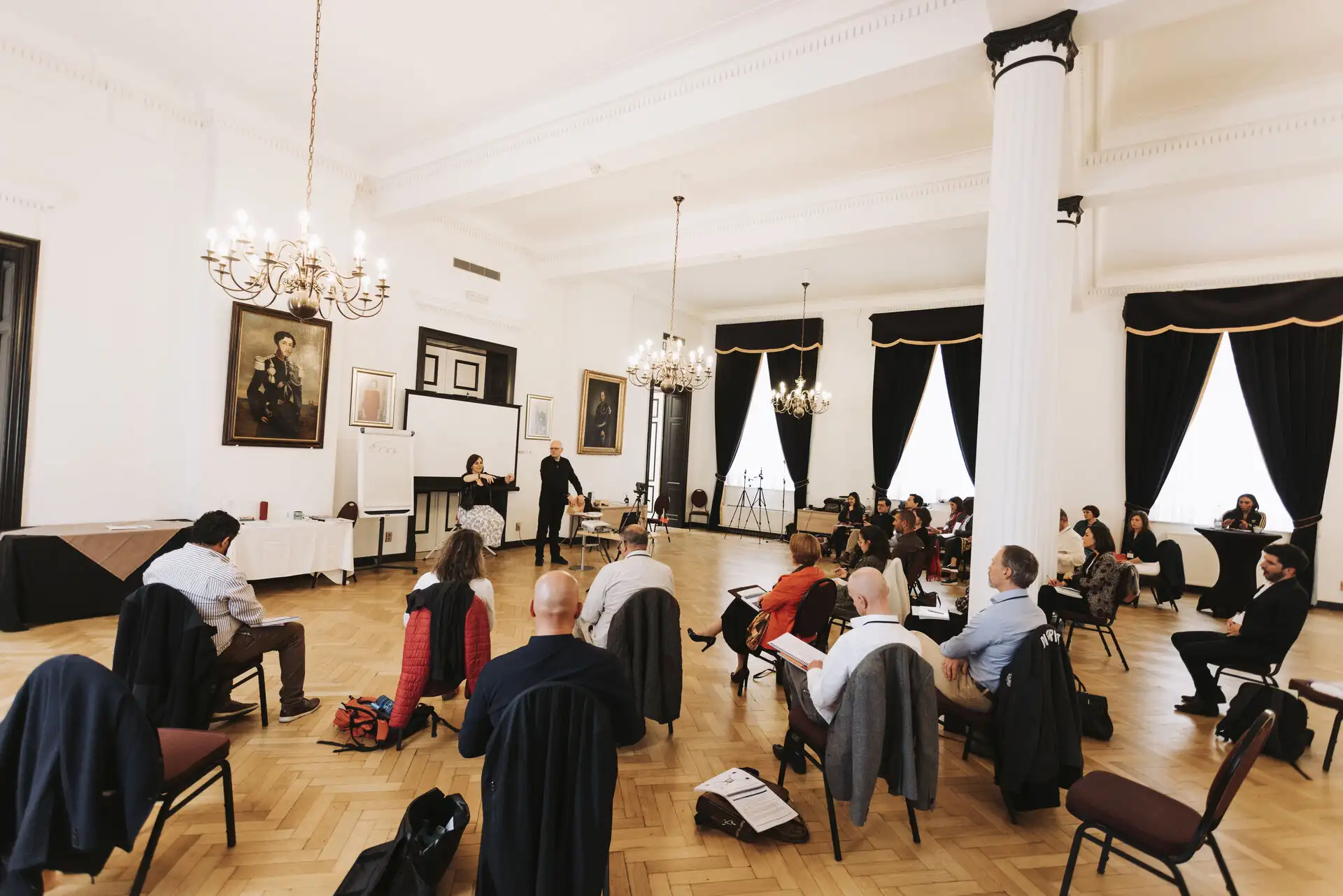
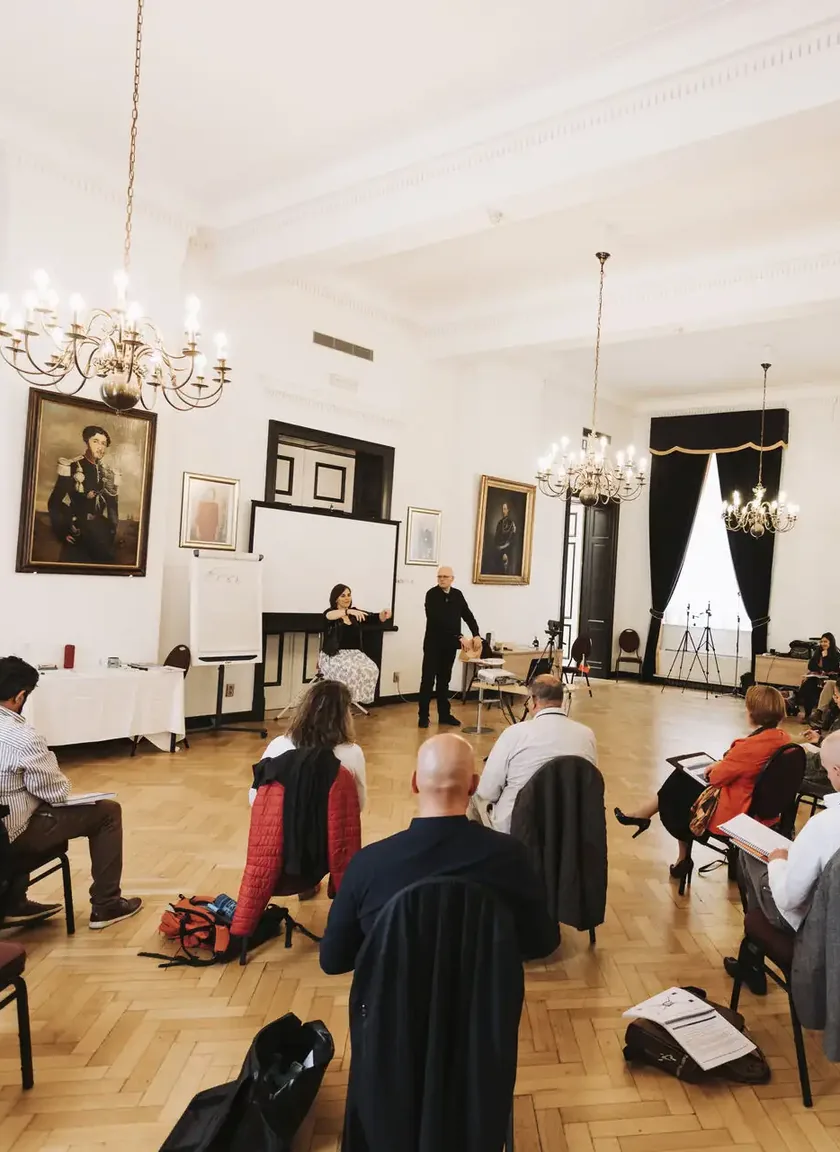
A training session: participants sitting in a circle with the trainers

What you’ll be able to do when you leave

  • Calibrate: read what you already perceive in the person in front of you without knowing it, and put it to use
  • Use the language of precision to bring out what a sentence doesn’t say
  • Master the language of influence: let someone find their own answer, and spot and see off the attempts at influence or manipulation aimed at you
  • Create an inner state at will and call it back, through anchoring
  • Change a feeling by changing how you represent the situation to yourself, through submodalities
  • Lead a belief change, in yourself and in others
  • Break down a strategy that works so that you can reproduce it elsewhere
  • Build, test and install a new strategy with the TOTE model

Why eight days, in person?

  1. Why eight days

    NLP isn’t learned by listening. You have to receive a technique, give it and feel it work, then start again until it stops being a procedure. The course runs to 56 full hours, and that is the time it takes for calibration, anchoring, submodalities, timelines and the change process to become more than words.

    Each day opens with a heart coherence exercise, and the afternoon starts again with the same exercise. Then comes a short spell of theory, and you move into workshops in small groups, each person taking a turn as the practitioner and then as the client.

  2. Why in person

    NLP is a relational approach. Most of the work rests on calibration: the micro-movements of the face, the breathing, what the voice does half a second before the word. That is what a screen conveys least well, and it is why the certificate is awarded in the room.

  3. Where it takes place

    We are a Swiss company. In English, the course takes place in Switzerland or at your organisation’s premises, including outside Switzerland. Wherever it is held, the eight days are set apart from your everyday work, and that is part of the learning: it leaves all the room for what you are learning. The venue is agreed when the course is arranged, and accommodation and meals are at your own expense.

How you get your certificate

The certificate requires the 56 hours in the room, over the eight days. That is all it requires.

We recommend adding 20 hours of practice – 10 as the client and 10 as the practitioner, with at least two different colleagues. The certificate rests on the 56 hours; these twenty hours are for going further, and it is by doing them that what you have learned becomes a practice.

No prior knowledge is required. What counts is motivation, flexibility and being available for the eight days.

Richard Bandler

Your certificate, Licensed Practitioner in NLP™, is certified by The Society of NLP and signed by Richard Bandler himself.

Where these eight days can lead

  1. Practitionerthese eight days
  2. Master Practitioner

The NLP Practitioner is the first step of the NLP programme. The second is the NLP Master Practitioner, nine days in the room, which goes deeper into the strategies for deciding, motivating, convincing and taking action.

Nothing obliges you to go further: the Practitioner is a complete certification, and many people stop there.

Who will train you?

We are Nathalie de Marcé and Michel Wozniak, the world’s first two French-speaking Master Trainers named by Richard Bandler himself, in the entire history of NLP. It is a title you cannot buy or sign up for. We are also among the only eight trainers in the world authorised to teach Teaching Excellence, by Richard Bandler and Kate Benson, and the only two French speakers among them.

We are the core of a team of trainers, professional coaches and consultants.

Nathalie de Marcé, Richard Bandler and Michel Wozniak
Nathalie de Marcé, Richard Bandler and Michel Wozniak.

Nathalie de Marcé

Nathalie is the second French-speaking Master Trainer in the history of NLP, named by Richard Bandler himself. She is a Licensed Trainer of NLP and a Licensed NLP Coaching Trainer with The Society of NLP. She is also Senior Instructor for Tony Buzan International in Creativity and Project Management, and a Master Instructor in Mind Mapping.

She began by writing content for television programmes, Nintendo’s among them. For more than 20 years she has coached teams and individuals, in multinationals, small and medium-sized businesses and top-level sport. She trained directly with Richard Bandler, John Grinder, Robert Dilts, Joseph O’Connor and Frank Farrelly, and is part of the assisting team in Richard Bandler’s seminars. She is fully trilingual: English, French and Spanish.

She passionately and tenaciously shares her knowledge with her students, who are sure to learn from her. Make the opportunity to train with her at the first chance you get!

Richard Bandler, co-creator of Neuro-Linguistic Programming, about Nathalie de Marcé
Listen to Richard Bandler talk about Nathalie (39 seconds)Recorded between our respective appointments as Master Trainer.

Michel Wozniak

Michel is the first French-speaking Master Trainer in the history of NLP, named by Richard Bandler himself, and an authorised translator of Richard Bandler’s seminars. Like Nathalie, he is part of the assisting team in Richard Bandler’s seminars. He is a computer engineer with more than 20 years in artificial intelligence (AI), and holds an MBA in Artificial Intelligence (with Merit) from the University of Cumbria and Robert Kennedy College.

In 13 years in industry, he led, among other things, the intercontinental project that rebuilt the logistics information system of a global automotive group, with more than a hundred engineers involved. That is where the parallels between the way a system learns and the way we learn come from, and they come up often in the room. He holds the Brevet Fédéral de Formateur (Federal Trainer) from the Swiss Confederation, and for Tony Buzan International he is Vice President, Grandmaster Instructor, International Ambassador Emeritus and Exclusive Representative for Europe.

He has been very instrumental in teaching NLP in French speaking countries, where it was greatly needed, and as soon as you can, be sure to train with him!

Richard Bandler, co-creator of Neuro-Linguistic Programming, about Michel Wozniak
Listen to Richard Bandler talk about Michel (23 seconds)Recorded between our respective appointments as Master Trainer.

Michel is the author of Logbook of an Expert in Mind Strategies (page in French), the English edition of ‘Carnet de bord d’un expert en stratégies mentales’, with a foreword by Richard Bandler. In it he tells the story of the burnout he went through and of the strategies that brought him out of it.

What you keep after the eight days

The course itself is 56 hours. Around it come practice and a year of monthly contact with the trainers: the eight days are the first step.

  • The WhatsApp groupThe trainers stay in it for at least a year after the session, to answer the questions that come up once you are back at work.
  • Twelve live group sessionsOne hour as a group on Zoom every month, for a year. The moment you most need help rarely comes while you are learning; it comes months later, when a situation arises for real.
  • 20 hours of recommended practice10 hours of sessions received as the client and 10 hours given as the practitioner, with at least two different colleagues. This is the part that turns what you know into what you can do.
  • The OptimiStra® PlatformEffective, targeted apps in your browser for practising what you saw in the room, with one practice challenge a day at your own pace. Access has no time limit.

Reviewed by experts

The name ‘NLP’ belongs to everyone, and many poor applications have damaged its reputation. A single study says nothing about whether a whole approach holds together: as well as the studies we take into account, we had the content of the NLP Practitioner reviewed by a wide range of experts and professionals in the brain and human sciences, in 5 countries. Every piece of feedback was taken on board.

23

people reviewed the content

5

countries: France, Switzerland, Germany, Belgium and Hungary.

Our learners rate us

308 evaluations, 3,388 ratings.

9.8

out of 10 – ‘Overall, I am satisfied with the course’, 308 responses

  • Trainers’ expertise10.0
  • Activities and examples9.9
  • Organisation9.9
  • Clarity of teaching9.8
  • Useful in my work9.7
  • Objectives achieved9.7
  • Theory and practice9.5
  • Value for money9.4

The studies we take into account

Every day, we follow the research published on what we teach, including when it contradicts us.

1,231

scientific studies in NLP and related fields

  • Emotions and stress230
  • Leadership211
  • Communication187
  • NLP and meditation170
  • Influence and persuasion162
  • Manipulation95
  • NLP91
  • Hypnosis85

Figures as of 18 November 2026, updated daily.

In their own words

475 testimonials from 221 people.

Wonderful
Anne-Cécile, 2023

Translated from French

8 very rich days in terms of content, but also fantastic encounters among the participants, I can't wait to do it again
Léon, directeur associé, Suisse, 2019

Translated from French

My plans with NLP are to continue taking other trainings with Michel and with Nathalie to really deepen my knowledge in this direction.
Abdelati

Translated from French

What I take away from this training is this feeling of feeling totally in control of our life and then free to do what we want, that's really what I take away and that's what I'm leaving this training with.
Basma

Translated from French

And Michel, this year, was among the first French-speaking masters to be promoted by Richard Bandler. And that is really yet another guarantee of quality and of the trust that Richard places in Michel and Nathalie.
Adil

Translated from French

No suggestions to make, I don't see what there would be to change.
Simon FRESEL, 2020

Translated from French

NLP is first of all a stance that allows you to focus on what works well in order to apply it where and when it's useful.
Nicolas R.

Translated from French

But I used NLP enormously in my work, within the trainings I give, within the conferences I give.
Laure

Translated from French

I consider Nathalie and Michel as the yin and the yang, so there really is an incredible balance between them.
Nora

Translated from French

You can choose to solve your problem in a few minutes
Sylvie

Translated from French

Michel and Nathalie, frankly, this ease, this freedom, this attentive ear, this methodology, you can feel that it's not their first attempt, quite simply. They are the best in their profession.
Zinedine

Translated from French

I love your energy, both of you
Ras, 2024

Translated from French

I have already started applying it. And as for my teams, I have people telling me thank you for telling me that, for giving me this, etc.
Sabrina

Translated from French

Michel is an excellent teacher, he knows how to captivate us and make us absorb with great ease a high density of content in just a few days
Anne GAUTIER, Marseille, 2018

Translated from French

The skills learned during this training will allow me not only to work on myself, but will also allow me to refine certain tools that I was already using in FasterEFT. Until now I was doing certain things because that's how I was taught to do them, now I will do them knowing exactly why.
Philippe Wozniak, Praticien bien-être, Mulhouse, 2017

Translated from French

It was a real pleasure and a real revelation for me. This training allowed me to realize what I wanted to do in my life.
Marie-lys Antoniotti, étudiante en medecine, Corse, 2018

Translated from French

I thank Nathalie and Michel for their wonderful teaching and the sharing of so much know-how and so much being. A very rich content and transmitted with a lot of authenticity, professionalism and also benevolence and joy. A real magic toolbox to transform your life, shed limiting beliefs, mobilize your resources to achieve your goals both personal and professional! I got dazzling results right at the end of the training on procrastination patterns that used to limit me a lot before in my professional life!!! And yes, simple, quick and ultra effective tools!! And what a joy to receive feedback from patients (young and old) for whom problems of anxiety, fears rooted for years, could be released! The power of magic NLP!!
Mathilde Gallié- Thérapeute holistique France, 2020

Translated from French

My plans with NLP are to enrich my practice as a coach and trainer, with a better understanding of my own ways of functioning and also of everyone's ways of functioning, in representations and in language, etc.
Olivier

Translated from French

Everything is perfect, you are wonderful 😍
Mathilde, 2025

Translated from French

They are going to improve my private and professional relationships. They have brought down limiting beliefs and are opening the doors to a professional change that I now see as a close reality.
Alvaro Galiano, Ingénieur polytechnicien, 2020

Translated from French

The half-day split between Michel and Nathalie gave a good balance
Claude Elbaz, Kinesiologue France, 2023

Translated from French

to be used in everyday life, for me and the people around me
Théo, 2019

Translated from French

I am delighted to have done this training. It brought me an enormous amount for my personal development.
Florence

Translated from French

The trainers complement each other, each with their own approach, their own outlook, and then I think also their own inclinations.
Sandie

Translated from French

Is this the right time for you?

The course takes eight consecutive days, on site. It is a gift you give yourself, and it is worth choosing well: eight days taken in a week when you can really be there are worth more than eight days snatched from an overloaded month. You need to be able to attend from the first day to the last, because each day builds on the ones before.

What we do is a form of learning, and you practise it on yourself first. For eight days you will be your own testing ground, with a group of people you didn’t know the day before. It means accepting that you won’t be good at it straight away.

What we do is not therapy, and it is no substitute for therapy. If you are going through a really difficult time at the moment, this is probably not the right time, and we will be glad to welcome you later.

What we teach gives people influence; we pass it on to people who will put it to good use.

We don’t accept everyone, and it is better to know that in advance than to discover it on the third day. Before anyone joins, there is a 30-minute admission call on Zoom with Michel, held in English, and sometimes the conclusion of that call is ‘later’.

Taking the course in English

Our scheduled sessions are in French. In English, we give the NLP Practitioner on request: for a team from your organisation, or for a group of English speakers, in Switzerland or at your organisation’s premises, including outside Switzerland. You can also ask us to let you know when the next open session in English is scheduled.

When the course is given in English, everything is in English: the eight days and the course manuals, the admission call, the twelve live group sessions on Zoom, the WhatsApp group and the OptimiStra® Platform.

In English, this course is given on request, for a group or an organisation. To arrange one, or to hear when the next session opens, write to us.

When the course is given in English, you receive

  • The eight days in the room56 hours in the room with both trainers, in English, in Switzerland or at your organisation’s premises. The course manuals, in English, are included.
  • The Licensed Practitioner in NLP™ certificateCertified by The Society of NLP and signed by Richard Bandler himself, awarded once the 56 hours are completed.
  • 20 hours of recommended practice10 hours as the client, 10 hours as the practitioner.
  • Twelve live group sessionsOne hour as a group on Zoom every month, for a year, in English.
  • The WhatsApp groupWith the trainers, for at least a year after the session, in English.
  • The OptimiStra® PlatformEffective, targeted apps in your browser for practising what you saw in the room, with one practice challenge a day at your own pace. Access has no time limit.

How a request works

Write to us through the contact form and tell us who the course would be for: yourself, a group or your organisation. We reply, then we take 30 minutes together on Zoom, in English. The call is there to check that the timing and the format suit you, and it helps us put the group together. We decide together at the end.

If you would rather start with the call, you can book it here.

Frequently asked questions

Is the course really given in English?

Our scheduled sessions are in French. We give the NLP Practitioner in English on request, for a group or an organisation, in Switzerland or at your organisation’s premises, including outside Switzerland, and everything is then in English: the eight days and the course manuals, the admission call, the twelve live group sessions on Zoom, the WhatsApp group and the OptimiStra® Platform.

Request the course in English

How does a request work?

You write to us through the contact form. We then take 30 minutes on Zoom with Michel, in English: the call is there to check that the timing and the format suit you, and it helps us put the group together. We decide together at the end, and sometimes the answer is ‘later’.

Can you run the course for our organisation?

Yes. It is one of the two ways we give it in English, in Switzerland or at your premises, including outside Switzerland. Tell us how many people would take part and what they need, and we will come back to you with what is possible.

Write to OptimiStra®

Do I need any prior knowledge?

None. What is asked of you is motivation and flexibility: for eight days you will work on yourself with other people, and accept that you won’t be good at it straight away.

Is learning the language of influence learning to manipulate?

Knowing how to recognise the language of influence is the first protection against manipulation, and that is the main reason we teach it. For us, what separates influence from manipulation is the purpose more than the intention, which anyone can claim in good faith: is the direction taken the one the person chose for themselves? The ‘Influence and manipulation’ module works on this criterion, and teaches you to spot the signals that should make you say no. What we teach gives people influence; the admission call helps us pass it on to people who will put it to good use.

What are the days like, in practice?

Seven hours of work a day, with breaks. Meals and accommodation are at your own expense. The venue of each session is given with its dates.

How do the monthly group sessions on Zoom work?

You are invited to twelve one-hour group sessions, one a month for a year. You work through practical cases there and bring your questions. The link is sent before each session.

Which body recognises your courses?

The Society of NLP, Richard Bandler’s organisation, certifies our NLP courses, and your certificate is signed by Richard Bandler himself.

I need a quote, or an invoice in my company’s name.

Write to us through the contact form, mentioning the NLP Practitioner, and we will prepare it for you.

Write to OptimiStra®

I have a question that isn’t answered here.

Write to us through the contact form: we answer you ourselves.

Write to OptimiStra®