The core principles of NLP

Published November 18, 2026 · 6 min read
Read by an AI-generated voice.
In brief
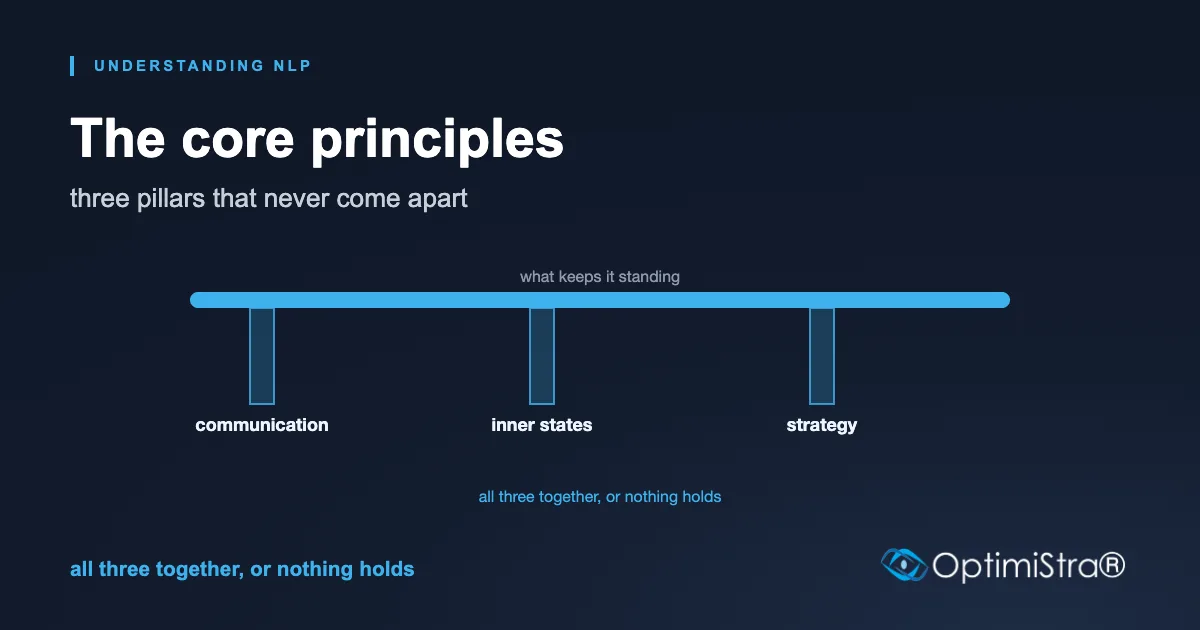
Neuro-Linguistic Programming (NLP) rests on three pillars: communication, including the conversation you hold with yourself; the management of inner states, with their chemical side; and strategies, which coordinate the other two. You can start with any one of them, but isolating a single pillar explains most of the changes that don’t last.
You have probably been sold Neuro-Linguistic Programming (NLP) as a toolbox. That is exactly why it so often fails to last.
There is a simple, almost mechanical reason why so many people “do NLP” without anything changing for long in their lives: they use one piece of it, and only one. They learn a breathing technique, or a communication formula, or a visualization exercise, and are surprised when the effect fades after a few days.
The core principles of NLP are not a list of recipes. They are three pillars. And the real secret, the one people rarely discover until several attempts have come to nothing, is that they only stand up together.
You have solved a problem before. And you have watched it come back.
Think back to a time when you really made an effort. You held yourself together, you calmed your stress and you decided that this time would be different.
Then, a few days later, the little voice started up again, with the same scenario, the same knot in your stomach and the same discouragement, as if something inside kept bringing you back to where you started.
It wasn’t a lack of willpower, and it isn’t “just the way you are.” You simply acted on one level of a system that has three. Calming your stress without changing what you tell yourself is like bailing out a boat without plugging the hole. And this is where NLP really begins.
First pillar: communication, including the kind you don’t hear
When people talk about communication, everyone thinks of the same thing: talking to others, making yourself understood, getting an idea across. That is interpersonal communication, and yes, it matters.
There is a second kind of communication, far more decisive and yet almost invisible: intrapersonal communication, the kind that goes from you to yourself.
All day long, you talk to yourself. You comment, you anticipate, you judge yourself. And that communication shapes everything else, because the way you address the world depends on what you said to yourself 30 seconds earlier. So the first pillar of NLP is not “speaking well.” It is realizing that two conversations are going on all the time, and the more important one is silent.
Second pillar: managing your inner states
We are not computers. It is obvious, and yet we keep forgetting it when we try to “reason” ourselves into feeling better.
We are emotional beings. Our feelings and emotions, the things that make us human, are not only the product of our thoughts: they are also governed by real chemistry, by hormones, by the whole workings of the body, which do not take orders from good intentions alone.
The second pillar is the ability to take back control at that level. The aim is not to become cold or unfeeling; it is to stop being at the mercy of an emotion that decides in your place. Learning to act on your inner state means you are no longer simply subject to the weather of your own body.
Third pillar: strategies, or the way you go about things
Take two people with the same goal. One gets there, the other doesn’t. What separates them is a way of doing things, a kind of expertise: what NLP calls a strategy.
Imagine someone who has to give a talk. Their strategy includes what they know about public speaking, of course, and it doesn’t stop there, because the talk you give when you are stressed is nothing like the one you give when you are relaxed. So the strategy takes in the management of the inner state, which itself takes in the quality of the communication.
You can see where this leads: a strategy does not sit beside the other two pillars. It is built on top of them. It is the level that coordinates them. It is also what Locke and Latham established after 35 years of work: an intention only has an effect when it is tied to a way of going about things.
The principle everyone forgets: the three pillars are never separated
Here is the most important point in this whole article. Communication, managing inner states, strategies: these three pillars are not independent of one another. They are completely interlinked. Webb, Miles and Sheeran show as much, indirectly: acting on one without the others gives very uneven results. And that is exactly why “à la carte” approaches fail.
Take a concrete example. Someone learns, thanks to the second pillar, to regulate their stress. So far, so good. If, straight afterward, they go on telling themselves a thousand negative things about the problem in question, what happens? They recreate their problem within a few minutes. Because the communication pillar was never brought in, the problem reappears, intact.
Even if they deal with those two levels, a third is still missing. As long as we are run by automatic habits that pull us back toward the negative, it takes a real strategy to replace ways of functioning that have been in place for years. Without one, the old habits come straight back.
That is the underlying reason for this article: to resolve almost any human difficulty, all three levels are needed. Not one, not two: all three together, each supporting the others.
And above the three pillars sits the real foundation.
You might think the core principles of NLP stop at this architecture. There is something underneath it, or rather above it, that carries the whole structure.
That foundation is a way of taking responsibility for yourself: an inner decision to take back the reins of your own life. Inner dialogue is its first lever, and the meta-analysis by Hatzigeorgiadis and colleagues measures its effect. Arnsten’s work is a reminder, in passing, of why that decision is best taken with a cool head: under stress, the resources it calls for are precisely the ones that are missing. Everything else (communication, inner states, strategies) is only the machinery in the service of that fundamental shift: you stop waiting for things to change from the outside, and become once more the author of what happens on the inside.
This is the point at which NLP becomes something other than a discipline. It becomes a way of taking your place again.
Where to go next
If what you have just read speaks to you, the next steps are what NLP is, managing your inner state, how success is built and observing without jumping to conclusions.
You have just seen why changes don’t last when one part of the structure is worked on in isolation. What comes next is learning to make the three pillars work together, and that is what our NLP Practitioner course is for.
Article designed and written by Michel Wozniak, and optimized by artificial intelligence. Illustration created by artificial intelligence.
Sources
- Hatzigeorgiadis, Zourbanos, Galanis & Theodorakis (2011), Self-Talk and Sports Performance: A Meta-Analysis, Perspectives on Psychological Science
- Arnsten (2009), Stress signalling pathways that impair prefrontal cortex structure and function, Nature Reviews Neuroscience
- Webb, Miles & Sheeran (2012), Dealing with feeling: A meta-analysis of the effectiveness of strategies derived from the process model of emotion regulation, Psychological Bulletin
- Locke & Latham (2002), Building a practically useful theory of goal setting and task motivation: A 35-year odyssey, American Psychologist
Frequently asked questions
What are the three pillars of NLP?
Communication (between people and, above all, the communication you have with yourself), the management of inner states (emotions, feelings and their chemical and hormonal side) and strategies (the practical way you go about doing things).
Can you work on one pillar at a time?
You can start with one of them, but isolating a single pillar does not give a lasting result. The three are interlinked: dealing with your stress without changing your inner dialogue, for example, often brings the problem back within a few minutes.
Why is strategy described as the “higher” pillar?
Because it is built on top of the other two. What you do changes with your inner state and with the quality of your communication: strategy coordinates those two dimensions and gives them a direction.
Is the real foundation of NLP a technique?
No. Beyond the three pillars, the foundation is a way of taking responsibility for yourself: the decision to take back the reins of your own life. It is an attitude, not a tool.
Understanding NLP
What is NLP? (And why it isn’t what you think)
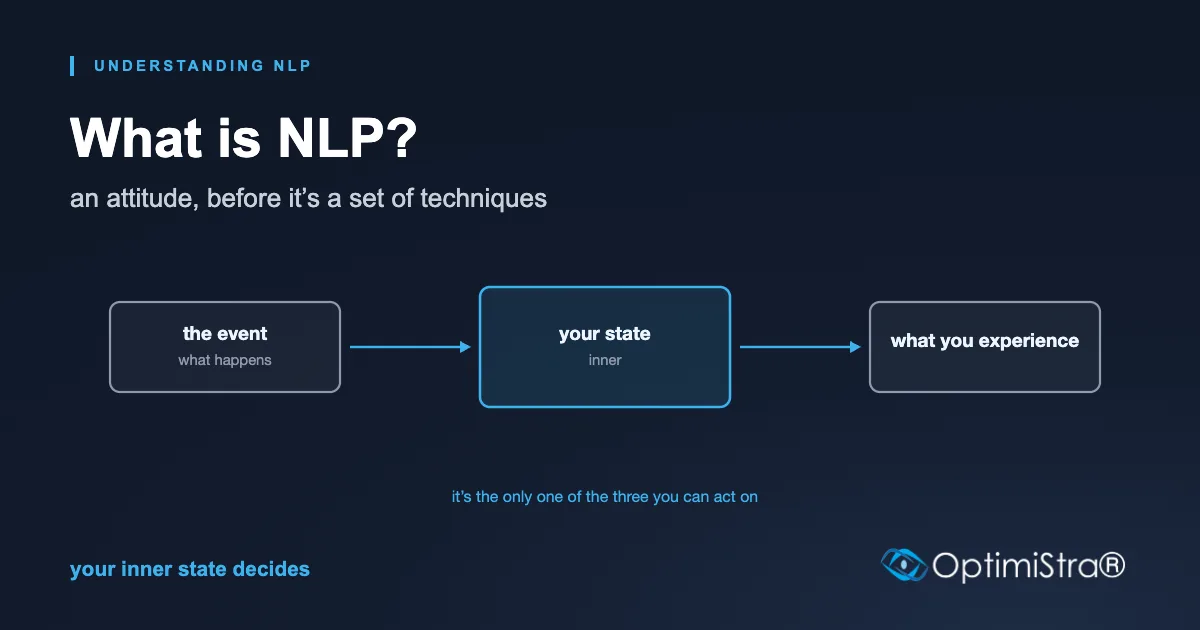
Neuro-Linguistic Programming (NLP) is passed on as an attitude, not as a catalog of techniques. It teaches you to notice the inner dialogue that runs all day, to recognize the automatic responses it sets up and to take charge of your inner state rather than being at its mercy day after day.
November 18, 2026 · 5 min read
Understanding NLP
How does NLP work?
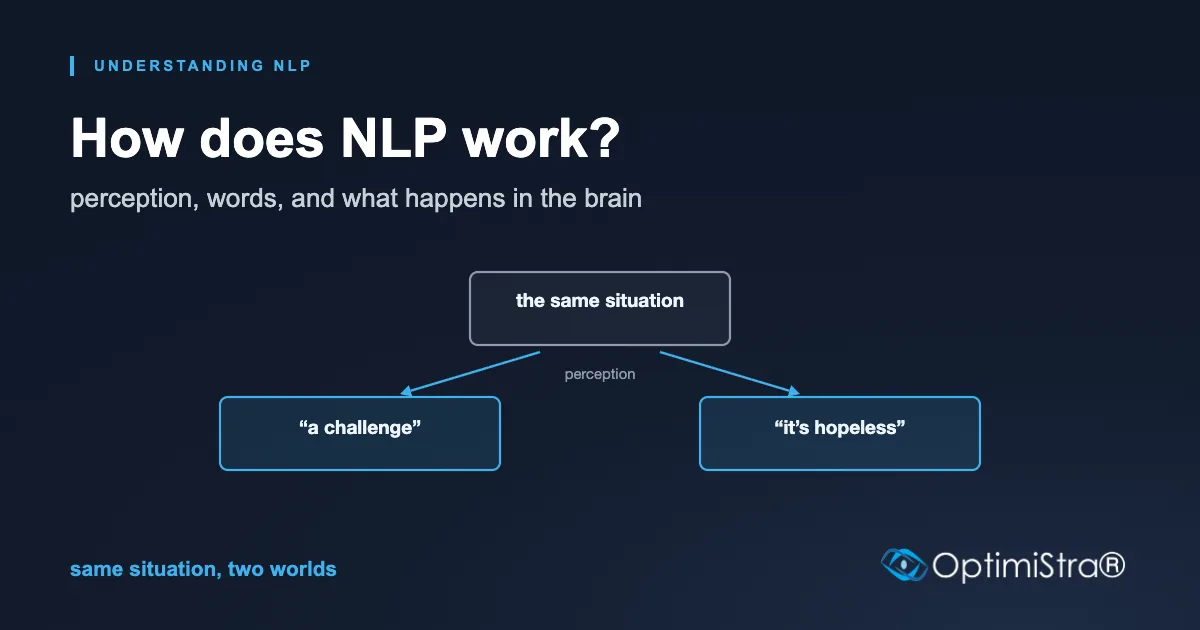
Neuro-Linguistic Programming (NLP) works on perception rather than on events: two people facing the same situation do not live in the same world. The words you say to yourself set up an inner state, and that state has measured effects on attention, decision-making and memory. There is nothing mysterious about it.
November 18, 2026 · 8 min read
Understanding NLP
Why is it called Neuro-Linguistic Programming?
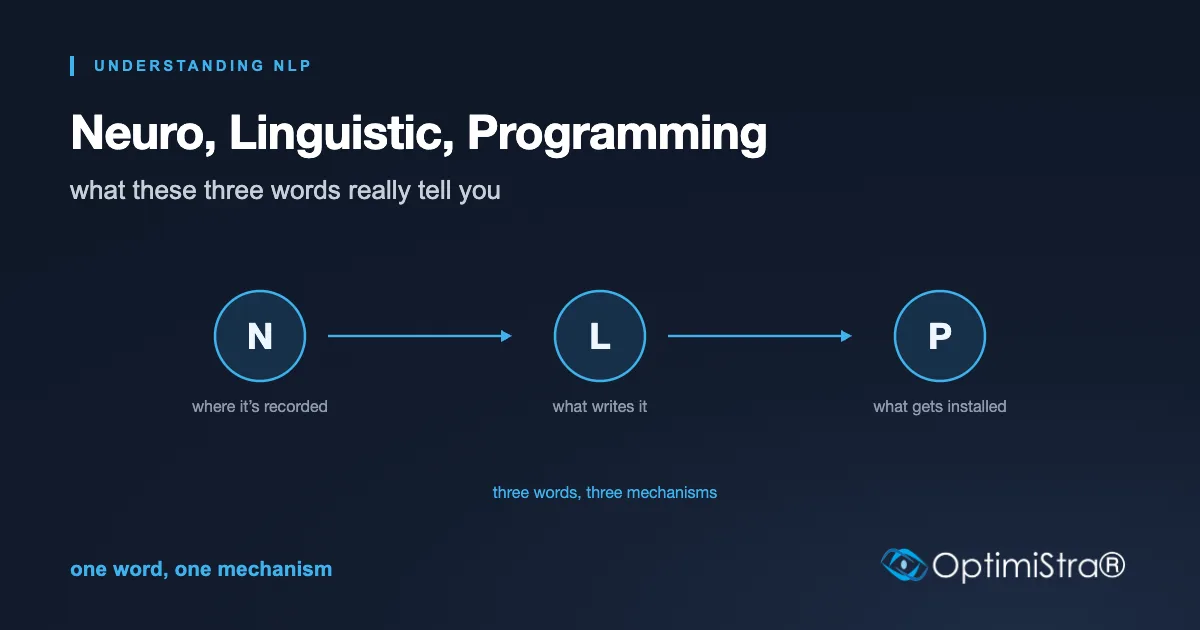
Neuro-Linguistic Programming (NLP) is named after three mechanisms. Programming, because experiences settle in us the way programs are installed. Neuro, because those programs live in neural connections that repetition strengthens. Linguistic, because language writes them and can rewrite them. The name is a map, and it shows where to look first.
November 18, 2026 · 7 min read