The OptimiStra® blog
Articles on Neuro-Linguistic Programming (NLP), artificial intelligence and leadership, written by the trainers who teach them.
Featured
What NLP Makes Possible
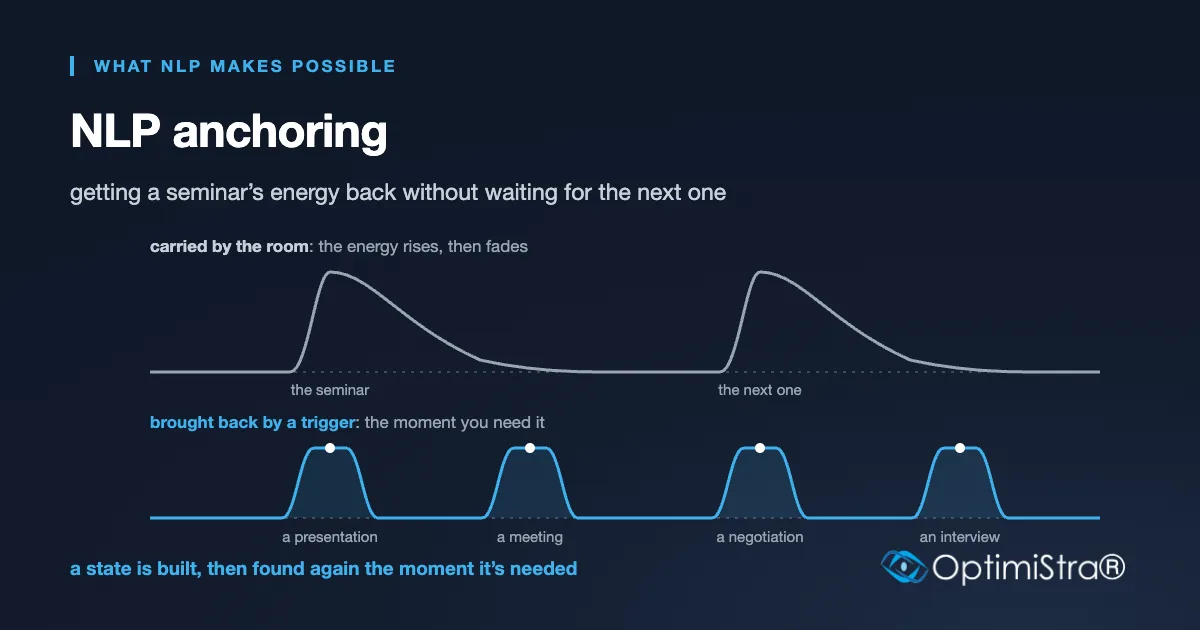
After a motivational seminar, the energy fades: what NLP anchoring changes
A motivational seminar produces real energy, and it often fades within a few weeks because it stays attached to the room. Elite athletes learn to bring back the state they need on their own, with a chosen trigger such as Florent Manaudou’s word “puissance.” NLP calls this an anchor, and it can be learned.
November 18, 2026 · 14 min read
Stress and Emotions
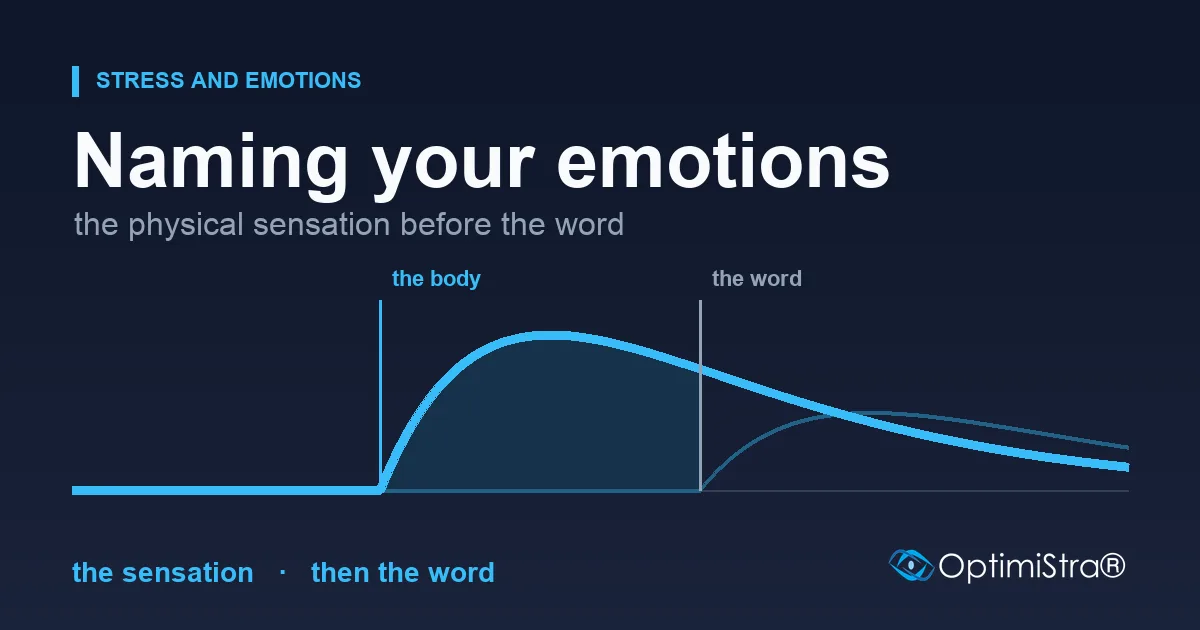
An emotion starts in the body: naming the sensation before the emotion
An emotion is a physical reaction set off by how you interpret an event, not by the event itself. The body moves first and the word comes later. Naming the sensation before the emotion takes 10 seconds. Here is what the research establishes, and the three precise points where it stops.
November 18, 2026 · 8 min read
Stress and Emotions
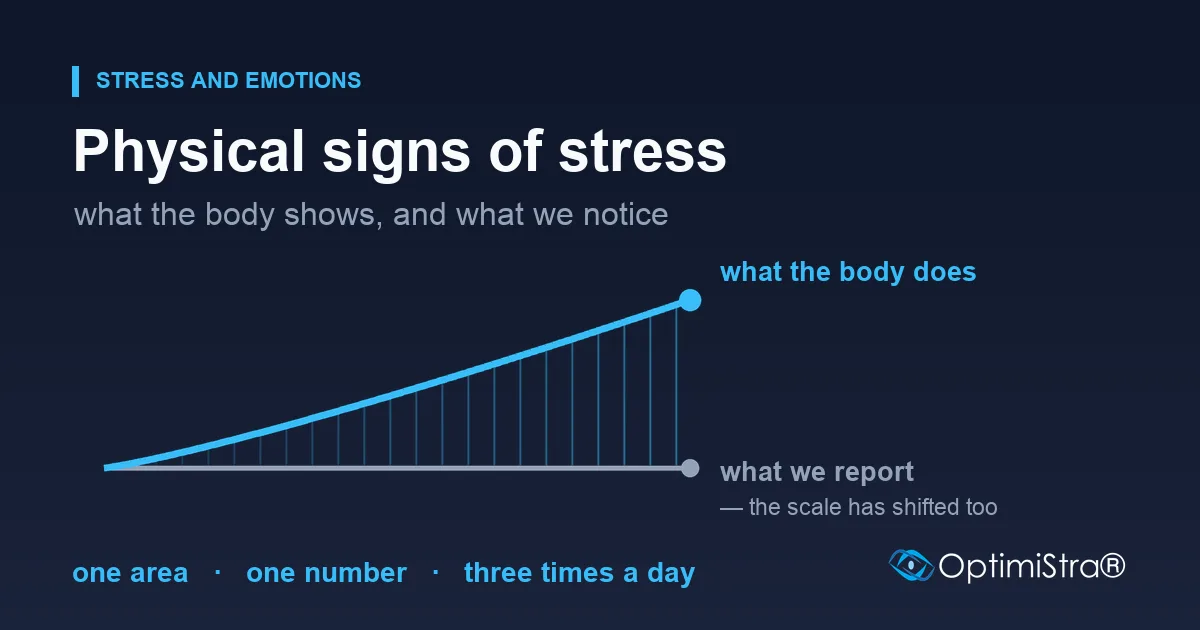
Physical signs of stress: what the body shows, and how much of it we notice
Under stress, the jaw muscles work harder: 38 studies show it. Yet what people report about their own tension from memory has almost nothing to do with what they notice when asked in the moment. And their point of comparison shifts along with them.
November 18, 2026 · 9 min read
Earlier articles
46 articles
Stress and Emotions
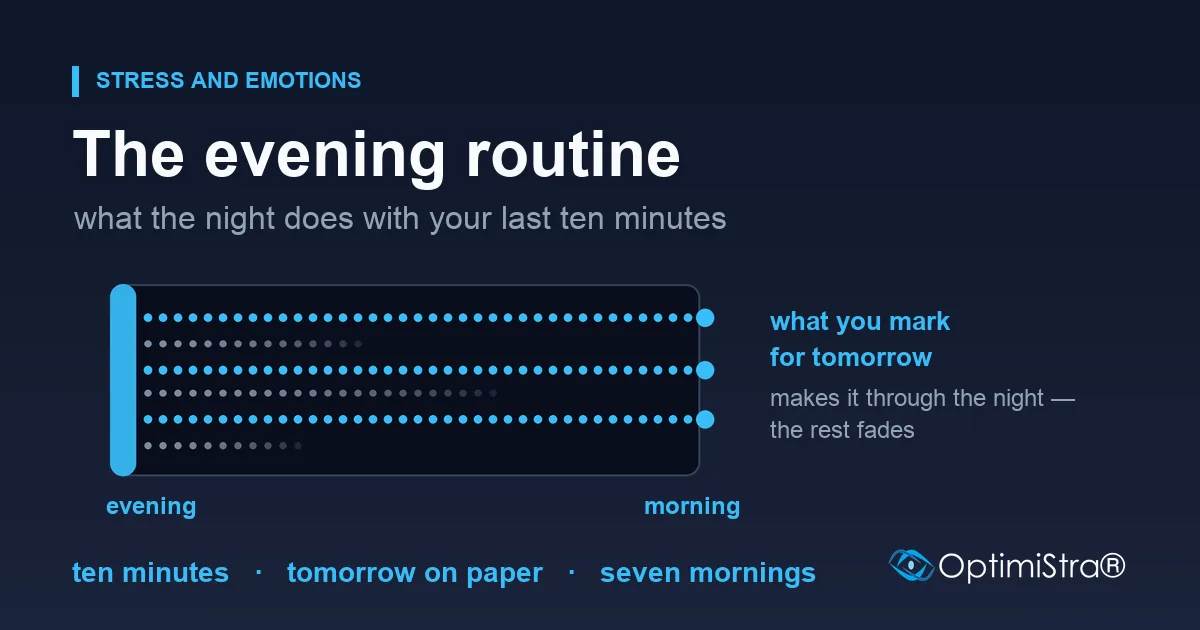
Evening routine: what the night does with your last 10 minutes
During sleep, the brain replays and consolidates what the day left behind, and it is selective: what has been marked as useful for tomorrow gets through, the rest far less. The best-measured evening habit is not positive thinking. It is writing tomorrow’s to-do list, in detail.
November 18, 2026 · 10 min read
Beliefs and Change
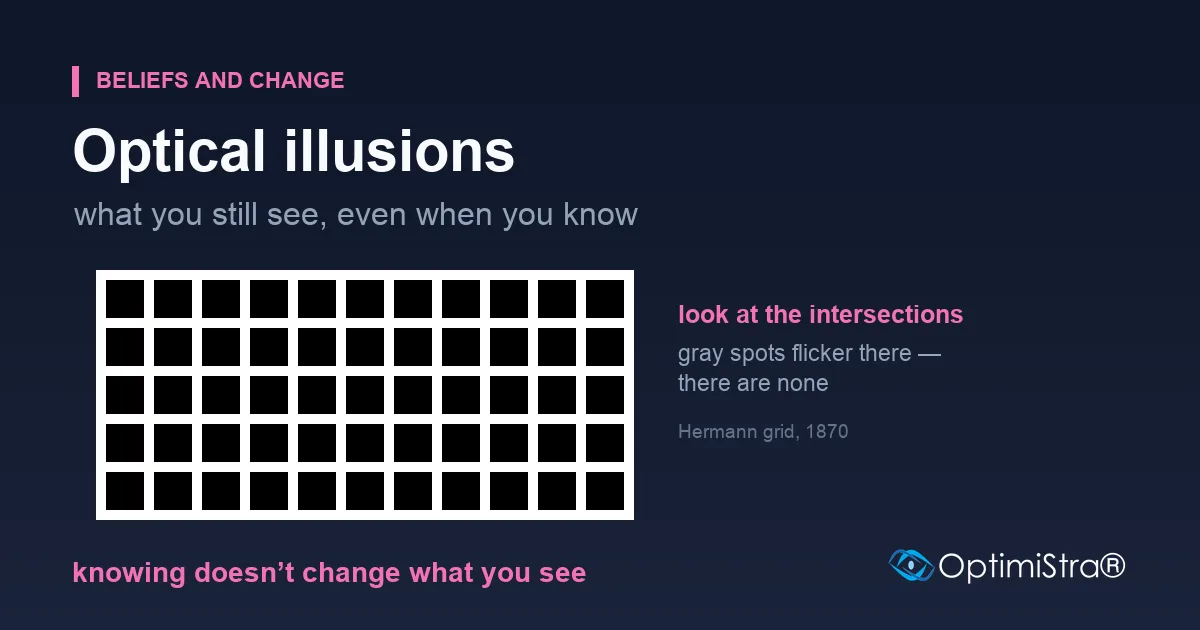
Optical illusions: what your brain still sees, even when you know better
An optical illusion isn’t a malfunction: it is the brain interpreting what it sees, correcting for shadows or filling in what’s missing. The most striking part is that the illusion holds even once you know how it works. Three famous illusions show this, and research explains why.
November 18, 2026 · 8 min read
Stress and Emotions
Reliving a happy memory from the inside: what it does, and what we know
Reliving a happy memory from the inside means going back into it through your own eyes, with its sounds and sensations. In the lab, recalling positive memories after a brief stressor limited the rise in cortisol, and thinking in images does more than thinking in words. The effect is modest and no substitute for care.
November 18, 2026 · 5 min read
Beliefs and Change
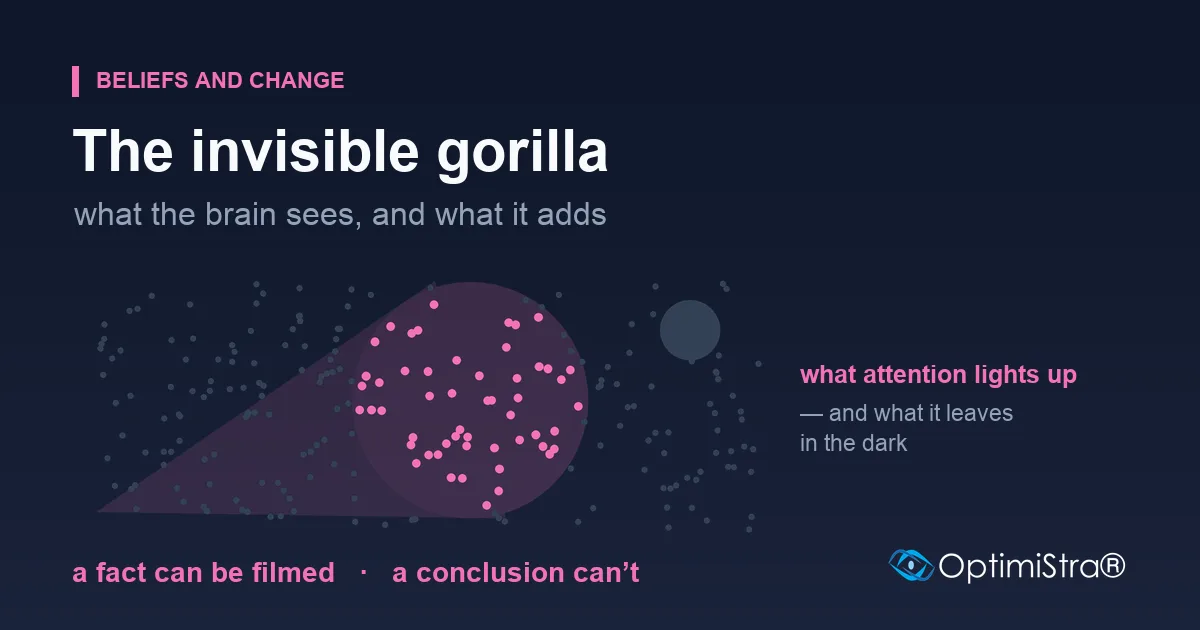
The invisible gorilla: what the brain sees, and what it adds
Attention works like a flashlight: it lights one spot at a time, and you can miss a gorilla while looking straight at it. Whatever it does light, the brain fills in with interpretations it never announces. You can observe both in yourself in a few minutes.
November 18, 2026 · 6 min read
Beliefs and Change
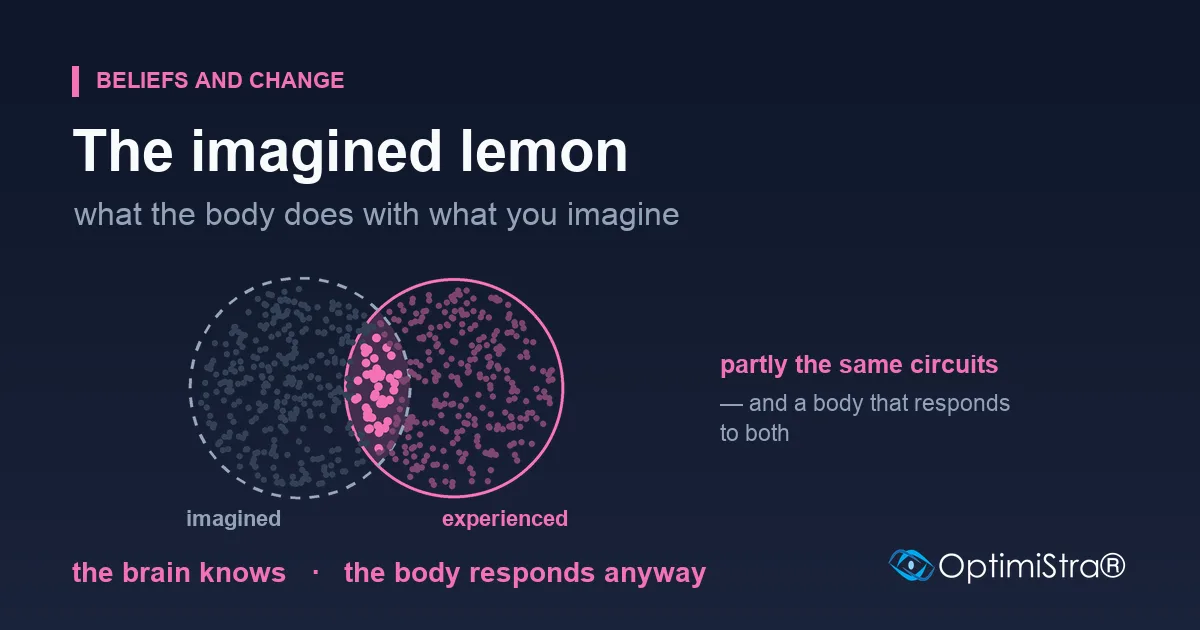
The imagined lemon: what your body does with what you imagine
Imagining a lemon makes you salivate, and imagining a movement activates some of the circuits that control it. Even so, the brain does not confuse real and imagined: it tells them apart, except when the inner image becomes strong enough. That is what makes mental rehearsal useful, to a modest degree.
November 18, 2026 · 8 min read
Stress and Emotions
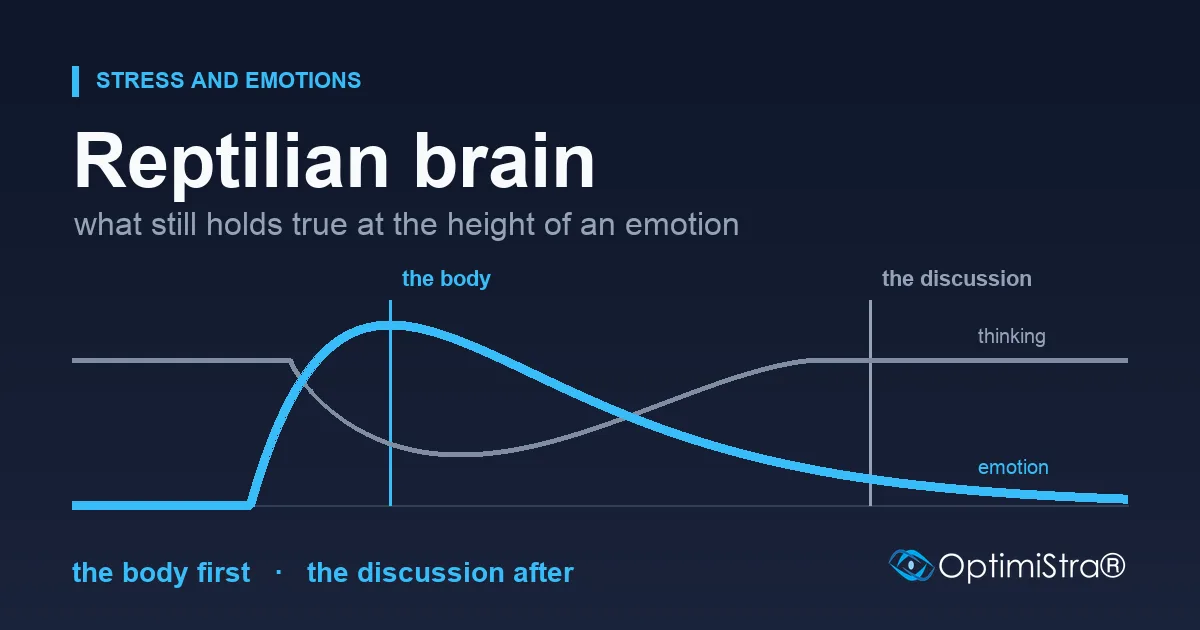
Reptilian brain: why we stop thinking clearly in the grip of emotion
At the peak of an emotion, the prefrontal cortex loses some of its capacity while fast reactions take over. The “reptilian brain” said to explain this is an abandoned model; the shift itself is well measured. Hence a simple move: body first, discussion afterward. Here are the studies, and their limits.
November 18, 2026 · 9 min read
Beliefs and Change
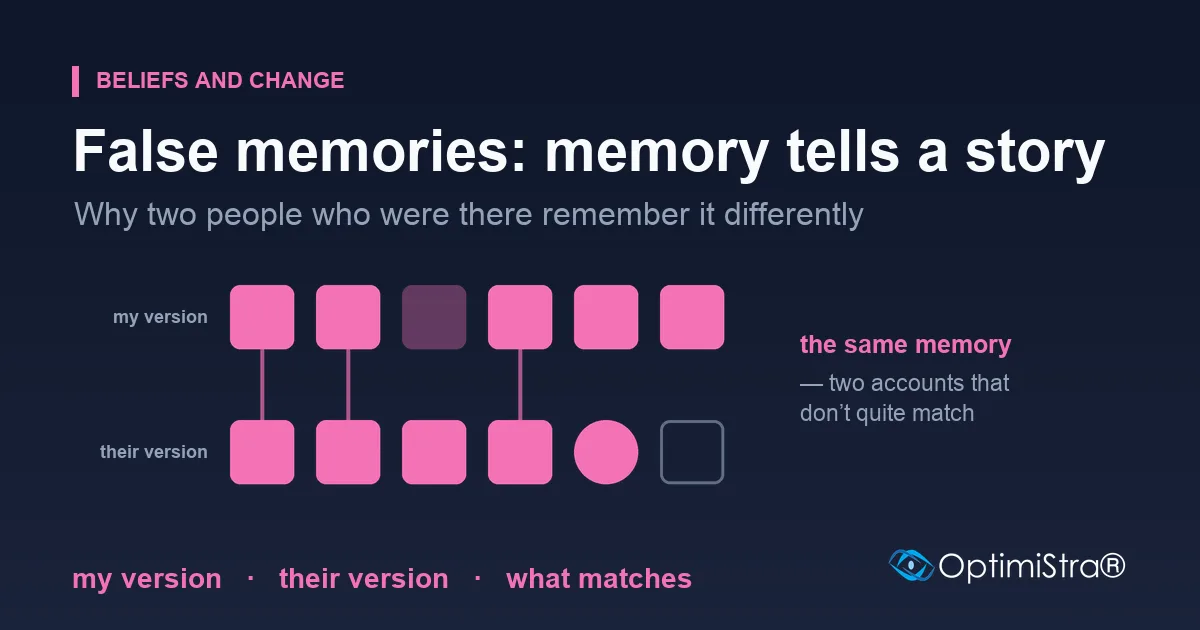
False memories: why we remember things that never happened
A false memory is one you’re sure of that didn’t happen the way you believe, in part or sometimes entirely. Studies show that a photo, a word, or a conversation is enough to alter an ordinary memory, and that confidence doesn’t guarantee accuracy. False memories are rarely false all the way through.
November 18, 2026 · 6 min read
Stress and Emotions
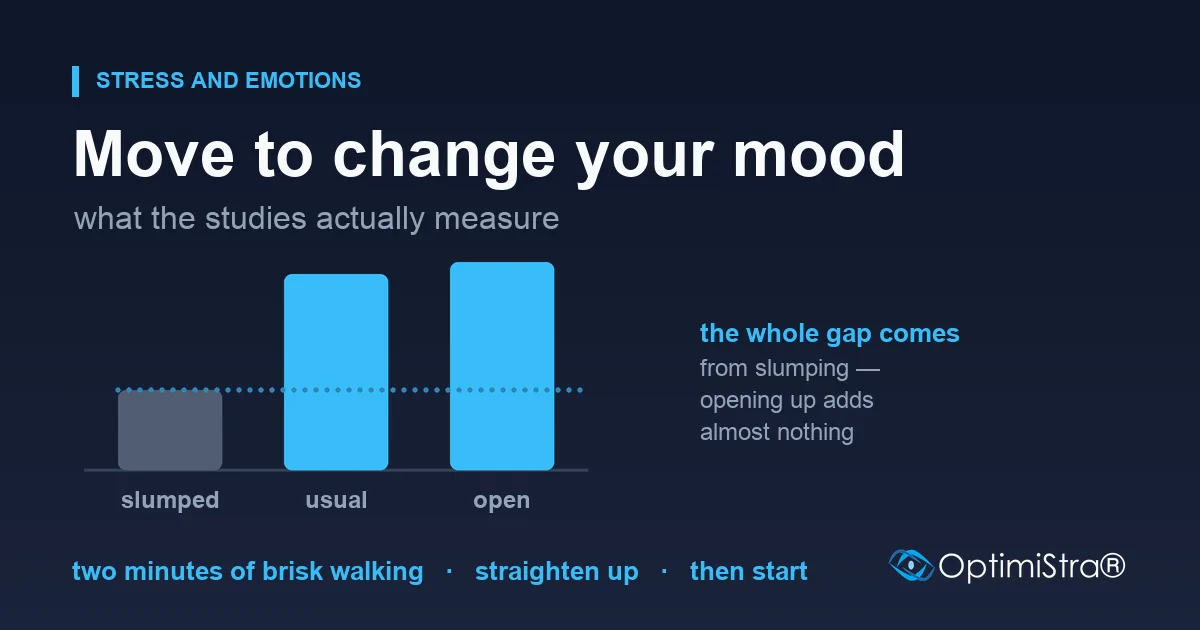
How movement changes your mood: what the studies actually measure
Five minutes of moderate walking is enough to improve self-reported mood, and six 5-minute breaks do more across a day than a single 30-minute block. On posture, a synthesis of 73 experiments gives an unexpected result: the cost comes from the contracted position, and an open position adds almost nothing.
November 18, 2026 · 10 min read
What NLP Makes Possible
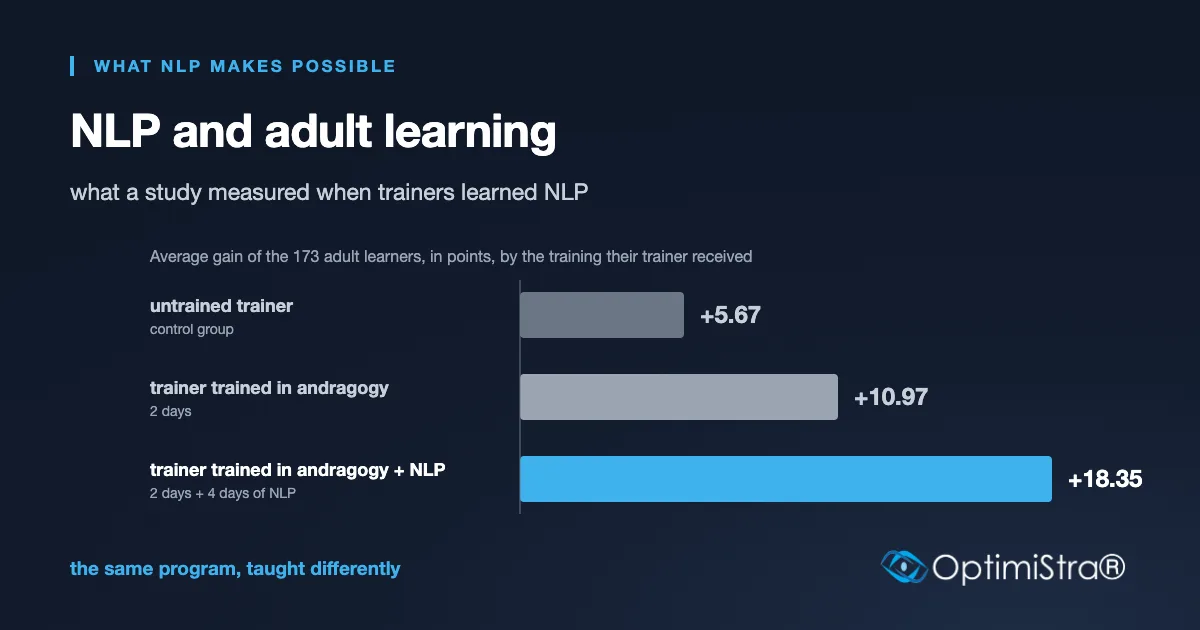
NLP and adult learning: what a study measured in 173 adult learners
In 2012, a study in England randomly assigned 24 trainers of adults to three groups. Learners whose trainer had taken 4 days of Neuro-Linguistic Programming (NLP) on top of a course in andragogy improved by 18.35 points, compared with 10.97 when the trainer had taken andragogy alone. Research on expectations, relationships, and stress helps explain the gap.
November 18, 2026 · 15 min read
Beliefs and Change
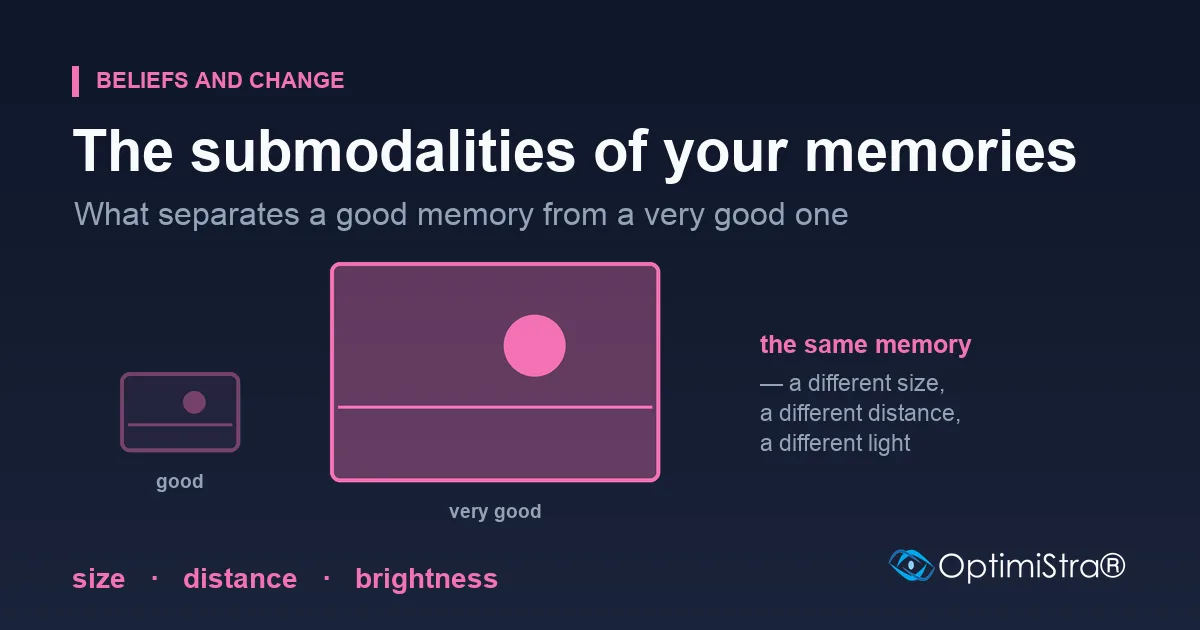
Submodalities: what separates a good memory from a very good one
Submodalities are the fine qualities of a mental representation: the size, distance, and brightness of an image, the volume of a sound, the warmth of a sensation. Studies show that the intensity of a memory goes hand in hand with its vividness, though the notion itself has never been tested as such.
November 18, 2026 · 5 min read
Stress and Emotions
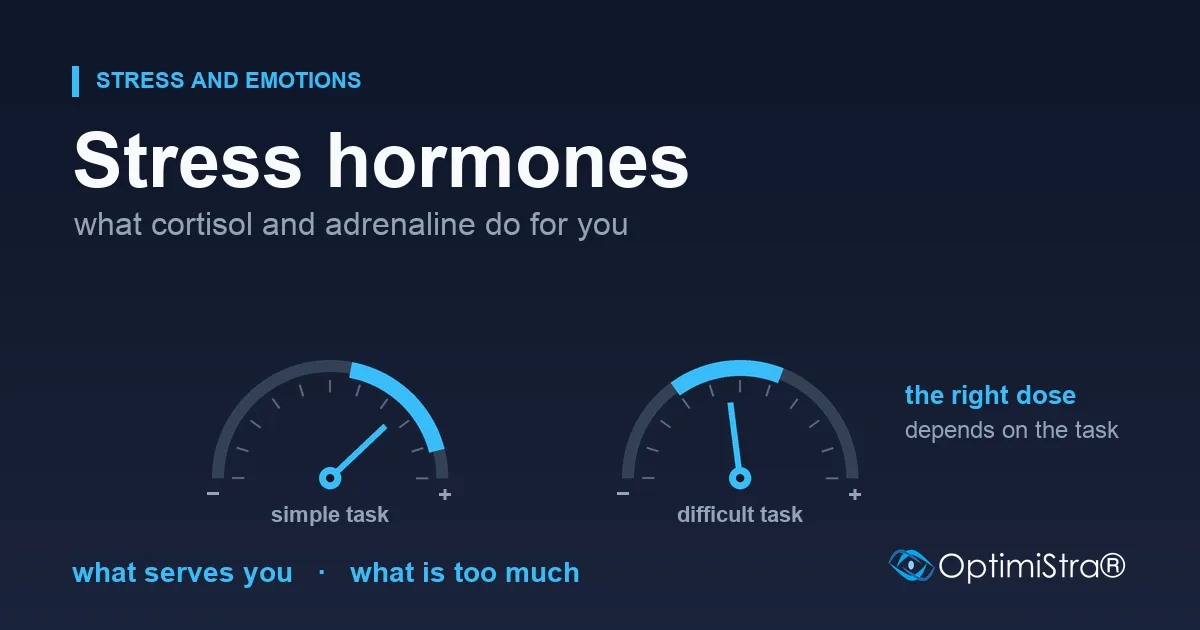
Stress hormones: what cortisol and adrenaline do for you
Cortisol and adrenaline are essential. Adrenaline readies the body to act within seconds, cortisol helps it allocate energy, and both help you retain the moments that matter. Their effect depends on the dose and on how difficult the task is. This article sets out what the studies show, and where their limits lie.
November 18, 2026 · 9 min read
Beliefs and Change
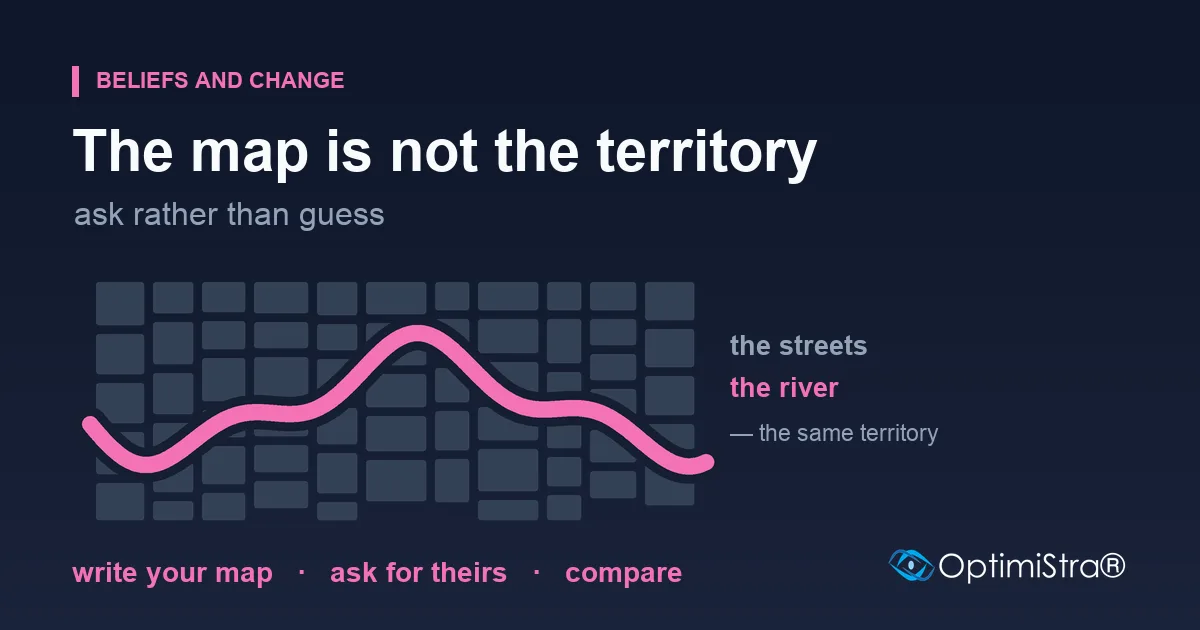
The map is not the territory: ask rather than guess
Everyone perceives the same reality through a map of their own, and two different maps can both be accurate. The trap is believing you see things as they are and attributing the disagreement to the other person. Imagining their point of view does not make you more accurate; asking them for it does.
November 18, 2026 · 6 min read
Stress and Emotions
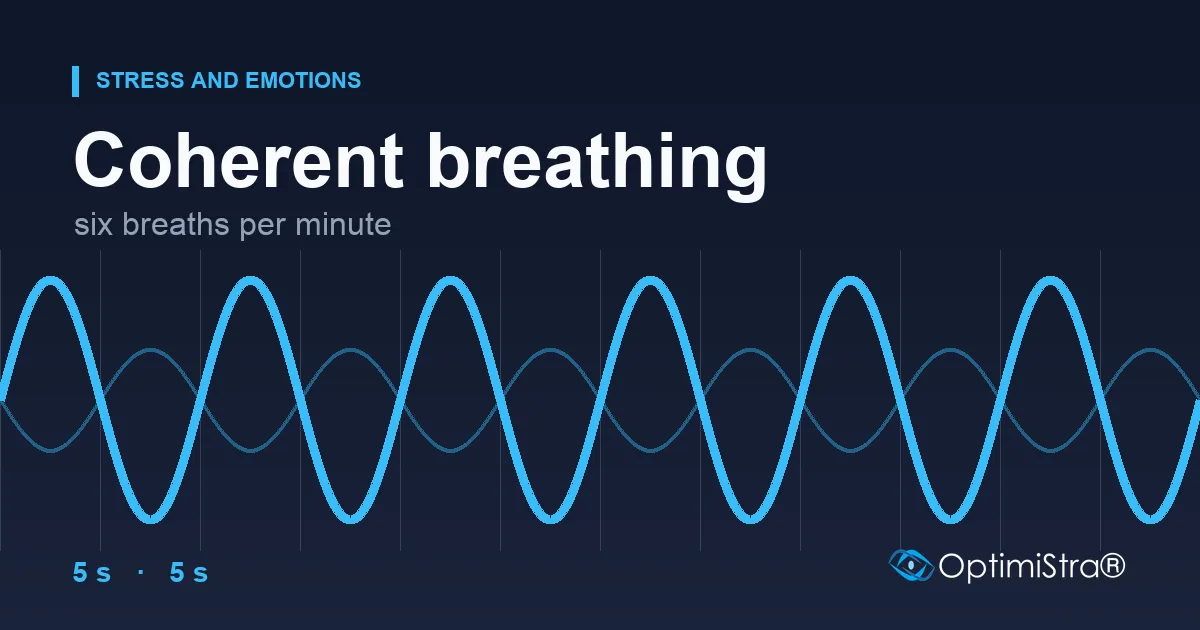
Coherent breathing: why 5 seconds, and not 4
Coherent breathing comes down to one instruction: breathe in for 5 seconds, out for 5, for 5 minutes, three times a day. The rhythm is not arbitrary. At six breaths a minute, two regulating mechanisms fall into phase and amplify each other. Here is what the research establishes, and where it stops.
November 18, 2026 · 6 min read
Leadership Strategy
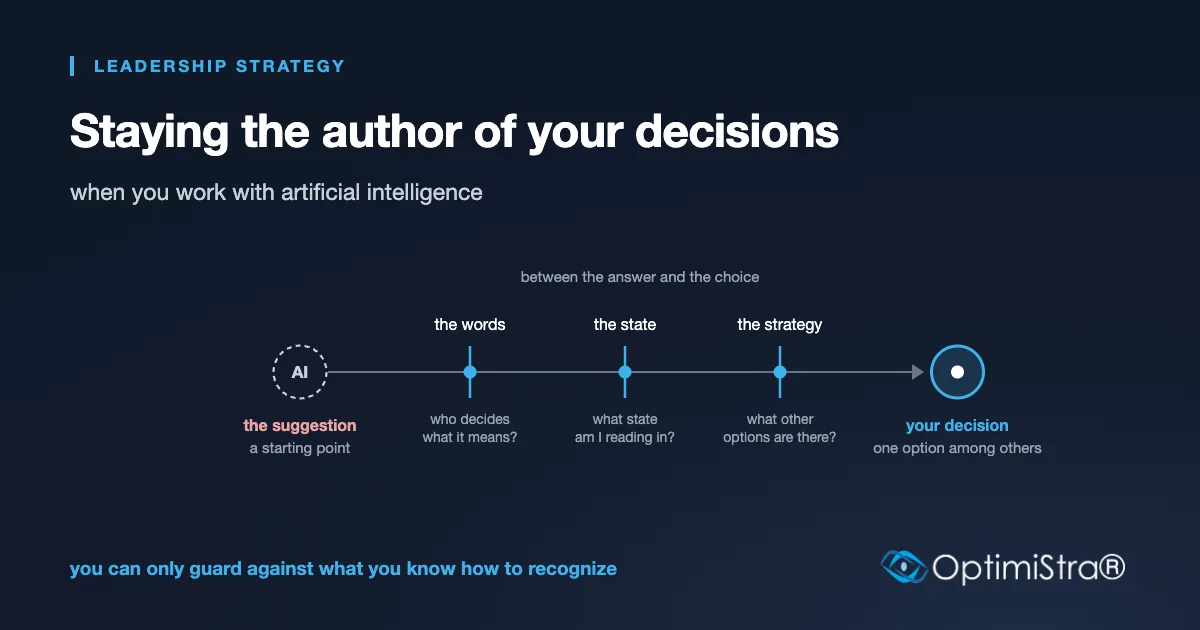
Staying the author of your decisions when you work with AI
A language model can steer a decision with words alone: a suggested figure becomes the starting point, and the way a risk is framed changes the choice that follows. Knowing you can be influenced is not enough to protect you. What does protect you can be trained: precise language, managing your inner state, and strategic thinking.
November 18, 2026 · 14 min read
Stress and Emotions
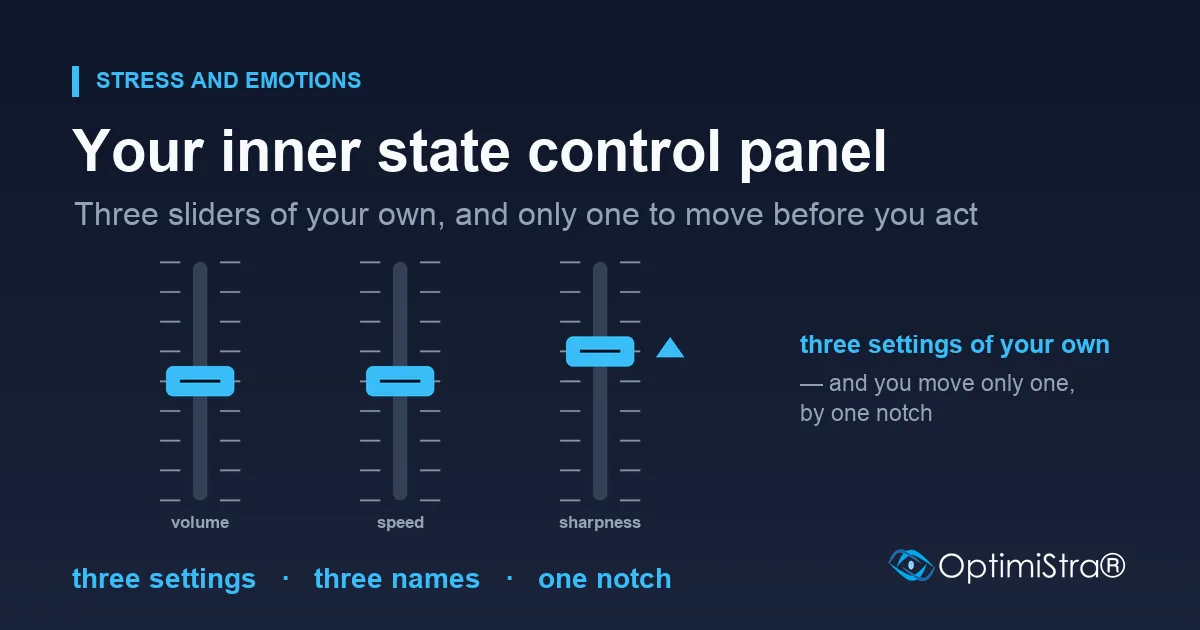
The control panel: three sliders for adjusting your inner state
The control panel is an NLP tool: an imaginary interface, like a mixing board, where you set three controls for your own state, name them, and move one a single notch before a task. The tool itself has not been tested as such, but the sense of being in control and the perception of time have been studied.
November 18, 2026 · 5 min read
Beliefs and Change
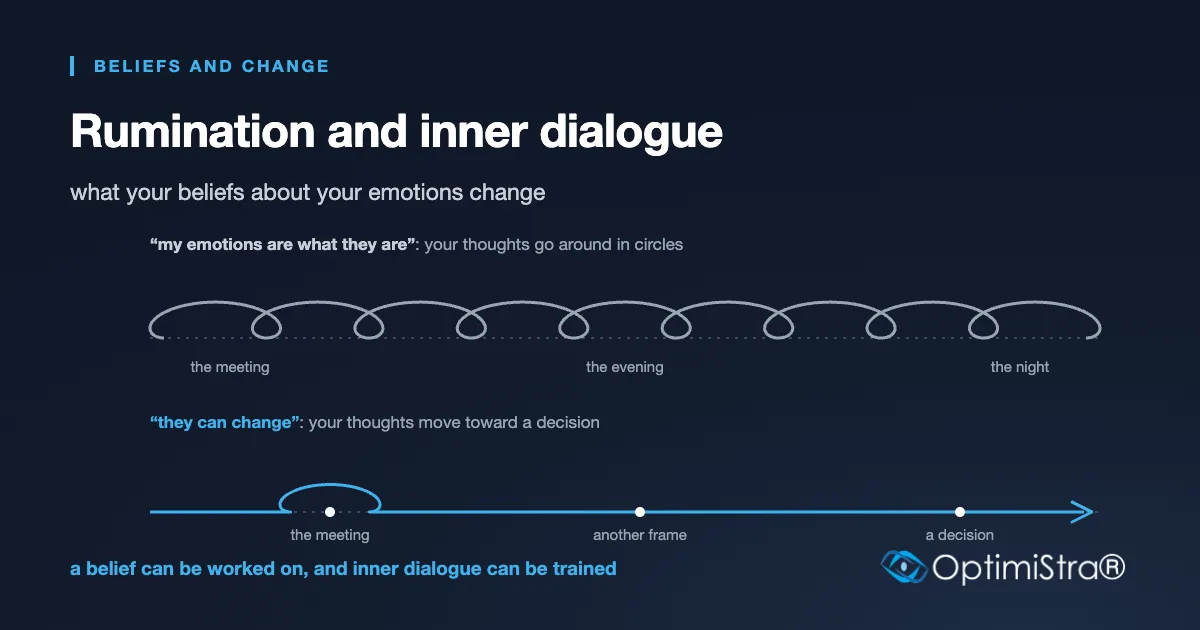
Rumination and inner dialogue: what your beliefs about your emotions change
Rumination, the inner dialogue that replays what went wrong on a loop, leaves you tired and costs you sleep and effectiveness at work. A Yale study of 3,282 professionals suggests it depends in part on one belief: that your emotions can change. That belief can be worked on, and inner dialogue can be trained.
November 18, 2026 · 14 min read
Beliefs and Change
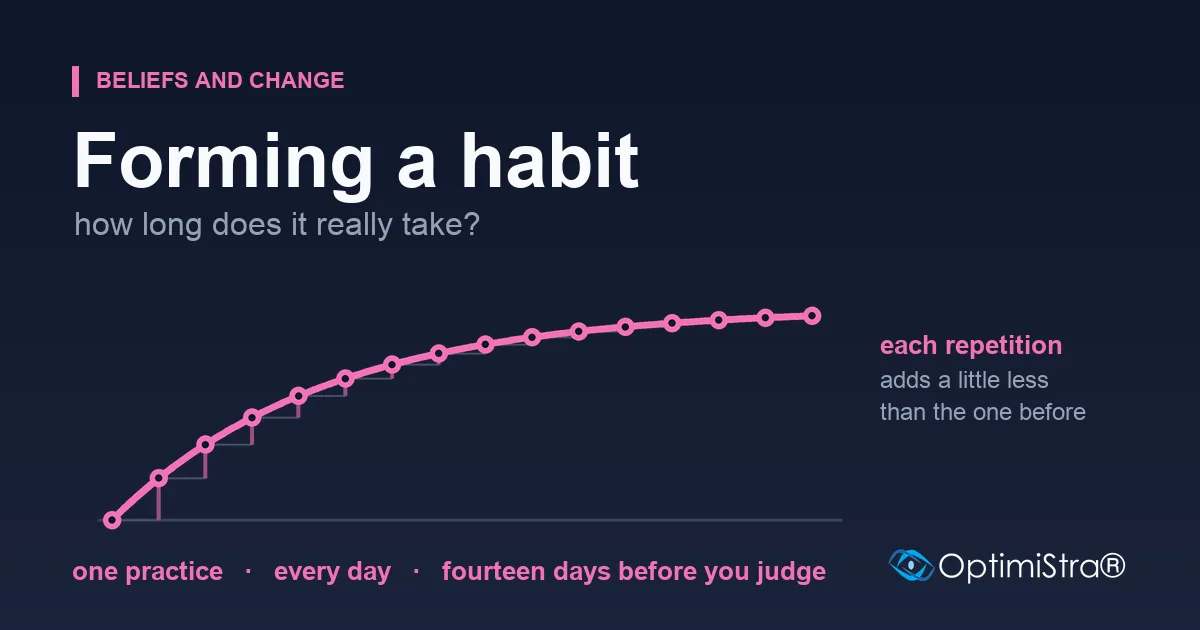
How long does it really take to form a habit?
Repeating what you learn changes the connections between neurons, as Eric Kandel showed. In people, an action repeated every day takes a median of 66 days to approach its highest level of automaticity, with a range of 18 to 254 days. The 21-day rule does not hold up, and one missed day does no harm.
November 18, 2026 · 8 min read
Stress and Emotions
Acute and chronic stress: what returning to calm changes
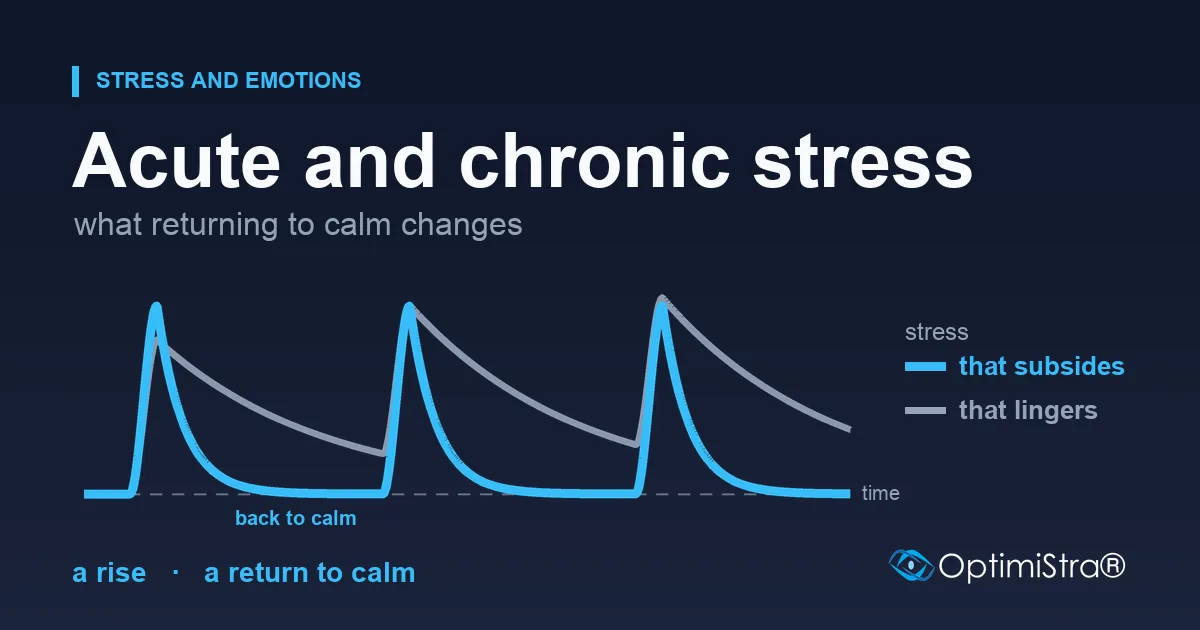
Acute stress rises, then subsides: it is the response the body is built for. Chronic stress keeps the body mobilized without leaving it time to return to calm, and that missing recovery is what wears it down. Here is what the studies show, what they leave open, and an exercise for the week.
November 18, 2026 · 9 min read
Leadership Strategy
AI coaching: what you tell it, and what you stand to lose
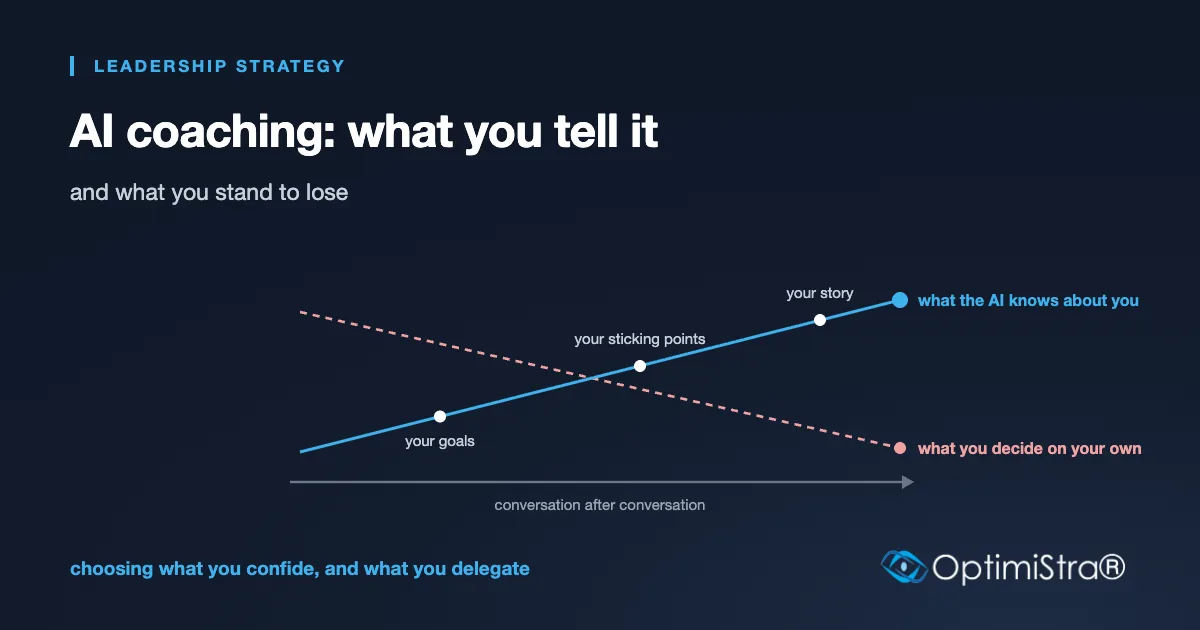
With six pieces of information about you, an artificial intelligence (AI) persuades better than a human, and AI coaching tools invite you to share far more, with no professional confidentiality. Handing your thinking over to them also has a cost, which studies are starting to measure. Human skills are gaining value, and they can be trained.
November 18, 2026 · 16 min read
What NLP Makes Possible
Developers in the age of AI: what decides who gets the contract
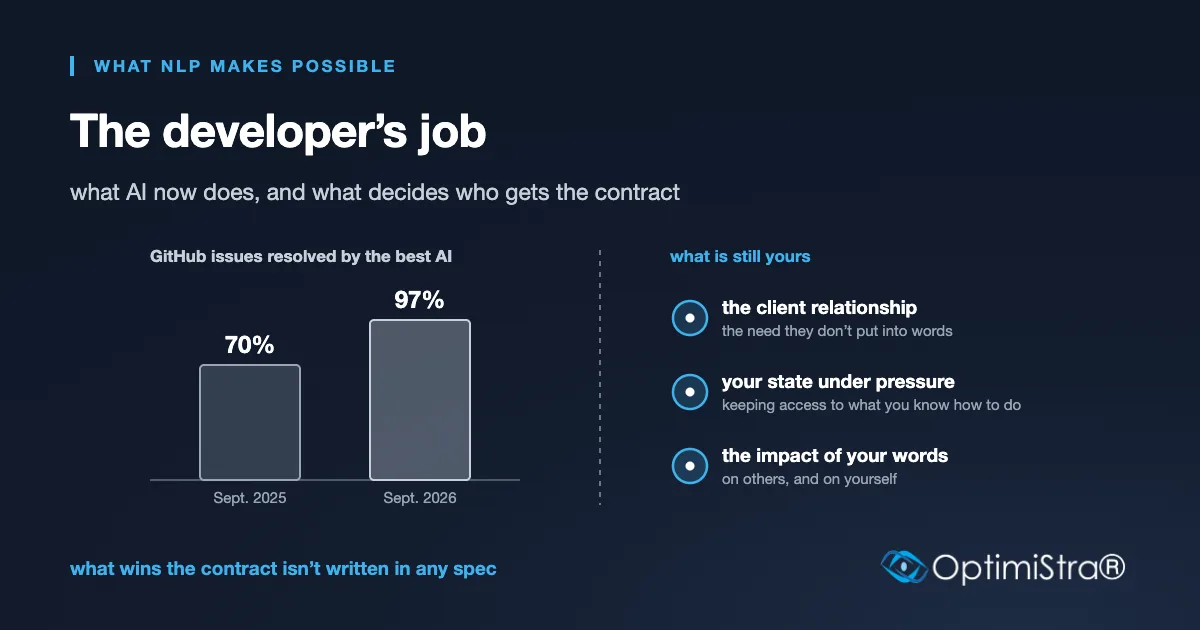
AI now resolves almost all the tickets in a benchmark test, and the market for developers has tightened. What decides who gets the contract increasingly lies in the relationship with the client and in the state you are in under pressure. These human skills can be trained, and Neuro-Linguistic Programming (NLP) works on them through three pillars.
November 18, 2026 · 11 min read
Beliefs and Change
VAKOG: the five senses of your memories, and what we really know about them
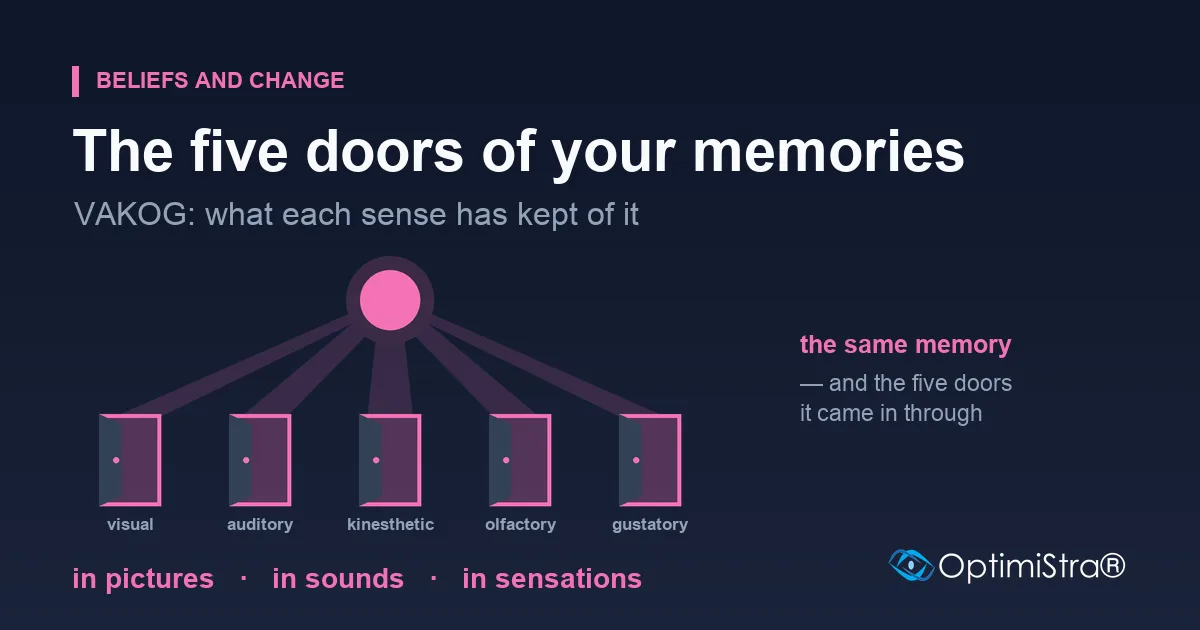
VAKOG stands for the five senses through which we live and recall an experience: visual, auditory, kinesthetic (the body and emotions), olfactory, and gustatory. Imagining draws partly on the same brain regions as perceiving, and each person does it differently. The idea of a dominant channel, however, has not been confirmed by research.
November 18, 2026 · 7 min read
Beliefs and Change
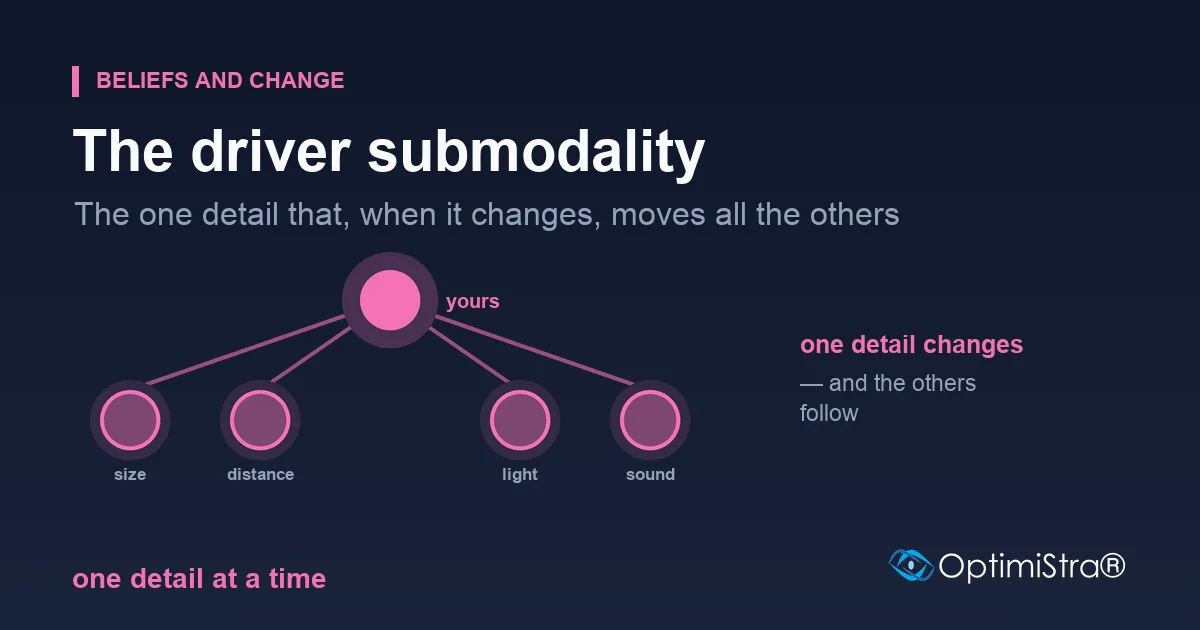
The driver submodality: the one detail that moves all the others
In NLP, the driver submodality is the quality of a mental image that carries the others with it when you change it: size, distance, brightness, or color, depending on the person. Studies show that a single visual detail can change what we feel, but none has tested this ripple effect.
November 18, 2026 · 5 min read
Stress and Emotions
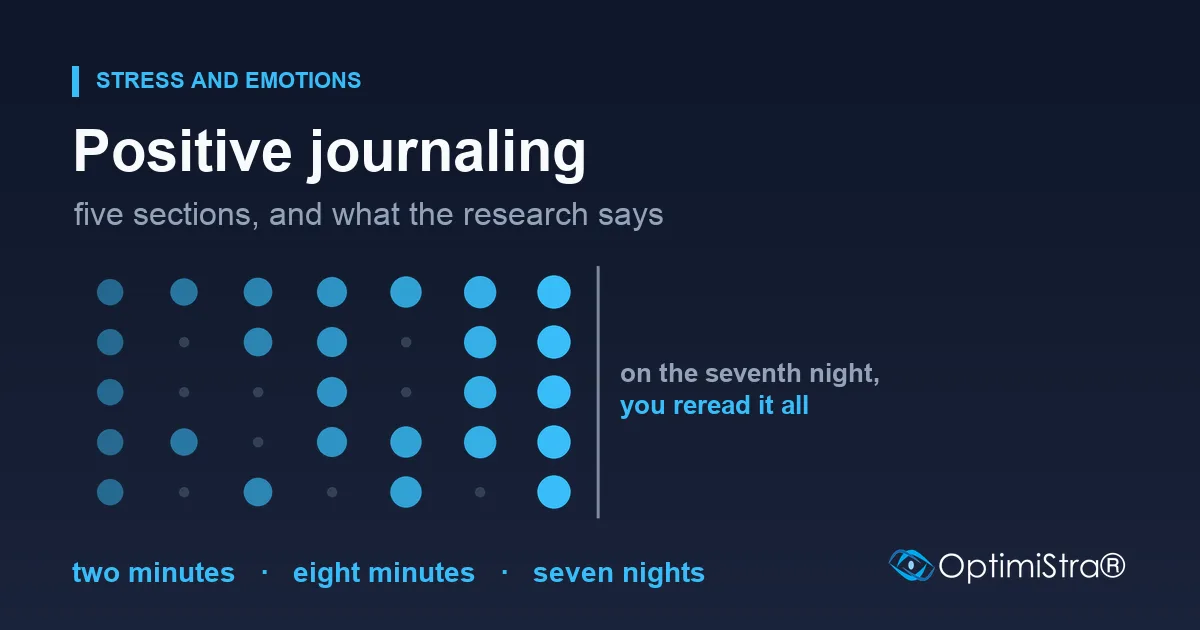
Positive journaling: five sections, and what the research says
Writing down what you are grateful for helps a little, and no more than any other positive activity. Two findings change how to keep a journal: recount a good moment instead of analyzing it, and write only positive affirmations you can believe. That is the case for five sections instead of one.
November 18, 2026 · 7 min read
Leadership Strategy
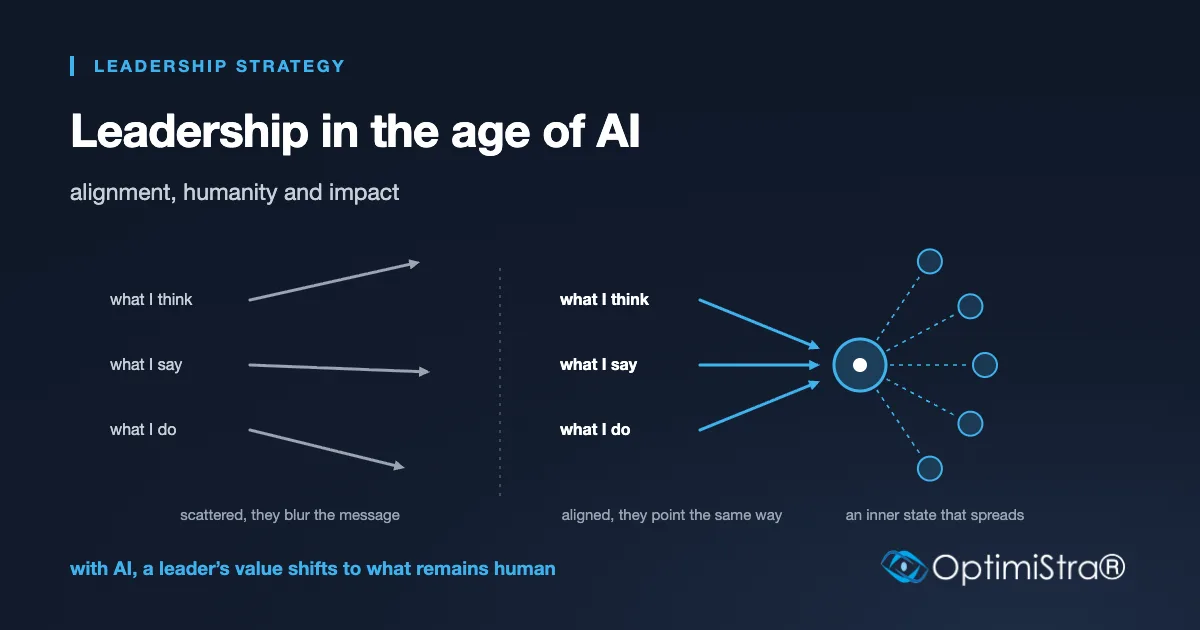
Leadership in the age of AI: alignment, humanity and impact
As AI becomes faster and more consistent at technical work, a leader’s value moves toward what stays human: coherence between thoughts, words and actions, the quality of connection and the ability to bring out other people’s potential. This inner alignment is not improvised. It is worked on and kept up over time.
November 18, 2026 · 7 min read
Leadership Strategy
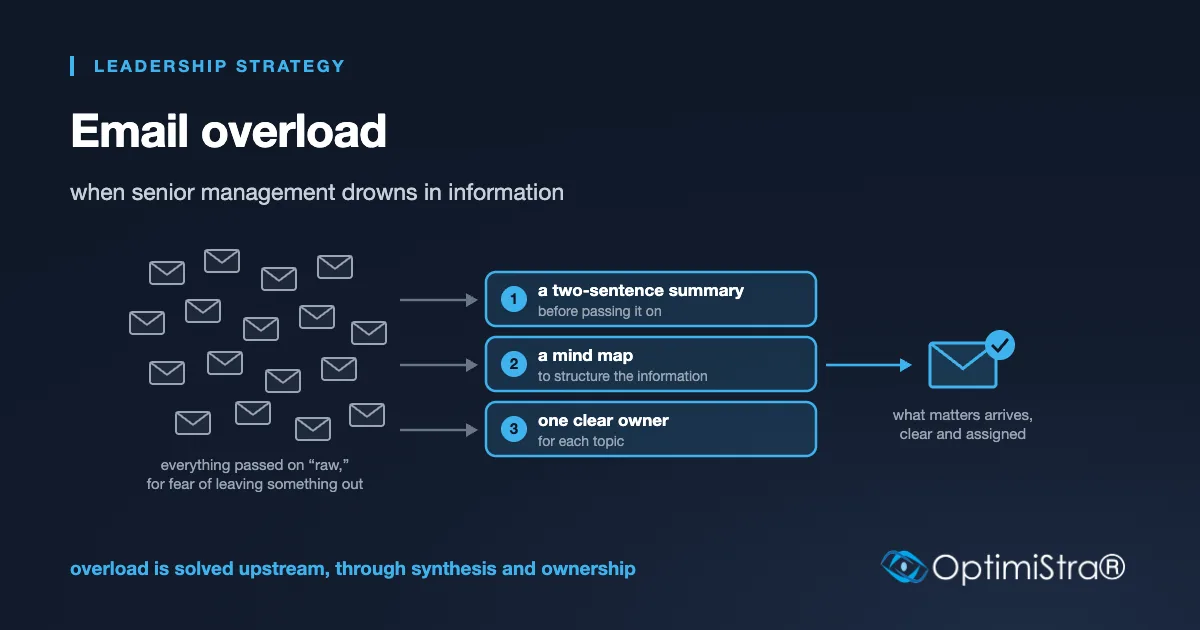
When senior management drowns in email
Email overload comes mostly from the fear of leaving something out: people forward everything raw instead of taking responsibility for a summary. Three things help: ask for a two-sentence summary before anything is forwarded, structure information with mind mapping and make clear who is responsible for what, backed by training and feedback.
November 18, 2026 · 9 min read
What NLP Makes Possible
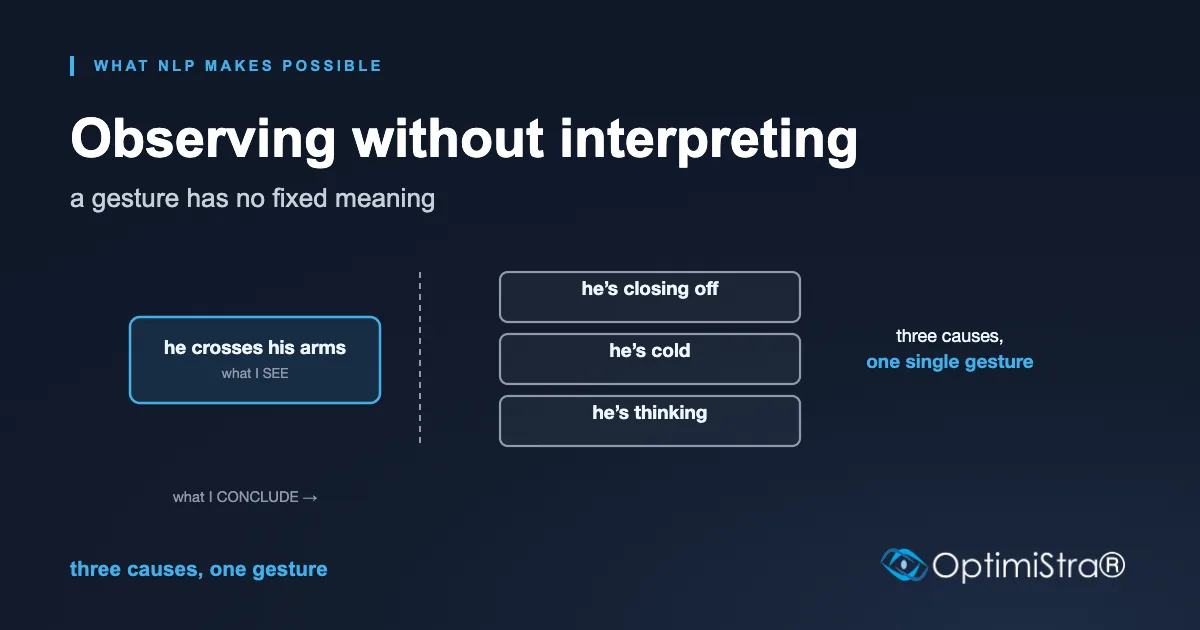
Observing without jumping to conclusions
Someone crosses their arms and we have already reached a verdict. The brain would rather have a wrong answer than the gap left by an open question. Separating what you observe from what you infer can be learned, and the test is simple: if your reading confirms a fear you already had, be wary of it.
November 18, 2026 · 5 min read
What NLP Makes Possible
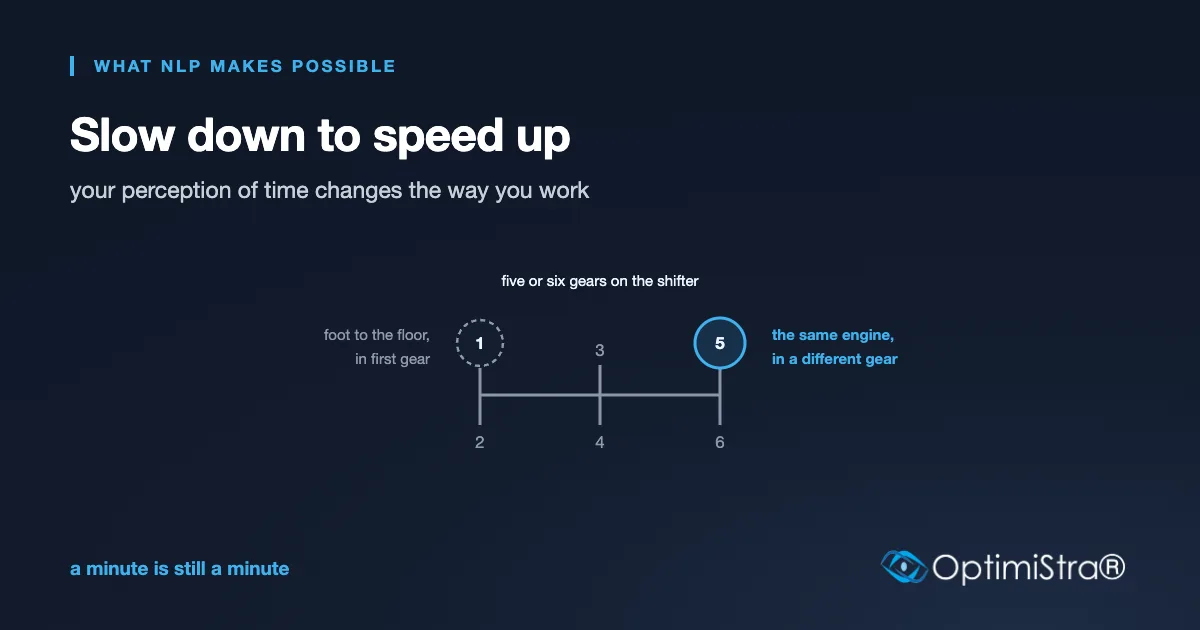
Slow down to speed up: how your perception of time changes the way you work
The state you work in matters as much as how you organize your days. Hurry reduces your capacity to think without giving any sign, and sets up a race against the clock that feeds itself. Your perception of time, which Neuro-Linguistic Programming (NLP) calls the timeline, can be trained: you meet the same workload more calmly and effectively.
November 18, 2026 · 6 min read
Understanding NLP
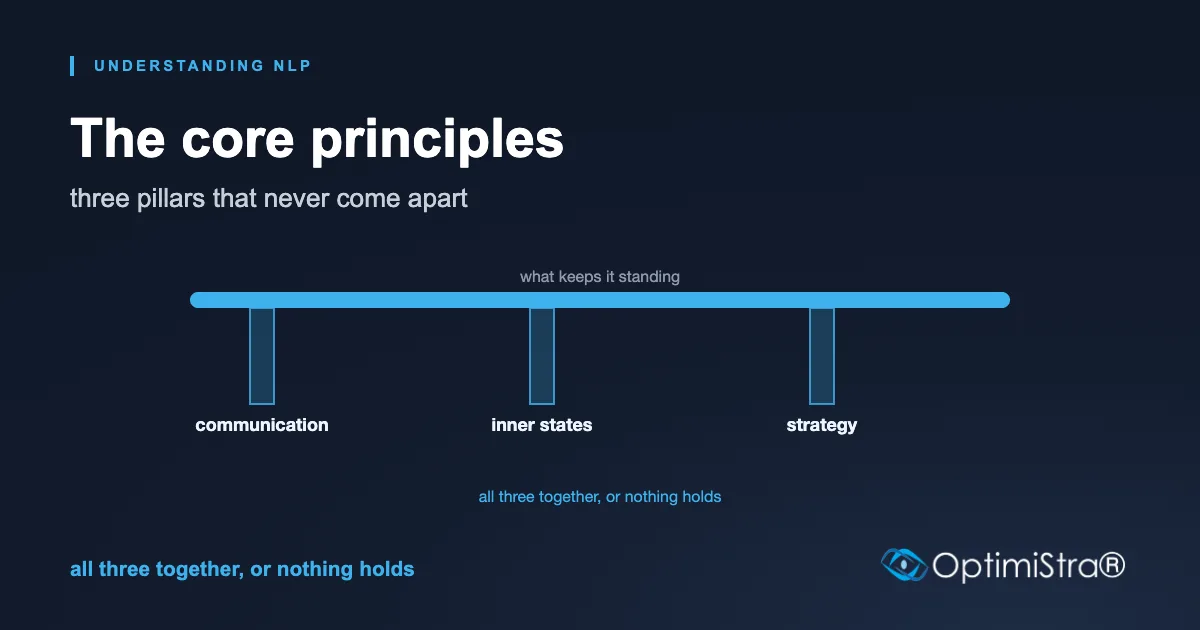
The core principles of NLP
Neuro-Linguistic Programming (NLP) rests on three pillars: communication, including the conversation you hold with yourself; the management of inner states, with their chemical side; and strategies, which coordinate the other two. You can start with any one of them, but isolating a single pillar explains most of the changes that don’t last.
November 18, 2026 · 6 min read
Understanding NLP
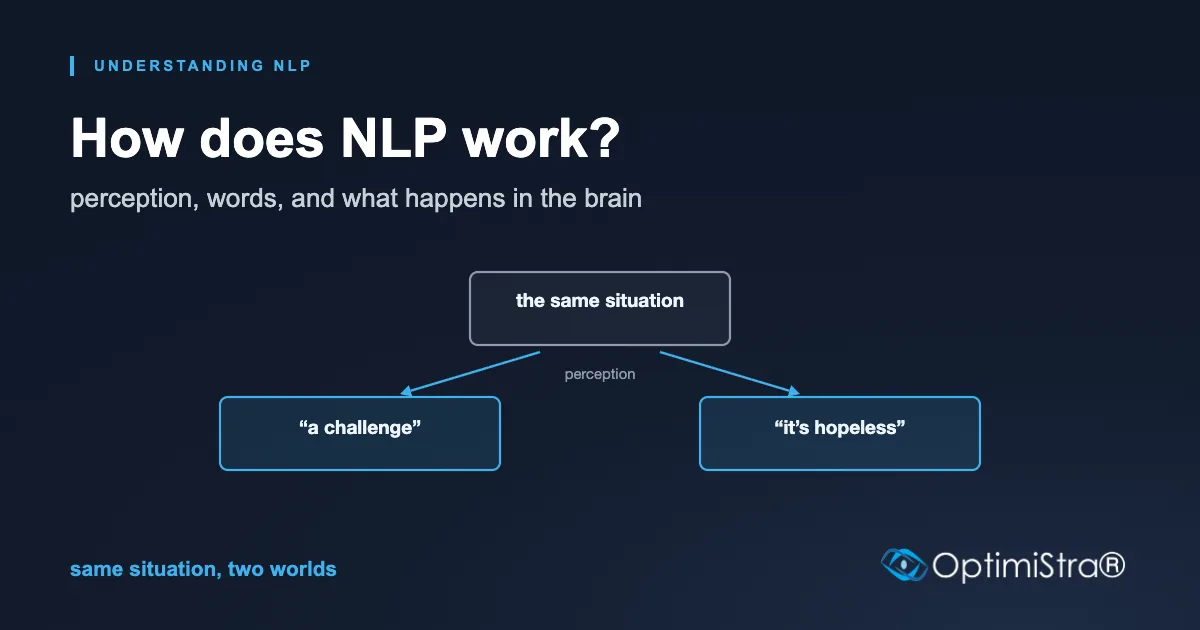
How does NLP work?
Neuro-Linguistic Programming (NLP) works on perception rather than on events: two people facing the same situation do not live in the same world. The words you say to yourself set up an inner state, and that state has measured effects on attention, decision-making and memory. There is nothing mysterious about it.
November 18, 2026 · 8 min read
Understanding NLP
What is NLP? (And why it isn’t what you think)
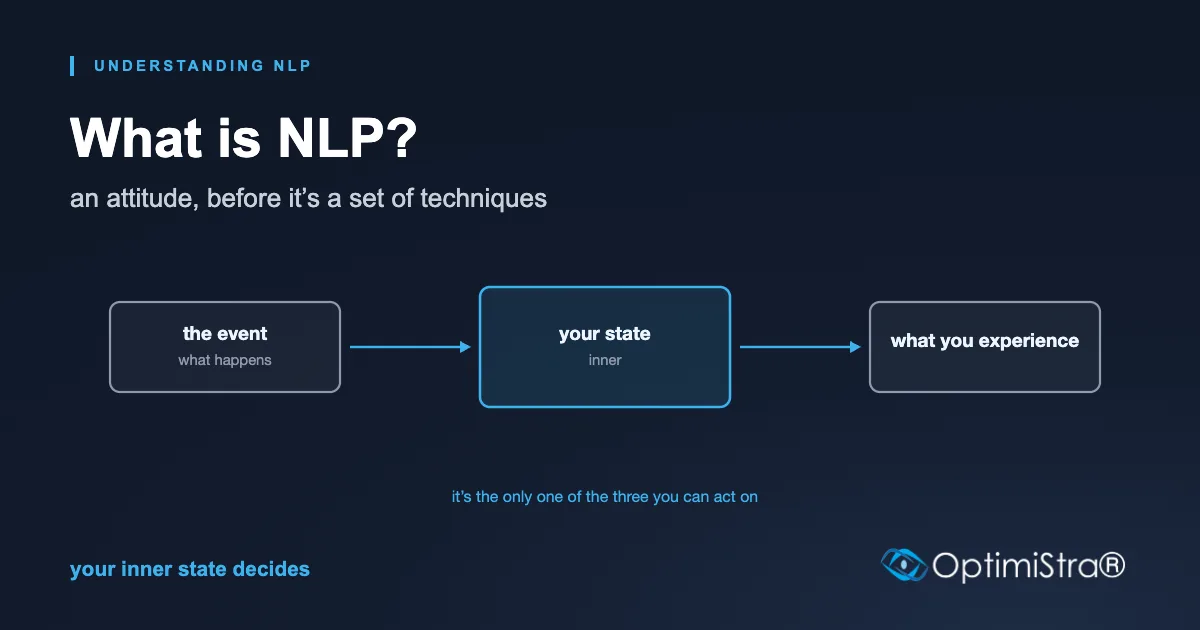
Neuro-Linguistic Programming (NLP) is passed on as an attitude, not as a catalog of techniques. It teaches you to notice the inner dialogue that runs all day, to recognize the automatic responses it sets up and to take charge of your inner state rather than being at its mercy day after day.
November 18, 2026 · 5 min read
What NLP Makes Possible
Communicating with greater precision
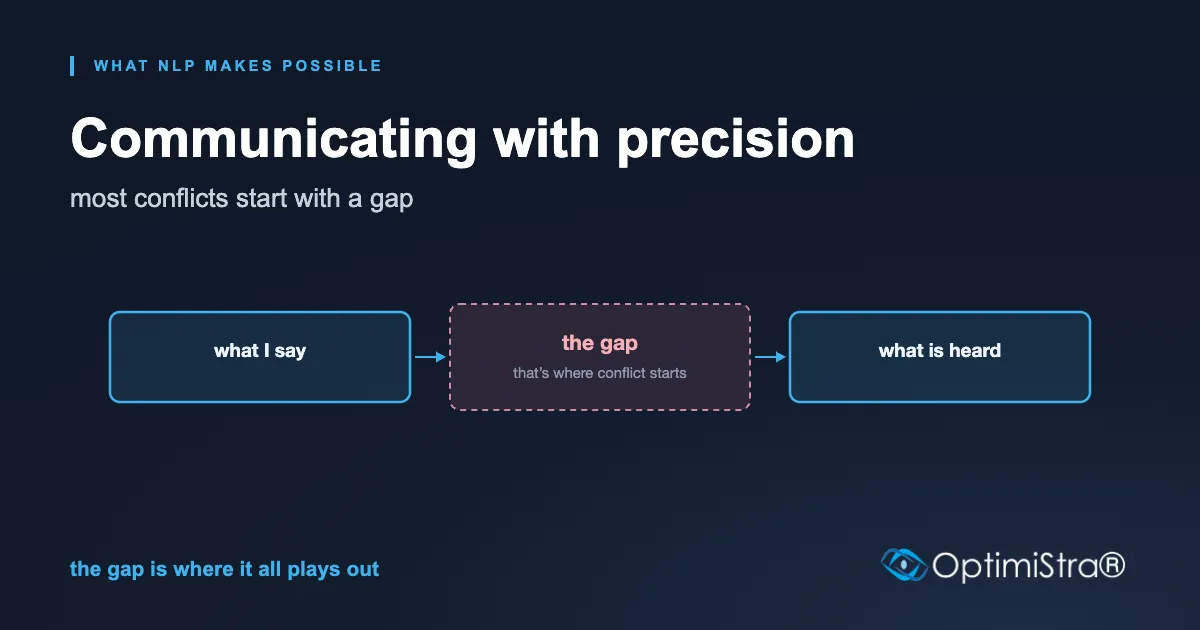
Most conflicts start not with a disagreement but with a sentence badly said and badly heard. “It’s not bad” does not mean “it’s good”: the intention was good, the result was not. Reading the intention beneath the words keeps you from adding fuel to a fire that never asked for any.
November 18, 2026 · 5 min read
What NLP Makes Possible
Changing a thought pattern: what if you were never condemned to live with it?
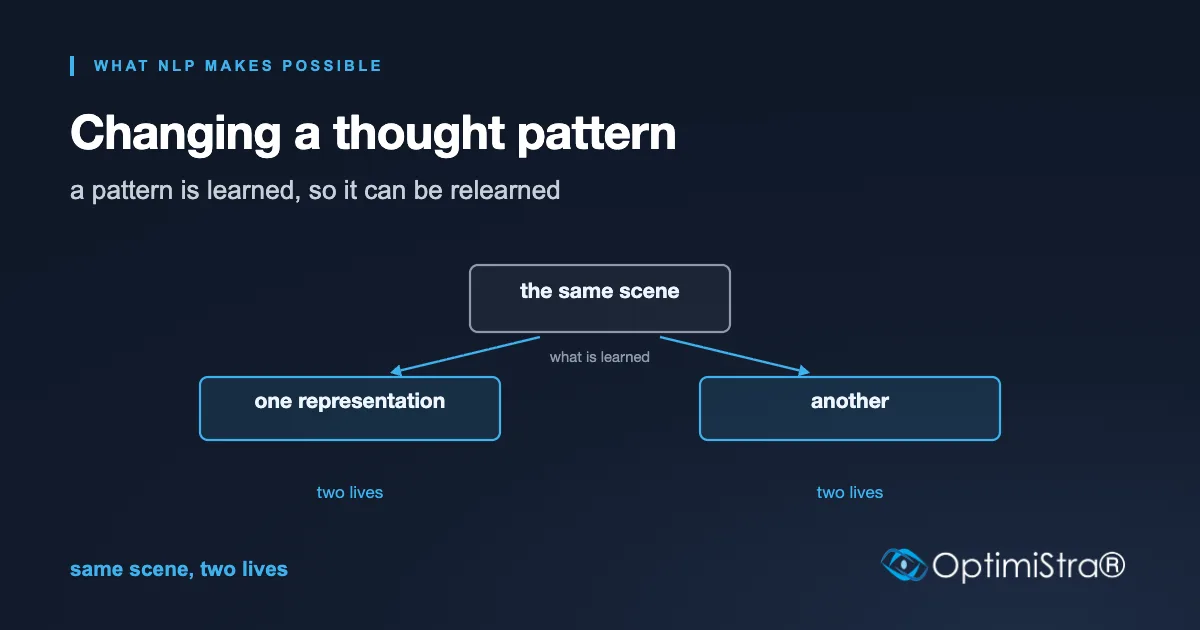
A thought pattern is learned, not inherited: two brothers from the same household can draw opposite conclusions from the same childhood. Because it is learned, it can be relearned, even after decades. An old pattern is no more permanent than a recent one. It is simply better rehearsed, and that is a difference of degree.
November 18, 2026 · 6 min read
What NLP Makes Possible
How success is built (and why it never just happens)
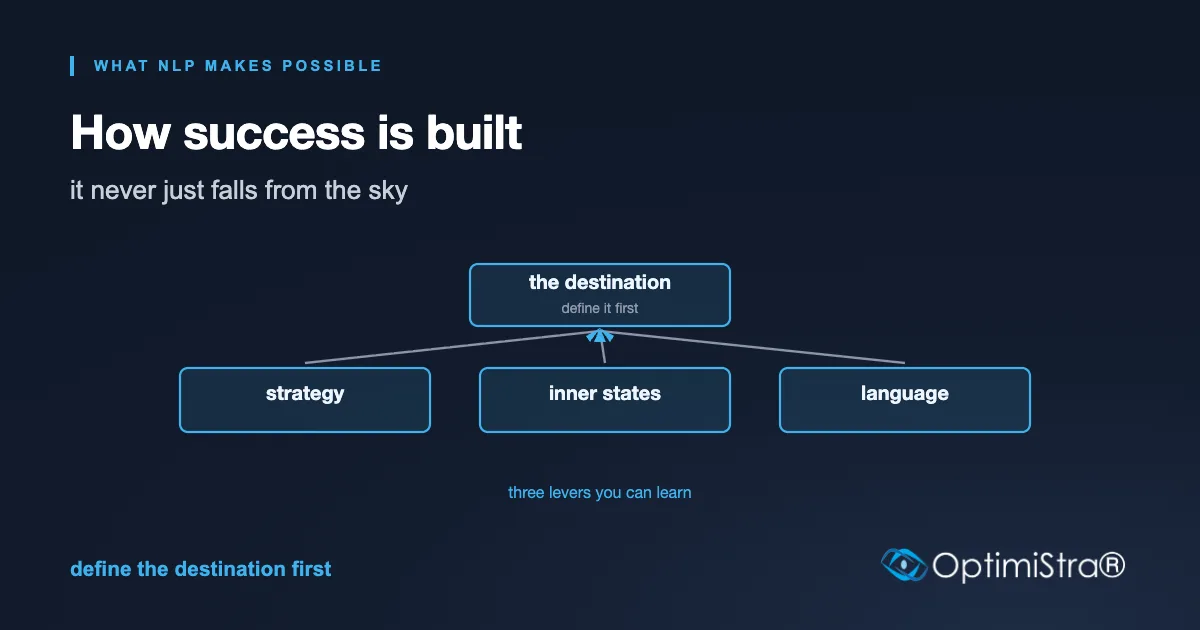
Success starts with knowing what the word means to you, a step that is almost always skipped. After that comes the assembly, and it can be learned: a strategy that holds up when the unexpected happens, inner states you can return to at will and language that builds rather than tears down.
November 18, 2026 · 4 min read
What NLP Makes Possible
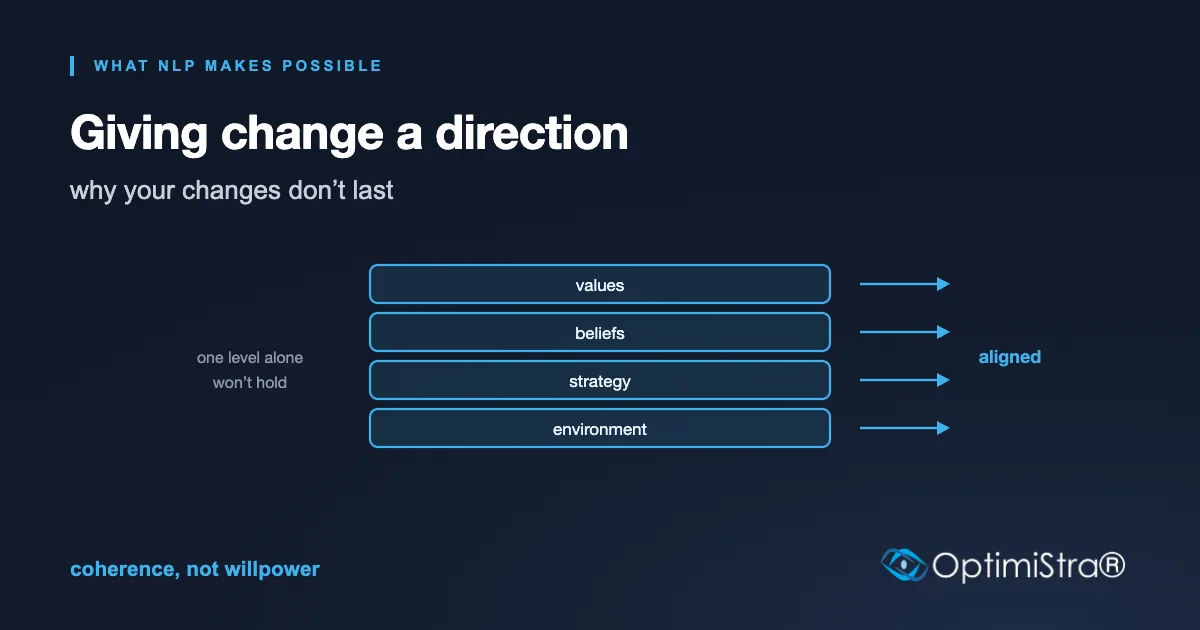
Lasting change needs a coherent direction: why resolutions don’t hold, and what to do about it
A change holds when four levels agree: the environment it happens in, the strategy that organizes it, the beliefs you hold about it and the value that gives it meaning. Decided at one level only, it gives way to the other three. The timescale is counted in weeks, and one missed day undoes nothing.
November 18, 2026 · 7 min read
NLP: Straight Answers
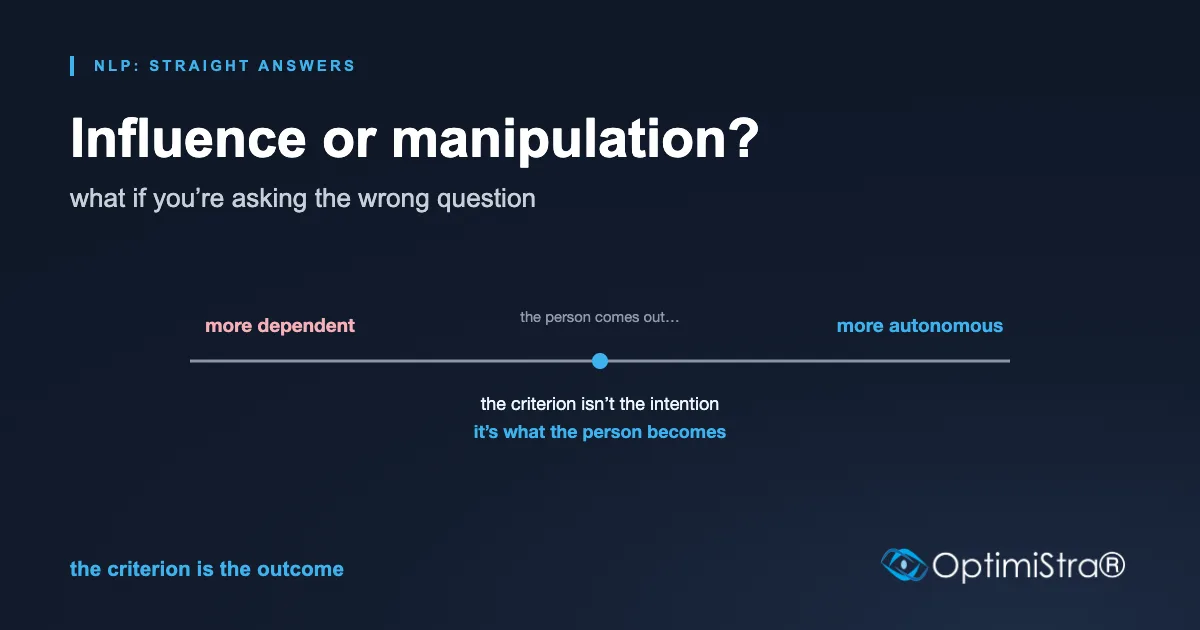
Influence or manipulation: are you asking the wrong question?
Framing the question in terms of intention leads to a dead end, because nobody describes themselves as a manipulator. The useful test is the result: does the other person come away more autonomous, or more dependent? That is a question you can check rather than simply assert.
November 18, 2026 · 7 min read
NLP: Straight Answers
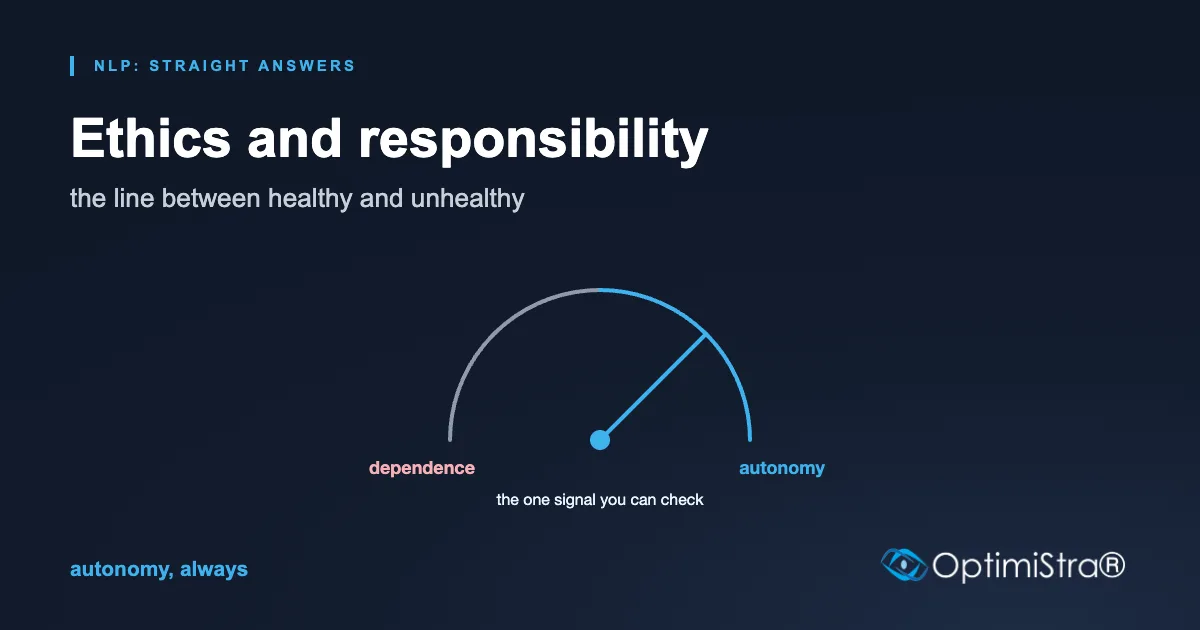
Ethics and responsibility in NLP: the one line between healthy and unhealthy practice
The most reliable signal of a healthy practice is autonomy. A practitioner who keeps adding sessions without ever making the person able to act alone should put you on your guard. And the practitioner is not responsible for the results: taking the credit for them is already the first step in the wrong direction.
November 18, 2026 · 5 min read
What NLP Makes Possible
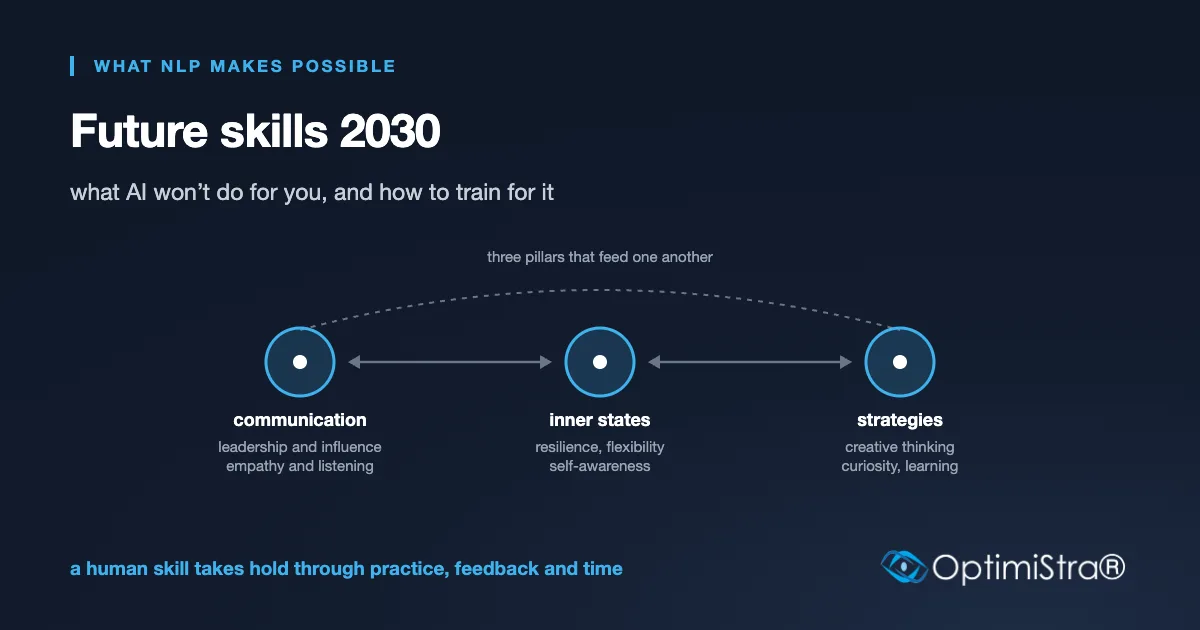
Future skills 2030: what AI won’t do for you, and how NLP trains it
Employers rank resilience, leadership, self-awareness and communication among the core skills of 2030, in Switzerland even more than elsewhere. Neuro-Linguistic Programming (NLP) trains them through three pillars: communication, inner states and strategies. Research shows they are acquired through practice, feedback from a trainer and time.
November 18, 2026 · 18 min read
NLP: Straight Answers
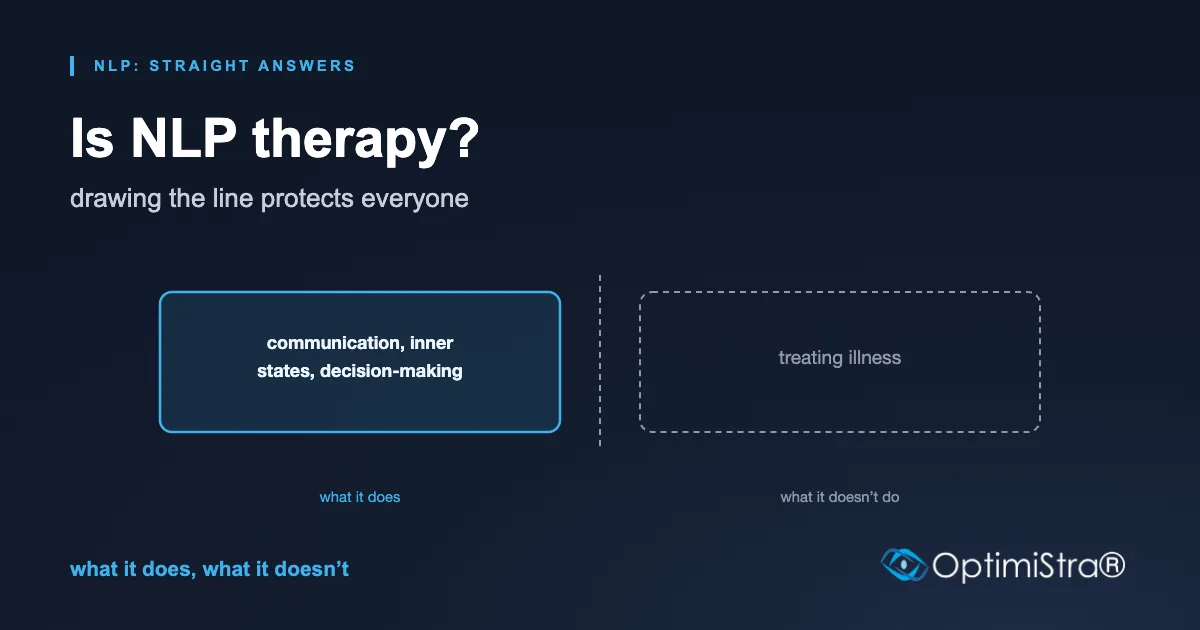
Is NLP therapy?
Neuro-Linguistic Programming (NLP) is not therapy and is no substitute for it. It works on communication, inner states and the way you make decisions, in the here and now, with no claim to treat anything. Stating that limit plainly, from the outset, protects people as much as it protects the discipline.
November 18, 2026 · 6 min read
What NLP Makes Possible
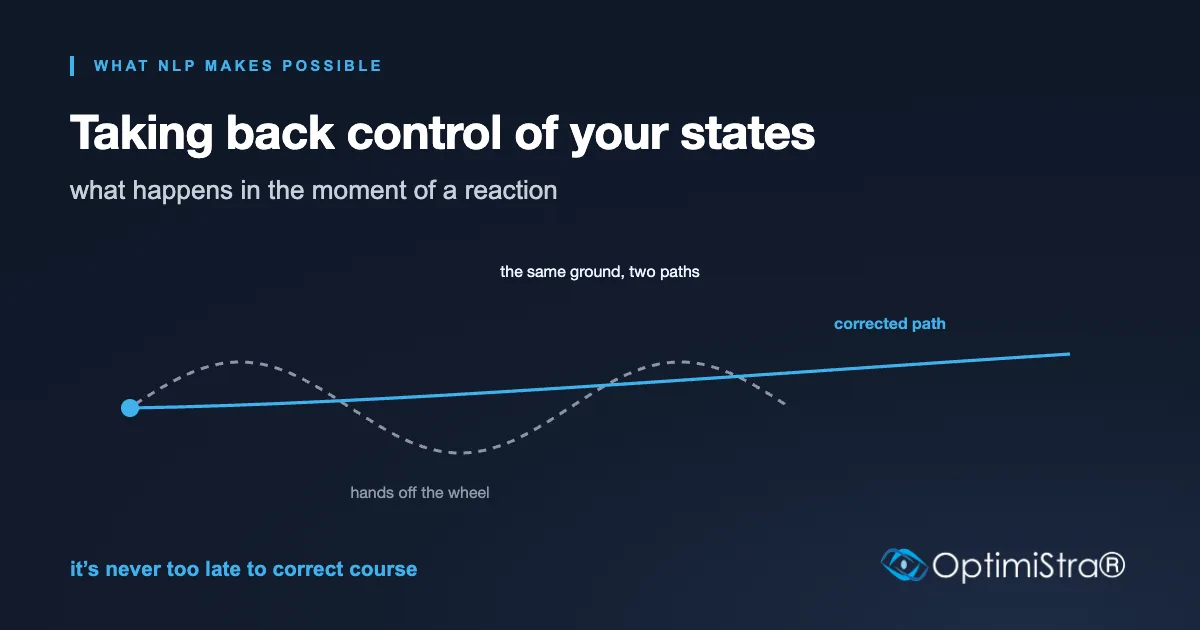
How to take back control of your emotional reactions
Losing your composure at a passing remark comes down to an inner state that was not brought back under control in time. That control is learned, at any age and from any starting point, and the earlier you put your hands back on the wheel, the simpler the change of course.
November 18, 2026 · 5 min read
Understanding NLP
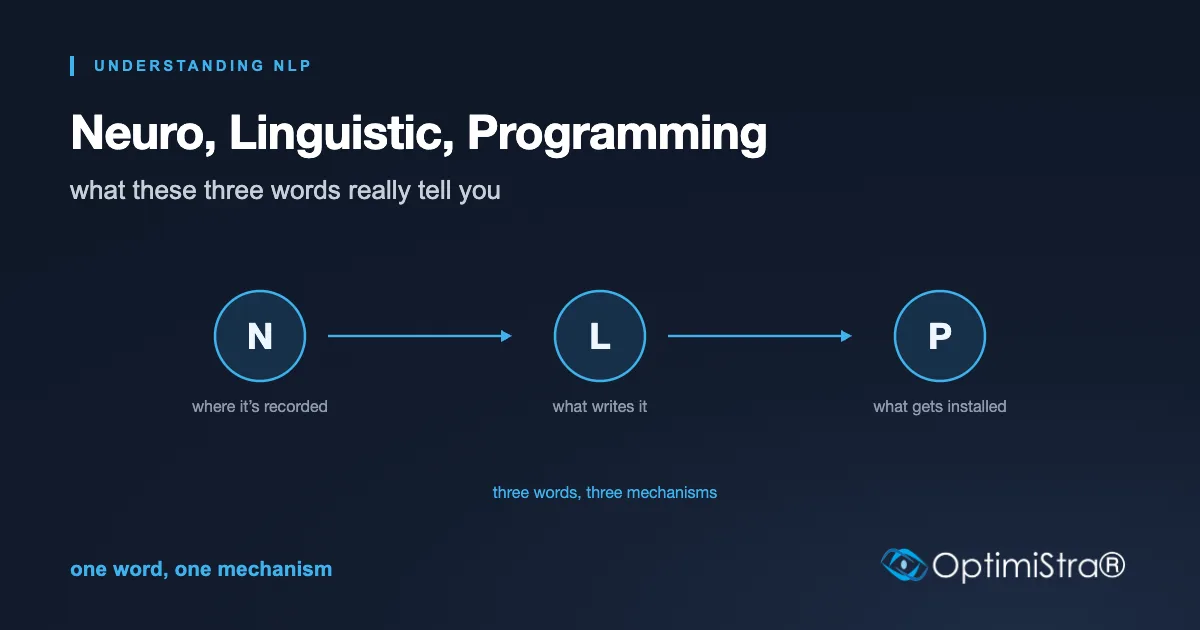
Why is it called Neuro-Linguistic Programming?
Neuro-Linguistic Programming (NLP) is named after three mechanisms. Programming, because experiences settle in us the way programs are installed. Neuro, because those programs live in neural connections that repetition strengthens. Linguistic, because language writes them and can rewrite them. The name is a map, and it shows where to look first.
November 18, 2026 · 7 min read
NLP: Straight Answers
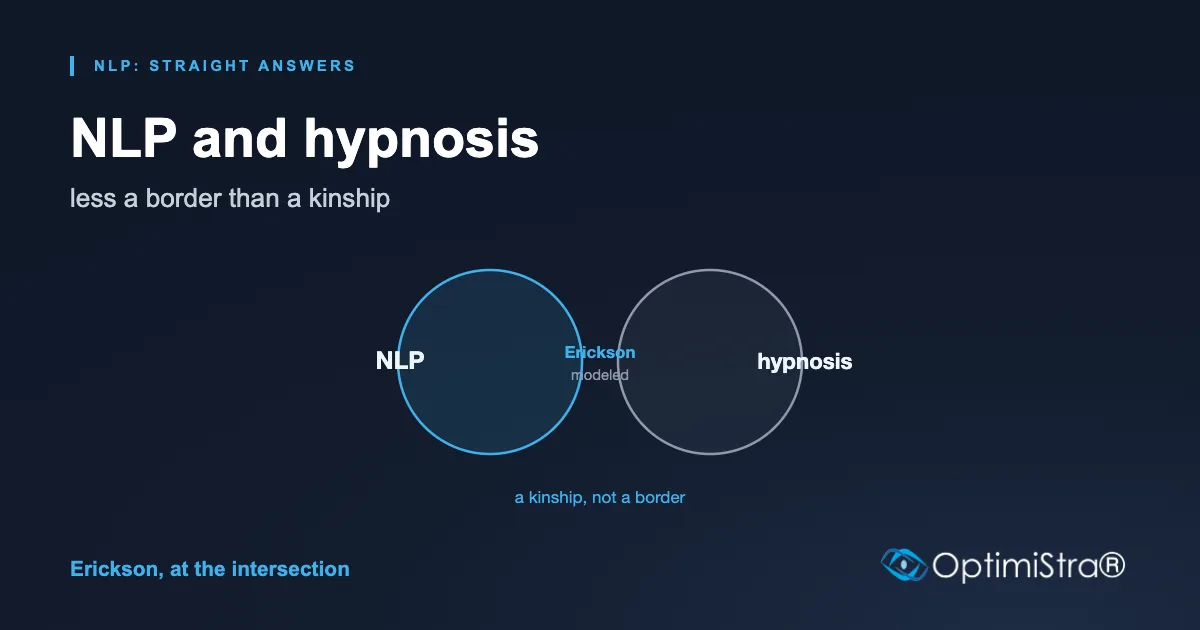
NLP vs hypnosis: what’s the difference?
Neuro-Linguistic Programming (NLP) and hypnosis share a root: NLP was built by modeling remarkable practitioners, among them Milton Erickson, the father of Ericksonian hypnosis. The version taught in the French-speaking world has often cut that root, which leaves an NLP shorter than the original and markedly less effective.
November 18, 2026 · 5 min read
NLP: Straight Answers
The limits, risks and misuses of NLP
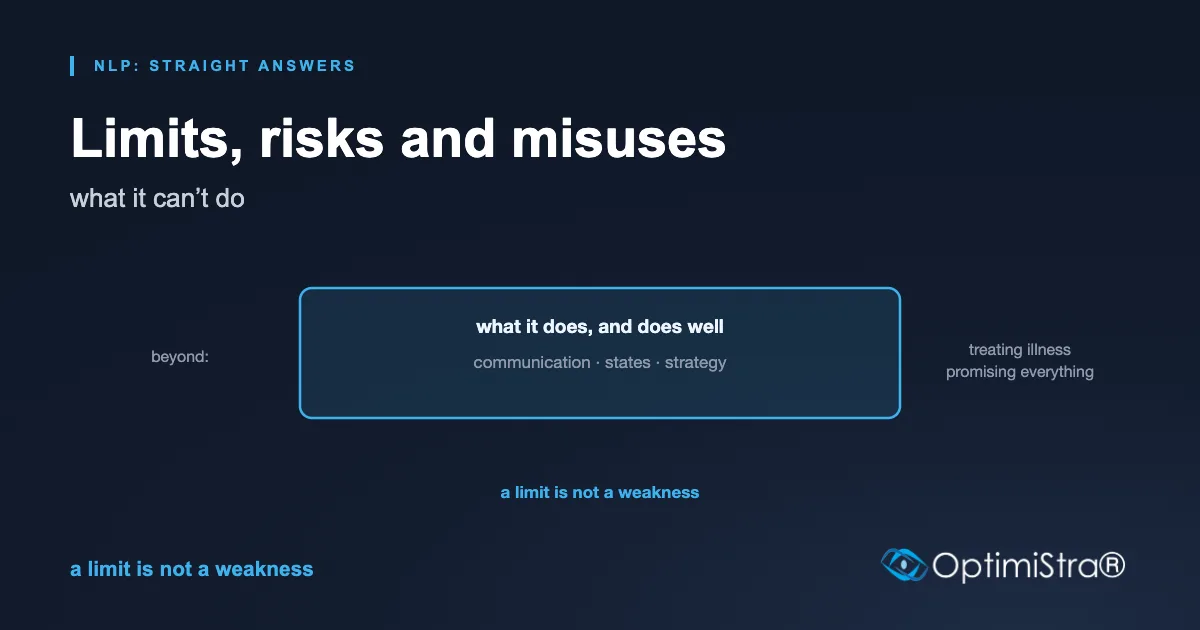
Neuro-Linguistic Programming (NLP) is not a panacea, and its limits are not a weakness: they are what makes it usable. Some claims attributed to NLP have been tested and do not hold up. Detecting lies from eye movements is the best-documented example.
November 18, 2026 · 6 min read
NLP: Straight Answers
Is NLP scientific? The real question isn’t the one you think it is
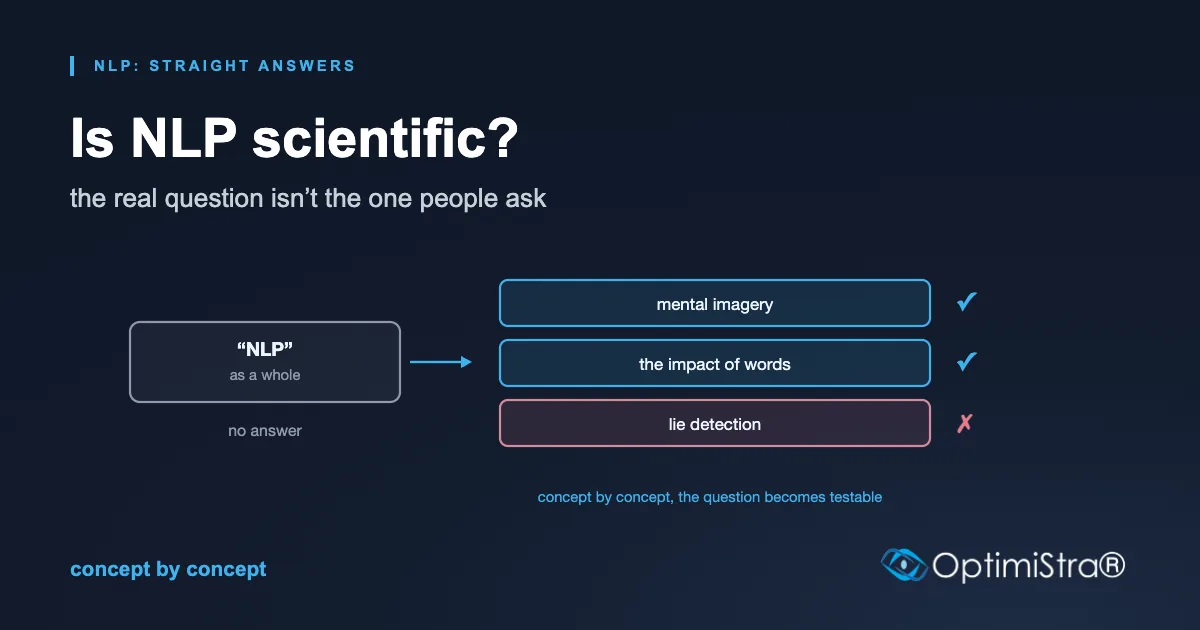
Neuro-Linguistic Programming (NLP) cannot be validated as a block, because it is an assembly of separate concepts and not a single theory. The most critical review says so itself: the scarcity of evidence reflects how few and how weak the studies are, not proof that it does not work. Taken concept by concept, the answer can be checked.
November 18, 2026 · 12 min read