The map is not the territory: ask rather than guess


Michel Wozniak and Nathalie de Marcé
Published November 18, 2026 · 6 min read
In brief
Everyone perceives the same reality through a map of their own, and two different maps can both be accurate. The trap is believing you see things as they are and attributing the disagreement to the other person. Imagining their point of view does not make you more accurate; asking them for it does.
“The map is not the territory.” The phrase is well known, and almost everyone agrees with it. That is exactly what makes it tricky: we accept it in principle and go on, in practice, believing that our own map is the right one.
This article looks at where the phrase comes from, what social psychology has measured about the trap it points to, and why the most useful move in a disagreement is to ask the other person for their point of view rather than imagine it.
What “the map is not the territory” means
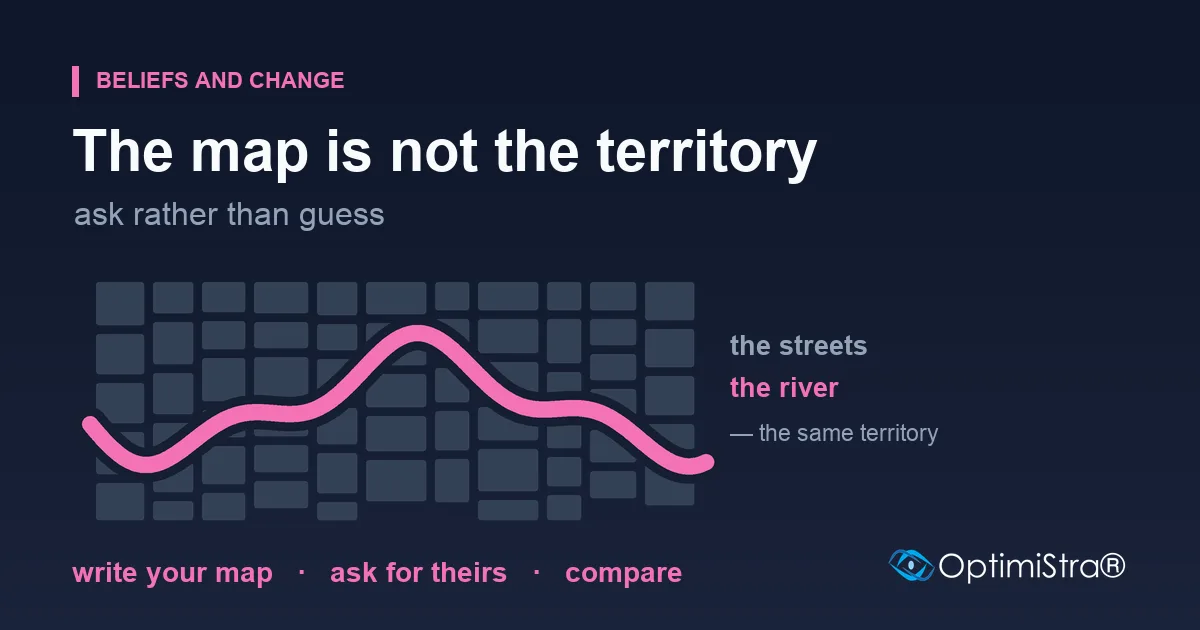
Each of us perceives the world through a representation: what we have learned, what we notice, what matters to us. That representation is a map. It is never the territory itself, and two very different maps of the same place can both be accurate.
In the training room, we illustrate this with the maps of a single city. The road map shows streets and intersections; the waterways map shows the river and its canals; the sewer map shows what runs beneath the streets; the bike-lane map shows still other routes; the relief map shows slopes the others ignore. None of them is wrong. None of them shows the whole city. The cyclist and the sewer worker are both right, each from where they stand, and neither has to convince the other.
Applied to a disagreement, the principle says something simple: two people can see the same situation differently without either of them being wrong. This doesn’t lead to relativism: a map can be wrong, and an accurate map can be incomplete. But a disagreement alone doesn’t prove that one of the maps is wrong.
Where the phrase comes from
We owe it to Alfred Korzybski. He presented it in December 1931 and returned to it in his 1933 book Science and Sanity, in a fuller form than the one usually quoted: “A map is not the territory it represents, but, if correct, it has a similar structure to the territory, which accounts for its usefulness.”
The second half matters. Korzybski doesn’t say that all maps are equally good. He says that an accurate map reproduces the structure of the terrain, and that this is what makes it useful. Two accurate maps of one city don’t show the same lines, but they don’t contradict each other: you can lay one over the other.
The phrase then traveled, notably into Neuro-Linguistic Programming (NLP), which made it one of its starting presuppositions; we present the core principles of NLP elsewhere, along with the way it works on perception rather than on events.
The trap: believing your map is the territory
Social psychology has a name for what the phrase pushes against: naive realism. Emily Pronin, Thomas Gilovich, and Lee Ross described it in 2004 in Psychological Review. At its heart, they write, is “the conviction that one perceives objects and events ‘as they are.’”
The consequence follows. If I see things as they are, any reasonable, attentive person should see what I see. And when they see something else, “we infer that the source of their responses must be something about them”: a vested interest, a prejudice, bad information.
In 2007, in Trends in Cognitive Sciences, Emily Pronin added an observation that sheds light on many conflicts: “the more people disagree with us, the more we view them as biased.” The wider the disagreement, the more biased we judge the other person to be, and that judgment itself tends to escalate the conflict.
The finding has been replicated. In 2021, three preregistered experiments with 969 participants again found what researchers call the bias blind spot: we rate ourselves as markedly less prone to bias than other people. The 2004 authors add a fair caveat: no one in their studies claimed to be entirely immune. People simply rated themselves as less susceptible than average.
Imagining the other person’s map is not enough
The remedy most often suggested is to “put yourself in the other person’s shoes.” It has been tested, and the result is surprising.
In 2018, Tal Eyal, Mary Steffel, and Nicholas Epley published a series of 25 experiments in the Journal of Personality and Social Psychology. Participants had to guess what another person was thinking or feeling: reading emotions on a face, telling a real smile from a fake one, spotting a lie, predicting their partner’s preferences. Some of them were instructed to put themselves in that person’s place before answering.
The instruction did not make them more accurate. The abstract says so plainly: “If anything, perspective taking decreased accuracy overall while occasionally increasing confidence in judgment.” Taking the other person’s perspective did reduce egocentrism, but what took its place was no more accurate.
Only one thing did better, in the final experiment: “getting another person’s perspective directly, through conversation, increased accuracy but that perspective taking did not.” Asking, rather than guessing.
We were only able to read the abstract of this paper, which is not open access, so we cite neither its sample sizes nor its limitations. But its conclusion matches what we have long observed in our courses: the map we attribute to the other person often looks more like our own than like theirs.
What we suggest
A three-step exercise, on a disagreement that is recent and low-stakes: the choice of a restaurant, a way of working, the ending of a movie.
- Write down the other person’s map. What they see, what matters to them, what led them there. Start each sentence with “From where they stand…” and start none of them with “but.”
- Then ask them: “What led you to that conclusion?” Listen all the way to the end.
- Compare. The gap between the map you attributed to them and the one they showed you is the real result of the exercise.
Writing first isn’t wasted effort, even though imagination alone falls short: the first map gives you something to compare against. Without it, you wouldn’t know how far off you were, or about what.
The question itself comes from our NLP Practitioner course. It replaces “you’re wrong” with curiosity, and it has a valuable side effect: it obliges you to listen to the answer. Research on intellectual humility points the same way. A 2022 review in Nature Reviews Psychology reports that people who more readily acknowledge that their beliefs might be wrong are more tolerant of opposing views, while noting that most of this research is correlational.
What the principle doesn’t say
One necessary clarification. Recognizing the other person’s map doesn’t mean agreeing with them, or accepting what hurts you. The principle applies to ordinary disagreements, the kind where each person sees part of the terrain. It doesn’t turn harmful behavior into “just a point of view”: if a relationship is causing you pain, it is not a question of maps, and it is not an exercise to do alone.
Conversely, the principle doesn’t ask you to give up your own map. It asks you to take it for what it is: accurate, perhaps, and partial, certainly. This is also what makes for more precise communication: you stop defending one map and start comparing them.
In our NLP Practitioner course, this is the first thing we establish, on the first morning, before any technique.
Article written by Michel Wozniak and Nathalie de Marcé, and optimized by artificial intelligence.
Sources
- Pronin, Gilovich & Ross (2004), Objectivity in the eye of the beholder: divergent perceptions of bias in self versus others, Psychological Review
- Pronin (2007), Perception and misperception of bias in human judgment, Trends in Cognitive Sciences
- Chandrashekar et al. (2021), Agency and self-other asymmetries in perceived bias and shortcomings: replications of the Bias Blind Spot, Judgment and Decision Making
- Eyal, Steffel & Epley (2018), Perspective mistaking: accurately understanding the mind of another requires getting perspective, not taking perspective, Journal of Personality and Social Psychology (résumé)
- Porter et al. (2022), Predictors and consequences of intellectual humility, Nature Reviews Psychology
Frequently asked questions
What does “the map is not the territory” mean?
That each of us perceives reality through our own representation of it, our map, and never reality itself. Two very different maps of the same place can both be accurate, like the road map and the waterways map of the same city.
Who said “the map is not the territory”?
Alfred Korzybski, who presented the phrase in 1931 and returned to it in Science and Sanity in 1933. He added that an accurate map has a structure similar to the terrain’s, and that this is what makes it useful. The phrase later became one of the presuppositions of Neuro-Linguistic Programming (NLP).
Why do we assume our own view is the right one?
Psychologists call it naive realism: the conviction that we see things as they are. When someone sees things differently, we conclude that the cause lies with them. And the more they disagree with us, the more biased we judge them to be (Pronin, Gilovich, and Ross, 2004; Pronin, 2007).
Does putting yourself in someone else’s shoes help you understand them?
Less than we think. In a series of 25 experiments published in 2018, Eyal, Steffel, and Epley found no gain in accuracy when participants took the other person’s perspective. What did improve accuracy was asking that person directly for their point of view.
Does recognizing someone’s map mean admitting they’re right?
No. The principle applies to ordinary disagreements, where each person sees part of the terrain. A map can be wrong, and an accurate map can be incomplete. Recognizing the other person’s map doesn’t mean accepting what hurts you: if a relationship is harming you, it is not a matter of point of view.
Beliefs and Change
Optical illusions: what your brain still sees, even when you know better
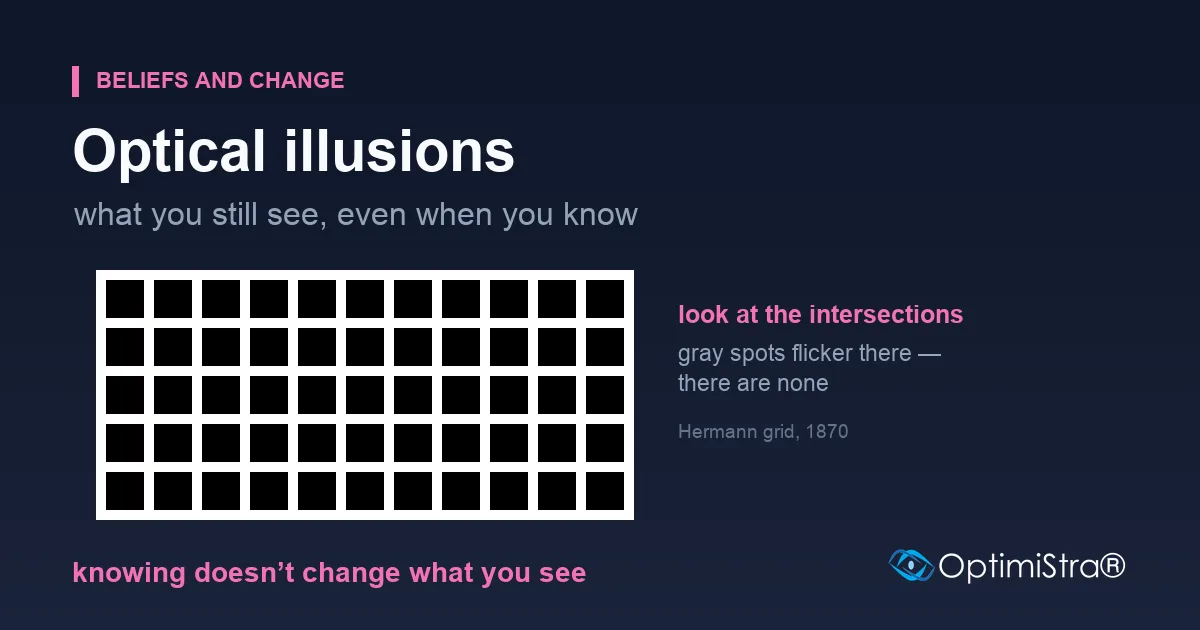
An optical illusion isn’t a malfunction: it is the brain interpreting what it sees, correcting for shadows or filling in what’s missing. The most striking part is that the illusion holds even once you know how it works. Three famous illusions show this, and research explains why.
November 18, 2026 · 8 min read
Beliefs and Change
The invisible gorilla: what the brain sees, and what it adds
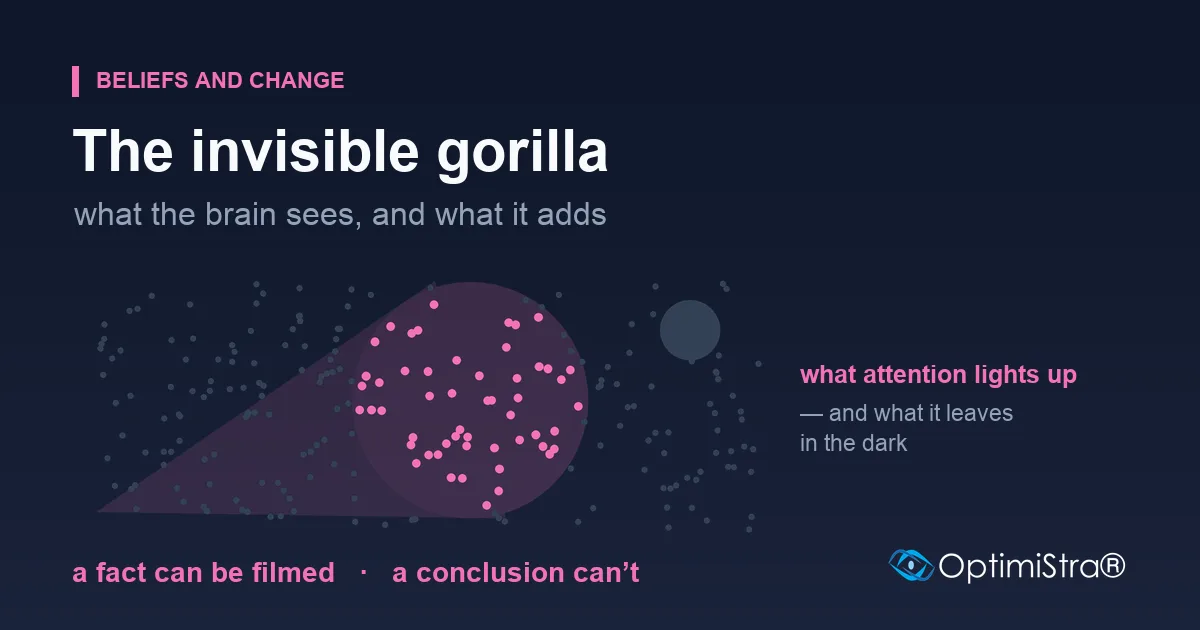
Attention works like a flashlight: it lights one spot at a time, and you can miss a gorilla while looking straight at it. Whatever it does light, the brain fills in with interpretations it never announces. You can observe both in yourself in a few minutes.
November 18, 2026 · 6 min read
Beliefs and Change
The imagined lemon: what your body does with what you imagine
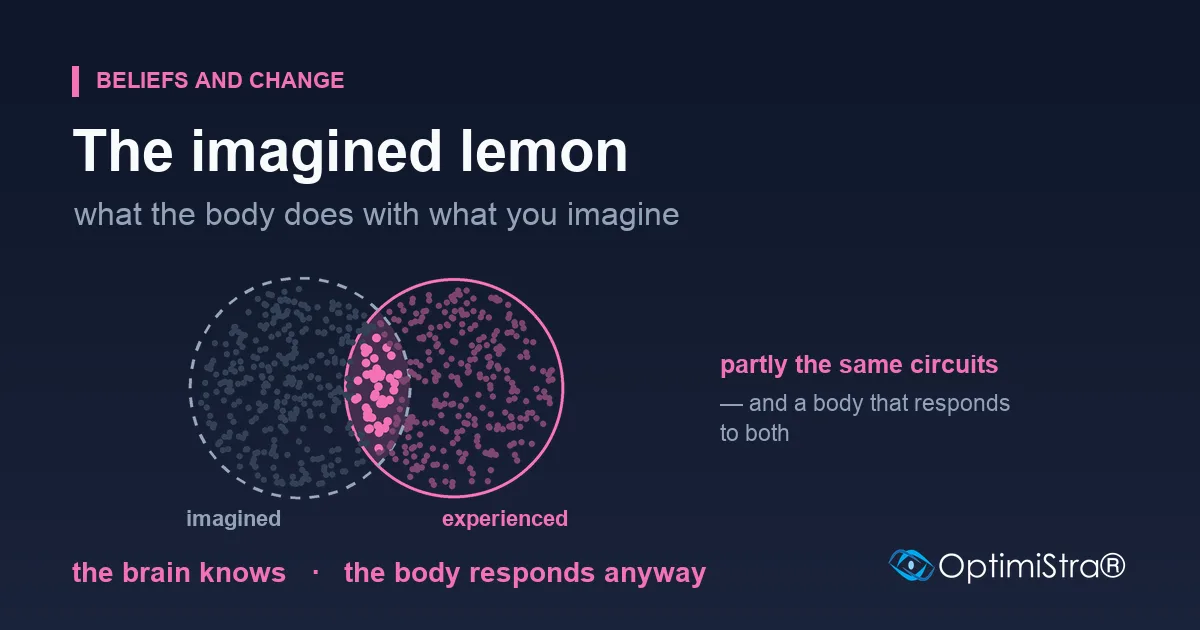
Imagining a lemon makes you salivate, and imagining a movement activates some of the circuits that control it. Even so, the brain does not confuse real and imagined: it tells them apart, except when the inner image becomes strong enough. That is what makes mental rehearsal useful, to a modest degree.
November 18, 2026 · 8 min read