Communicating with greater precision

Published November 18, 2026 · 5 min read
Read by an AI-generated voice.
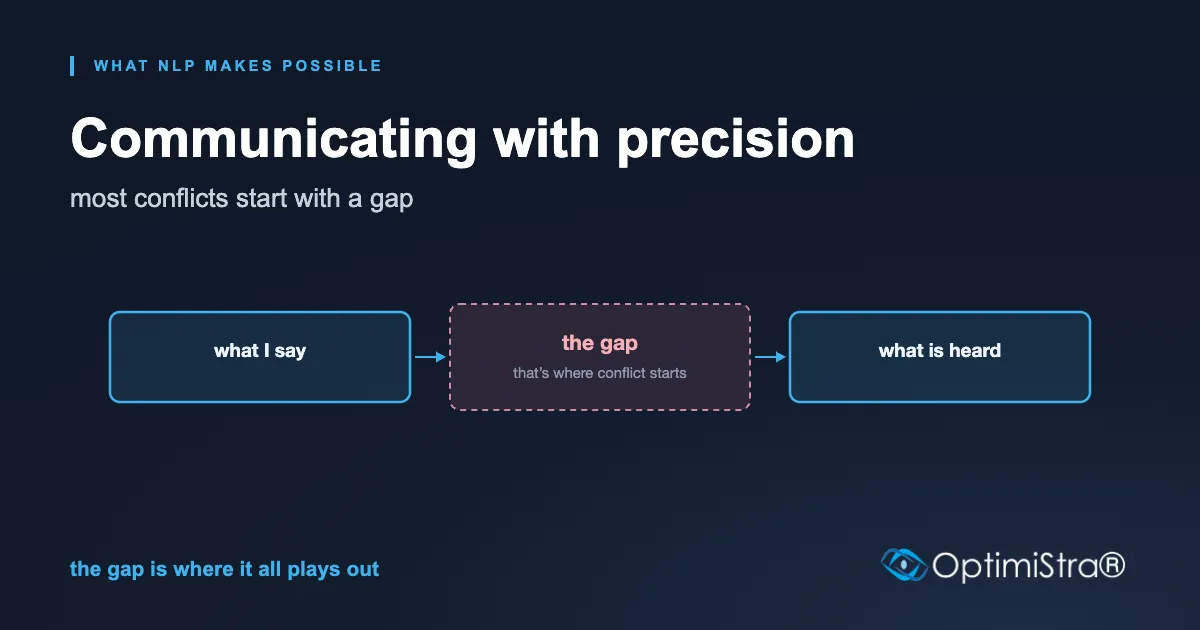
In brief
Most conflicts start not with a disagreement but with a sentence badly said and badly heard. “It’s not bad” does not mean “it’s good”: the intention was good, the result was not. Reading the intention beneath the words keeps you from adding fuel to a fire that never asked for any.
The comfortable lie
Ask a manager whether they communicate well and the answer will almost certainly be yes. Then ask the people who work with them, and the picture often changes completely. Very few agree, unless of course the manager is the one asking.
That gap is no small matter. It is the most widespread blind spot there is. We are all convinced we are clear, and we are rarely as clear as we think.
Nor is it only an office matter. The same mechanism plays out at home, in the evening, around the table. In France, the last figure that Insee, the national statistics office, was able to publish on the subject is 44 divorces for every 100 marriages – close to one in two. Look into what sets these break-ups off and you almost always come back to the same root: “I can’t talk to them any more”, “the moment I say anything, he loses his temper”.
We assume these couples separate because of what happened. In reality, they separate because of what was badly said and what was badly understood. Kluger, Itzchakov and their colleagues brought together 664 measures of the effects of feeling listened to.
What precision reveals in your relationship, your family and your team
A lack of precision doesn’t break things in one go; it wears them down. In a team, it starts with a vague instruction, an intention nobody spelled out, something left implied. Nobody reacts at the time. Then the things left unsaid pile up, and one day the team tears itself apart, without anyone being able to say exactly where it tipped.
In a family, the same invisible thread runs through. Loose remarks, made without anyone weighing them, end up opening a distance. Couples torn apart, families torn apart, employers and employees torn apart: each time, the trail leads back to a problem of communication.
So precision is not a linguist’s refinement. It is what keeps a relationship from fraying when nobody even saw the moment the fraying began.
“It’s not bad”: the anatomy of a misunderstanding
Imagine you spend your morning cooking a dish for a friend. You put your time and your care into it. Your friend arrives, tastes it and says: “Oh, it’s not bad.”
We all understand what the friend means: it is a roundabout way of saying the food is good. Look at the words themselves, though. “It’s not bad” doesn’t say it’s good. It says only that it isn’t bad, and nothing more. Finding the right word for what you feel matters, incidentally: Lieberman and his colleagues showed that simply naming an emotion changes its intensity.
And that remark, meant as a compliment, can land badly with the person who gave their time and effort. The intention was kind. The result stings a little.
What happens here is tiny and enormous at once, because the same thing happens when we talk to ourselves. “I’m useless.” “I’ll never manage it.” “It’s too complicated.” How many times a day? Those sentences have an impact, exactly as the friend’s did. Communication always has an impact, even when the only person you are speaking to is yourself.
The French-speaking world has a stubborn habit here: it speaks in negatives. People don’t say “that’s a success,” they say “that’s not bad.” They think they are paying a compliment, and they are watering it down.
Reading between the lines rather than adding fuel to the fire
Here is what changes almost everything, once you understand how language works.
When you grasp how the language of precision and the language of influence work, you become able to step back from the message. A sentence that looks like an attack is no longer automatically an attack. You can put it back where it belongs: often it isn’t aggression, it’s clumsiness, an inability to express what the person really wanted to say.
And that changes what happens next. Instead of raising the stakes, you refrain from adding fuel to the fire. When someone is already communicating badly, answering in the same register only makes things worse. Understanding the mechanism means being able to leave the bait alone.
Communicating with precision therefore means two things at once. The first is to stop being approximate yourself: to say what you need to say, without vagueness. The second is to read between the lines: to understand what the other person is really trying to get across, even when they go about it badly, and especially then.
The stance: being the smartest person in the room
In the end, all of this comes down to a very simple stance. When a conversation starts to go wrong, the aim is to be the smartest person in the room.
That doesn’t mean the most brilliant, or the one who gets the last word. It means the most clear-sighted: the person who sees clumsiness for what it is, doesn’t take it personally and declines to join the escalation.
It is a skill, and it can be developed. It begins with a shift in how you look at things: you stop reacting to the words and start listening for the intention beneath them. Webb, Miles and Sheeran measured it: putting yourself in the other person’s place is one of the most effective ways of defusing your own reaction.
Where to go next
If what you have just read speaks to you, three articles carry on from here: observing without jumping to conclusions, managing your inner state and email overload and what produces it.
The language of precision is part of Neuro-Linguistic Programming (NLP). If you would like to take it further, the NLP Practitioner course is the place to look.
Article designed and written by Michel Wozniak, and optimized by artificial intelligence. Illustration created by artificial intelligence.
Sources
- Lieberman, Inagaki, Tabibnia & Crockett (2011), Subjective responses to emotional stimuli during labeling, reappraisal, and distraction, Emotion
- Kluger, Lehmann, Aguinis, Itzchakov, Gordoni, Zyberaj & Bakaç (2023), A Meta-analytic Systematic Review and Theory of the Effects of Perceived Listening on Work Outcomes, Journal of Business and Psychology
- Webb, Miles & Sheeran (2012), Dealing with feeling: A meta-analysis of the effectiveness of strategies derived from the process model of emotion regulation, Psychological Bulletin
- Bellamy (2016), 123 500 divorces en 2014 — Des divorces en légère baisse depuis 2010, Insee Première n° 1599 (in French)
Frequently asked questions
What is the language of precision in NLP?
In Neuro-Linguistic Programming (NLP), it is the ability to leave approximation behind: to say clearly what you need to say, and to work out what the other person is really trying to get across, beyond wording that is sometimes clumsy.
Why do so many relationship problems come down to communication?
Because most break-ups are caused not by the facts themselves but by the way things are said and heard. *“I can’t talk to them any more”* is often the real root, well before the underlying disagreement.
Why can a compliment hurt?
Because the words count for more than the intention. *“It’s not bad”* literally means *not bad*, and not *good*. The intention was positive, and the result isn’t necessarily so. That is the whole point of precision.
How do I stop an argument from escalating?
By understanding that many apparent attacks are only clumsiness. Reading the intention beneath the words lets you avoid answering in kind, and so avoid adding fuel to the fire.
Doesn’t being precise make a conversation feel cold?
It is the most common worry, and experience says the opposite. Being precise doesn’t mean weighing every word in front of the other person; it means no longer treating an approximation as a fact. Conversations become warmer, because you stop replying to what you thought you heard.
What NLP Makes Possible
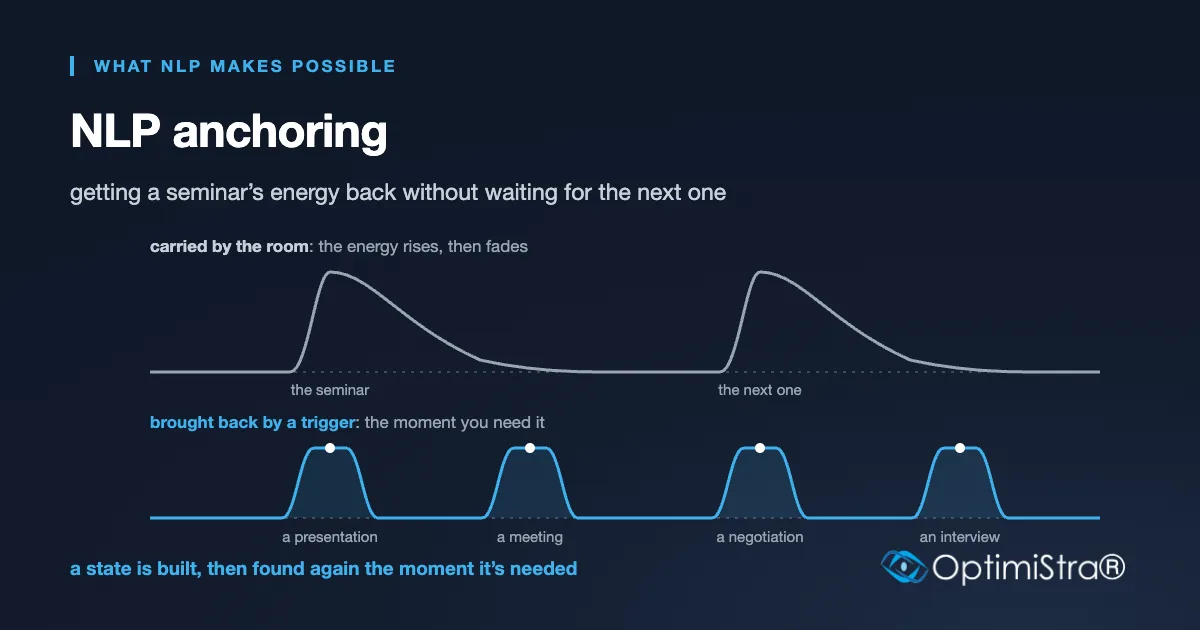
After a motivational seminar, the energy fades: what NLP anchoring changes
A motivational seminar produces real energy, and it often fades within a few weeks because it stays attached to the room. Elite athletes learn to bring back the state they need on their own, with a chosen trigger such as Florent Manaudou’s word “puissance.” NLP calls this an anchor, and it can be learned.
November 18, 2026 · 14 min read
What NLP Makes Possible
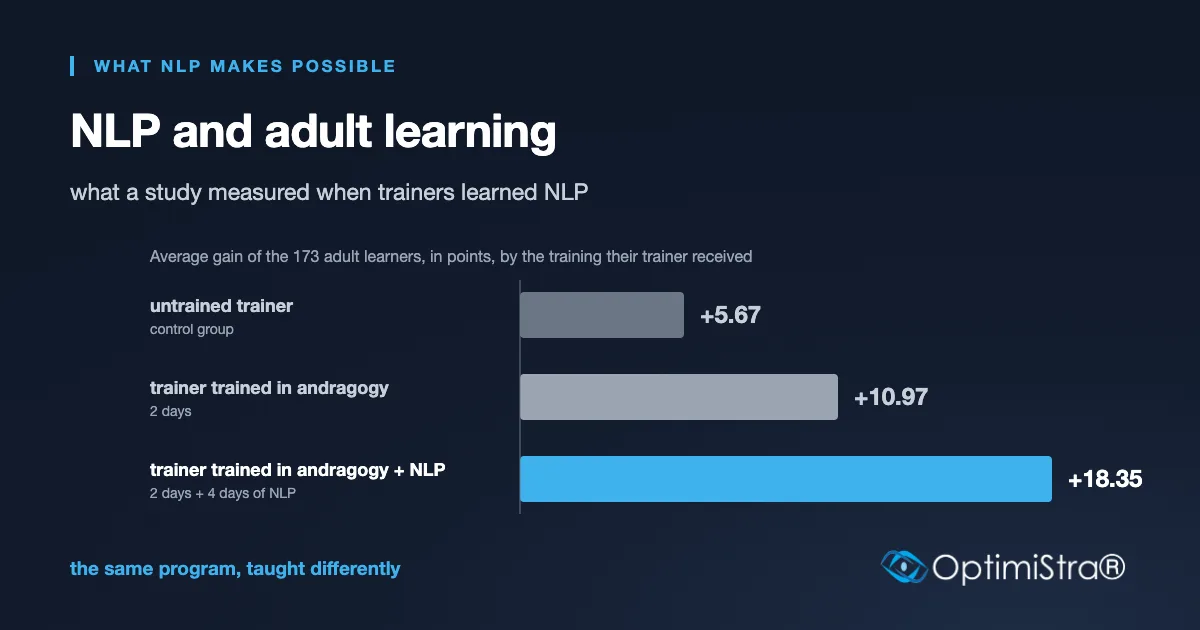
NLP and adult learning: what a study measured in 173 adult learners
In 2012, a study in England randomly assigned 24 trainers of adults to three groups. Learners whose trainer had taken 4 days of Neuro-Linguistic Programming (NLP) on top of a course in andragogy improved by 18.35 points, compared with 10.97 when the trainer had taken andragogy alone. Research on expectations, relationships, and stress helps explain the gap.
November 18, 2026 · 15 min read

What NLP Makes Possible
Developers in the age of AI: what decides who gets the contract
AI now resolves almost all the tickets in a benchmark test, and the market for developers has tightened. What decides who gets the contract increasingly lies in the relationship with the client and in the state you are in under pressure. These human skills can be trained, and Neuro-Linguistic Programming (NLP) works on them through three pillars.
November 18, 2026 · 11 min read