How to take back control of your emotional reactions

Published November 18, 2026 · 5 min read
In brief
Losing your composure at a passing remark comes down to an inner state that was not brought back under control in time. That control is learned, at any age and from any starting point, and the earlier you put your hands back on the wheel, the simpler the change of course.
Someone makes a remark. It may be a perfectly ordinary sentence. Within a second, you lose your composure. Or worse: you hear yourself answer in a voice that isn’t yours, with a sharpness you don’t recognize in yourself. Once the door has closed, one question keeps going round: “Why did I react like that?”
If that has ever happened to you, you’re in the right place, because it is neither a character flaw nor something you have to live with. It is simply a steering wheel you let go of for a moment. And that wheel is physical first: Nummenmaa, Glerean, Hari and Hietanen have mapped where each emotion is felt in the body.
What could be worse than being at the mercy of your surroundings?
Ask yourself the question honestly. What could be worse than feeling at the mercy of whatever is happening around you?
One clumsy word and you’re thrown off balance. A remark and your temper rises, a silence and you read the worst into it. In those moments, you’re no longer the one deciding what state you’re in: the outside world decides for you.
We tend to call this “being reactive,” “being on edge” or “being too sensitive.” None of those labels says what is really going on. The truth is simpler and more mechanical: it is a lapse in control over your inner state. Nothing more. And what is mechanical can be repaired.
The car, the steering wheel and the rough ground
There is an image I like, because it describes exactly what is at play.
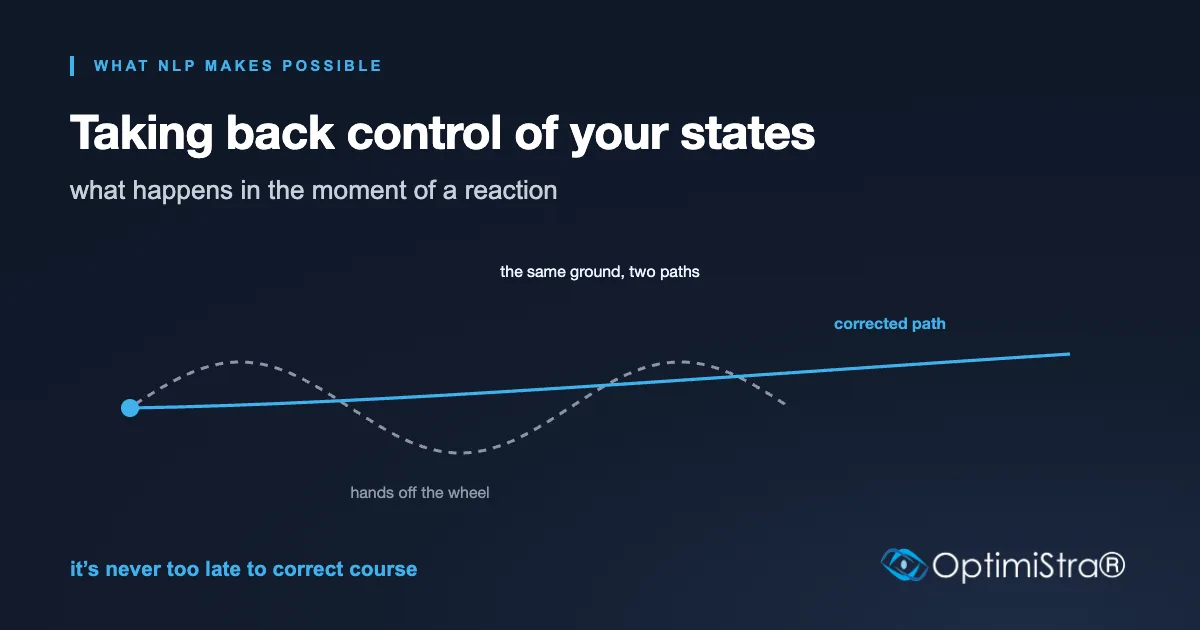
Imagine that your surroundings are a stretch of rough ground. Not a smooth motorway: a piece of waste ground, with bumps, holes, stones and slopes. That is what our days are really like, with their surprises, remarks, tensions and annoyances.
Now ask yourself this: what happens if you drive across that ground without holding the wheel?
The smallest stone changes your direction. The smallest hole pushes you off course, and the slightest slope sends you somewhere else, rarely where you meant to go. You’re no longer driving forward, you’re being thrown about. Everything outside you sets your course for you.
That is exactly what happens when you’re not in command of how you function on the inside. You no longer choose your road. You take the one that events impose on you.
The trajectory nobody sees coming
Here is the trap: as long as you’re not holding the wheel, you can’t expect to follow a consistent course.
Sometimes, by luck, the ground sends you back in the right direction, and you tell yourself that all is well, that you’re coping. At other times the same ground sends you straight toward the ravine. And as long as your hands aren’t on the wheel, there is nothing you can do to avoid it.
This is precisely what happens before a burnout. People don’t collapse overnight. They drift, gently, kilometer after kilometer, without having taken back control, until the trajectory becomes irreversible.
The real problem is almost never the ravine itself. The real problem is having waited too long to put your hands back on the wheel. Arnsten’s work explains why: under prolonged stress, the prefrontal cortex loses precisely the resources that the correction would need.
There is always time to correct your course
And here I want to be very clear, because this point changes almost everything.
You may have communicated badly for 20 years. You may have handled your inner states badly all your life, or believe you have “always been like this.” There is still time to do something about it.
When someone is on the edge of burnout, a few meters from the ravine, there is still some room left. If at that precise moment they take the wheel again and turn it in the right place and in the right way, they can avoid the ravine. Not by magic, by taking back control.
That is the underlying message of Neuro-Linguistic Programming (NLP) applied to your states: you don’t have to wait until you have reached rock bottom. The correction is possible long before that. It is even possible now.
Taking back control, or learning it for the first time
The aim here is twofold. For many people, it is a matter of taking back control of their inner states: recovering a command they had without knowing it, and that they let slip away under pressure.
It should also be said honestly that some people have never had that control. It is no fault of theirs: nobody taught them. They were taught to read, to count and to drive a car, and never to drive what goes on inside them.
For them, there is nothing to take back. It is a matter of learning, for the very first time, to take the wheel. Webb, Miles and Sheeran compared these ways of learning across 300 experiments, and some work markedly better than others. That is excellent news, because what has never been learned can always be learned, at any age and whatever the starting point.
What now?
You may not have held this wheel for a long time, or perhaps ever. In both cases, what comes next begins with the same thing: understanding in practical terms how you learn to manage your inner states. One point is worth knowing: Nolen-Hoeksema, Wisco and Lyubomirsky show that going over the episode again and again is not a way of taking back control, it is the opposite.
Further reading
If what you have just read speaks to you, the next steps are why we stop thinking clearly in the grip of a strong emotion, naming the sensation before the word, changing a thought pattern and the three pillars of NLP.
Article designed and written by Michel Wozniak, and optimized by artificial intelligence. Illustration created by artificial intelligence.
Sources
- Nummenmaa, Glerean, Hari & Hietanen (2014), Bodily maps of emotions, Proceedings of the National Academy of Sciences
- Arnsten (2009), Stress signalling pathways that impair prefrontal cortex structure and function, Nature Reviews Neuroscience
- Webb, Miles & Sheeran (2012), Dealing with feeling: A meta-analysis of the effectiveness of strategies derived from the process model of emotion regulation, Psychological Bulletin
- Nolen-Hoeksema, Wisco & Lyubomirsky (2008), Rethinking Rumination, Perspectives on Psychological Science
Frequently asked questions
Is losing my composure just part of my personality?
No. Losing your composure at a remark or in a tense moment is not a trait set in stone. It is the result of an inner state that was not under control in the moment. What sets itself off automatically is something you can learn to regulate.
Do I have to be close to burnout for this work to be useful?
Quite the opposite. The earlier you put your hands back on the wheel, the simpler the correction. If you wait until you’re a few meters from the ravine, turning the wheel is still possible, and it is a much tighter turn.
How is this different from therapy?
It is not about digging into the past. It is about learning to take back control of your inner trajectory, here and now. It is a matter of steering your states, not of receiving care.
What if I have never been able to manage my reactions?
Then it is not a matter of getting something back, it is a matter of acquiring it. It is a skill like any other and, like any skill, it can be learned at any point in life.
Where do I start when the reaction is already under way?
With the body, before the discussion. A strong emotion first takes over physically, and coming back to calm frees up what you need in order to reason. Only then comes the question of what you wanted to say, and it is much easier to answer.
What NLP Makes Possible
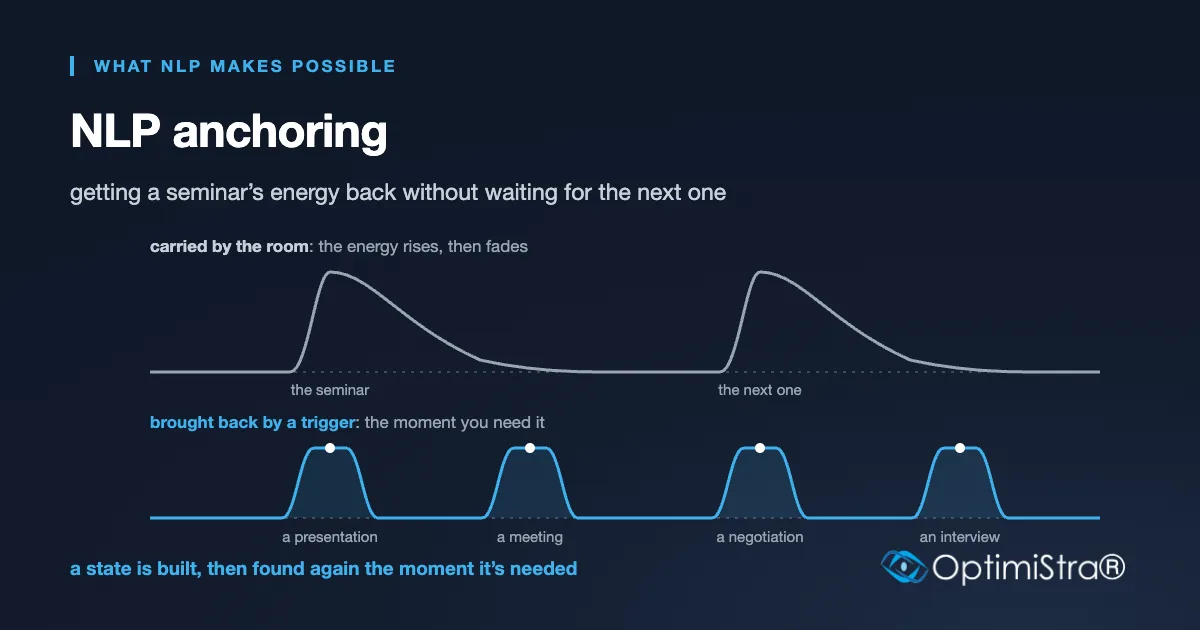
After a motivational seminar, the energy fades: what NLP anchoring changes
A motivational seminar produces real energy, and it often fades within a few weeks because it stays attached to the room. Elite athletes learn to bring back the state they need on their own, with a chosen trigger such as Florent Manaudou’s word “puissance.” NLP calls this an anchor, and it can be learned.
November 18, 2026 · 14 min read
What NLP Makes Possible
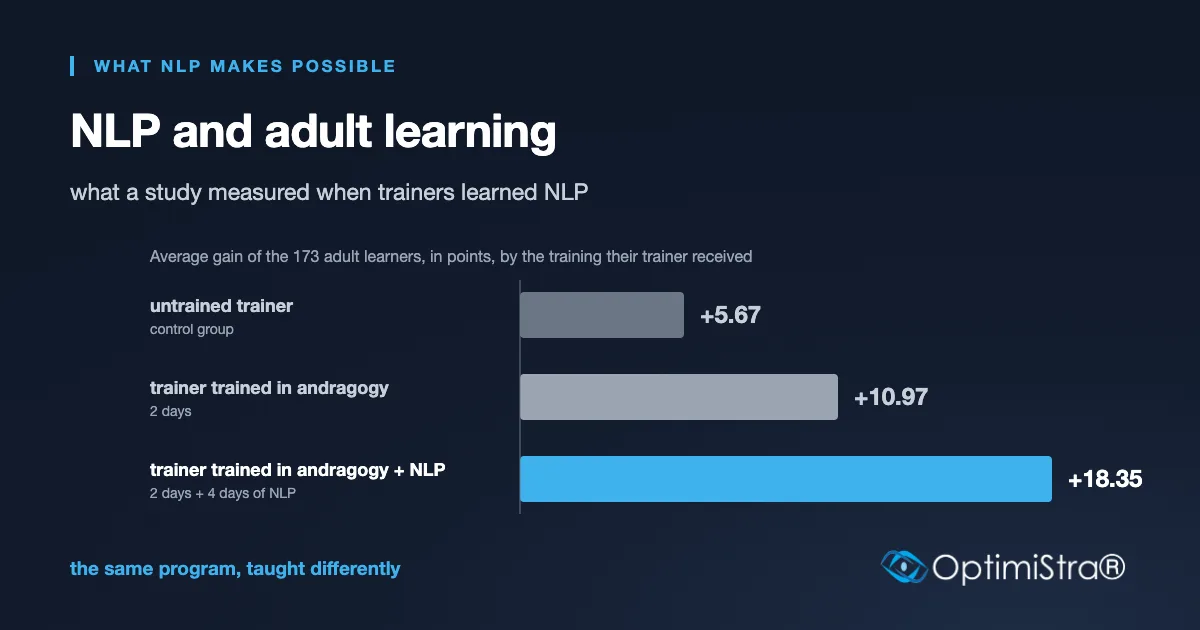
NLP and adult learning: what a study measured in 173 adult learners
In 2012, a study in England randomly assigned 24 trainers of adults to three groups. Learners whose trainer had taken 4 days of Neuro-Linguistic Programming (NLP) on top of a course in andragogy improved by 18.35 points, compared with 10.97 when the trainer had taken andragogy alone. Research on expectations, relationships, and stress helps explain the gap.
November 18, 2026 · 15 min read
What NLP Makes Possible
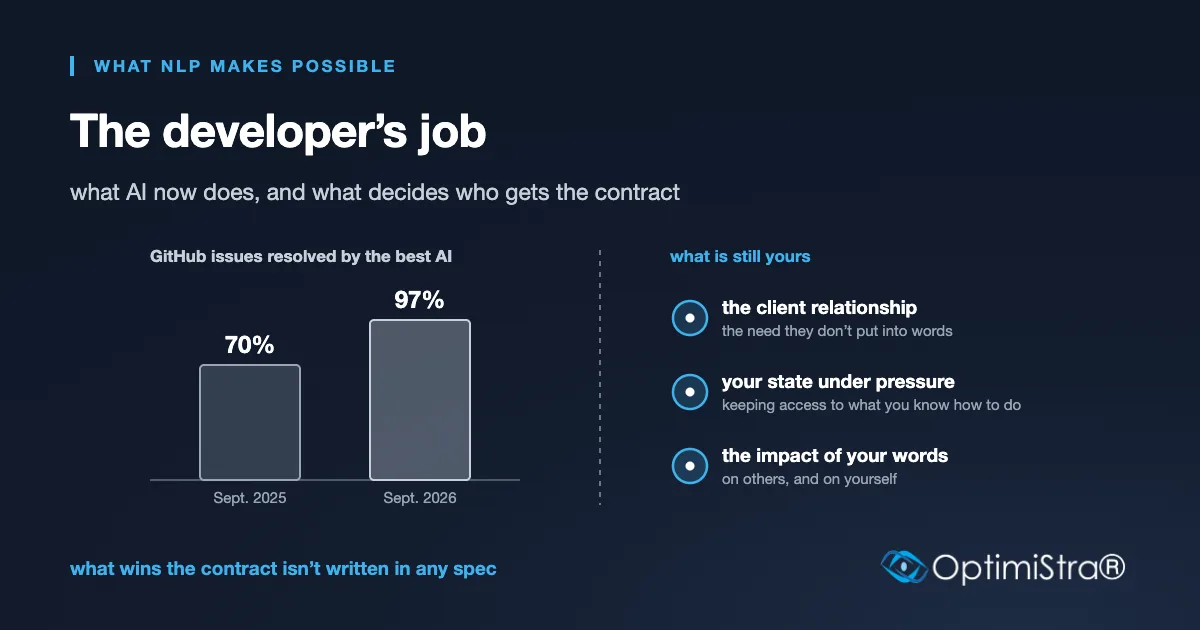
Developers in the age of AI: what decides who gets the contract
AI now resolves almost all the tickets in a benchmark test, and the market for developers has tightened. What decides who gets the contract increasingly lies in the relationship with the client and in the state you are in under pressure. These human skills can be trained, and Neuro-Linguistic Programming (NLP) works on them through three pillars.
November 18, 2026 · 11 min read