An emotion starts in the body: naming the sensation before the emotion


Michel Wozniak and Nathalie de Marcé
Published November 18, 2026 · 8 min read
In brief
An emotion is a physical reaction set off by how you interpret an event, not by the event itself. The body moves first and the word comes later. Naming the sensation before the emotion takes 10 seconds. Here is what the research establishes, and the three precise points where it stops.
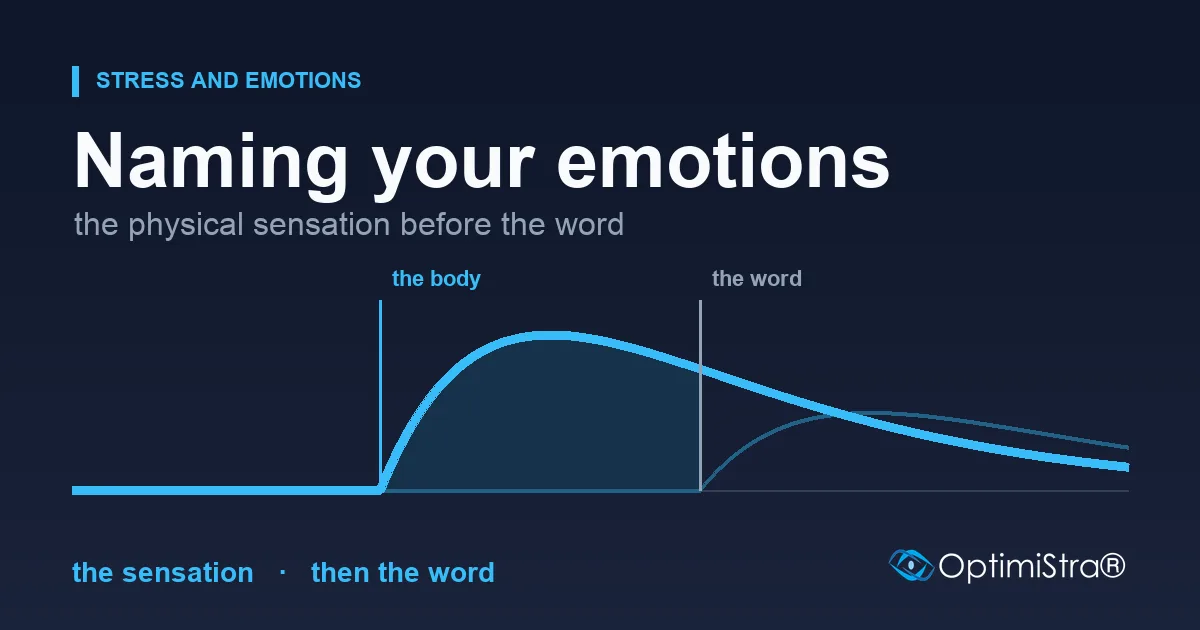
Between the moment something happens and the moment you could say what you feel, there is a brief gap. In that gap your body has already been at work: your throat has tightened, your shoulders have risen, warmth has passed across your face. The word comes afterward, and it comes from you.
That gap can be measured, it is documented, and it opens the way to something very simple to do: say the sensation before you say the emotion.
What an emotion is
An emotion is a set of changes in the body (heart rate, breathing, muscle tension, skin temperature, digestive activity), together with the meaning the brain gives them. So it begins in the body before it begins in thought.
What matters is the trigger, which is the interpretation of the event rather than the event itself. Two people facing the same scene do not react in the same way, and the same person does not react to it in the same way at two points in their life. What has changed in between is what the brain makes of the scene.
The brain learned that interpretation. It has a history: something lived through, something heard again and again, an image received at the wrong moment. It can settle in within a fraction of a second and last 30 years, without the person ever knowing what put it there.
What 700 people drew on a silhouette
In 2014 a Finnish team published a remarkably elegant experiment in the Proceedings of the National Academy of Sciences. Participants were shown two blank human silhouettes, then an emotion word (or a story, a film, a face), and were asked to color the regions of the body where they felt activity increasing on the first silhouette and decreasing on the second.
There were 701 participants across five experiments. The maps they produced are statistically separable from one emotion to the next: a classifier can recover the emotion from the bodily topography alone, well above chance. With the stories, it tells one emotion from all the others in 79% of cases where chance would give 50%, and it picks correctly among the seven categories tested in 48% of cases where chance would give 14%.
Above all, the maps look alike from one country to another. The authors ran the experiment again with Swedish speakers, then with Taiwanese speakers, whose language and culture have nothing in common with Finnish. Agreement between Finland and Taiwan reaches a mean correlation of 0.70, comfortably above the usual threshold for what is called strong agreement.
In other words, when you say “my throat is tight,” you are not only using a figure of speech. You are pointing to a place that people on the other side of the world point to as well.
Why the reaction is to a perception, not to the event
The theoretical framework that accounts for this sequence is that of construction. In a review article published in 2017, Lisa Feldman Barrett puts it this way: the brain uses emotion concepts to categorize sensations, and that categorization is what makes up an instance of emotion. Sensations are sorted so as to be actionable and therefore meaningful, on the basis of past experience.
An image helps here. A GPS does not see the road: it calculates from what it has stored, which is why it can tell you to turn right where there is no longer a street. Your brain works in the same way: it does not react to the event, it reacts to what the event resembles, going by everything it has already seen.
That is why the reaction can be learned. A small child lifted up at arm’s length bursts out laughing: they do not yet have the map for the empty space beneath them. The adult who takes a step back at the edge of a terrace has the same bodily machinery, and a different map.
One point in the interest of honesty, because it matters on a subject this debated: this framework is not a consensus. It was published in a section devoted to scientific debate, set against the classic position that certain emotions have a biological signature of their own. We cite it because it accounts for the order observed, not because the question is settled.
What naming does
That leaves the question of what the act of naming itself changes. A series of four experiments carried out at the University of California, Los Angeles, and published in 2011 set out to answer it. The first three compare several ways of getting through an unpleasant image: looking at it passively, choosing a word for it, trying to reappraise it, or distracting yourself.
Participants who named what they saw reported less distress than those who simply looked, and to a degree comparable with deliberate reappraisal, which is a far more demanding mental effort.
The most curious result lies elsewhere. Participants were asked to predict how it would feel. They predicted that naming would be more unpleasant. And they still predicted it after going through the experiment, even though their own ratings said the opposite. The authors conclude that putting feelings into words acts as incidental regulation: it works without your feeling it work, and so without your thinking to use it.
A fourth study, using pleasant images, brings the most useful practical nuance in this whole body of work: naming reduced the pleasure reported. Putting things into words turns the volume down in both directions. With what is good, then, you gain by feeling without commenting.
What the research does not establish
There are three limits, and you need to know them to make proper use of everything above.
There is no bodily signature for each emotion. This is the point that calls for the most precision. A meta-analysis of 202 studies measuring autonomic nervous system reactivity during laboratory emotion inductions, published in 2018, concludes that the pattern of effect sizes does not clearly distinguish one emotion category from another. Variability within a single category is substantial (more than half the effect sizes show moderate to high heterogeneity), and correcting for publication bias lowers the estimates further. The authors themselves point out that their ability to test their hypothesis directly remains limited by the studies available.
The direct consequence for you: a sensation will not tell you which emotion it is. It will tell you that something is happening, and sooner than the word does. That is already a great deal, and it is not a diagnosis.
The body maps are reported feelings. Participants colored what they felt, not what a sensor measured. The authors acknowledge this explicitly: their study cannot completely rule out that the maps reflect conceptual associations between emotions and bodily sensations. They add a sentence you would not expect from them: individuals are poor at detecting their specific physiological states, beyond perhaps their heartbeat and the dampness of their palms.
The effects of naming were measured in the laboratory, on small groups. Each study involved between 22 and 46 students, looking at projected images in a university building. That is not a week of ordinary life, and no one has measured what happens when you do this three times in a corridor.
We would rather say so. The exercise below is free, takes 10 seconds and carries no known risk. That is why it is worth trying, not because a study guarantees it.
The full protocol
- Three times in the week, when something makes you react.
- One place in the body, and one sensation. “Warm in the neck.” “Shoulders rising.” “A hollow stomach.” Two words are enough. You are not looking for the right term, you are looking for the place.
- The name of the emotion next, if it comes. If it doesn’t, the exercise has still taken place: it is about the order, not about accuracy.
- On small occasions. A minor hitch, a wait that drags on, an unexpected message. This is not an exercise for big emotions, and there is nothing to fix.
- With what is pleasant, feel without commenting. This follows directly from the fourth study described above.
- Three lines on a piece of paper at the end of the week: the sensation, then the word. You will see which ones come back, and it will be your list, not an average.
One caveat to finish. This exercise is for ordinary moments. If you are going through a difficult period, or if an emotion feels too strong to be simply observed, no blog page replaces proper support: talk to a professional.
Where this technique fits
Noticing what the body does before naming it is the second step in our progression on inner states, after the steady breathing described in our article on coherent breathing. The order is not arbitrary: the first teaches you to act on your state, the second to read it. The other articles are gathered on the blog.
Both steps also lay the groundwork for our Neuro-Linguistic Programming (NLP) courses, where several protocols assume you can already notice what is moving in your body before you know what to call it.
Article written by Michel Wozniak and Nathalie de Marcé, and optimized by artificial intelligence.
Sources
- Nummenmaa, Glerean, Hari & Hietanen (2014), Bodily maps of emotions, Proceedings of the National Academy of Sciences
- Barrett (2017), The theory of constructed emotion: an active inference account of interoception and categorization, Social Cognitive and Affective Neuroscience
- Lieberman, Inagaki, Tabibnia & Crockett (2011), Subjective responses to emotional stimuli during labeling, reappraisal, and distraction, Emotion
- Siegel et al. (2018), Emotion fingerprints or emotion populations ? A meta-analytic investigation of autonomic features of emotion categories, Psychological Bulletin
Frequently asked questions
What exactly is an emotion?
An emotion is a set of bodily changes (heart rate, breathing, muscle tension, skin temperature) together with the meaning the brain gives them. The trigger is not the event itself. It is the way the brain interprets the event, based on everything it has already encountered. That is why two people react differently to the same situation.
Should I name the sensation or the emotion?
Both, in that order. The sensation first: a place in the body and a simple word, such as “warm in the neck” or “a hollow stomach.” The name of the emotion next, if it comes. Starting with the name skips the step where the information is most reliable: what the body actually did.
Does putting a name to an emotion make it go away?
No. In a series of experiments at the University of California, Los Angeles, participants who named what they were looking at reported less distress than those who looked passively, to a degree comparable with deliberate reappraisal. The effect is real and moderate. It was measured in the laboratory on small groups of students, and it removes nothing.
Does each emotion have its own signature in the body?
No, and this is a point that calls for precision. A meta-analysis of 202 studies published in 2018 found no pattern of autonomic nervous system reactivity that cleanly distinguishes one emotion category from another. A bodily sensation tells you that something is happening. It does not tell you which emotion it is.
What if no word comes to mind?
That is not a failure. The exercise is about the order, not about getting the vocabulary right. Noticing the place (the throat, the shoulders, the stomach) is enough to do the work. The word usually comes by itself after a few days, and it tends to be more accurate than if you had looked for it first.
Stress and Emotions
Physical signs of stress: what the body shows, and how much of it we notice
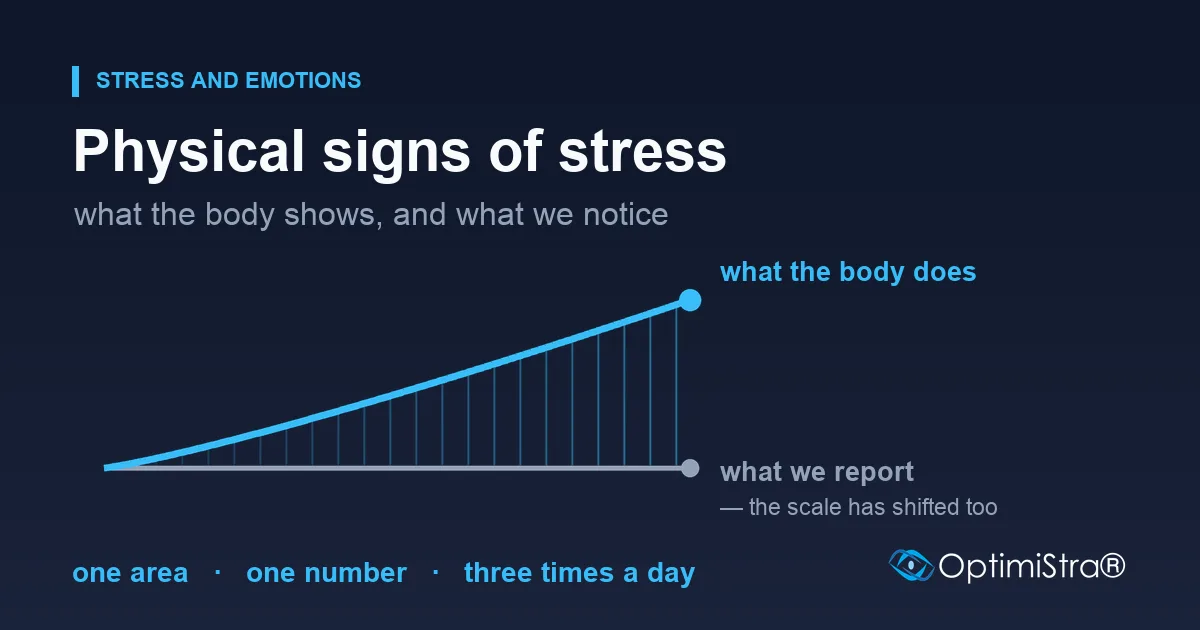
Under stress, the jaw muscles work harder: 38 studies show it. Yet what people report about their own tension from memory has almost nothing to do with what they notice when asked in the moment. And their point of comparison shifts along with them.
November 18, 2026 · 9 min read
Stress and Emotions
Evening routine: what the night does with your last 10 minutes
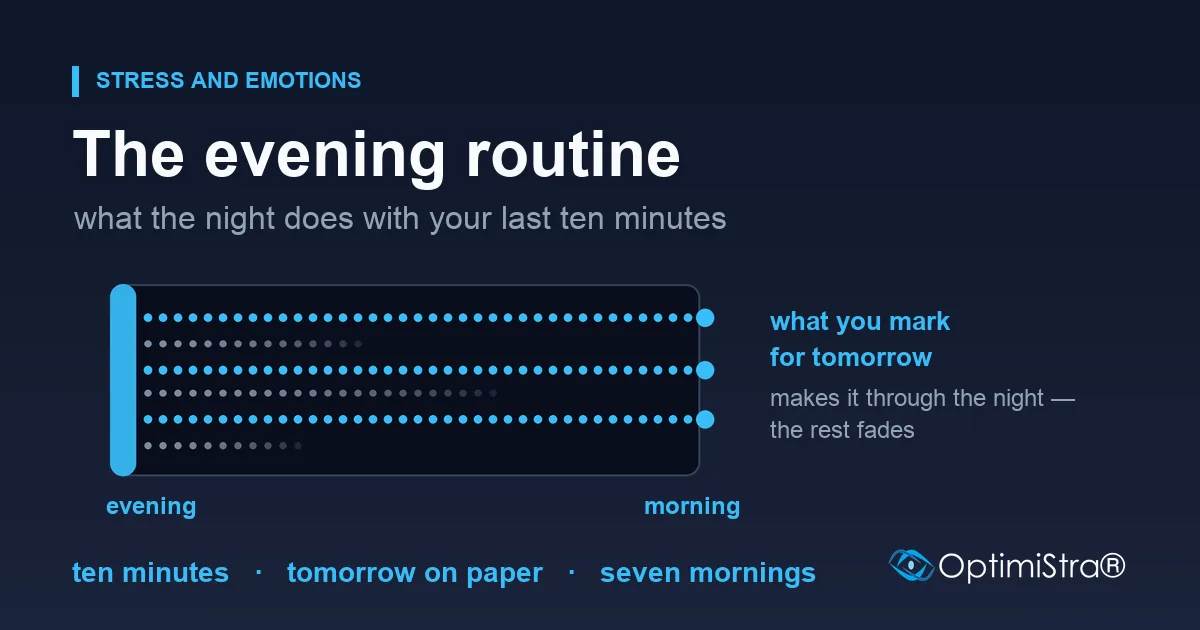
During sleep, the brain replays and consolidates what the day left behind, and it is selective: what has been marked as useful for tomorrow gets through, the rest far less. The best-measured evening habit is not positive thinking. It is writing tomorrow’s to-do list, in detail.
November 18, 2026 · 10 min read
Stress and Emotions
Reliving a happy memory from the inside: what it does, and what we know
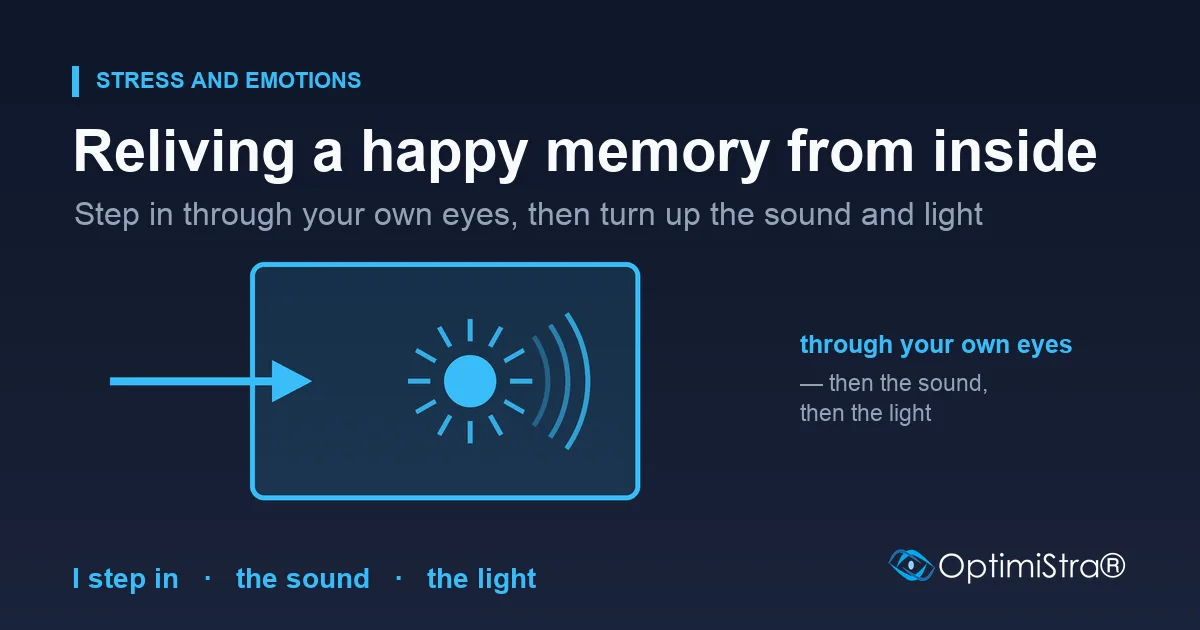
Reliving a happy memory from the inside means going back into it through your own eyes, with its sounds and sensations. In the lab, recalling positive memories after a brief stressor limited the rise in cortisol, and thinking in images does more than thinking in words. The effect is modest and no substitute for care.
November 18, 2026 · 5 min read