Physical signs of stress: what the body shows, and how much of it we notice


Michel Wozniak and Nathalie de Marcé
Published November 18, 2026 · 9 min read
In brief
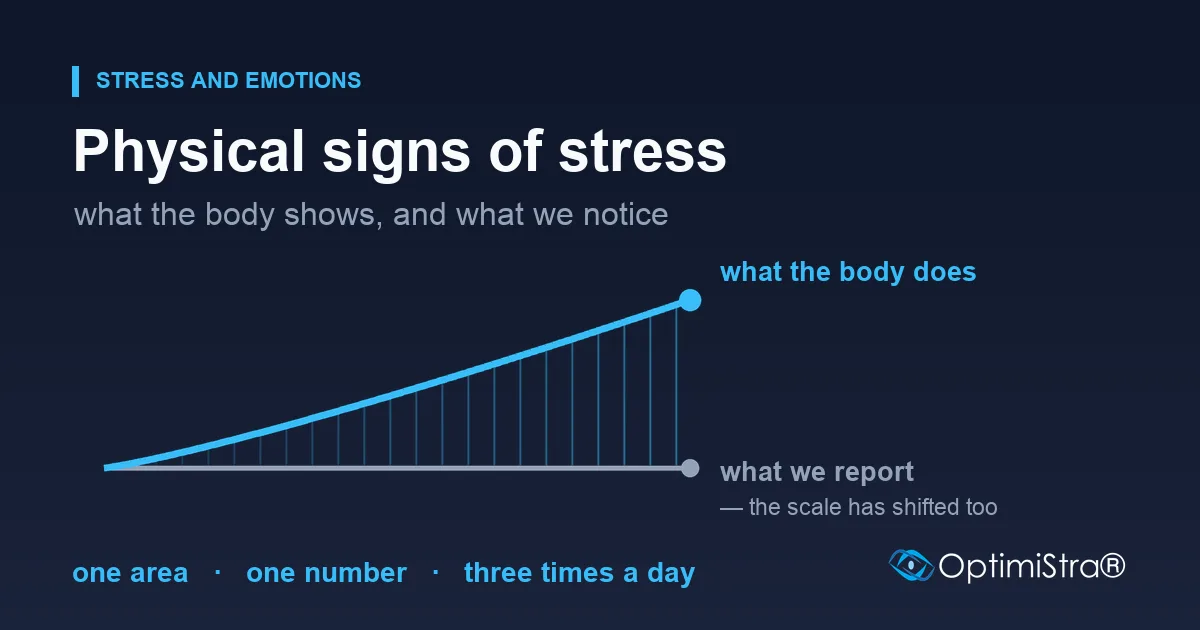
Under stress, the jaw muscles work harder: 38 studies show it. Yet what people report about their own tension from memory has almost nothing to do with what they notice when asked in the moment. And their point of comparison shifts along with them.
“Listen to your body.” The advice is everywhere, and it rests on something real: the physical signs of stress exist, they can be measured, and the body produces them before you have finished thinking about what set them off. The advice also assumes something that is far less certain: that we are good readers of our own signals.
On that second point the research is at its most instructive, and its least comfortable. The studies discussed here don’t say we are deaf to our bodies. They say something more precise, and more useful: what we believe we know about our own tension has almost nothing to do with what we notice when someone asks us in the moment. And the scale we measure on shifts along with us.
What we mean here by physical signs of stress
Not symptoms, and not a diagnosis. The physical signs of stress are measurable changes in the body that go with a demanding situation: the heart speeds up, breathing moves up into the chest, digestion slows down, and above all, because that is where it shows most clearly, muscles contract without being asked to. The jaw, the neck, the shoulders, the stomach.
These reactions are not malfunctions. They are part of a useful response, whose chemical fuel we describe in our article on stress hormones. The problem is never the reaction itself. It is how long it lasts and how often it comes back, as we explain in our article on acute and chronic stress.
The question here sits even further upstream, and it is rarely asked: do we notice?
What the body does, and what we know how to measure
The jaw is the best-documented case of all, for a practical reason: it is the one researchers know how to record cleanly. Two electrodes go on the masseter or the temporalis, the participant is given an unpleasant task, such as mental arithmetic against the clock or a speed test that cannot be passed, and the muscle’s electrical activity is read.
A scoping review published in 2026 in the Journal of Oral & Facial Pain and Headache gathered everything published on this protocol between 1971 and 2025: 38 studies, of which 29 were clinical experiments, three were cross-sectional studies, and six were preclinical. The result is clear. The authors write that 25 of the 29 clinical experiments reported an increase in the electrical activity of the chewing muscles under psychological stress, and that all of the cross-sectional and preclinical studies point the same way.
They immediately add a caveat, and it is worth reading: “some caution is warranted given the paucity of manipulation checks in the included studies.” Half of the experiments did not check that the frustration they had set up had actually produced stress. Of the four studies that found no increase, two did not monitor the participants’ state at all.
So the muscle is working. What remains to be seen is how much the person knows about it.
What we notice: the in-the-moment report versus the memory
This is where the most interesting study comes in, and it looked at an ordinary habit: clenching your teeth during the day, which dentists call awake bruxism.
In 2021, an Israeli and Italian team published a direct comparison between two ways of measuring that habit in the Journal of Clinical Medicine. First, 106 dental students filled out a standard questionnaire: do you clench your teeth during the day, do you grind them, do you brace your jaw? Then they installed an app that sent them 20 alerts a day, at random intervals, for 7 days. Each alert asked a single question: your jaw, right now?
The picture those in-the-moment reports give is instructive in itself. Muscles relaxed in 59.7% of cases; teeth in contact in 20.2%; jaw braced in 13.7%; teeth clenched in 5.7%; grinding in 0.6%. In other words, 4 times out of 10, the jaws of these healthy young adults were doing something.
The real finding lies elsewhere. The questionnaire answers barely predict the in-the-moment reports. The correlations are weak: −0.297 for relaxed muscles, 0.220 for bracing, 0.225 for clenching. For teeth in contact and for grinding, the authors simply write that no correlation could be observed. The questionnaire’s ability to tell people apart, measured by the area under the ROC curve, tops out at around 0.66: above chance, and a long way from a reliable instrument.
These are the same people, a few days apart, answering on the same subject. The only thing that changes is when the question is asked.
The point of comparison moves with you
One difficulty remains, and it is the deepest one. Even when you record correctly in the moment, you are writing a number on a scale, and that scale belongs to the person using it.
Quality-of-life research has a name for this and has been studying it for 30 years: response shift. The idea is simple. If a person’s understanding of what they are being asked changes between two measurements, then comparing the two amounts, as Steven McPhail and Terry Haines write, to comparing “the proverbial apple and orange.”
Their study, published in 2010 in Health and Quality of Life Outcomes, gives a demonstration that is hard to forget. It involved 103 hospital patients, average age 73, after a stay of about 40 days. On the day they were discharged, they were asked three things: how they were now; how, looking back, they thought they had been on arrival; and finally what score they believed they had given on arrival.
That third question is the one that produces the result. The gap between the change they perceived and the change actually recorded was clinically significant in 84 of the 101 participants, or 83.2%. Once corrected by what they believed they had answered, that figure falls to 8 participants, or 7.9%. On the visual scale, they judged that they had improved by 26.7 points when the questionnaires recorded 9.3.
Nobody had lied. Their memory of their own score had drifted, and it had drifted toward their present state.
This is exactly the mechanism that makes self-observation fragile when stress has settled in. Tension that rises slowly moves the reference point as it rises. The 2 you write down today is honest; it is simply no longer the 2 of 3 years ago.
Recording changes what it measures
One last finding, and it cuts both ways.
The study that developed this alert protocol, published in 2019 in Frontiers in Neurology, followed 30 students with 15 alerts a day for a week, then did it again a month later with the same people. Between the two weeks, the share of relaxed jaws went from 62% to 74%, and teeth in contact from 20% to 11%.
The authors offer an explanation, and they present it as a hypothesis: “being asked about a behavior in close contextual and temporal proximity to its occurrence draws one individual’s attention toward the behavior, thereby promoting self-awareness.” Being asked about a habit at the very moment you are doing it draws your attention to it, and attention alone is sometimes enough to undo it.
For anyone who wants to feel better, that is good news. For anyone who wants to measure themselves, it is a limit: a record that changes what it measures is not a measurement. Both things are true at once, and it is better to know that before you start than to be surprised by it afterward.
What these studies do not establish
On a subject where claims travel quickly, it is worth saying what these four studies do not say.
They do not compare a perception with an instrument reading. In the awake bruxism study, both sides of the comparison are self-reports: a questionnaire on one side, immediate answers on the other. The authors note this themselves as a limitation. What is shown is that we remember poorly, not that we sense poorly.
They rely on small samples and narrow populations. There were 30 students in one case and 106 in the other, all young and all healthy; the authors of the first write explicitly that these data “do not allow any generalization due the unrepresentativeness of the study population.” The response shift study covers older hospital patients, a single instrument, and a single domain.
The link between muscle tension and felt stress is still debated, and the 2026 review puts its finger on this with a remark that applies to the whole subject: “perceived tension” can serve as an indicator of psychological stress, yet it may reflect the physical consequences of a situation more than the presence of stress itself. For that reason, the authors write, it is a less robust psychometric measure.
Finally, none of this says that a week of self-observation reveals anything about a person’s health. None of these studies tested that, and that is reason enough not to claim it.
What you can do with this in practice
These studies leave three solid findings and one practical consequence.
The solid findings: the body responds to a demanding situation with muscle contractions that can be recorded; what a person says about their own tension from memory is only very weakly linked to what they notice when asked in the moment; and the memory we keep of our own rating drifts with our present state.
The practical consequence comes down to three rules.
Record in the moment, not from memory. Choose one area of the body in advance, keep the same one all week, and rate it from 0 to 5 at three fixed times of day. Five seconds, one number.
Don’t comment. It is the same discipline of observation we suggest for naming a sensation before naming the emotion: you note, you don’t interpret, and above all you don’t look for the cause. Looking for a cause turns ordinary tension into a symptom, and it is the shortest route to monitoring yourself constantly.
And ask someone. This is the most counterintuitive point, and the one the data support best. Since the point of comparison drifts with the person, the only one that has not drifted lies outside them. Show your numbers, and only the numbers, to someone who knows you well, and ask what they notice from the outside: your posture, how fast you speak, your pace. Listen first.
What this record does not replace is medical advice. Tension that persists, gets worse, or comes with pain is a matter for a doctor, not for an observation exercise, and jaw pain in particular has its own dedicated forms of care.
If the exercise makes you want to do something with what you notice, two of our articles lend themselves to it directly: coherent breathing, the simplest way to come back down in 5 minutes, and the evening routine, for what the end of the day hands over to the night. Do it after the week of observation, though, not during: you cannot measure and correct at the same time.
Article written by Michel Wozniak and Nathalie de Marcé, and optimized by artificial intelligence.
Sources
- Weden, Koutris & van der Meer (2026), The effect of psychological stress on masticatory muscle electromyography — a scoping review, Journal of Oral & Facial Pain and Headache
- Emodi-Perlman, Manfredini, Shalev, Yevdayev, Friedman-Rubin, Bracci, Arnias-Winocur & Eli (2021), Awake Bruxism — Single-Point Self-Report versus Ecological Momentary Assessment, Journal of Clinical Medicine
- McPhail & Haines (2010), Response shift, recall bias and their effect on measuring change in health-related quality of life amongst older hospital patients, Health and Quality of Life Outcomes
- Zani, Lobbezoo, Bracci, Ahlberg & Manfredini (2019), Ecological Momentary Assessment and Intervention Principles for the Study of Awake Bruxism Behaviors, Part 1, Frontiers in Neurology
Frequently asked questions
What are the physical signs of stress?
The best documented are muscular. A review published in 2026 in the Journal of Oral & Facial Pain and Headache gathered 38 studies on the jaw: 25 of the 29 clinical experiments report an increase in the electrical activity of the chewing muscles under psychological stress. The heart, breathing, and digestion react too, but the jaw is the case researchers record best. The review’s authors still call for caution: half of the experiments did not check that the frustration they set up had actually produced stress.
Can you trust what you feel in your own body?
Not when you answer from memory. In a study published in 2021, 106 students filled out a questionnaire about how they clench their teeth during the day, then were asked 20 times a day for a week about the state of their jaw at that instant. The correlations between the two range from 0.22 to 0.30, and there is none for teeth in contact. Note that both measures are self-reports. What is shown is that we remember poorly, not that we sense poorly.
Why record tension in the moment instead of at the end of the week?
Because a memory of your own state is not a record, it is a reconstruction. Steven McPhail and Terry Haines asked 103 hospital patients, on the day they were discharged, what score they believed they had given themselves on arrival: for 83.2% of them, the gap with the score actually written down was enough to change the conclusion. Recording in the moment takes that reconstruction out of the equation.
Why ask someone else what they notice about you?
Because the scale you rate yourself on is calibrated on you, and it moves with the state it measures. Quality-of-life research calls this response shift. An outside point of comparison has not drifted. The question to ask is about what can be seen, such as posture, speed of speech, and pace, not about a state the other person would have to guess.
Does tracking your muscle tension change anything?
Perhaps, and it cuts both ways. Thirty students followed for a week, then again a month later, had a relaxed jaw in 74% of reports, up from 62% the first time. The authors put forward the hypothesis that paying attention to a habit at the moment you are doing it is enough to change it. That is good news if you want to feel better, and a limit if you want to measure yourself.
Stress and Emotions
An emotion starts in the body: naming the sensation before the emotion
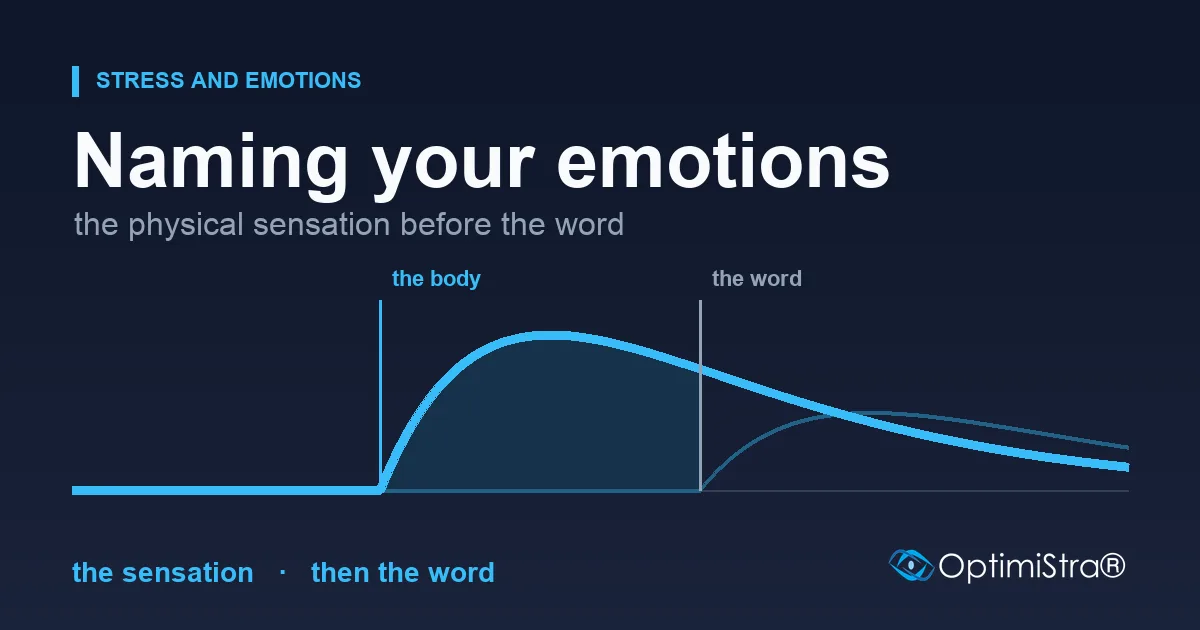
An emotion is a physical reaction set off by how you interpret an event, not by the event itself. The body moves first and the word comes later. Naming the sensation before the emotion takes 10 seconds. Here is what the research establishes, and the three precise points where it stops.
November 18, 2026 · 8 min read
Stress and Emotions
Evening routine: what the night does with your last 10 minutes
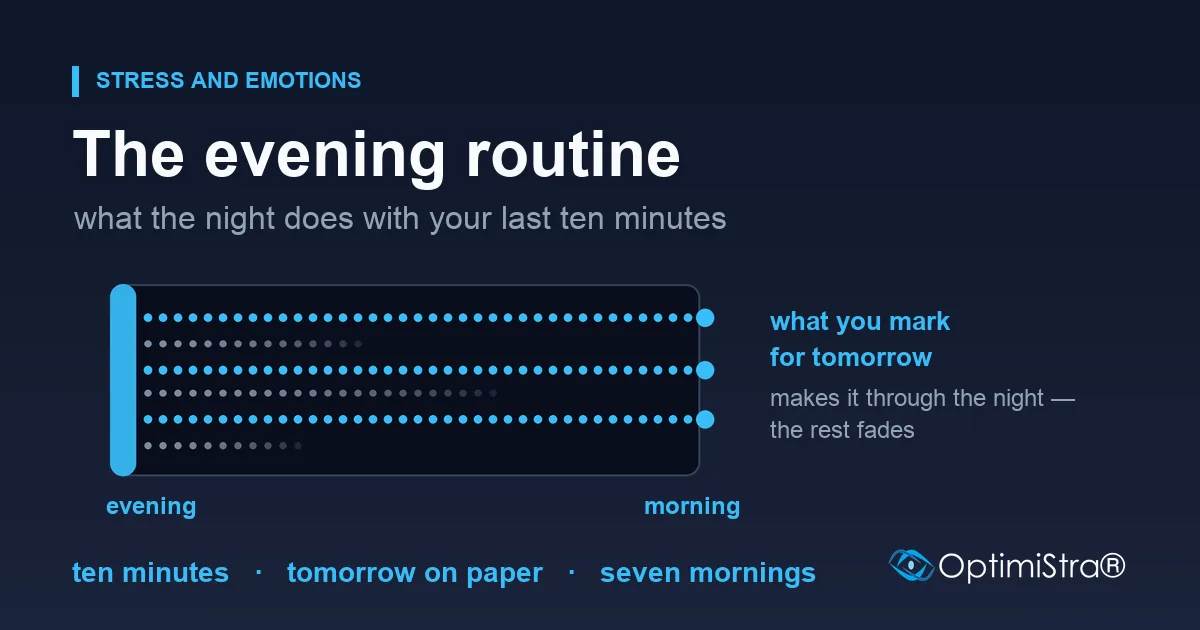
During sleep, the brain replays and consolidates what the day left behind, and it is selective: what has been marked as useful for tomorrow gets through, the rest far less. The best-measured evening habit is not positive thinking. It is writing tomorrow’s to-do list, in detail.
November 18, 2026 · 10 min read
Stress and Emotions
Reliving a happy memory from the inside: what it does, and what we know
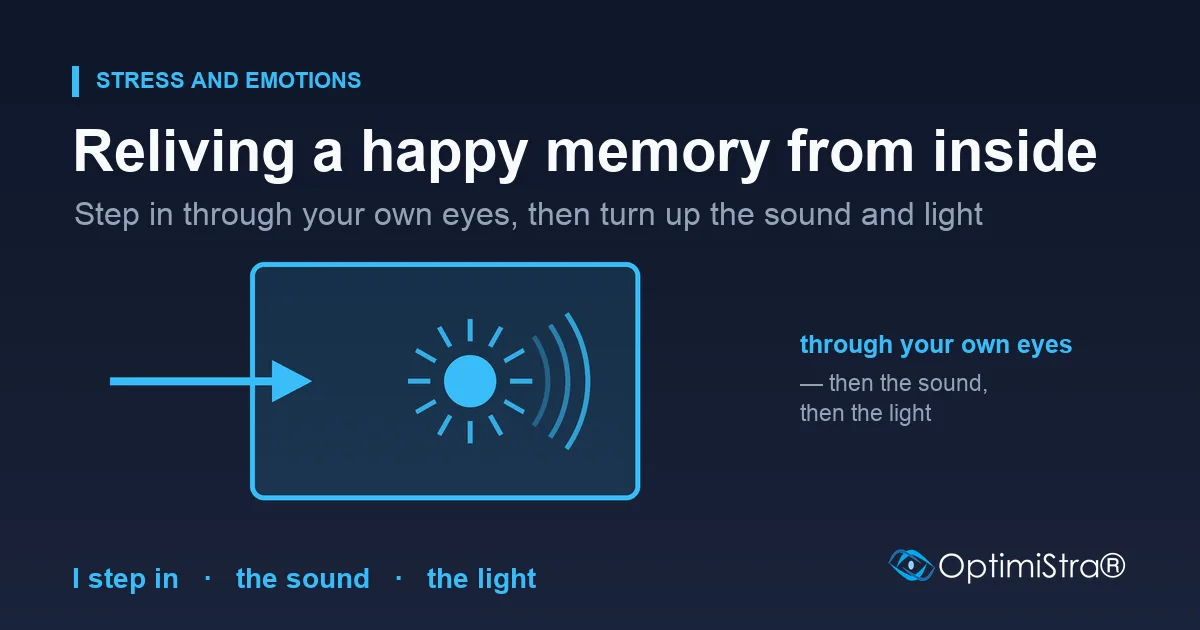
Reliving a happy memory from the inside means going back into it through your own eyes, with its sounds and sensations. In the lab, recalling positive memories after a brief stressor limited the rise in cortisol, and thinking in images does more than thinking in words. The effect is modest and no substitute for care.
November 18, 2026 · 5 min read