Stress hormones: what cortisol and adrenaline do for you


Michel Wozniak and Nathalie de Marcé
Published November 18, 2026 · 9 min read
In brief
Cortisol and adrenaline are essential. Adrenaline readies the body to act within seconds, cortisol helps it allocate energy, and both help you retain the moments that matter. Their effect depends on the dose and on how difficult the task is. This article sets out what the studies show, and where their limits lie.
The word “stress” has a bad reputation, and the two hormones associated with it share that reputation. Adrenaline and cortisol are in fact among the most useful mechanisms in the body: they give you the drive to act, allocate energy, and help you remember what matters.
What decides their effect is, first, the amount released relative to what the situation calls for, and how difficult the task in front of you is. Here is what is known about these two hormones, what the famous stress curve really is, and what changes when you look at your stress differently.
What stress hormones are
When a situation calls for effort, two systems switch on. The first runs through the sympathetic nervous system and the adrenal glands, which release adrenaline and noradrenaline. The second, slower, links the hypothalamus, the pituitary gland, and the same adrenal glands, which release cortisol. According to a review published in 2018 by a team at the University of São Paulo, this coordinated response begins within seconds and can last several days; it mobilizes energy, alters metabolism, activates the immune system, and puts digestion on hold.
Adrenaline acts first. It sustains alertness, raises blood sugar, and speeds up the heart: this is the preparation for action that the physiologist Walter Cannon was already describing in the early 20th century. Cortisol comes next, and its effects on energy balance are seen mostly between 30 minutes and 2 hours after the stress begins.
Why “stress hormone” is a misleading shortcut
In 2019, four researchers from Western Ontario, Queen’s, Tufts, and Virginia Tech published an argument with a plain title: Glucocorticoids and “Stress” Are Not Synonymous. In humans, the main glucocorticoid is cortisol. Its primary function, the authors point out, is to mobilize energy, notably by regulating carbohydrate metabolism, hence its name; it is essential to life, and it acts on the expression of thousands of genes.
When cortisol rises in response to a challenge, it is one of the mechanisms that help the body cope, they write, and we would do better to see it as a mediator of recovery that prepares the body for the challenges that follow. They also warn against a common confusion: measuring cortisol is not measuring stress, just as a fast heartbeat does not prove you have just been running.
That is why we talk about dose here. For a hormone this essential, the useful question is how much.
What these hormones do for memory
Why do some memories last a lifetime when most fade? William James was already asking. In 2013, the neurobiologist James McGaugh, of the University of California, Irvine, summed up in the journal PNAS what decades of experiments have shown. An emotion releases adrenaline and cortisol, and these two hormones strengthen the consolidation of what has just been experienced, by way of the amygdala. That is how memory selectively holds on to the experiences that matter.
Two details make this finding very concrete. Pleasant emotions count as much as the others: birthdays, celebrations, and weddings are remembered very well too, and it is the intensity of the emotion that makes the difference, far more than its tone. A mild emotion is already enough: images or words rated as only slightly emotional are remembered better than neutral ones. In a study the author cites, students who watched a stimulating video clip right after a lecture did better on their midterm exam 2 weeks later.
Part of what we call stress, then, is also what lets us remember.
The bell curve, and what Yerkes and Dodson actually found
Many readers have come across this curve: performance rises with stimulation, peaks, then falls as the pressure becomes too strong. It is attributed to the “Yerkes-Dodson law.” In 2007, a team at the University of South Florida went back to the original paper, and what they read there differs from what the textbooks retained.
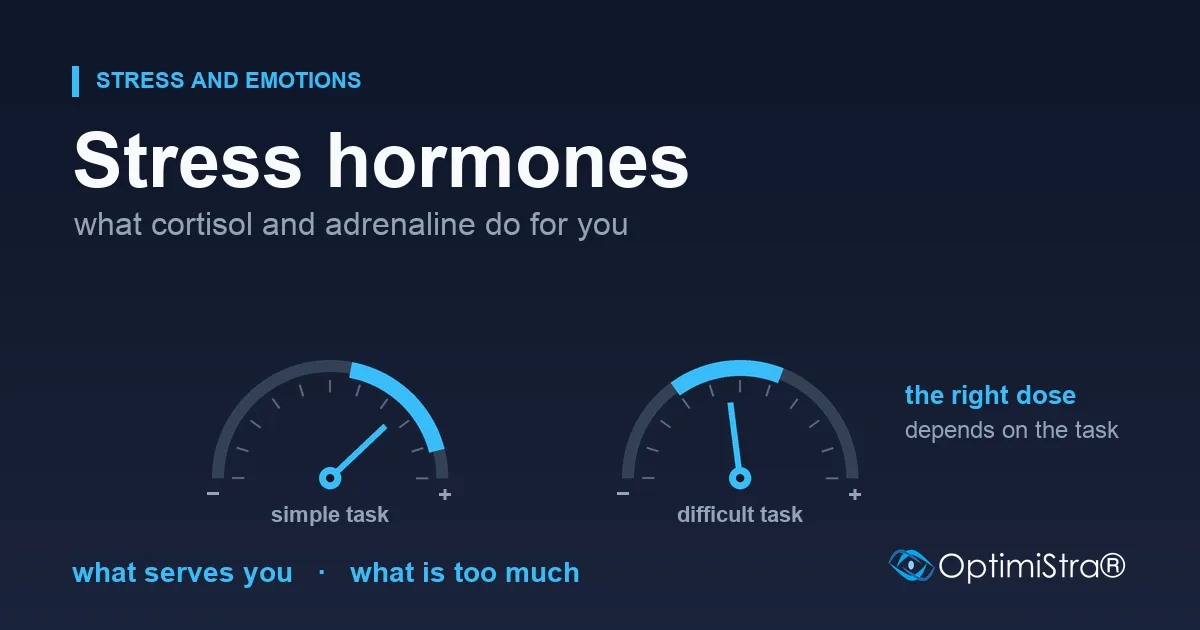
In 1908, Robert Yerkes and John Dodson trained mice to choose, between two compartments, the one that spared them an electric shock, while varying the strength of the shock. When the two compartments were easy to tell apart, one light and one dark, the mice learned faster the stronger the shock. When they were hard to tell apart, a moderate intensity gave the best results. The two authors wrote as much themselves: an easy habit forms readily under strong stimulation, a difficult habit only under relatively weak stimulation.
The single bell curve has a different origin. In the 1950s, several leading psychologists, Donald Hebb among them, described a bell-shaped relationship between arousal and performance without citing Yerkes and Dodson; from the 1960s on, textbooks gave that curve their name. Diamond and his colleagues note, with some irony, that the 1908 paper may be the most cited and least read in the history of science.
This detail has a practical consequence. High arousal can help with a simple, well-defined task, and get in the way of a complex one that requires holding many things in mind or doing several things at once. So the right dose depends on what you have to do. The original experiment was on mice, though: extending it to human situations is an interpretation, which the 2007 authors support with other work in both humans and rodents.
Looking at your stress differently: what has been measured
If the energy of stress can be useful, does the way you interpret it matter? A team at Harvard University has asked the question more than once.
In 2010, Jeremy Jamieson and his colleagues recruited 60 students preparing for the GRE, the admission exam for graduate programs in the United States; 28 actually took it within 3 months and could be followed. Before a practice test, participants randomly assigned to the reappraisal group read a short message: feeling nervous during an exam does not necessarily hurt your results, and may even help. They scored higher in math than the control group, on the practice test and on the real exam taken 1 to 3 months later, with 770 points versus 706 out of 800; on the verbal section, no difference appeared. In this group, a salivary marker of sympathetic activation had risen, and the more it rose, the higher the math score.
Two years later, the same team put about 50 participants through a demanding laboratory task: a 5-minute speech in front of two evaluators with disapproving expressions, followed by mental arithmetic out loud. Those who had been told that arousal helps performance showed a more favorable cardiovascular profile, with a heart pumping more blood and less constricted vessels, and their attention was drawn slightly less to negative words. They did not report feeling less stressed than the others. Arousal itself, measured by the force of the heart’s contraction, stayed comparable across the three groups; only its profile differed.
These studies are telling, and they are small. The reviews that followed carry more weight.
What the research does not establish
In 2019, a team at Ryerson University in Toronto pooled the trials that tested a brief stress reappraisal intervention. Overall, perceived stress goes down compared with control groups, while physiological measures do not differ. The effect appears only with tasks that require action, such as public speaking, and the authors specify that their conclusions apply to brief, single-session interventions.
In 2024, two researchers from the universities of Bern and Lausanne combined 35 studies, 5,638 participants in all, that measured the effect of these messages on performance. The measured improvement is small, and slightly clearer for tasks performed in front of an audience than for written ones. Their analysis also suggests that some unpublished studies are missing from the picture; once that bias is corrected, the effect shrinks further while remaining significant. The authors do not present these interventions as a miracle solution, while judging the approach promising, inexpensive, and easy to access.
Four limits are worth knowing before you use any of the above.
No one has tested our exercise as it stands. None of these studies measured what a list of six stresses kept for a week produces. The exercise brings together converging findings and our experience as trainers; it has not been validated as such.
Participants are mostly healthy young adults. In the 2024 meta-analysis, their average age was 22, and no study involved a clinical population.
The Yerkes-Dodson law comes from mice. Extending it to humans rests on other work, and the “difficulty” of a task remains, as the 2007 authors themselves admit, a subjective measure.
The measured effects are mostly short-term. Most studies in the 2024 review looked at immediate effects; those that followed participants for several months point the same way, though it isn’t yet known whether the effect carries over from one domain to another.
The exercise below costs nothing and has no known risk. The surest thing to expect from it is a more precise view of your own week.
The full protocol
- Six stresses, two columns. Over the week, write down three stresses that served you and three that were more than the task called for. Ordinary stresses are enough, and none needs to be relived.
- The useful kind gets you moving. The energy that rises before a meeting that matters, the focus as a deadline approaches, the momentum that makes you finish what you started.
- The excess kind is bigger than the stakes, or the difficulty. A lot of energy for an email that could have waited, or for a delicate task that would have called for more calm.
- Next to each excess stress, one idea for lowering the dose. A break, a few minutes of walking, or 5 minutes of breathing in for 5 seconds and out for 5 seconds.
- Two sentences, for the moment it rises. “This energy can help me,” when the stakes deserve it; “my body is giving me a little more than this needs,” when they don’t.
- At the end of the week, reread the list, and keep it.
One caveat to finish. This exercise is about the ordinary stresses of a week. If you are going through a difficult period, or if what you are experiencing feels too heavy to simply write down, no article replaces real support: talk to a professional.
Where this exercise fits
Dosing your stress is the fourth step in our progression on inner states. The first teaches you to act on your state through steady breathing, the second to read it by naming the sensation before the emotion, the third to choose the moment you speak when an emotion rises; this one teaches you to look at how much energy each situation deserves.
The articles in this progression are gathered on the blog.
Article written by Michel Wozniak and Nathalie de Marcé, and optimized by artificial intelligence.
Sources
- MacDougall-Shackleton, Bonier, Romero & Moore (2019), Glucocorticoids and "Stress" Are Not Synonymous, Integrative Organismal Biology
- Godoy, Rossignoli, Delfino-Pereira, Garcia-Cairasco & Umeoka (2018), A Comprehensive Overview on Stress Neurobiology: Basic Concepts and Clinical Implications, Frontiers in Behavioral Neuroscience
- McGaugh (2013), Making lasting memories: Remembering the significant, Proceedings of the National Academy of Sciences
- Diamond, Campbell, Park, Halonen & Zoladz (2007), The Temporal Dynamics Model of Emotional Memory Processing: A Synthesis on the Neurobiological Basis of Stress-Induced Amnesia, Flashbulb and Traumatic Memories, and the Yerkes-Dodson Law, Neural Plasticity
- Jamieson, Mendes, Blackstock & Schmader (2010), Turning the knots in your stomach into bows: Reappraising arousal improves performance on the GRE, Journal of Experimental Social Psychology
- Jamieson, Nock & Mendes (2012), Mind over matter: Reappraising arousal improves cardiovascular and cognitive responses to stress, Journal of Experimental Psychology: General
- Liu, Ein, Gervasio & Vickers (2019), The efficacy of stress reappraisal interventions on stress responsivity: A meta-analysis and systematic review of existing evidence, PLoS ONE
- Bosshard & Gomez (2024), Effectiveness of stress arousal reappraisal and stress-is-enhancing mindset interventions on task performance outcomes: a meta-analysis of randomized controlled trials, Scientific Reports
Frequently asked questions
Is cortisol really the stress hormone?
It’s a shortcut that researchers themselves consider misleading. Cortisol’s primary function is to regulate the body’s energy, and it is essential to life. Its level rises in response to a challenge, and it is then one of the means the body uses to cope. Measuring cortisol is therefore not the same as measuring stress.
What do adrenaline and cortisol do?
Adrenaline acts within seconds: it sustains alertness, raises blood sugar, and speeds up the heart. Cortisol acts more slowly; its effects on energy balance are seen mostly between 30 minutes and 2 hours after a stress begins, and it helps the body prepare for what comes next. Both also strengthen the memory of significant moments.
What is the Yerkes-Dodson law?
It comes from an experiment published in 1908 by Robert Yerkes and John Dodson, in which mice learned to choose the compartment that spared them an electric shock. On the easy task, they learned faster the stronger the shock; on the difficult task, a moderate intensity gave the best results. The single bell curve shown under that name today appeared decades later, and it erases the role of difficulty.
Can stress improve performance?
Under certain conditions, and modestly. A 2024 meta-analysis of 35 studies finds that presenting the energy of stress as a help improves results a little, slightly more clearly for tasks performed in front of an audience. The effect remains small, and it shrinks further once studies that probably went unpublished are taken into account.
Does changing how you see stress change what your body does?
The results are mixed. In a Harvard University study, participants invited to see their arousal as useful had a more favorable cardiovascular profile during a speaking task, without reporting less stress. A 2019 meta-analysis paints a different picture across studies: perceived stress goes down, and physiological measures do not differ from those of control groups.
Stress and Emotions
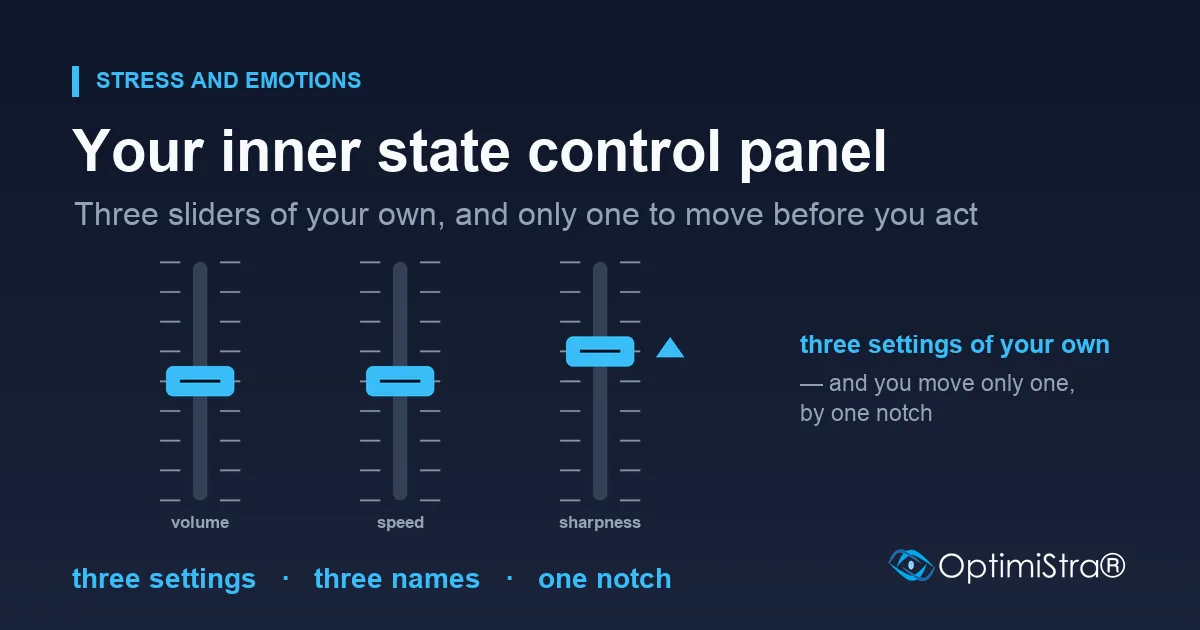
The control panel: three sliders for adjusting your inner state
The control panel is an NLP tool: an imaginary interface, like a mixing board, where you set three controls for your own state, name them, and move one a single notch before a task. The tool itself has not been tested as such, but the sense of being in control and the perception of time have been studied.
November 18, 2026 · 5 min read
Stress and Emotions
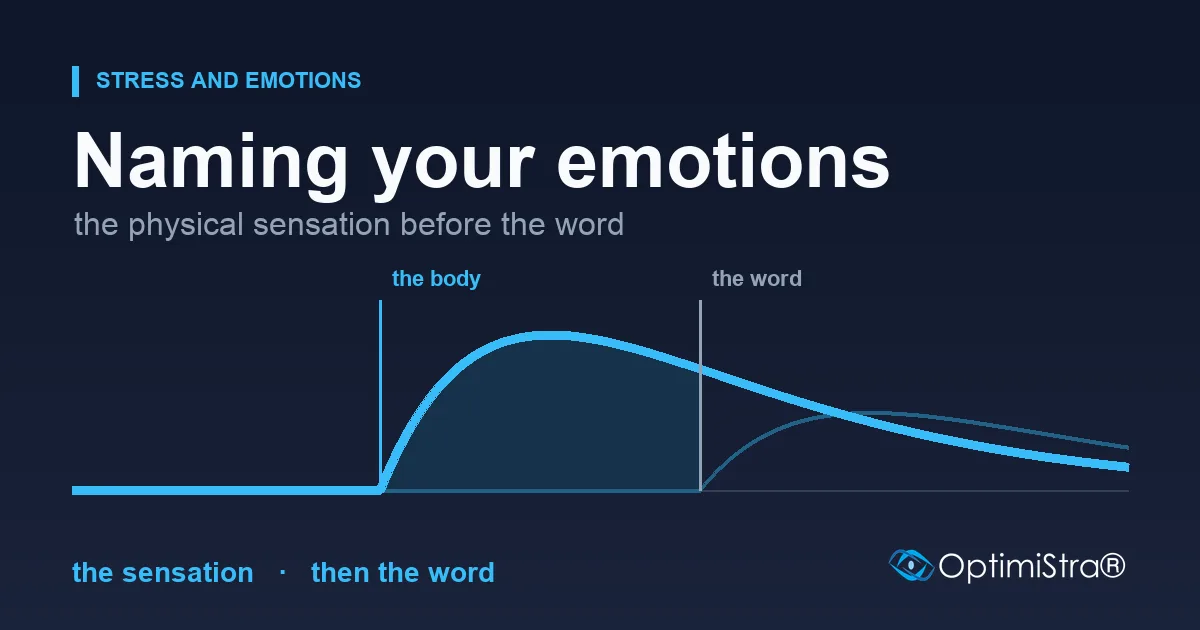
An emotion starts in the body: naming the sensation before the emotion
An emotion is a physical reaction set off by how you interpret an event, not by the event itself. The body moves first and the word comes later. Naming the sensation before the emotion takes 10 seconds. Here is what the research establishes, and the three precise points where it stops.
November 18, 2026 · 8 min read
Stress and Emotions
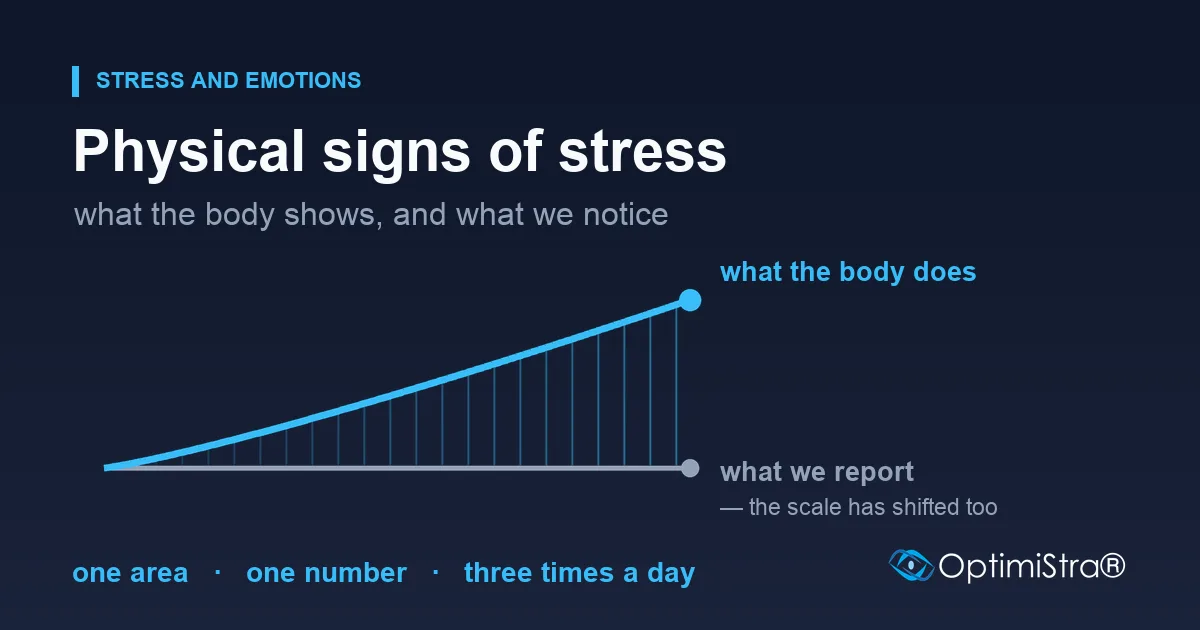
Physical signs of stress: what the body shows, and how much of it we notice
Under stress, the jaw muscles work harder: 38 studies show it. Yet what people report about their own tension from memory has almost nothing to do with what they notice when asked in the moment. And their point of comparison shifts along with them.
November 18, 2026 · 9 min read