Reptilian brain: why we stop thinking clearly in the grip of emotion


Michel Wozniak and Nathalie de Marcé
Published November 18, 2026 · 9 min read
In brief
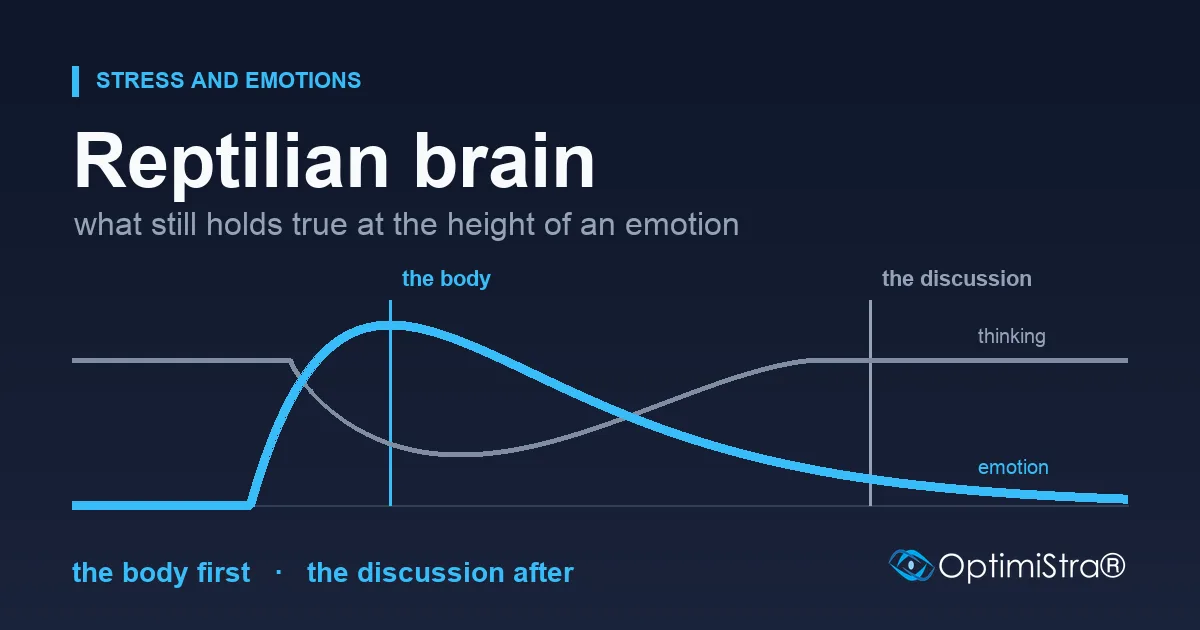
At the peak of an emotion, the prefrontal cortex loses some of its capacity while fast reactions take over. The “reptilian brain” said to explain this is an abandoned model; the shift itself is well measured. Hence a simple move: body first, discussion afterward. Here are the studies, and their limits.
At the peak of an emotion, something changes in the way you think. Arguments stop getting through, other people’s and your own, and sometimes a reply is out before you’ve chosen it. The usual explanation is the “reptilian brain,” which is said to take over from the rational brain.
Specialists in brain evolution abandoned that model long ago. The shift it tried to explain, though, is solidly documented, and it leads to a very simple move: start with the body, and save the discussion for later.
What the three-layer brain is
The model comes from the American researcher Paul MacLean, who wrote in 1964 that humans appear to have inherited, in essence, three brains. He stacked them in the supposed order of evolution: at the bottom, a “reptilian” complex in charge of basic functions such as movement and breathing; around it, the limbic system, said to drive emotional responses; on top, the cortex, home of language and reasoning.
Its practical consequence is easy to remember: faced with danger or a strong emotion, the lower layers are supposed to take over while the top layer goes on standby. The model thus accounts for an experience everyone knows: you can’t reason with someone at an emotional peak, and that includes yourself. The most telling image is the bear: if you meet one in the street, the question of whether it is brown or white can wait.
What science has dropped
In 2020, three researchers from Michigan State University and the University of Maryland published a paper that sets the record straight, with a blunt title: Your Brain Is Not an Onion With a Tiny Reptile Inside. Among those who study the evolution of the nervous system, they write, agreement is unanimous: across species, new structures were not laid on top of old ones. All vertebrates have the same major brain regions, and all mammals have a prefrontal cortex. The model still holds its place in teaching: of 14 recent introductory psychology textbooks that covered brain evolution, 12 contained at least one error of this kind.
Two years later, Patrick Steffen, whose work on breathing at six cycles a minute we have already cited, spelled out, with two colleagues at Brigham Young University, where the model fails when it comes to the stress response. Emotion and cognition work together: the limbic system also takes part in memory, and the cortex takes part in emotional responses. The authors use the image of the elephant’s trunk: a structure equivalent to a snout, in different proportions. And from one situation to the next, the brain shifts the balance between networks that work in concert, far more than it switches regions on or off.
The three authors of the 2020 paper offer an explanation for the model’s long life, and we think it is right: these ideas may persist because they match what we experience when an emotion overwhelms us and we borrow words from the animal world to describe it.
What actually happens at the peak of an emotion
In 2009, Amy Arnsten, a neurobiologist at Yale University, reviewed what was known about the phenomenon. The prefrontal cortex, which holds information in mind, regulates attention, and lets you change strategy, is also the brain region most sensitive to stress: even fairly mild acute stress, when you have no control over it, can cause a rapid and marked loss of these abilities.
The mechanism is chemical. Released in large amounts, norepinephrine and dopamine weaken the prefrontal cortex and strengthen the amygdala and the habit circuits: the brain moves from slow, thoughtful regulation to fast, reflexive responses. These mechanisms, she sums up, can save your life when you need to react quickly, and work against you when you need to take the time to analyze. She also notes that, as early as the first postwar studies, participants who felt in control of the situation, even wrongly, were often spared.
In 2014, Erno Hermans and his Dutch colleagues added the time dimension to this shift. At the start of acute stress, the brain allocates its resources to a network geared toward vigilance and fast reaction, at the expense of the one that carries executive control. Once the stress has subsided, the allocation reverses, and the higher functions return to their place.
That return takes time. In animals, the first chemical wave rises almost instantly and returns to normal within 30 to 60 minutes; the slower effects of cortisol, which are thought to help tip the balance back, need at least an hour to set in. So the top layer comes back at its own pace, and the brain itself does the work.
What drops, and what holds
In 2016, three researchers at the University of California, Davis, pooled 51 studies that induced acute stress in the laboratory, in adults with no known disorder, before a task that called on executive functions. The result is more nuanced than the image of a layer switched off. Stress impairs working memory, with a small average effect; it also impairs mental flexibility, measured in only six studies, and the ability to screen out distracting information. On the other hand, it improves the ability to stop an action that was already on its way. The authors read this as a state that weakens control over thoughts and preserves control over actions: a state that prepares you to act. They also note that the more intense the stress, the more working memory suffers.
A 2009 study at Ruhr University Bochum shows how this changes behavior. Students kept a hand in ice water for 3 minutes, filmed and watched by a stranger, before learning to obtain two drinks by choosing symbols on a screen. Then, once they had eaten their fill of the food matching one of the two, the unstressed participants dropped the symbol that led to it; the stressed participants kept choosing it, out of habit. Stress, the authors conclude, favors habits at the expense of goal-directed behavior.
That, in our view, is why a move is worth practicing on small occasions before it is needed on a big one: at the peak of the moment, the brain relies on what it is used to doing.
Why step away first, and come back afterward
In 2011, Gal Sheppes and his colleagues at Stanford University let participants choose between two ways of getting through an unpleasant emotion: rethinking it, by looking for a less negative meaning, or turning away from it by thinking about something neutral. Across three experiments, with images that were more or less distressing and then electric shocks whose intensity was announced in advance, the result is the same. At low intensity, participants mostly chose to rethink the situation, two-thirds to three-quarters of the time; at high intensity, they more often preferred to turn away, six to seven times out of 10.
The authors’ explanation ties in with what comes before: turning away stops the emotional information early, before it gathers strength, whereas rethinking it means letting it in, which becomes costly when it is strong. Turning away has a price, though, and the study measures it: participants remembered fewer details of the images they had turned away from. What you set aside is not processed in the moment, and that, in our view, is why you need to come back to the discussion afterward.
In these experiments, turning away meant thinking about something else; the link to a physical action is ours.
What the research does not establish
There are four limits to know before you use any of this.
No one has tested the protocol as it stands. None of the studies cited measured what happens when you walk for a few minutes before resuming a discussion. The move we suggest brings together converging results and our experience as trainers; it has not been validated as such.
Laboratory stress is moderate. Speaking in front of a panel of strangers, keeping a hand in cold water, looking at images: research ethics require it, and it remains milder than a real moment of tension. Participants are often healthy students, and average effects remain small.
Part of the mechanism comes from animal research. The chemical timeline, in particular the 30 to 60 minutes of the first wave, was established mainly in animals, and the Dutch team’s network model is presented by its authors as a framework that will grow more complex.
Individual differences are wide. A sense of control changes the effect of stress, and the sex differences reported in the 2016 meta-analysis do not point the same way from one study to the next.
We would rather say so. The move suggested here costs nothing, carries no known risk, and rests on what research describes about acute stress: that is what makes it worth trying.
The full protocol
- The sign. Arguments stop getting through, in either direction, and the ones you address to yourself land no better.
- Body first. Put the discussion off until a little later and do something physical: walk for a few minutes, or breathe in for 5 seconds and out for 5.
- Discussion afterward. Pick it up again when you feel able to hear an objection through to the end. The return takes time; let it come.
- On small occasions. An exchange that is speeding up, a reply that is about to come out too quickly. That is where the move becomes a habit, and the habit is what will be available on the day the intensity really rises.
- In the evening, one line. What you noticed first, what you did, and when the discussion was able to resume. Read your lines again at the end of the week.
A final caution. This move is for ordinary moments. If you are going through a difficult period, or if what rises in you feels too strong to simply observe, no article replaces proper support: talk to a professional.
Where this technique fits
Recognizing the moment when thinking withdraws is the third step in our series on inner states. The first teaches you to act on your state through steady breathing, the second to read it by naming the sensation before the emotion; this one teaches you to choose the moment when you speak.
All three steps are groundwork for our Neuro-Linguistic Programming (NLP) courses, which start from a simple principle: you pass on your inner state before you pass on anything else.
The articles in this series are gathered on the blog.
Article written by Michel Wozniak and Nathalie de Marcé, and optimized by artificial intelligence.
Sources
- Cesario, Johnson & Eisthen (2020), Your Brain Is Not an Onion With a Tiny Reptile Inside, Current Directions in Psychological Science
- Steffen, Hedges & Matheson (2022), The Brain Is Adaptive Not Triune: How the Brain Responds to Threat, Challenge, and Change, Frontiers in Psychiatry
- Arnsten (2009), Stress signalling pathways that impair prefrontal cortex structure and function, Nature Reviews Neuroscience
- Hermans, Henckens, Joëls & Fernández (2014), Dynamic adaptation of large-scale brain networks in response to acute stressors, Trends in Neurosciences
- Shields, Sazma & Yonelinas (2016), The effects of acute stress on core executive functions: A meta-analysis and comparison with cortisol, Neuroscience & Biobehavioral Reviews
- Schwabe & Wolf (2009), Stress prompts habit behavior in humans, Journal of Neuroscience
- Sheppes, Scheibe, Suri & Gross (2011), Emotion-regulation choice, Psychological Science
Frequently asked questions
Is the reptilian brain real?
Not in the sense of the model that made it famous. Specialists in brain evolution agree that new layers were not stacked on top of a reptile’s brain from one species to the next. All vertebrates have the same major regions, in different shapes and proportions. The image remains useful for describing a real shift, as long as you don’t take it for anatomy.
Why can’t I think straight when I’m very emotional?
The prefrontal cortex, which holds information in mind and lets you change your point of view, is very sensitive to stress. Under the effect of norepinephrine and dopamine released in large amounts, it loses some of its capacity, while fast responses and habits take over. This shift is useful when you face danger, and it gets in the way when you need to take the time to analyze.
How long does it take to think clearly again after a strong emotion?
No single duration applies to everyone. In animals, the first chemical wave of stress returns to normal within 30 to 60 minutes, and slower effects then help restore executive control. In practice, the best marker is being able once again to hear an objection through to the end.
Should I try to reason with myself when I’m overwhelmed?
At the peak of the moment, it is rarely the most effective choice. In the Stanford University experiments, participants preferred to rethink a low-intensity situation and to turn away from a high-intensity one, which the authors consider more effective at that level. The price of turning away is that the situation is not processed in the moment, so you need to come back to it afterward.
Does stress make you less intelligent?
Not across the board. A meta-analysis of 51 studies finds that acute stress slightly impairs working memory and mental flexibility, and that it improves the ability to stop an action that was already on its way. The authors see it as a state that prepares you to act, and the average effects measured remain small.
Stress and Emotions
An emotion starts in the body: naming the sensation before the emotion
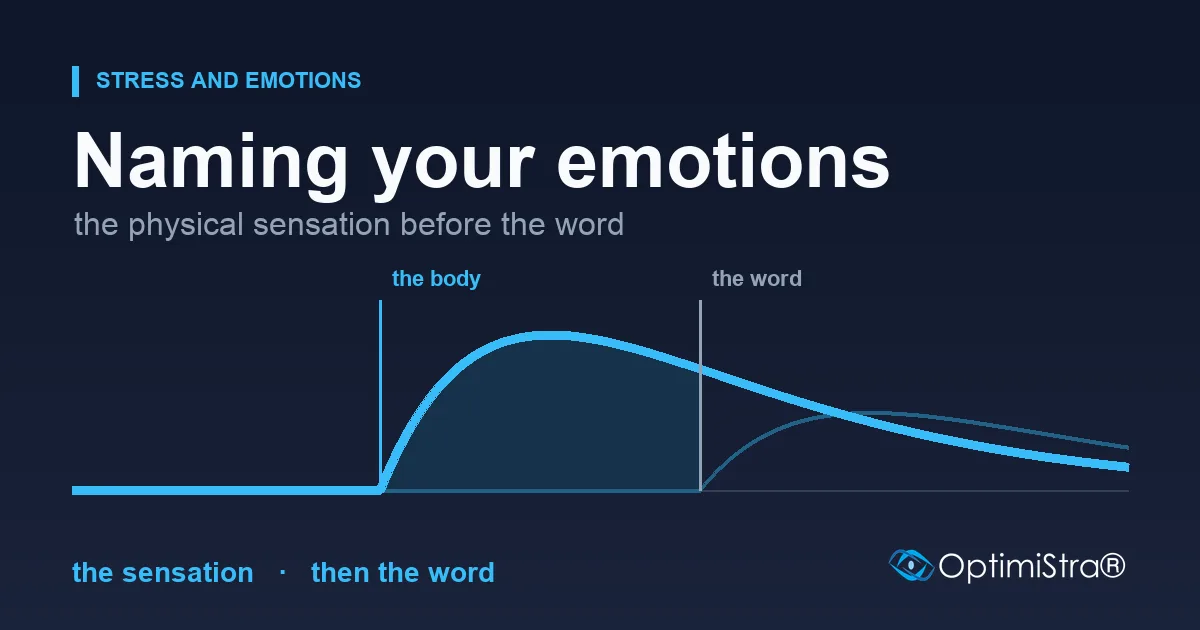
An emotion is a physical reaction set off by how you interpret an event, not by the event itself. The body moves first and the word comes later. Naming the sensation before the emotion takes 10 seconds. Here is what the research establishes, and the three precise points where it stops.
November 18, 2026 · 8 min read
Stress and Emotions
Physical signs of stress: what the body shows, and how much of it we notice
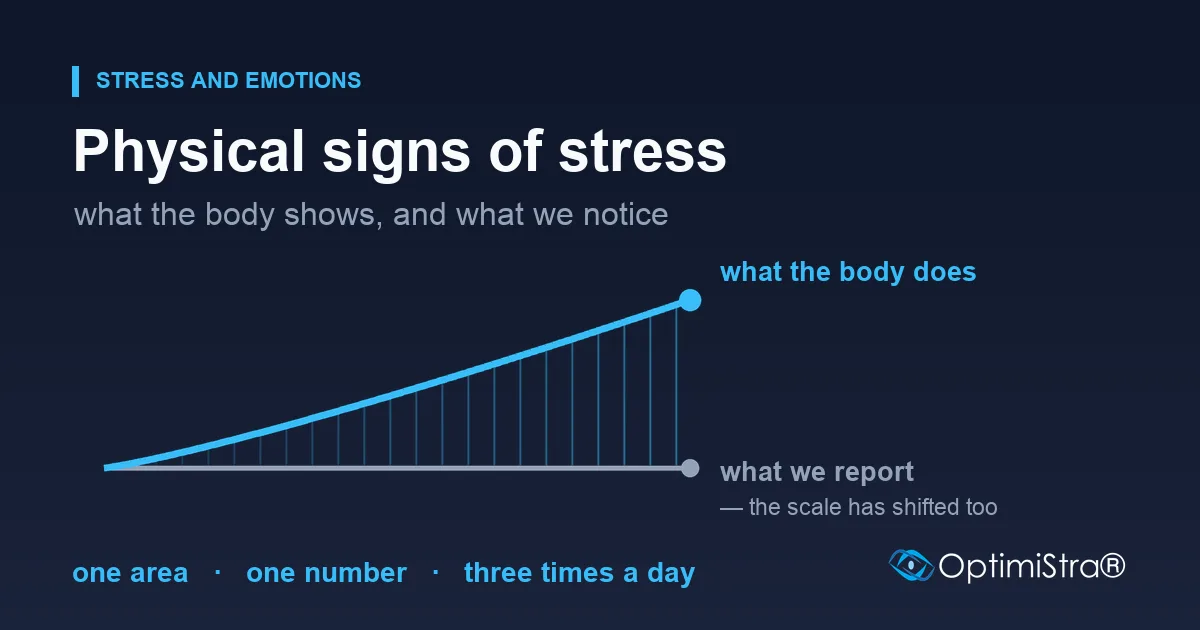
Under stress, the jaw muscles work harder: 38 studies show it. Yet what people report about their own tension from memory has almost nothing to do with what they notice when asked in the moment. And their point of comparison shifts along with them.
November 18, 2026 · 9 min read
Stress and Emotions
Evening routine: what the night does with your last 10 minutes
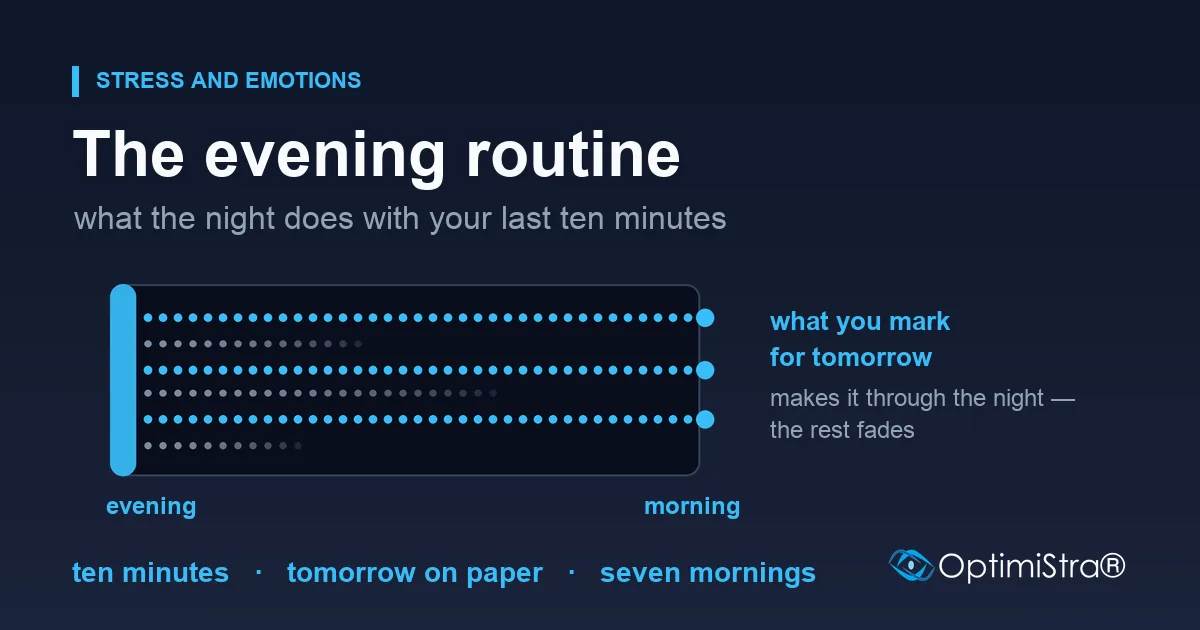
During sleep, the brain replays and consolidates what the day left behind, and it is selective: what has been marked as useful for tomorrow gets through, the rest far less. The best-measured evening habit is not positive thinking. It is writing tomorrow’s to-do list, in detail.
November 18, 2026 · 10 min read