Acute and chronic stress: what returning to calm changes


Michel Wozniak and Nathalie de Marcé
Published November 18, 2026 · 9 min read
In brief
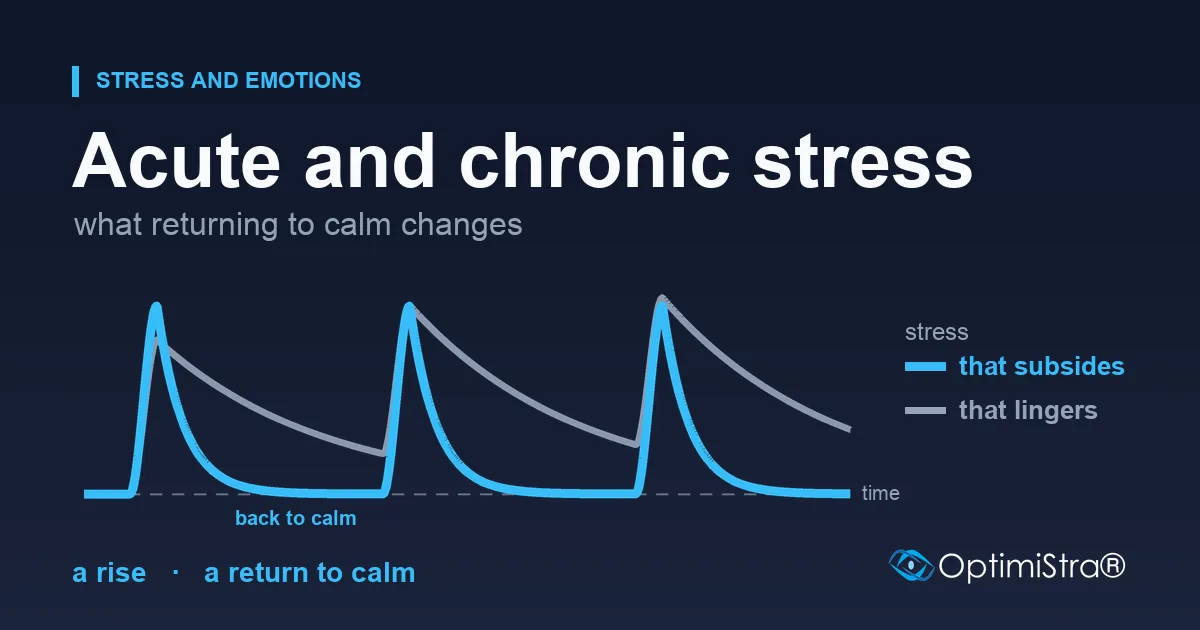
Acute stress rises, then subsides: it is the response the body is built for. Chronic stress keeps the body mobilized without leaving it time to return to calm, and that missing recovery is what wears it down. Here is what the studies show, what they leave open, and an exercise for the week.
We talk about stress as if it were one thing, yet research separates two forms of it, depending on whether it passes or lasts. That is the whole difference between acute and chronic stress. A brief surge mobilizes the body, then switches off; the same response, kept up day after day, ends up wearing it down.
What separates the two is mostly the time the body is given to return to calm. Here is what is known about that difference, what recovery changes, what short breaks are worth, and what the studies do not establish.
Acute stress, chronic stress: a question of duration
Researchers first sort stressful situations by how long they last and how they unfold. In their 2004 meta-analysis, Suzanne Segerstrom and Gregory Miller distinguish, among others, acute stressors, produced in the laboratory by public speaking or mental arithmetic and lasting from 5 to 100 minutes; brief real-life stressors, such as an exam period; and chronic stressors, which settle into a person’s life without the person knowing whether, or when, they will end.
There is no consensus on the point at which stress becomes chronic. In a review published in 2018, Elissa Epel and her colleagues note that one classic interview framework uses 4 weeks, and they themselves propose at least 6 months. The review adds a case closer to ordinary life: a small daily stressor that comes back often, because it stems from the same ongoing situation, can already be considered a form of chronic stress.
A response built to switch on, then off
When a situation calls for it, the body releases mediators, adrenaline and cortisol among them, that help it cope. Sterling and Eyer called this process allostasis: achieving stability through change. Bruce McEwen and his colleagues added the notion of allostatic load, to name the wear that results from stress that is too frequent or from a poorly managed response, for example when it fails to switch off once it is no longer needed.
A 2006 article by McEwen describes how this response normally unfolds: it is triggered by a stressor, is sustained for as long as necessary, then switches off. He distinguishes four situations that produce allostatic load instead: repeated hits from multiple stressors; a lack of adaptation when the same stressor returns; a prolonged response, because it is slow to switch off; and an inadequate response, which leads other systems to overwork in compensation.
The same text points out that the events of daily life, by their sheer number, raise and sustain the activity of these systems more than dramatic events do. The review by Epel and her colleagues draws from this the principle that underlies the study of these responses: an acute response that switches on and then quickly off does not harm the body. It is the prolonged responses, or those slow to return to baseline, that demand extra physiological effort and wear the body down over time. The review also states that prospective evidence linking these responses to disease risk remains limited.
What the immune system shows
The immune system offers a clear illustration of this difference. In 2004, Suzanne Segerstrom, of the University of Kentucky, and Gregory Miller, of the University of British Columbia, brought together more than 300 articles on the link between psychological stress and immunity in humans.
Acute laboratory stressors came with a mobilization of what is called natural immunity, which the study considers potentially adaptive: the number of natural killer cells in the blood rose markedly, as if the body were preparing for a possible injury. Exam periods tended instead to shift the balance between two arms of immunity. Chronic stressors, finally, were associated with a decline in almost all functional measures of the immune system.
The article concludes that the further a stressor moves from the duration of a fight-or-flight situation and becomes chronic, the more components of the immune system it affects in a potentially detrimental way. The authors add two caveats of their own. Beyond their duration, the chronic stressors studied often changed people’s identity or social roles, and left them less control over the situation. And whether these immune changes actually make people more vulnerable to disease remains, according to the article, the most pressing question in the field.
Recovery, the link between the moment and the long term
If stress reactions are brief by nature, how does stress become established? In 2006, Sabine Geurts, of Radboud University Nijmegen, and Sabine Sonnentag, of the University of Konstanz, proposed an answer in a journal devoted to work and health: recovery.
Their starting point takes only a few lines. Physiological reactions to stress are, in principle, short-lived: when exposure stops, they decrease and often disappear after a certain time. Recovery is that return, through which the systems activated during the effort come back to baseline and stabilize there. When the return is incomplete, you start again from a state that has not come back to that level. You then have to make a compensatory effort, which in turn calls for more recovery, and a cumulative process can set in.
The article reports a field study carried out in the Netherlands among driving examiners. On days with a very heavy load, 11 exams with no break between them, their adrenaline levels were higher than on days with nine or 10 exams, and they stayed higher throughout the evening.
It also identifies two obstacles to recovery. The first is the length of exposure: long days reduce the time available to recover, and keep drawing on systems that are already activated. The second is less visible: the thoughts that prolong the situation, whether you go over what happened or anticipate what is coming. Conversely, being able to detach mentally from work during your free time seems to make recovery easier.
A 2017 meta-analysis covering more than 38,000 employees points the same way: people who manage this detachment report greater well-being, better sleep, and less fatigue. These links are correlations, measured mostly by questionnaire, and they do not show up in the physiological indicators of stress.
Why stress stays after the situation is over
The team of Brosschot, Verkuil, and Thayer gave this second obstacle a name: perseverative cognition, whose main forms are worry and rumination. In a 2018 review, they note that most stressors are short-lived, and that the responses they provoke while they are happening are generally too brief to threaten health. What matters, according to this review, is prolonged physiological activity: slow recovery after a stressor, activation that anticipates it, sometimes long in advance, and activation that returns between two stressors, when you worry or ruminate. In daily life, an episode of worry has been associated with cardiac effects that lasted up to 2 hours afterward.
Geurts and Sonnentag report a laboratory experiment that makes this mechanism visible: in participants who were free to dwell on things after a stressful mental arithmetic task, blood pressure returned to baseline more slowly than in participants who were kept busy with a task where nothing was at stake.
Short breaks: what has been measured
The easiest break to fit into a day is also the shortest. In 2022, Patricia Albulescu and her colleagues brought together the experimental studies on micro-breaks, defined as interruptions of 10 minutes at most between two tasks: 22 study groups, 2,335 participants, and breaks ranging from 8 seconds to 10 minutes.
Micro-breaks increase the energy people feel and reduce fatigue, with effects that are statistically significant and small. Their effect on performance is not significant overall: it appears for routine or creative tasks, not for cognitively demanding ones, and it grows with the length of the break. The study suggests that recovering from a highly demanding task probably takes more than 10 minutes. It also notes that none of the studies examined found that a break made performance worse, even with less time spent on the task.
What the research does not establish
Before moving on to the exercise, here is what this body of work does not allow anyone to claim.
Our exercise has not been evaluated as such. None of these studies measured what 2 minutes of breathing placed between two demands produces, or what sorting six stressors into two columns does. The exercise brings together converging results and our experience as trainers.
The effects of short breaks are small, and measured mostly by questionnaire. In the 2022 meta-analysis, well-being was always self-reported, half of the studies involved students, most took place in a laboratory, and only four studies out of 22 had a low risk of bias.
The links with health are mostly associations. The chronic stressors studied differ from acute ones in more than their duration, and the 2018 review still considers the prospective evidence linking prolonged responses to disease to be limited.
Recovery is still poorly understood over long periods. Geurts and Sonnentag were already pointing out in 2006 how rare longitudinal studies covering long durations were; the 2017 meta-analysis on detachment makes the same observation.
One week does not tell you whether stress is chronic. Depending on the definition, that takes several weeks, or even several months. The two columns of the exercise show where calm had time to return; a diagnosis remains a matter for a professional.
The exercise that follows simply shows you, over a week, how much room returning to calm gets in your days, and gives it a little more.
The full exercise
- Six stressors, two columns. Take six recent, ordinary stressors and sort each one: subsided if calm returned within the hour or within the day, stayed if it followed you into the evening, into the next day, or if it comes back every day. None of them needs to be relived.
- One line per stressor. Its name and its column are enough.
- Two minutes between two demands. On a day when one thing follows another, just before you move on to the next, breathe in for 5 seconds and out for 5 seconds, as in steady breathing. Then pick up where you left off.
- At the end of the week, look at your two columns. They show where calm had time to return, and where your 2 minutes have the most to do.
One last caveat. This exercise is about the ordinary stressors of a week. If a tension has been with you for a long time, or if what you are going through feels too heavy to simply be written down, no article replaces proper support: talk to a professional.
Where this exercise fits
Telling the stress that passes from the stress that lasts is the fifth step in our series on inner states. The first teaches you to act on your state through steady breathing, the second to read it by naming the sensation before the emotion, the third to choose the moment when you speak when an emotion rises, and the fourth to look at the dose of energy each situation deserves. This one teaches you to give the body time to return to calm.
The articles in this series are gathered on the blog.
Article written by Michel Wozniak and Nathalie de Marcé, and optimized by artificial intelligence.
Sources
- McEwen (2006), Protective and damaging effects of stress mediators: central role of the brain, Dialogues in Clinical Neuroscience
- McEwen (2017), Neurobiological and Systemic Effects of Chronic Stress, Chronic Stress
- Segerstrom & Miller (2004), Psychological Stress and the Human Immune System: A Meta-Analytic Study of 30 Years of Inquiry, Psychological Bulletin
- Epel et al. (2018), More than a feeling: A unified view of stress measurement for population science, Frontiers in Neuroendocrinology
- Geurts & Sonnentag (2006), Recovery as an explanatory mechanism in the relation between acute stress reactions and chronic health impairment, Scandinavian Journal of Work, Environment & Health
- Brosschot, Verkuil & Thayer (2018), Generalized Unsafety Theory of Stress: Unsafe Environments and Conditions, and the Default Stress Response, International Journal of Environmental Research and Public Health
- Albulescu et al. (2022), « Give me a break! » A systematic review and meta-analysis on the efficacy of micro-breaks for increasing well-being and performance, PLoS ONE
- Wendsche & Lohmann-Haislah (2017), A Meta-Analysis on Antecedents and Outcomes of Detachment from Work, Frontiers in Psychology
Frequently asked questions
What is the difference between acute and chronic stress?
Acute stress is a brief response to a specific situation: the body mobilizes its energy, then returns to baseline once the situation has passed. Chronic stress lasts, because the situation goes on or keeps coming back. The point at which researchers call stress chronic varies, from 4 weeks to at least 6 months.
Is acute stress bad for your health?
A review published in 2018 sets out the principle that a response that switches on and then quickly off does not harm the body. It is the prolonged responses, or those slow to return to baseline, that wear it down over time. The same review states that the evidence linking these responses to disease risk remains limited.
What is allostatic load?
It is the term proposed by Bruce McEwen and his colleagues for the wear on the body when the stress response systems are overused or poorly regulated. A 2006 article describes four forms: repeated hits, a lack of adaptation to a stressor that returns, a response that is slow to switch off, and an inadequate response that other systems have to compensate for.
Do micro-breaks actually work?
A meta-analysis published in 2022, covering 22 study groups and 2,335 participants, finds that breaks of 10 minutes at most slightly increase the energy people feel and slightly reduce fatigue. Their effect on performance is not significant overall; it appears for routine or creative tasks, and not for highly cognitively demanding ones.
Why do I still feel stressed after the situation is over?
Because thinking can prolong the body’s response. Going over what happened, or anticipating what is coming, keeps physiological activation going beyond the situation itself: researchers call this mechanism perseverative cognition. In the laboratory, blood pressure returns to baseline more slowly when people are left to ruminate after a stressful task than when their mind is kept busy with a task where nothing is at stake.
Stress and Emotions
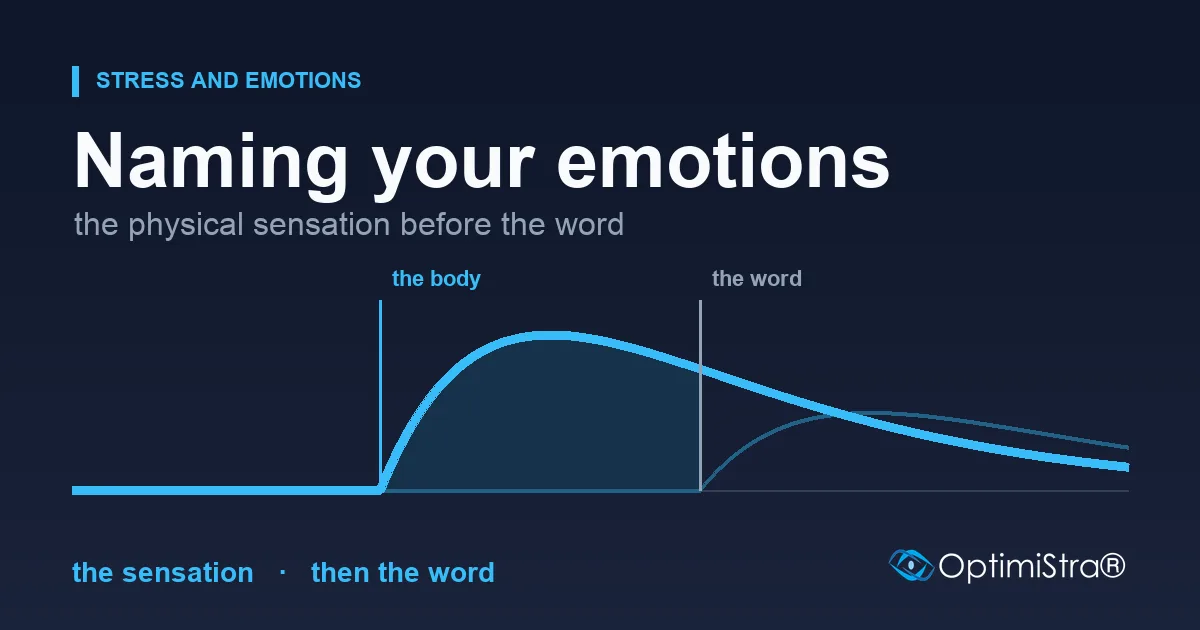
An emotion starts in the body: naming the sensation before the emotion
An emotion is a physical reaction set off by how you interpret an event, not by the event itself. The body moves first and the word comes later. Naming the sensation before the emotion takes 10 seconds. Here is what the research establishes, and the three precise points where it stops.
November 18, 2026 · 8 min read
Stress and Emotions
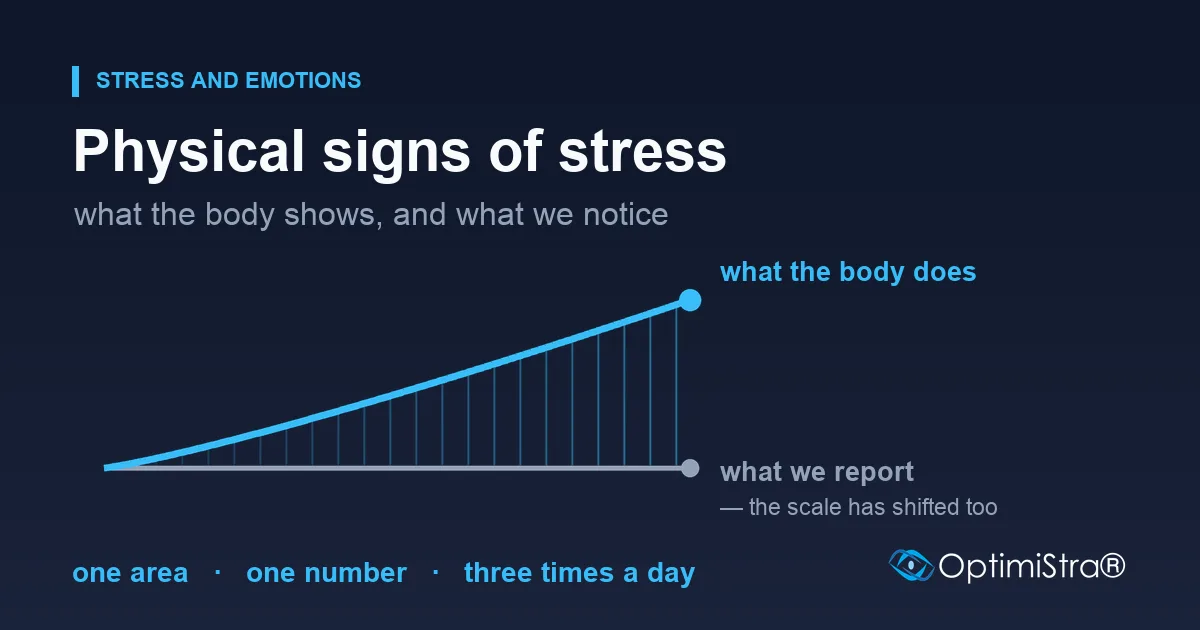
Physical signs of stress: what the body shows, and how much of it we notice
Under stress, the jaw muscles work harder: 38 studies show it. Yet what people report about their own tension from memory has almost nothing to do with what they notice when asked in the moment. And their point of comparison shifts along with them.
November 18, 2026 · 9 min read
Stress and Emotions
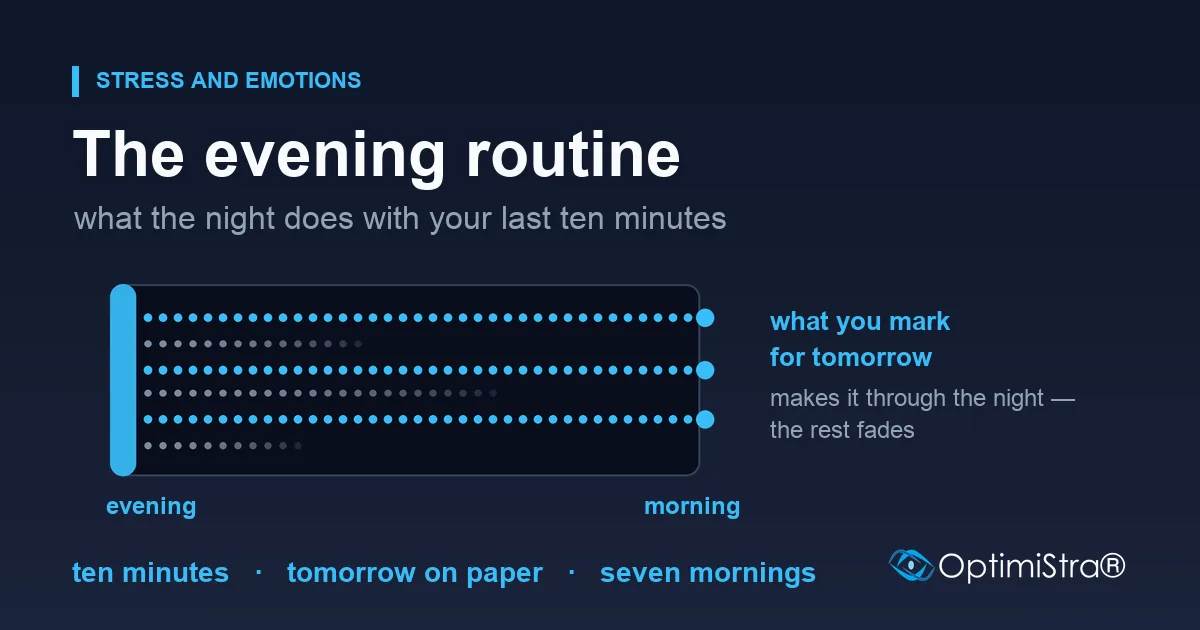
Evening routine: what the night does with your last 10 minutes
During sleep, the brain replays and consolidates what the day left behind, and it is selective: what has been marked as useful for tomorrow gets through, the rest far less. The best-measured evening habit is not positive thinking. It is writing tomorrow’s to-do list, in detail.
November 18, 2026 · 10 min read