Reliving a happy memory from the inside: what it does, and what we know


Michel Wozniak and Nathalie de Marcé
Published November 18, 2026 · 5 min read
In brief
Reliving a happy memory from the inside means going back into it through your own eyes, with its sounds and sensations. In the lab, recalling positive memories after a brief stressor limited the rise in cortisol, and thinking in images does more than thinking in words. The effect is modest and no substitute for care.
There’s a difference between remembering a good moment and going back to it. Remembering is knowing that the meal took place, that the day was beautiful. Going back is finding the table in front of you again, the voices around you, the warmth of the sun on your arms. The first takes a second. The second takes a little longer, and doesn’t have the same effect.
This article is about the second: reliving a happy memory from the inside, what research has measured about it, and what it hasn’t tested yet.
What reliving a memory from the inside means
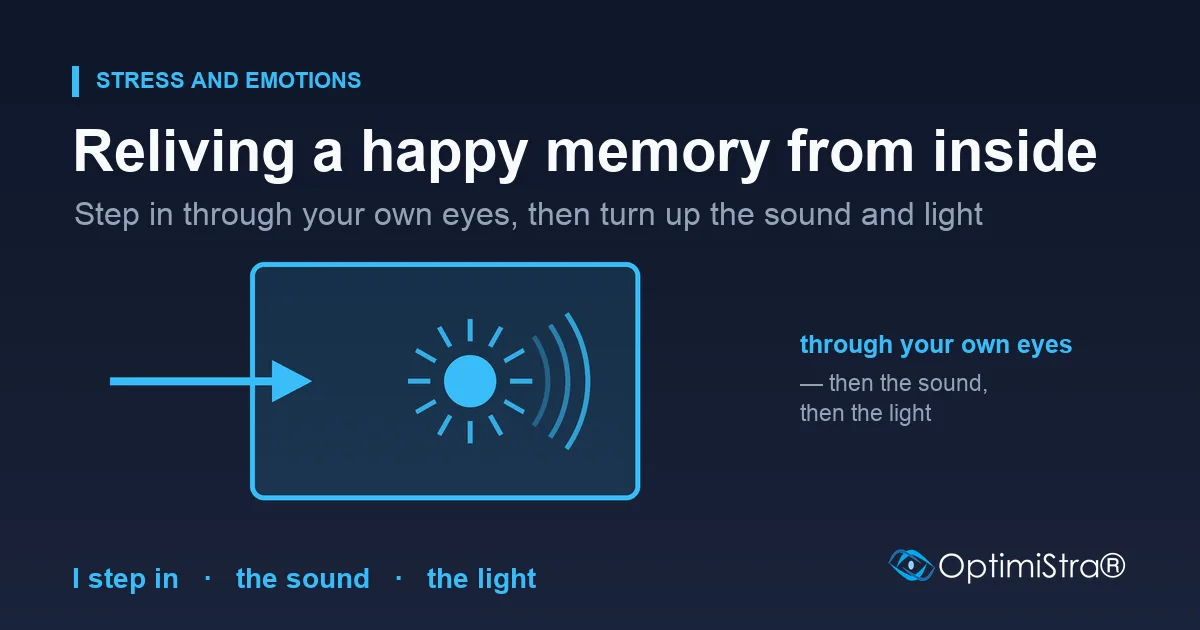
Reliving a memory from the inside means going back into it through your own eyes, as if you were there again: what was in front of you, your hands, the ground under your feet, each sound where it was, what your body felt. In Neuro-Linguistic Programming (NLP), we say you associate into the memory.
The exercise we suggest goes one step further. Once you’re inside the memory, you turn the sound up a little, then the light, as you would with a picture and a piece of music. These are qualities of the memory itself, which we introduced in the article on what separates a good memory from a very good one. And you stay a minute longer than usual, because we often pass through a good memory in the time it takes to smile, then move on to something else.
Why the body follows
We touched on this with the imagined lemon: the body responds in part to what you imagine in enough detail. Most of the time the brain knows it is imagining; when the imagining is precise, it has a harder time telling the difference. A happy memory relived in detail draws on the same mechanism: its sensations come back with it, at least in part.
It’s also the spirit of positive journaling, where you tell the story of a good moment instead of analyzing it. Here you don’t even tell it: you go back.
What a relived happy memory does in the face of stress
The most telling study comes from Rutgers University. Megan Speer and Mauricio Delgado recruited 134 healthy adults and put them through a mild laboratory stressor: a hand held in ice water while an evaluator watched. Afterward, each person spent a few minutes recalling 24 real memories, positive or neutral depending on the group. A second study, using brain imaging, involved 43 other people.
In both studies, recalling happy memories, and not neutral ones, limited the rise in cortisol, one of the stress hormones. The authors sum it up this way: “recalling positive, but not neutral, memories resulted in a dampened cortisol rise.”
They also point out the limits, and we pass them on. In the behavioral study, the drop in negative mood did not reach statistical significance. Their results say nothing about levels of stress other than the one in the lab. And the effect on mood appeared only in people who described themselves as fairly resilient: the strategy, they write, “may not be effective for everyone.”
A pleasant memory has value, literally
A few years earlier, the same team had asked a different question: how much do we value a happy memory? Trial after trial, participants could choose between recalling a positive memory and a neutral one, with small sums of money at stake. They regularly gave up part of their earnings to recall their happy memories, and that recall activated the brain’s reward circuit.
But the same study found no average change in mood among its participants, and its authors call it exploratory. A happy memory has value for the person recalling it; that doesn’t mean it improves everyone’s mood, every time.
In images rather than in words
On one point, the findings agree more closely. Sven Nelis and his colleagues at the University of Leuven had 78 students listen to about 100 short pleasant situations. Some were asked to picture them, others to think about the meaning of the words. Positive mood rose more after imagery. The difference is small, and the authors say so.
Do you also need to look through your own eyes? Studies that have looked for an advantage specific to that way of doing it find a small one, or none: the Leuven team, for example, found none with its imagined scenes. We keep it in the exercise because it helps you feel you’re there, without making it a rule. What matters most is reliving the memory in images, with its sounds and sensations, rather than thinking about it.
What research hasn’t tested
Turning up the sound and the light of a memory: none of the studies we read measured that. It’s a suggested practice, one we teach and one you can test for yourself.
The exercise
Choose a memory that is only good: if there’s a regret mixed in, or someone you miss, pick another. Then:
- close your eyes and step into it, until you see what you saw that day;
- turn the sound up a little: the voices, the music, the background noise;
- turn the light up a little: the colors, the sun;
- stay there a minute longer than usual.
If anything turns unpleasant, open your eyes: the exercise ends there. Then write down the memory in a few words, along with three details you noticed along the way.
Reliving a good moment this way is part of what we call managing your inner state. And what an article can’t do – watch you while you do it – is something you start learning on the first day of the NLP Practitioner course, eight days in person. It’s called calibration. The course includes twelve live group sessions on Zoom, one hour a month for a year.
Tomorrow morning
Try it. Tomorrow, a pleasant moment will come along: a hot coffee, a voice calling your name, a piece of work you finish well. Imagine you’re already there, looking through your own eyes. You hear the voice a little more clearly, the light in the room is a little warmer, and you stay a second longer than usual, just long enough to notice.
What will you want to keep from that moment?
Article written by Michel Wozniak and Nathalie de Marcé, and optimized by artificial intelligence.
Sources
- Speer & Delgado (2017), Reminiscing about positive memories buffers acute stress responses, Nature Human Behaviour
- Speer, Bhanji & Delgado (2014), Savoring the past. Positive memories evoke value representations in the striatum, Neuron
- Nelis, Vanbrabant, Holmes & Raes (2012), Greater positive affect change after mental imagery than verbal thinking in a student sample, Journal of Experimental Psychopathology
Frequently asked questions
What does it mean to relive a memory from the inside?
It means going back into it through your own eyes, as if you were there again: the setting around you, each sound where it was, what your body felt. In NLP, we say you associate into it. You can then turn the sound and the light of the memory up a little, and stay a minute longer.
Does recalling happy memories help with stress?
In the lab, yes, modestly. Speer and Delgado (2017) exposed 134 healthy adults to a brief stressor, then had them recall happy or neutral memories. Cortisol rose less after the happy memories. The study says nothing about stress that lasts, and the authors note that the strategy doesn’t work for everyone.
Is it better to think about a good moment in images or in words?
In images. Nelis and colleagues (2012) had 78 students either imagine pleasant scenes or think about the meaning of the words describing them. Positive mood rose more after imagery. The effects remain small.
What should I do if a happy memory turns unpleasant?
Open your eyes and stop there. Then choose another memory, one that is only good: no regret mixed in, no one you miss. A meal that went well, a walk, or a piece of good news will do very well.
How can I make a happy memory more vivid?
Choose a memory that is only good, close your eyes and step into it through your own eyes, then turn the sound up a little, then the light, and stay a minute longer than usual. If anything unpleasant comes in, open your eyes and choose another one.
Stress and Emotions
An emotion starts in the body: naming the sensation before the emotion
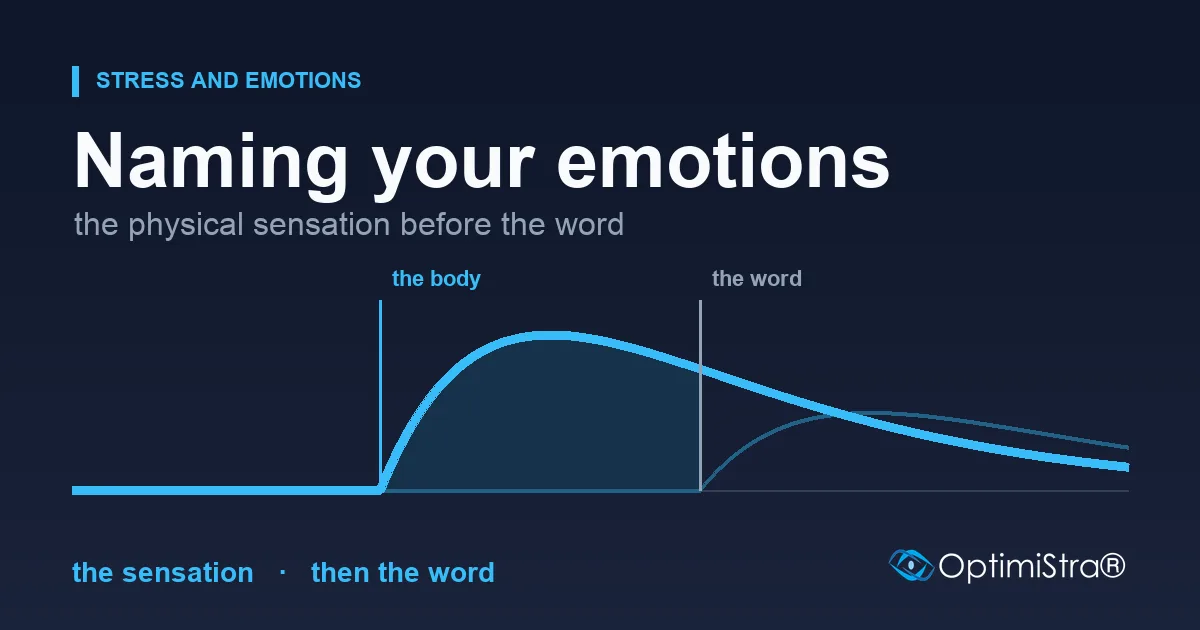
An emotion is a physical reaction set off by how you interpret an event, not by the event itself. The body moves first and the word comes later. Naming the sensation before the emotion takes 10 seconds. Here is what the research establishes, and the three precise points where it stops.
November 18, 2026 · 8 min read
Stress and Emotions
Physical signs of stress: what the body shows, and how much of it we notice
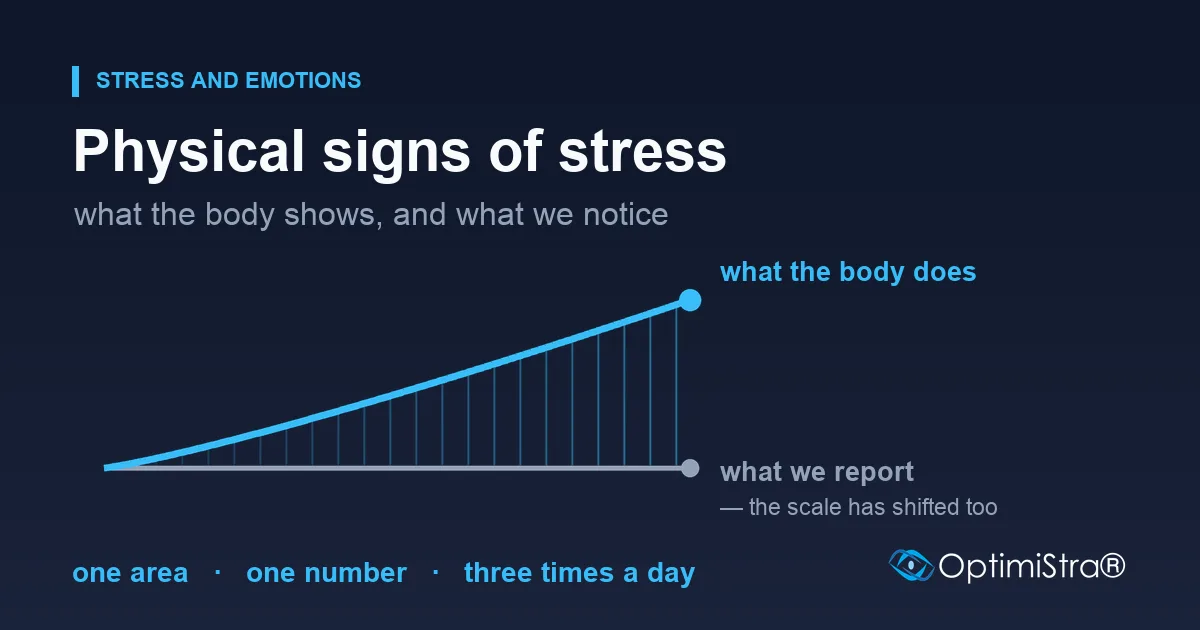
Under stress, the jaw muscles work harder: 38 studies show it. Yet what people report about their own tension from memory has almost nothing to do with what they notice when asked in the moment. And their point of comparison shifts along with them.
November 18, 2026 · 9 min read
Stress and Emotions
Evening routine: what the night does with your last 10 minutes
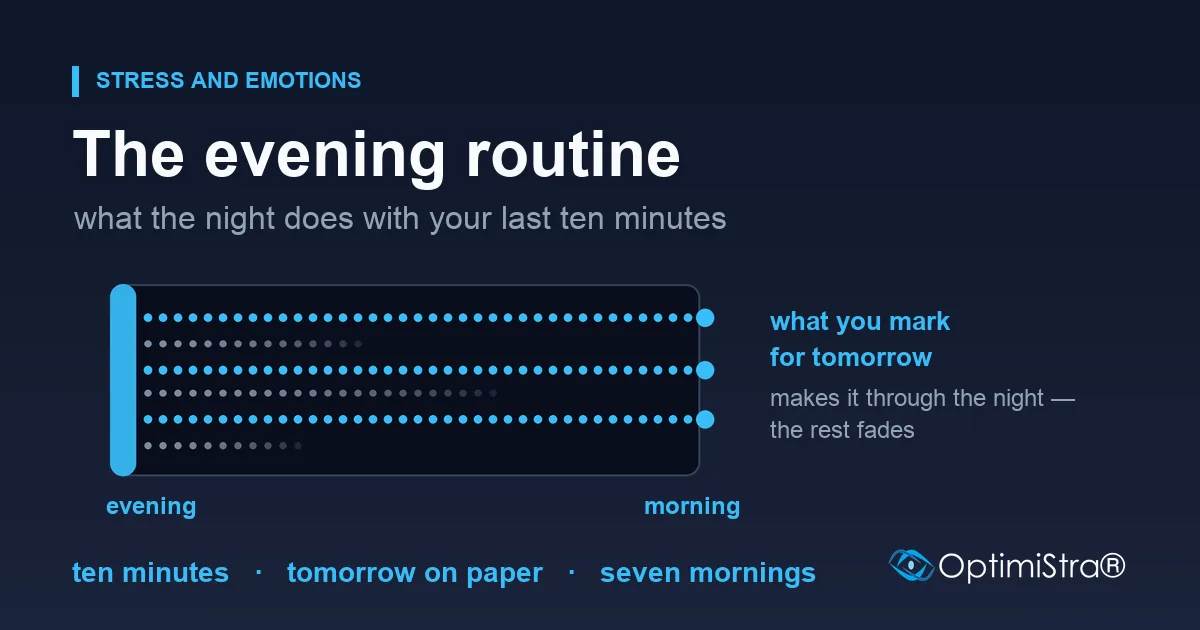
During sleep, the brain replays and consolidates what the day left behind, and it is selective: what has been marked as useful for tomorrow gets through, the rest far less. The best-measured evening habit is not positive thinking. It is writing tomorrow’s to-do list, in detail.
November 18, 2026 · 10 min read