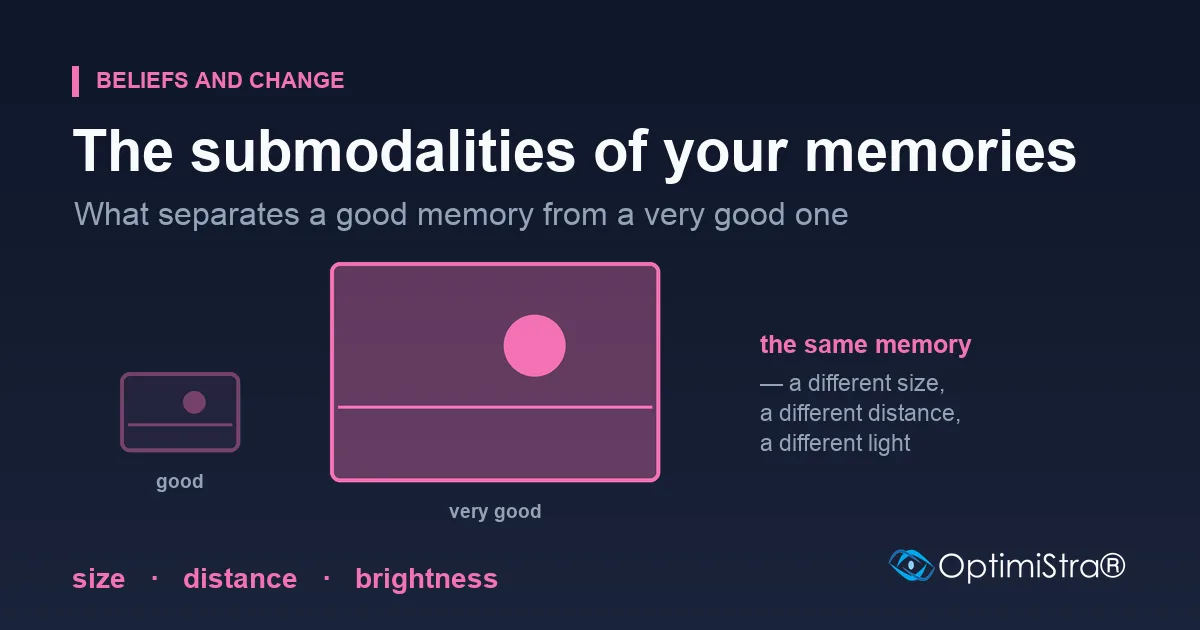
Submodalities: what separates a good memory from a very good one


Michel Wozniak and Nathalie de Marcé
Published November 18, 2026 · 5 min read
In brief
Submodalities are the fine qualities of a mental representation: the size, distance, and brightness of an image, the volume of a sound, the warmth of a sensation. Studies show that the intensity of a memory goes hand in hand with its vividness, though the notion itself has never been tested as such.
Before you read on, think of two good memories of the same kind: two meals, two walks, two evenings with friends. One was pleasant. The other still warms you when you think back to it. What separates them is, of course, what happened. Now look at how they come back to you. Is one larger than the other? Closer? Brighter?
Those qualities have a name in Neuro-Linguistic Programming (NLP): submodalities. This article explains what they are, what research has observed in closely related areas, and what it has never tested.
What submodalities are
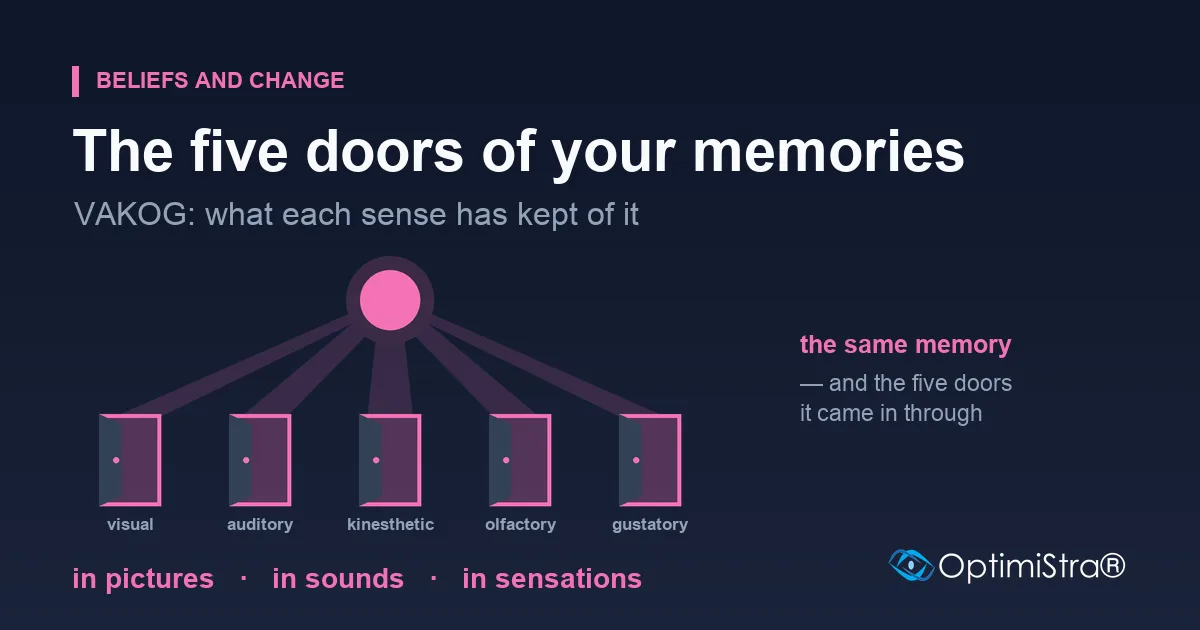
Everything we experience reaches us through five channels, which NLP groups under the acronym VAKOG: visual, auditory, kinesthetic, olfactory, and gustatory. We covered them in the article on the five senses of your memories. Submodalities go one level finer: they are the qualities of each of those channels.
- For an image: its size, distance, brightness, colors, sharpness, movement, and whether it has a frame.
- For a sound: its volume, direction, distance, rhythm, and tone.
- For a sensation: its warmth, its weight, where it sits in the body, and its intensity.
They describe the form of a memory, not its content. Two people can remember the same dinner; one sees it large, close up, and in vivid color, the other small, far away, almost in black and white. We teach submodalities from the second day of the NLP Practitioner course, because much of what follows builds on them. The course also includes twelve live group sessions on Zoom, one hour a month for a year.
Content and form
In the training room, Michel introduces them with an image: a pair of glasses. Changing the lenses changes nothing about the landscape. It only changes how the landscape reaches you. The content of a memory is what happened; its form is the way it comes back to you today.
That is why the exercise compares two memories of the same kind. When the stories are similar, what sets them apart has more to do with their form, and the difference is easier to see.
What research has observed
No study, to our knowledge, has tested submodalities under that name. Several have nonetheless measured things that come very close.
The vividness of intense memories. At Duke University, Jennifer Talarico, Kevin LaBar, and David Rubin asked 78 students to describe 20 memories, all of them pleasant: 10 calm ones and 10 more intense ones. The pleasure was the same in both sets. The intensity was not, and other differences came with it: on average, the intense memories came back slightly more vivid, and were felt much more clearly in the body. The authors sum it up: “intensity significantly predicts every autobiographical memory property.” Two reservations matter here: the differences in vividness were small, and the study is correlational. It does not say that enlarging an image would make a memory stronger; it says that intensity and form go together.
The size of an image. At the University of Bologna, Andrea De Cesarei and Maurizio Codispoti showed 40 people photographs, either intact or reduced to as little as one-eighth of their size. When reduced, the pleasant photos were less arousing, both in what participants said they felt and in their skin response. The authors stress, though, that once the content was recognized, size and blur left “little room for modulation.” And these were photos people looked at, not mental images.
Light. Daniël Lakens and his colleagues presented two versions of the same neutral photo, one lightened and one darkened. The lighter version was rated slightly more positive. The effect is modest, as the authors say themselves, and it comes mostly from the dark side: “negativity is more strongly associated with darkness, than positivity is associated with brightness.”
None of these studies deals with a memory you look at in your mind while noting its size. What they do say is that the form of an image has some bearing on what we feel about it, and that makes the observation worth making.
What has not been proven
In 2010, Tomasz Witkowski reviewed 35 years of research on NLP. The studies he analyzes deal with other notions: the preferred representational system and eye movements. Submodalities are not tested in them, and he lists them among the expressions he considers impressive and empty. They have been neither confirmed nor refuted. They have simply never been put to the test.
We would rather tell you this ourselves, as we do in the article that asks the broader question, is NLP scientific? We are the world’s first two French-speaking Master Trainers named by Richard Bandler himself, the co-creator of Neuro-Linguistic Programming, and we teach submodalities as a way of observing. The exercise below does not ask you to believe in any theory, only to look at two of your own memories.
An exercise to observe it for yourself
Choose two pleasant memories, a good one and a very good one, of the same kind if you can. For each, let the image come, then note three things:
- its size: as large as a photo, or as a movie screen?
- its distance: right in front of you, or far away?
- its brightness: bright, or rather dull?
If you feel like going further, add the colors, the sharpness, the movement, and whether or not there is sound. Then look for where the two memories differ most.
Two things to keep in mind. First, you note without changing anything: this week, you simply observe. Second, if no image comes, it doesn’t mean you’ve done it wrong. Some people form few mental images; in that case, just tell yourself what you would see if you could see it, as with the imagined lemon. That answer counts too.
The next time a good moment comes along
Try this. Think of a pleasant moment waiting for you this week: a meal with someone you love, an hour of quiet, a walk. Imagine you are already there. You look around and notice the light on the table, the faces close to you, the voices filling the room. You now know what your very good memories look like, and this one already has their form.
What in that scene tells you this moment will count?
Article written by Michel Wozniak and Nathalie de Marcé, and optimized by artificial intelligence.
Sources
- Talarico, LaBar & Rubin (2004), Emotional intensity predicts autobiographical memory experience, Memory & Cognition
- De Cesarei & Codispoti (2010), Effects of picture size reduction and blurring on emotional engagement, PLoS ONE
- Lakens, Fockenberg, Lemmens, Ham & Midden (2013), Brightness differences influence the evaluation of affective pictures, Cognition & Emotion
- Witkowski (2010), Thirty-Five Years of Research on Neuro-Linguistic Programming. NLP Research Data Base. State of the Art or Pseudoscientific Decoration?, Polish Psychological Bulletin
Frequently asked questions
What is a submodality in NLP?
A fine quality of a mental representation. For an image: its size, distance, brightness, colors, sharpness, and movement. For a sound: its volume, direction, and rhythm. For a sensation: its warmth, its weight, and where it sits in the body. Submodalities describe the form of a memory, not its content.
Are submodalities scientifically proven?
Not as such. Reviews of the research on NLP, such as Witkowski’s in 2010, deal with other notions, and no controlled trial has tested submodalities themselves. Related studies show that the intensity of a memory goes together with its vividness, or that a larger photo is more arousing.
Why does one memory feel stronger than another?
First because of what happened. With equal pleasure, though, Talarico, LaBar, and Rubin (2004) found that the most intense memories come back, on average, slightly more vivid and more strongly felt in the body. That is a correlation, not proof that enlarging an image strengthens a memory.
Are submodalities the same for everyone?
No. Two people can remember the same dinner, one large, close up, and in vivid color, the other small, far away, almost in black and white. That is why the exercise compares two memories from the same person instead of applying a general rule.
How do I identify the submodalities of a memory?
By comparing two pleasant memories of the same kind, a good one and a very good one. For each, note the size of the image, its distance, and its brightness, then look for where they differ. You observe without changing anything. If no image comes, tell yourself what you would see.
Beliefs and Change
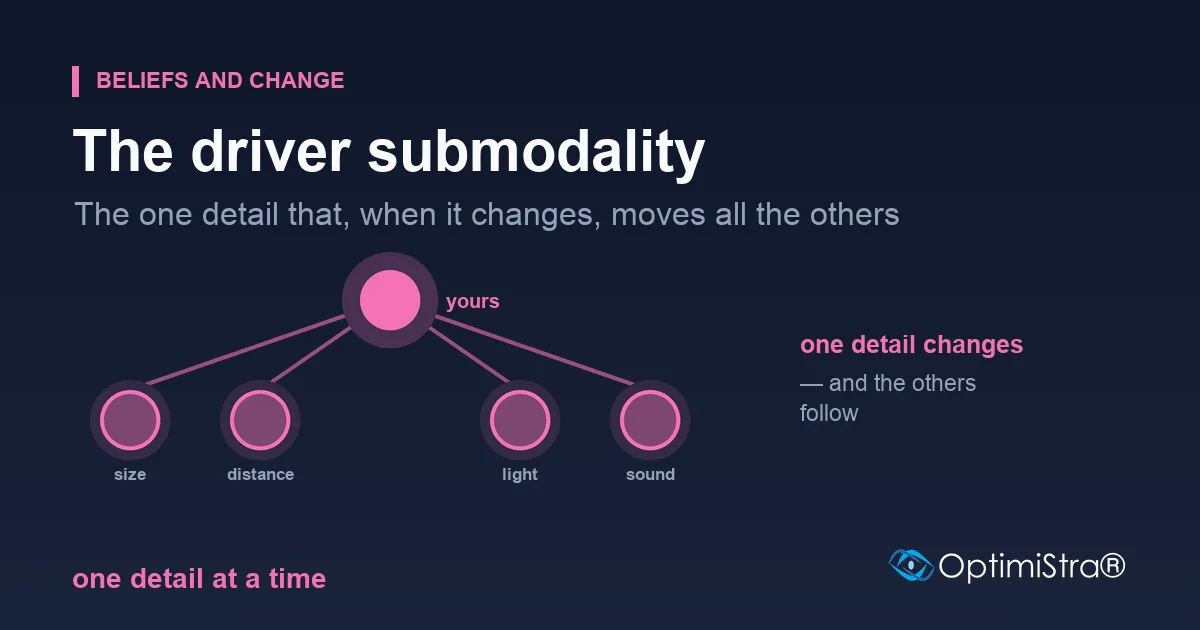
The driver submodality: the one detail that moves all the others
In NLP, the driver submodality is the quality of a mental image that carries the others with it when you change it: size, distance, brightness, or color, depending on the person. Studies show that a single visual detail can change what we feel, but none has tested this ripple effect.
November 18, 2026 · 5 min read
Beliefs and Change
VAKOG: the five senses of your memories, and what we really know about them
VAKOG stands for the five senses through which we live and recall an experience: visual, auditory, kinesthetic (the body and emotions), olfactory, and gustatory. Imagining draws partly on the same brain regions as perceiving, and each person does it differently. The idea of a dominant channel, however, has not been confirmed by research.
November 18, 2026 · 7 min read
Beliefs and Change
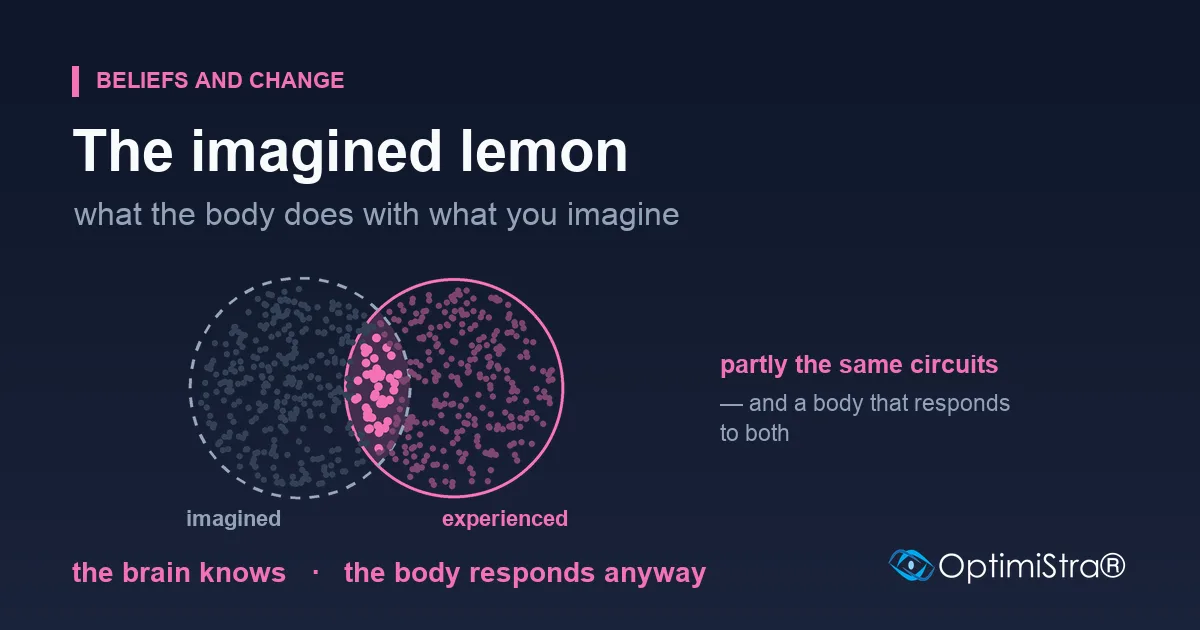
The imagined lemon: what your body does with what you imagine
Imagining a lemon makes you salivate, and imagining a movement activates some of the circuits that control it. Even so, the brain does not confuse real and imagined: it tells them apart, except when the inner image becomes strong enough. That is what makes mental rehearsal useful, to a modest degree.
November 18, 2026 · 8 min read