VAKOG: the five senses of your memories, and what we really know about them

Michel Wozniak and Nathalie de Marcé
Published November 18, 2026 · 7 min read
In brief
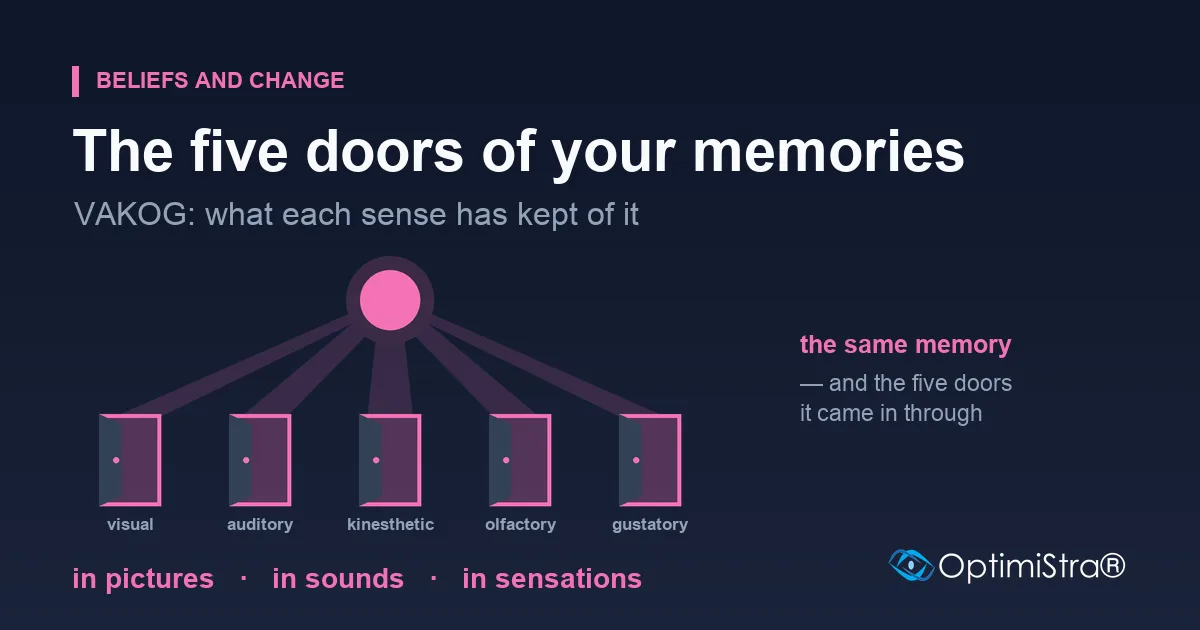
VAKOG stands for the five senses through which we live and recall an experience: visual, auditory, kinesthetic (the body and emotions), olfactory, and gustatory. Imagining draws partly on the same brain regions as perceiving, and each person does it differently. The idea of a dominant channel, however, has not been confirmed by research.
Try a ten-second experiment. Think of the word “banana.”
Chances are you didn’t see only a yellow shape. Perhaps the smell came, or the taste, or the small sound of the peel being pulled back, or the weight of the fruit in your hand. A single word opened several doors at once. This is the example Michel gives in class, and it is the whole subject of this article: which senses we live an experience through, which ones we use to find it again, and what research says about it, including when it contradicts us.
What VAKOG stands for
VAKOG is an acronym from Neuro-Linguistic Programming (NLP): visual, auditory, kinesthetic, olfactory, gustatory. These are the five channels through which an experience reaches us, and the five channels through which we represent it afterward, when we remember it, imagine it, or tell it. “Kinesthetic” covers everything the body feels: touch, movement, position, temperature, and emotions as they are physically felt.
Richard Bandler and John Grinder, who founded the discipline in the 1970s, called them “representational systems.” We teach them from the first day of the NLP Practitioner course, because everything else rests on them: you only work well on a representation once you have learned to notice what it is made of.
A representation is not reality. It is the map you keep of it, with its own details and its own gaps. We wrote about this in the article on what the brain sees, and what it adds: perception is already a construction. Memory is even more so.
Imagining puts your senses to work
Brain imaging measures what the banana exercise only hints at. In 2012, Chris McNorgan, at Northwestern University, brought together 65 studies that had asked participants to imagine something in one specific sense: sounds, touch on the skin, gestures, tastes, smells, shapes, colors, movements.
His conclusion: as a general rule, imagery in a given sense activates the regions that process that same sense in perception. The regions involved “generally overlap with” those of perception “but are not confined to” them. Imagining a sound puts part of your hearing to work, and imagining a gesture puts part of your motor system to work. On top of that, there is a shared network that is active whichever sense you imagine in.
In other words, remembering a meal is not like pulling a card from a file. It means replaying, in part and more faintly, what your senses did at the time. That is why a memory can be told in several ways, and why each telling lights up a different side of it.
Not everyone has the same doors open
The instruction “visualize” doesn’t work for everyone, and research established this only recently.
Carla Dance, Alberta Ipser, and Julia Simner surveyed 1,004 people who did not know what the study was looking for, using a standard questionnaire on the vividness of mental images. About 4% fell in the range of aphantasia: no mental images, or vague and dim ones. 0.8% had none at all. The authors point out that many of these people live without knowing they differ from others, and take the expression “seeing it in your mind” for a metaphor.
Another team, in Sydney, compared 267 people with aphantasia to control groups (Dawes, Keogh, Andrillon, and Pearson, 2020). On average, they report less imagery in all the senses, not only sight. Yet only 26% say they have no imagined sensory experience in any sense: the rest keep some in at least one sense. The authors conclude by pointing to “the large interindividual variability that characterizes our internal mental representations”: our inner representations vary a great deal from one person to the next.
The practical consequence is simple, and we think it matters. When an exercise asks you to “see” and nothing comes, you haven’t failed. Your memory goes through other doors. The right exercise is the one that lets you try them all.
What isn’t proven: the dominant channel
Part of the literature on NLP goes further. It claims that each of us thinks mainly in one channel, a “preferred representational system,” that you could recognize it from a person’s vocabulary (“I see what you mean” versus “I feel something’s off”), and that by speaking to them in that channel you would be better understood.
Studies have not confirmed this, and we would rather tell you so ourselves. In 1984, Christopher Sharpley reviewed the research available and concluded that the identification of this channel “is not supported by the research data.” In 2010, Tomasz Witkowski went back through the whole NLP research base: even among the studies favorable to NLP, none clearly established that distinct representational systems exist, or that a person mainly uses one of them from one situation to the next. And apart from one study, nothing solid showed that matching your vocabulary to the other person’s improves communication. The Sharpley quotation comes from Witkowski’s review, which we read in full; the 1984 article itself we have not opened.
Elsewhere on this blog, an article asks the broader question, is NLP scientific?, and examines its tools one by one. That is the spirit in which we teach. We are the world’s first two French-speaking Master Trainers named by Richard Bandler himself, the co-creator of Neuro-Linguistic Programming, and in class we are the ones who point out what research has not confirmed. VAKOG remains a valuable framework for observation. It is not a way of sorting people.
The same mistake at school: learning styles
The idea has a very widespread cousin: learning styles, in which every student is supposedly “visual,” “auditory,” or “kinesthetic” and would learn better if taught in that style.
Philip Newton, of Swansea University, summed up the state of the question in 2015: the matching step, teaching each person in their style, is “where the concept of Learning Styles completely falls down.” The standard review, by Harold Pashler and his colleagues in 2008, found no evidence that matching improves learning; we cite it through Newton. And yet, of the recent papers he surveyed, 89% still endorsed learning styles, implicitly or directly.
Newton also points to a risk: a student labeled “visual” may give up on a subject they believe is made for others. A label that closes a door does exactly the opposite of what VAKOG should make possible.
An exercise to observe it in yourself
What remains, once the promises are taken away, is both more modest and more useful: observing how your own memories are made. Choose a pleasant, recent memory, such as a meal, a walk, or a conversation, and tell it three times:
- in images: what there was to see, the place, the people, an object;
- in sounds: a voice, a noise, what was said;
- in sensations: what you were holding, the air on your skin, your position.
At the end, add a smell or a taste, if there was one. Then note which telling came easily, and which one took effort. Later in the week, do it again with another memory: the easy round is not necessarily the same one, and that is information in itself.
Listen, too, to the words around you, and to your own. Taken as a listening game, it is fun, and it makes you attentive to the way each person tells a story. Taken as a diagnosis, it is a mistake.
This preference for telling rather than explaining is the same one behind positive journaling, where you relive a good moment instead of analyzing it. Here, you relive it through each sense, one after the other.
Using the senses to aim more precisely
VAKOG has another use, which we also teach: checking that a goal is concrete enough. A goal you can see, hear, and feel once it is reached is a goal you know how to recognize.
Take a moment to try it. Think of a project that matters to you, and imagine the day it is done. You are there. What do you see around you: the place, the faces, the finished object sitting in front of you? What do you hear: a voice saying something to you, the quiet of a room, your own voice announcing it? And what do you feel, in your shoulders, in your breathing, at the moment you understand that it is done?
Which of these three tellings made you most want to be there?
Article written by Michel Wozniak and Nathalie de Marcé, and optimized by artificial intelligence.
Sources
- McNorgan (2012), A meta-analytic review of multisensory imagery identifies the neural correlates of modality-specific and modality-general imagery, Frontiers in Human Neuroscience
- Dawes, Keogh, Andrillon & Pearson (2020), A cognitive profile of multi-sensory imagery, memory and dreaming in aphantasia, Scientific Reports
- Dance, Ipser & Simner (2022), The prevalence of aphantasia (imagery weakness) in the general population, Consciousness and Cognition
- Witkowski (2010), Thirty-Five Years of Research on Neuro-Linguistic Programming. NLP Research Data Base. State of the Art or Pseudoscientific Decoration?, Polish Psychological Bulletin
- Newton (2015), The Learning Styles Myth is Thriving in Higher Education, Frontiers in Psychology
Frequently asked questions
What does VAKOG stand for?
Visual, auditory, kinesthetic, olfactory, and gustatory: the five channels through which we perceive an experience and through which we represent it afterward. Kinesthetic covers everything the body feels: touch, movement, position, and emotions as they are physically felt.
Can you tell whether someone is a visual, auditory, or kinesthetic person?
Not reliably. Reviews of the research on representational systems, from Sharpley in 1984 to Witkowski in 2010, found no clear evidence that a person mainly uses one channel from one situation to the next, or that it can be identified reliably. The telling that comes easily can change from one memory to another.
Do people learn better when taught in their learning style?
Studies do not show it. Classifying a student as visual, auditory, or kinesthetic and then teaching them in that style does not improve what they learn: this is the matching hypothesis, and it has never been confirmed. Newton (2015) notes that it is nonetheless still endorsed in a large majority of the recent papers that discuss it.
What is aphantasia?
The absence of visual mental images, or very dim ones. In a sample of about a thousand people, Dance, Ipser, and Simner (2022) found around 4%, including fewer than 1% with no image at all. Many are unaware of it, and most keep representations in other senses.
How can I notice which senses my own memories are made of?
Tell the same pleasant memory three times, one sense per round: what there was to see, what there was to hear, then what your body felt, with a smell or a taste if there was one. Note which telling comes easily, and repeat later with another memory to see whether it is the same one.
Beliefs and Change
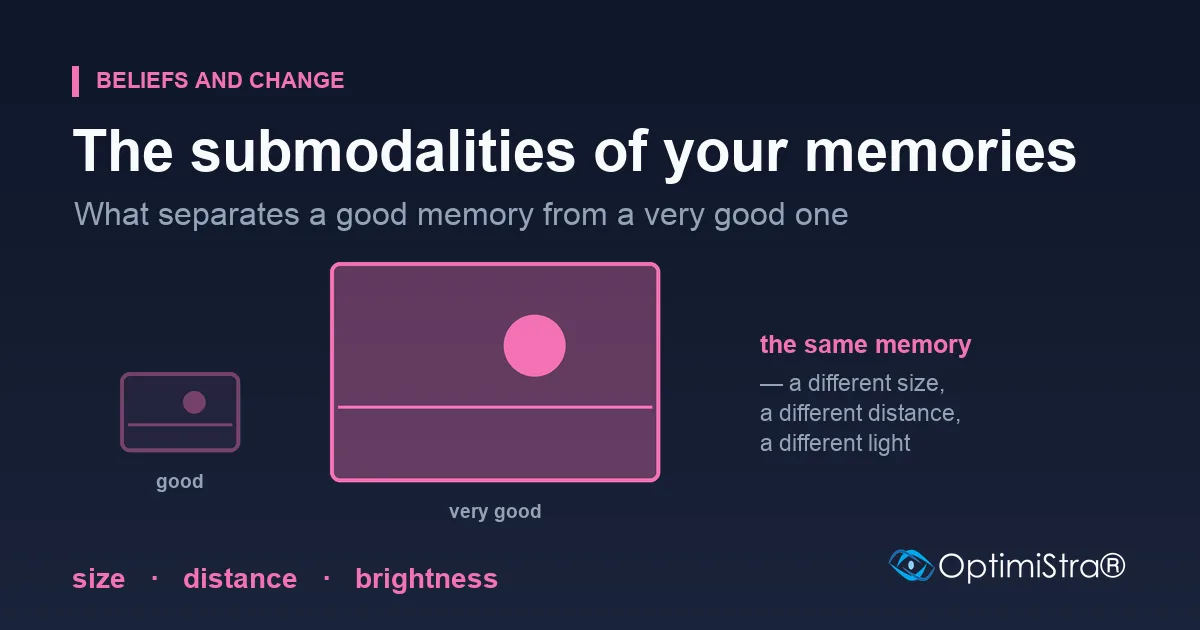
Submodalities: what separates a good memory from a very good one
Submodalities are the fine qualities of a mental representation: the size, distance, and brightness of an image, the volume of a sound, the warmth of a sensation. Studies show that the intensity of a memory goes hand in hand with its vividness, though the notion itself has never been tested as such.
November 18, 2026 · 5 min read
Beliefs and Change
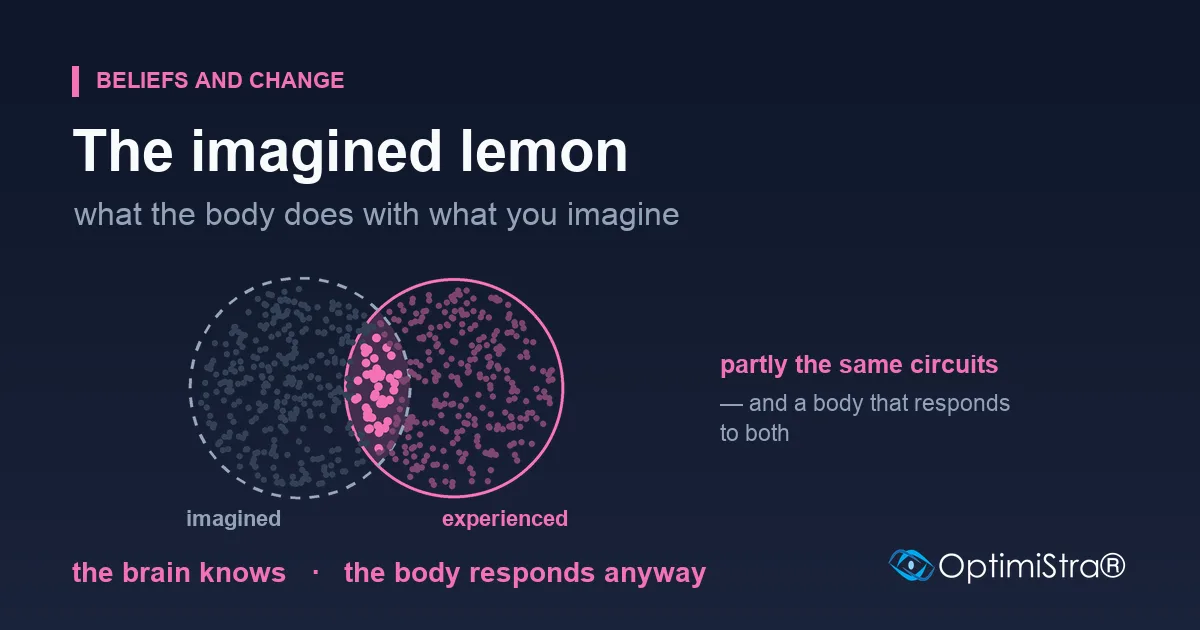
The imagined lemon: what your body does with what you imagine
Imagining a lemon makes you salivate, and imagining a movement activates some of the circuits that control it. Even so, the brain does not confuse real and imagined: it tells them apart, except when the inner image becomes strong enough. That is what makes mental rehearsal useful, to a modest degree.
November 18, 2026 · 8 min read
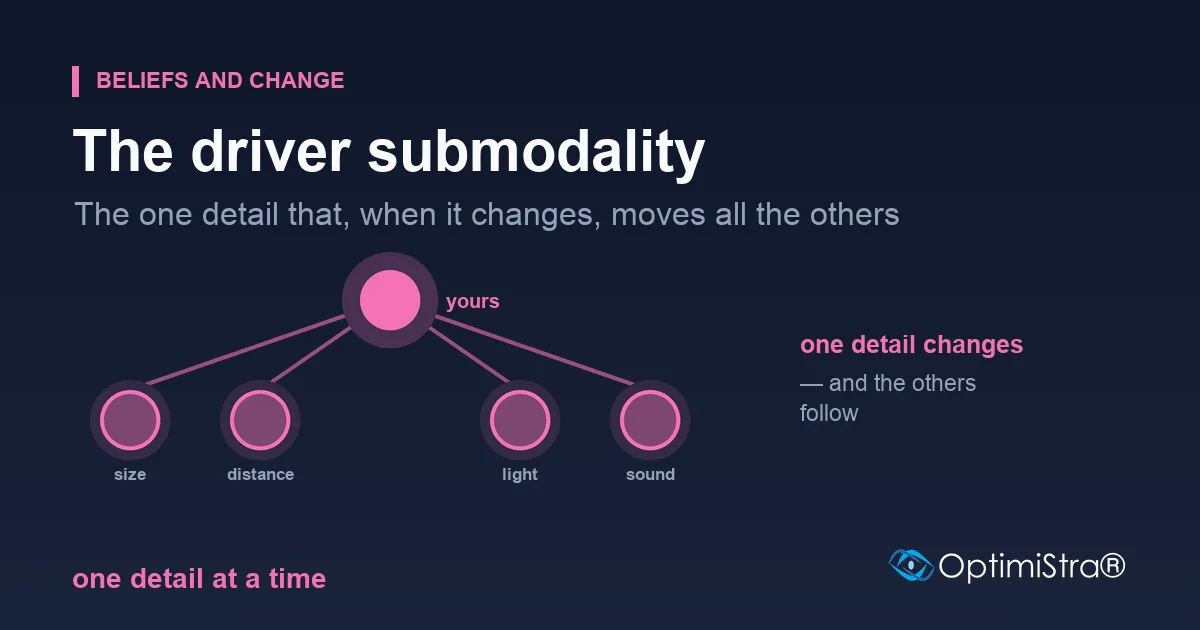
Beliefs and Change
The driver submodality: the one detail that moves all the others
In NLP, the driver submodality is the quality of a mental image that carries the others with it when you change it: size, distance, brightness, or color, depending on the person. Studies show that a single visual detail can change what we feel, but none has tested this ripple effect.
November 18, 2026 · 5 min read