The driver submodality: the one detail that moves all the others


Michel Wozniak and Nathalie de Marcé
Published November 18, 2026 · 5 min read
In brief
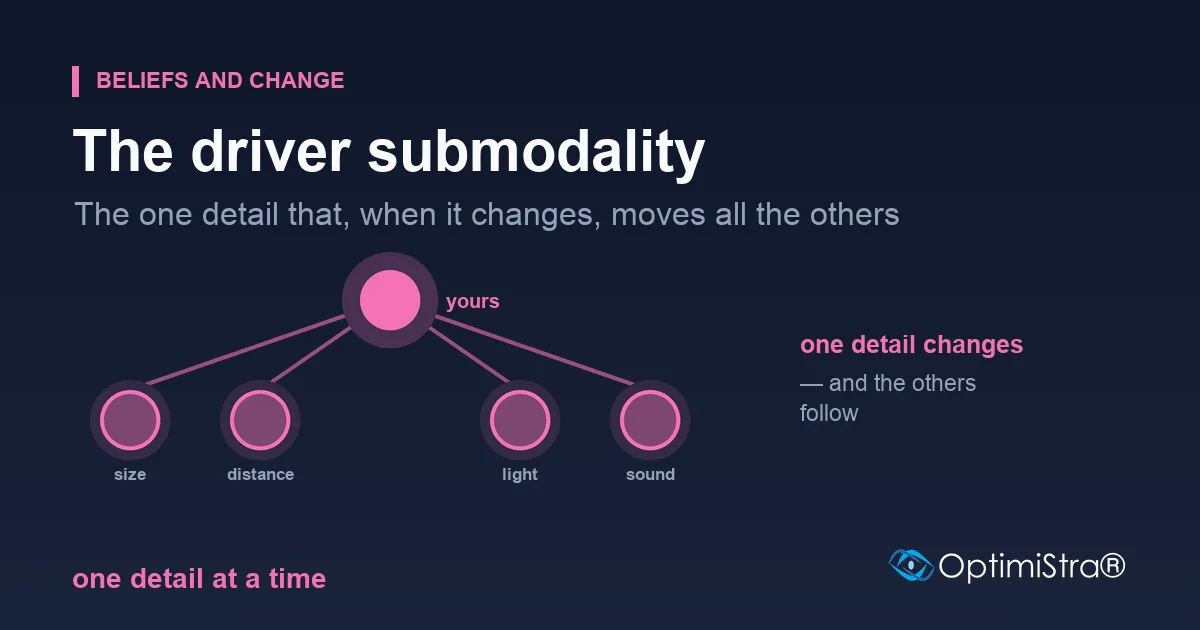
In NLP, the driver submodality is the quality of a mental image that carries the others with it when you change it: size, distance, brightness, or color, depending on the person. Studies show that a single visual detail can change what we feel, but none has tested this ripple effect.
Take a pleasant memory and make the image a little brighter. For some people, almost nothing happens. For others, the image moves closer at the same moment, the colors wake up, the voices get louder. Only one thing changed, and the rest followed.
In Neuro-Linguistic Programming (NLP), that detail is called the driver submodality. This article explains what it is, why people look for it, what research allows us to say about it, and what research has never tested.
What a driver submodality is
Submodalities are the fine qualities of a mental representation: the size, distance, brightness, or colors of an image, the volume of a sound, the warmth of a sensation. We introduced them in the article on what separates a good memory from a very good one, and they build on the five senses of VAKOG.
The driver submodality is one of them, the one that drives: when you change it, others change with it, and the overall impression shifts more than it would with any other. Driver is the word used in the course, and it says exactly what it means.
Looking for the simplest lever
The notion is taught at NLP Master Practitioner level, where it carries a principle called elegance. Rather than pulling every lever at once, you look for the smallest one that does the most. In the training room, Michel puts it in one line: don’t overcomplicate it, try the simplest thing first.
It’s also a matter of economy. When you know the detail that lights up a memory, you find that memory more easily, and you know what to look at when a new good moment comes along. There’s no need to adjust everything: a single move is often enough to change the overall impression.
A single detail can change what we feel
Nobody has measured the ripple effect itself. What several studies do show is that a single quality of an image can change how we feel about it.
Color. At the University of California, Los Angeles, Lin, Mottaghi, and Shams asked 99 students, across three experiments, to rate how much they enjoyed a series of photographs. Pleasant photos were enjoyed clearly more in color than in black and white. More striking still: when the researchers simply cut the color saturation by half, those photos were enjoyed less, even though no participant had noticed the difference. The authors conclude that “color presence amplifies the emotional reactions to real-life images.” They point out two limits themselves: these are subjective ratings, and these were photos people looked at, not mental images.
The image rather than the words. Mathews, Ridgeway, and Holmes compared two ways of thinking about the same ordinary object: picturing it as an image for 4 seconds, or making a sentence about it. Across 93 participants in two experiments, the mental image was rated as more pleasant than the sentence when the objects were pleasant ones. Their conclusion: images “seem to amplify emotion,” in the direction of their content. The gap is modest, and the objects were only mildly pleasant. Still, the study says something useful for the exercise: the image is where the adjustments take hold.
We don’t all respond to the same details
If the driver were the same for everyone, we could simply tell you what it is. It isn’t, and research on mental imagery points the same way.
The Plymouth questionnaire, developed by Jackie Andrade and her colleagues, measures how vivid mental images are, one sense at a time: sight, sound, smell, taste, touch, bodily sensations, emotions. According to the study’s abstract, it is not unusual for someone to rate one sense as strong and another as weak. A Spanish team used the questionnaire with 394 students and found the same seven distinct dimensions; it concludes that imagery depends on each person’s abilities and strategies.
None of this measures the size or the distance of an image. It does make plausible what the exercise will let you see for yourself: your detail is probably not your neighbor’s.
What has not been tested
We looked for a study that tests the driver submodality, or the idea that one quality of an image carries others with it. We found none. Researchers change one quality at a time, and they never measure that ripple effect. It is a notion drawn from observation and from practice, and we present it as such, in the same spirit as the article Is NLP scientific?.
The exercise below, on the other hand, measures precisely what the studies don’t: what followed on its own.
An exercise to find yours
Take a memory that is simply pleasant, and rate out of 10 what it makes you feel. Then try these changes, one at a time:
- the image larger;
- the image closer;
- the image brighter;
- the image more colorful;
- the sound louder, if there is one.
After each try, give a rating out of 10, write down what changed on its own, then put the image back the way it was before the next one. That reset is what lets you know which change did what. The one that changes the most, and carries the others with it, is probably your driver. At the end, leave the memory the way you like it best.
Next time
Imagine next week. A good moment arrives: a meal, a laugh, a quiet hour. You now know your detail, and you look for it almost without thinking: the light on the faces, or how close they are, or the sound of the voices. The moment settles in you a little more clearly than usual.
Which of your details would you like to find again that day?
Article written by Michel Wozniak and Nathalie de Marcé, and optimized by artificial intelligence.
Sources
- Lin, Mottaghi & Shams (2024), The effects of color and saturation on the enjoyment of real-life images, Psychonomic Bulletin & Review
- Mathews, Ridgeway & Holmes (2013), Feels like the real thing. Imagery is both more realistic and emotional than verbal thought, Cognition & Emotion
- Pérez-Fabello & Campos (2020), Spanish Version of the Plymouth Sensory Imagery Questionnaire, Frontiers in Psychology
- Andrade, May, Deeprose, Baugh & Ganis (2014), Assessing vividness of mental imagery. The Plymouth Sensory Imagery Questionnaire, British Journal of Psychology (résumé)
Frequently asked questions
What is a driver submodality in NLP?
Among the qualities of a mental image (size, distance, brightness, color, sound), it is the one that carries the others with it when you change it. When some people make the image brighter, for example, they also see it move closer and come to life. The term comes from NLP and is taught at Master Practitioner level.
Is the driver submodality the same for everyone?
No, and that is the whole point of looking for your own. Mental imagery questionnaires measure vividness one sense at a time, and many people rate one sense as strong and another as weak. The detail that matters for one person is not necessarily the one that matters for another.
Is there scientific evidence for the driver submodality?
No. No study has tested the idea that one quality of an image carries others with it. Studies do show that a single detail, such as the color of a photo, can change how much we enjoy it, even when we don’t notice the change.
Do I need to reset the image between tries?
Yes. Without that reset, the changes add up and you can no longer tell which one produced the effect. At the end of the exercise, you can leave the memory the way you like it best.
How do I find my driver submodality?
Take a pleasant memory, rate it out of 10, then change one quality at a time: larger, closer, brighter, more colorful, the sound louder. Rate it after each try and put the image back the way it was before the next one. The change that does the most, and carries others with it, is probably yours.
Beliefs and Change
Submodalities: what separates a good memory from a very good one
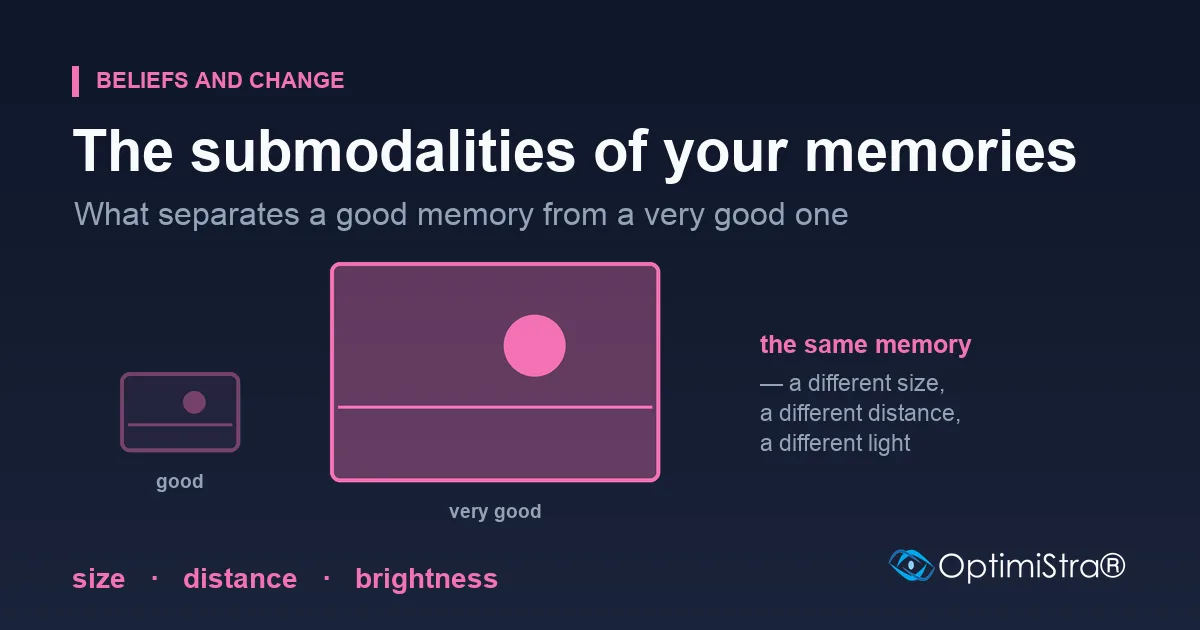
Submodalities are the fine qualities of a mental representation: the size, distance, and brightness of an image, the volume of a sound, the warmth of a sensation. Studies show that the intensity of a memory goes hand in hand with its vividness, though the notion itself has never been tested as such.
November 18, 2026 · 5 min read
Beliefs and Change
The imagined lemon: what your body does with what you imagine
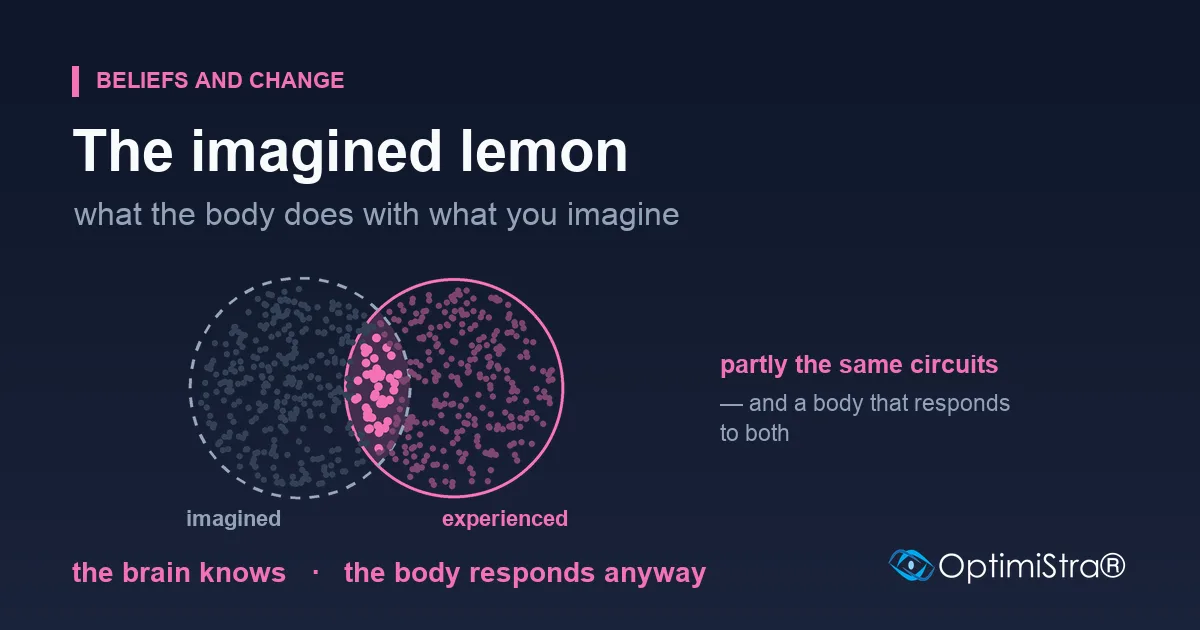
Imagining a lemon makes you salivate, and imagining a movement activates some of the circuits that control it. Even so, the brain does not confuse real and imagined: it tells them apart, except when the inner image becomes strong enough. That is what makes mental rehearsal useful, to a modest degree.
November 18, 2026 · 8 min read
Beliefs and Change
VAKOG: the five senses of your memories, and what we really know about them
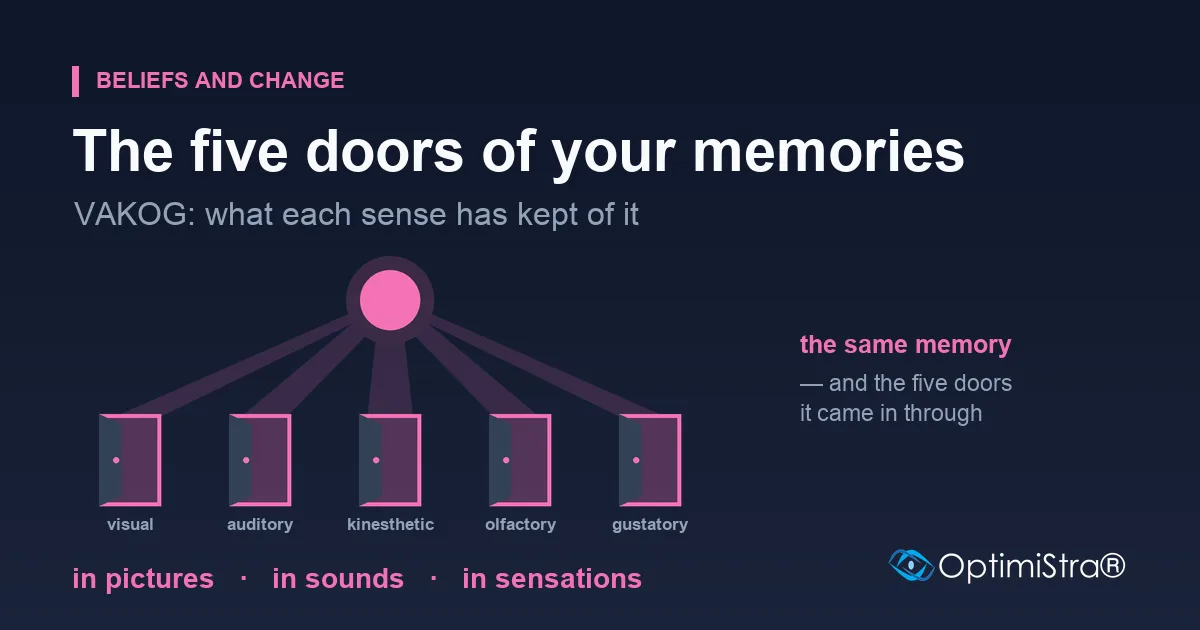
VAKOG stands for the five senses through which we live and recall an experience: visual, auditory, kinesthetic (the body and emotions), olfactory, and gustatory. Imagining draws partly on the same brain regions as perceiving, and each person does it differently. The idea of a dominant channel, however, has not been confirmed by research.
November 18, 2026 · 7 min read