Is NLP scientific? The real question isn’t the one you think it is

Published November 18, 2026 · 12 min read
In brief
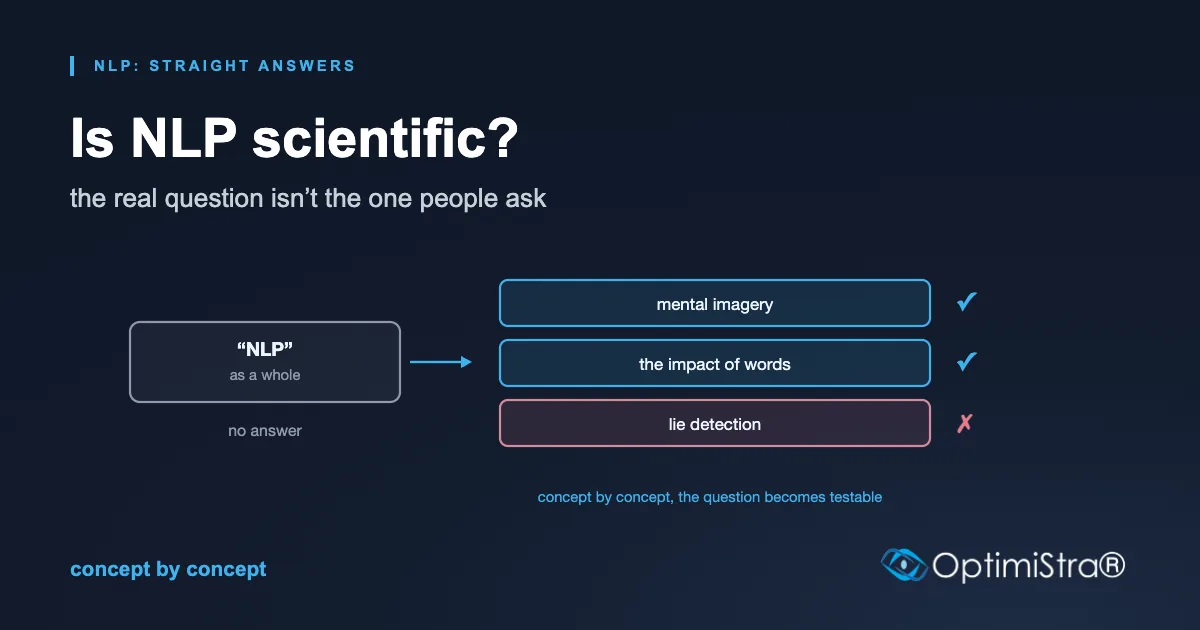
Neuro-Linguistic Programming (NLP) cannot be validated as a block, because it is an assembly of separate concepts and not a single theory. The most critical review says so itself: the scarcity of evidence reflects how few and how weak the studies are, not proof that it does not work. Taken concept by concept, the answer can be checked.
If you’ve landed on this page, the chances are you’re someone with high standards. Someone who doesn’t swallow an approach because it’s fashionable, who is wary of personal development when it smiles a little too much, and who would like to know, before going any further, whether all this rests on something solid or on thin air.
Good news: that’s exactly the right attitude. And it’s because you’re asking the question that this page will interest you.
Because I’m going to tell you something that a person selling a course would never tell you: the question “Is Neuro-Linguistic Programming (NLP) scientific?” is the wrong question. Not because the answer would be embarrassing, but because the question, as it stands, simply cannot be settled. Let me explain why.
The problem nobody dares to name
Ask 20 NLP trainers what NLP is and you’ll get 20 different definitions.
That isn’t an exaggeration, it’s a fact, and it’s the heart of the problem. How do you prove scientifically something that nobody can define precisely? You can’t validate, or invalidate for that matter, an object whose outline changes with whoever happens to be describing it.
So when people ask me “Is NLP scientific?”, my honest answer is: it can’t be answered. And nobody will ever answer it seriously until we’ve defined what we’re talking about.
Notice the reversal. You expected me on the defensive, ready to wave studies around in defense of my discipline. And I start by telling you that the question, put that way, means nothing. A trainer who begins by defusing his own subject is a rare thing. It’s also exactly where things get interesting.
What NLP really is: a collection of what works
To understand why, you need to know how NLP came about.
Most people imagine that its co-creators, Richard Bandler and John Grinder, invented a theory from scratch. That isn’t what happened, and what they did was a good deal more demanding. They went and observed people who were getting exceptional results – therapists, hypnotists, linguists – and took from them whatever produced those results. Even in linguistics they didn’t start from nothing: they drew on Noam Chomsky’s models.
Their genius lies in three moves, and none of the three is invention.
Drawing the best out of what works. That means spotting, in someone who succeeds, what actually produces the result, as opposed to what they believe they do or say they do. The two rarely match, and that’s usually where everything gets lost. It’s extraction work, and far more demanding than inventing one more theory.
Having the humility to throw out what doesn’t work. That includes what you found yourself, what you’ve been teaching for 10 years, what you’re attached to. Very few schools manage it: most defend their body of knowledge. Yet that’s exactly where the difference between a method and a dogma lies.
Combining it all into something that makes sense. This is the rarest of the three. Pieces taken from 10 different people don’t make an approach; they make a pile. They had to be fitted together until the whole thing stood up, could be passed on, and produced the same effects in someone else. The result is a coherent whole to practice and to teach, which is not the same thing as a single theory.
And that changes the whole picture. NLP isn’t a theory you could validate in one go. It’s an assembly of independent concepts, gathered here and there because they produced effects. Trying to prove “NLP” as a whole is like trying to prove “the toolbox.” It makes no sense. Witkowski ran into this when he compiled a database of research on NLP: what can be tested can be tested concept by concept, and the rest can’t be tested at all. Take each tool one at a time and put it under scrutiny, though, and a serious conversation can begin.
Taken one by one, the concepts are validated
So let’s do that. Let’s take the elements of NLP one at a time, independently, and look at what science says today.
Anchoring. NLP has talked about anchoring from the start. Today there are hundreds of studies on the subject, and elite athletes all over the world use the technique. One caution is needed here: NLP’s “anchoring” and the “anchoring” of judgment heuristics share a word without meaning the same thing. We now know what an anchor is: a connection that forms in the brain, which you set out to amplify and strengthen, and which lets a specific trigger set off a precise state. It isn’t magic. It’s neurology.
And these aren’t empty words. The mechanism has a name in the literature: evaluative conditioning. Hofmann, De Houwer, Perugini, Baeyens and Crombez brought together 214 studies of it: pairing a neutral item with an emotionally charged one shifts how the first is felt, by about half a standard deviation. One detail runs against what you’d expect: the effect is stronger when the person is aware of the pairing, not when it’s imposed without their knowing. Phelps and LeDoux, for their part, described the circuits that build these associations, with the amygdala foremost among them. In the field, Rupprecht, Tran and Gröpel pooled 112 measures on athletes’ pre-performance routines, those set gestures repeated before serving or taking a shot: the effect is there, and it holds under pressure, which is the very moment you need it. As for Smith and Vela, they established that a context associated with learning reopens access to it when that context is restored, including, and this is the whole point, when it is restored only in the mind.
Submodalities and mental imagery. For 50 years NLP has worked on the idea that when you imagine something, something real happens in the brain. Hardwick, Caspers, Eickhoff and Swinnen established it across 303 motor imagery experiments, and McNorgan for imagery in the other senses. Science now confirms it: when you imagine yourself lifting a weight, you activate almost the same brain areas as if you were really lifting it. And the effect doesn’t stop at brain imaging. In 2020 Toth and colleagues redid, to today’s methodological standards and with a check for publication bias, a meta-analysis of mental practice that was 24 years old. The result holds: small, but real and lasting. I’d rather tell you that than sell you a miracle. People said 50 years ago that this was nonsense, not scientific in the slightest. Today they say it’s scientific, because it has been proven. NLP hasn’t changed. Science has caught up with it.
The impact of words. Take the linguistic side: the effect of deletions, generalizations, distortions and imprecise language. Linguistics has produced a considerable body of research on it, and here are three of the most solid examples. Loftus and Palmer showed witnesses a film of a car accident, then asked them how fast the cars were going. Depending on whether the question used the verb “hit” or “smashed,” the average speed estimate rose by 20%, and a week later more than twice as many of those who had heard “smashed” remembered broken glass that had never been there. One verb was all that had changed. Kühberger pooled 136 studies and nearly 30,000 participants: presenting a strictly identical decision in terms of gains instead of losses tilts people toward caution, and the reverse toward risk. The effect is modest in size, but reliable. And Torre and Lieberman reviewed what happens when you put a word to what you feel: the intensity of the emotion drops, in the body as in the brain, without your even having the sense of regulating anything. A neighboring idea, on the other hand, doesn’t hold up, and here again it pays to be precise about what was refuted. Pashler, McDaniel, Rohrer and Bjork looked at whether teaching someone in their preferred sensory channel improves their learning, and found no evidence that it does. That preferences exist is one thing; turning them into a teaching rule is another. The impact of words on human beings no longer needs demonstrating.
And we could go on like this, topic after topic. The pattern is almost always the same: NLP observed a phenomenon decades ago, it was dismissed as esoteric, and research eventually confirmed what it had been saying.
The straw man: refuting what NLP never said
There’s another pattern, a less flattering one, and I’ll take it through the example most often cited against us.
In 2012 Wiseman, Watt, ten Brinke, Porter and colleagues tested the idea that eye movements give away a lie: looking up and to the right would signal lying, up and to the left the truth. They ran three studies, one of them on real press conferences, and found nothing. The idea doesn’t stand up.
I don’t dispute a line of that work. It’s well done, and the belief deserved to be demolished.
What I dispute is who it gets pinned on. Their paper opens with “Proponents of Neuro-Linguistic Programming (NLP) claim that certain eye-movements are reliable indicators of lying” and closes on results that “fail to support the claims of NLP.” Between the two, it has moved from what practitioners say to what the discipline is supposed to assert. Those aren’t the same thing.
Because the idea doesn’t come from NLP. What Bandler and Grinder described in Frogs into Princes are accessing cues: the direction of a person’s gaze tells you which sensory channel they are using at that moment, recalling an image or talking to themselves. It’s a clue to how someone is thinking, and never a lie detector. Paul Ekman shows exactly the same caution about facial micro-expressions: Ekman and Friesen described leakage, places worth probing, and never turned it into a verdict. A set of clues is not proof.
So where does the liar who looks to the right come from? From trainers who misread, passed it on badly, and turned a clue into a certainty because it made for a better workshop. They manufactured the belief, research refuted it, and NLP got the bill.
Remember the maneuver, because it has a name: the straw man. You attribute to someone a claim they never made, you demolish it, and you announce that you’ve refuted them. And if I’m teaching it to you here, on an example that works against us, it’s because that’s the only honest way to teach it.
Bandler’s method, and ours
Here’s a detail that says a lot about the spirit of the approach.
Richard Bandler has only ever kept what science ended up validating. It’s a principle of constant sifting: you observe, you test, you keep what survives the test and you throw out the rest. It’s a deeply experimental attitude, a long way from the dogma NLP is often credited with.
For our part, we took that logic all the way. Instead of trying to prove that “NLP works,” which as we’ve seen means nothing, we followed the advice of a minister’s office: bring scientists directly into our courses, and ask them to check whether everything said there matches their body of knowledge.
And I want to be precise about what happened next, because that’s where it all turns.
It wasn’t an exam you sit once. Around 20 experts came and attended: doctors of neuroscience, psychologists, psychoanalysts and other specialists besides. After each visit we debriefed with them. And whatever they flagged, we reworked: a phrasing that invited confusion, a shortcut that didn’t stand up in their discipline, a word that doesn’t mean the same thing to them as it does to us. We corrected the course. Then the next one came, and we started again. It took us several years.
It’s slow and thoroughly thankless work that no brochure boasts about: nobody advertises how many times a course has been rewritten. But it’s the reason why, today, what’s said in our training rooms agrees with what neuroscience knows, what psychology knows and what practitioners from other backgrounds know. None of the experts who came concluded that the approach was incompatible with their discipline, and I want that read for what it is: not an exam passed first time, but what remains after years of back-and-forth.
So we didn’t ask to be taken at our word, and we didn’t go looking for a stamp to display. We opened the door to the most demanding people, let them judge, and changed what needed changing. That is, I believe, the only honest way to answer someone who is wary.
So, is NLP scientific?
Put that way, the question will stay unanswered, because nobody can define what “NLP” is. The most cited review on the subject, by Sturt and colleagues in the British Journal of General Practice, ends up in the same place: it finds little evidence, and says itself that this reflects the scarcity and weakness of the studies, not a demonstration that NLP doesn’t work. But rephrase it – what, within NLP, is validated by research? – and the answer becomes clear, concrete and checkable concept by concept.
And that’s the idea I want to leave you with. Your skepticism isn’t an obstacle to NLP. It’s exactly the quality this approach asks for. Nobody is asking you to believe. You’re asked to look at what works, to test it on yourself, and to keep only what survives the test.
That’s what Bandler did. It’s what the scientists who came into our training rooms did. And it’s what I invite you to do in turn.
Going further
If this way of asking questions – demanding, uncompromising and ready to throw out what doesn’t stand up – appeals to you, you’ll soon see why NLP as we teach it has little to do with the image people have of it.
Keep exploring. The next article shows what NLP does not claim to do, and you’ll see that rigour often begins with knowing your own limits.
Read on
If what you’ve just read interests you, the next steps are the limits and risks of NLP, what sets it apart from therapy, a model that research has abandoned, what the three words of its name say and the NLP program: Practitioner, then Master Practitioner.
Article designed and written by Michel Wozniak, and optimized by artificial intelligence. Illustration created by artificial intelligence.
Sources
- Sturt, Ali, Robertson, Metcalfe, Grove, Bourne & Bridle (2012), Neurolinguistic programming: a systematic review of the effects on health outcomes, British Journal of General Practice
- Witkowski (2010), Thirty-Five Years of Research on Neuro-Linguistic Programming. NLP Research Data Base. State of the Art or Pseudoscientific Decoration?, Polish Psychological Bulletin
- Hardwick, Caspers, Eickhoff & Swinnen (2018), Neural correlates of action: Comparing meta-analyses of imagery, observation, and execution, Neuroscience & Biobehavioral Reviews
- McNorgan (2012), A meta-analytic review of multisensory imagery identifies the neural correlates of modality-specific and modality-general imagery, Frontiers in Human Neuroscience
- Wiseman, Watt, ten Brinke, Porter, Couper & Rankin (2012), The Eyes Don't Have It: Lie Detection and Neuro-Linguistic Programming, PLoS ONE
- Pashler, McDaniel, Rohrer & Bjork (2008), Learning Styles: Concepts and Evidence, Psychological Science in the Public Interest
- Hofmann, De Houwer, Perugini, Baeyens & Crombez (2010), Evaluative conditioning in humans: A meta-analysis, Psychological Bulletin
- Phelps & LeDoux (2005), Contributions of the Amygdala to Emotion Processing: From Animal Models to Human Behavior, Neuron
- Rupprecht, Tran & Gröpel (2021), The effectiveness of pre-performance routines in sports: a meta-analysis, International Review of Sport and Exercise Psychology
- Smith & Vela (2001), Environmental context-dependent memory: A review and meta-analysis, Psychonomic Bulletin & Review
- Toth, McNeill, Hayes, Moran & Campbell (2020), Does mental practice still enhance performance? A 24 Year follow-up and meta-analytic replication and extension, Psychology of Sport and Exercise
- Loftus & Palmer (1974), Reconstruction of automobile destruction: An example of the interaction between language and memory, Journal of Verbal Learning and Verbal Behavior
- Kühberger (1998), The Influence of Framing on Risky Decisions: A Meta-analysis, Organizational Behavior and Human Decision Processes
- Torre & Lieberman (2018), Putting Feelings Into Words: Affect Labeling as Implicit Emotion Regulation, Emotion Review
- Bandler & Grinder (1979), Frogs into Princes: Neuro Linguistic Programming, Real People Press
- Ekman & Friesen (1969), Nonverbal Leakage and Clues to Deception, Psychiatry
Frequently asked questions
Why can’t anyone say whether NLP is scientific?
Because nobody can define it precisely. Ask 20 NLP trainers what NLP is and you’ll get 20 different definitions. An object whose outline changes with whoever is describing it can be neither validated nor invalidated scientifically. Asked about NLP as a whole, the question will therefore stay unanswered, and the reason is methodological impossibility, not embarrassment.
Did Richard Bandler and John Grinder invent NLP?
Not in the sense people imagine, and what they did was a good deal more demanding. They went and observed people who were getting exceptional results (therapists, hypnotists, linguists) and took from them whatever produced those results; in linguistics, they started from Noam Chomsky’s models. Their genius lies in three moves. The first is drawing the best out of what works, which means spotting what really produces the result and not what the person believes they do. The second is having the humility to throw out what doesn’t work, including what you’re attached to, which is what separates a method from a dogma. The third, and the rarest, is combining it all into something that makes sense: pieces taken from 10 people don’t make an approach, they make a pile.
Which parts of NLP are backed by scientific research?
Taken separately, several concepts are solidly documented. Anchoring corresponds to what research calls evaluative conditioning: Hofmann, De Houwer, Perugini, Baeyens and Crombez brought together 214 studies of it, and Rupprecht, Tran and Gröpel pooled 112 measures on athletes’ pre-performance routines, whose effect holds under pressure. Mental imagery is confirmed on the brain side by Hardwick and colleagues, across 303 experiments, and on the performance side by the meta-analysis of Toth and colleagues. As for the impact of words, Loftus and Palmer showed that changing a single verb in a question is enough to distort the memory of the person answering it.
Has science confirmed NLP or debunked it?
Both, which is why each study needs a close reading. On the confirmation side, mental imagery is the clearest example: dismissed as fanciful 50 years ago, it is now established by Hardwick and McNorgan for the brain and by Toth for performance. On the refutation side, look at exactly what was refuted. Wiseman and colleagues showed in 2012 that eye movements don’t give away a lie, and they are right. That idea doesn’t come from Bandler and Grinder, though, who described only a clue to the sensory channel in use, never a lie detector. It comes from trainers who turned that clue into a certainty. Refuting a claim NLP never made, then concluding that NLP is wrong, is a straw man. In the same way, Pashler and colleagues didn’t show that sensory preferences don’t exist; they showed that teaching someone in their preferred channel doesn’t improve their learning.
How do you check that what you teach is valid?
We bring scientists into our courses, on the advice of a minister’s office, so that they can check whether what is said there matches their body of knowledge. It isn’t an exam you sit once: after each visit we debrief with them and correct what they flagged. That might be an ambiguous phrasing, a shortcut that doesn’t stand up in a given discipline, or a word that doesn’t mean there what it means to us. Then the next one comes. Around 20 experts have come this way (doctors of neuroscience, psychologists, psychoanalysts and other specialists) and the work took us several years. None concluded that the approach was incompatible with their discipline, and that is the result of those exchanges, not a verdict delivered at the first attempt.
NLP: Straight Answers
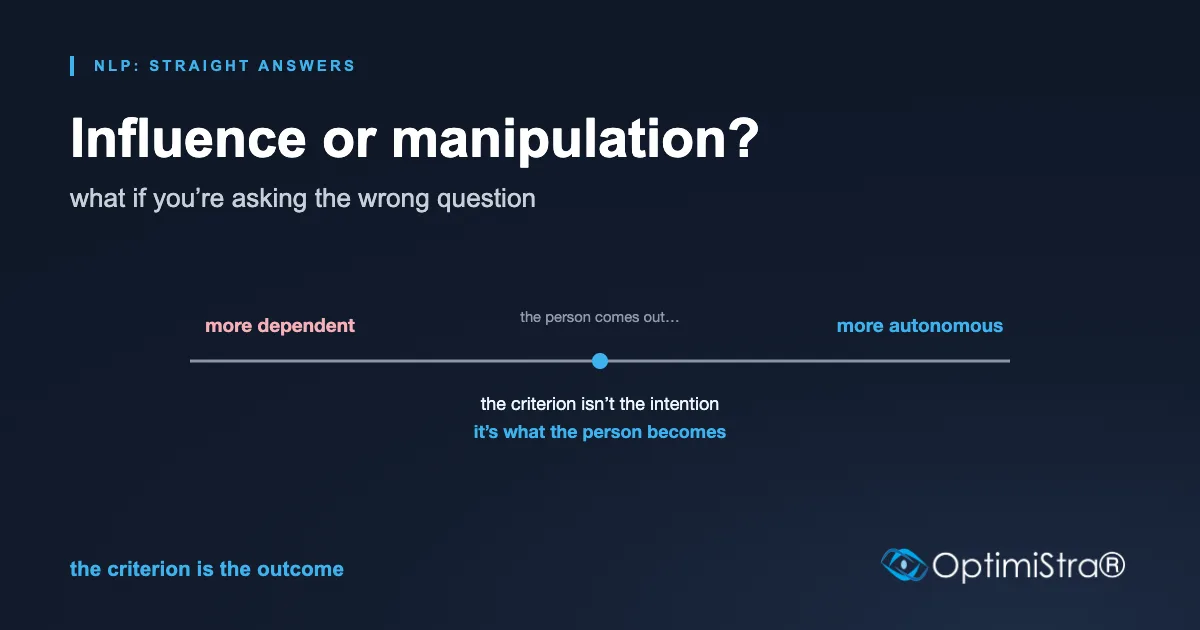
Influence or manipulation: are you asking the wrong question?
Framing the question in terms of intention leads to a dead end, because nobody describes themselves as a manipulator. The useful test is the result: does the other person come away more autonomous, or more dependent? That is a question you can check rather than simply assert.
November 18, 2026 · 7 min read
NLP: Straight Answers
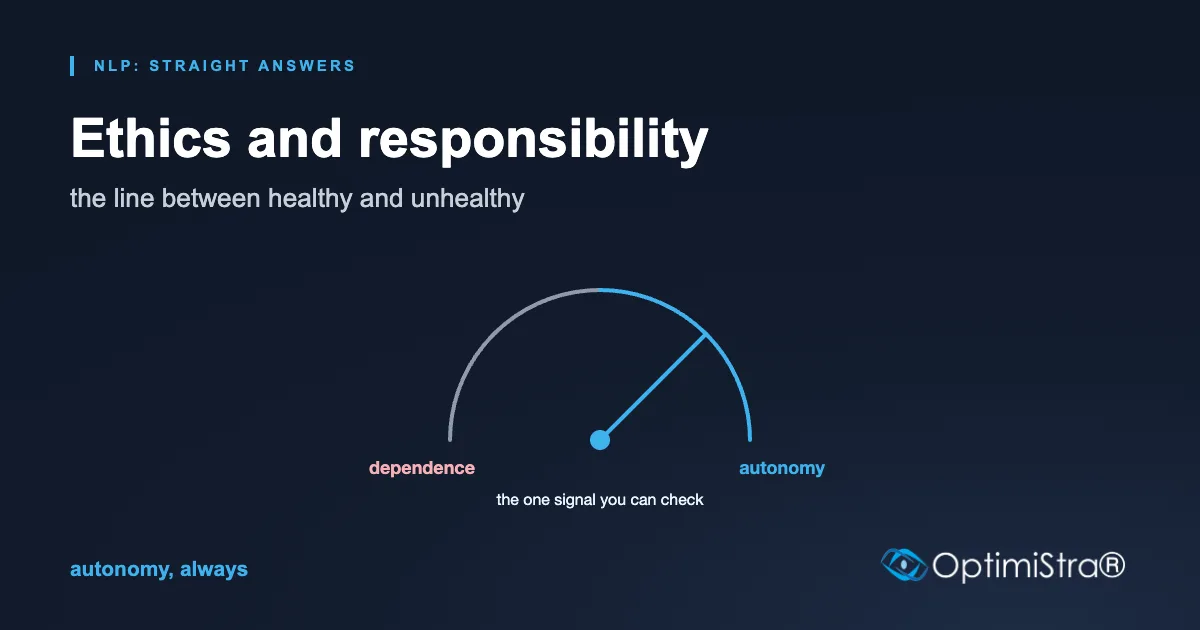
Ethics and responsibility in NLP: the one line between healthy and unhealthy practice
The most reliable signal of a healthy practice is autonomy. A practitioner who keeps adding sessions without ever making the person able to act alone should put you on your guard. And the practitioner is not responsible for the results: taking the credit for them is already the first step in the wrong direction.
November 18, 2026 · 5 min read
NLP: Straight Answers
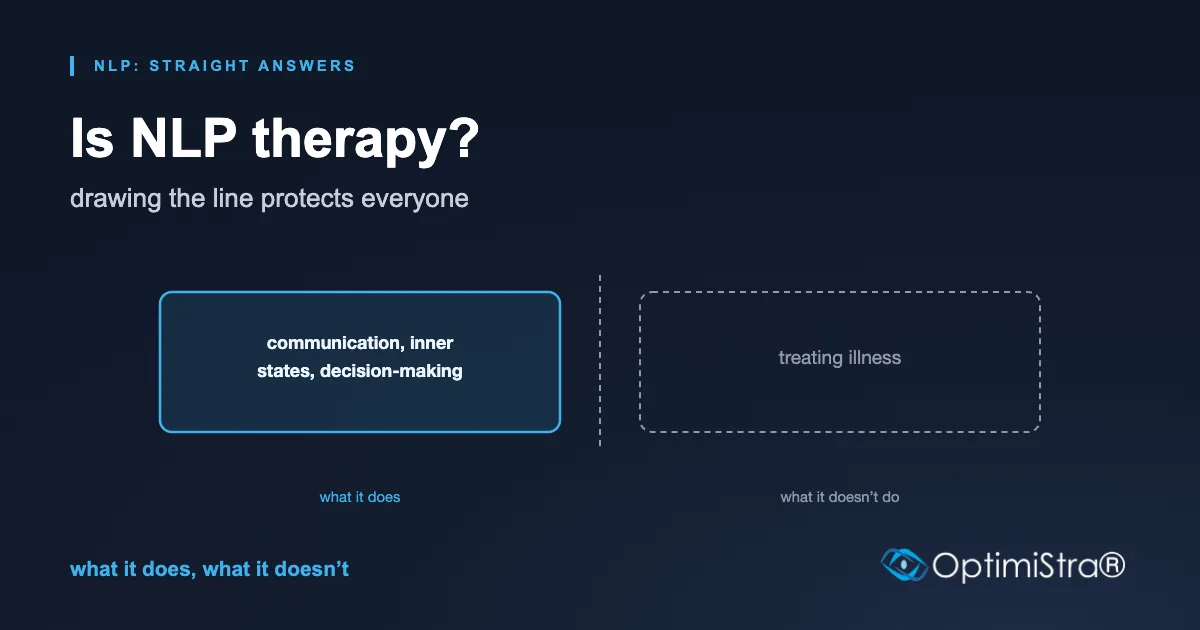
Is NLP therapy?
Neuro-Linguistic Programming (NLP) is not therapy and is no substitute for it. It works on communication, inner states and the way you make decisions, in the here and now, with no claim to treat anything. Stating that limit plainly, from the outset, protects people as much as it protects the discipline.
November 18, 2026 · 6 min read