Influence or manipulation: are you asking the wrong question?

Published November 18, 2026 · 7 min read
In brief
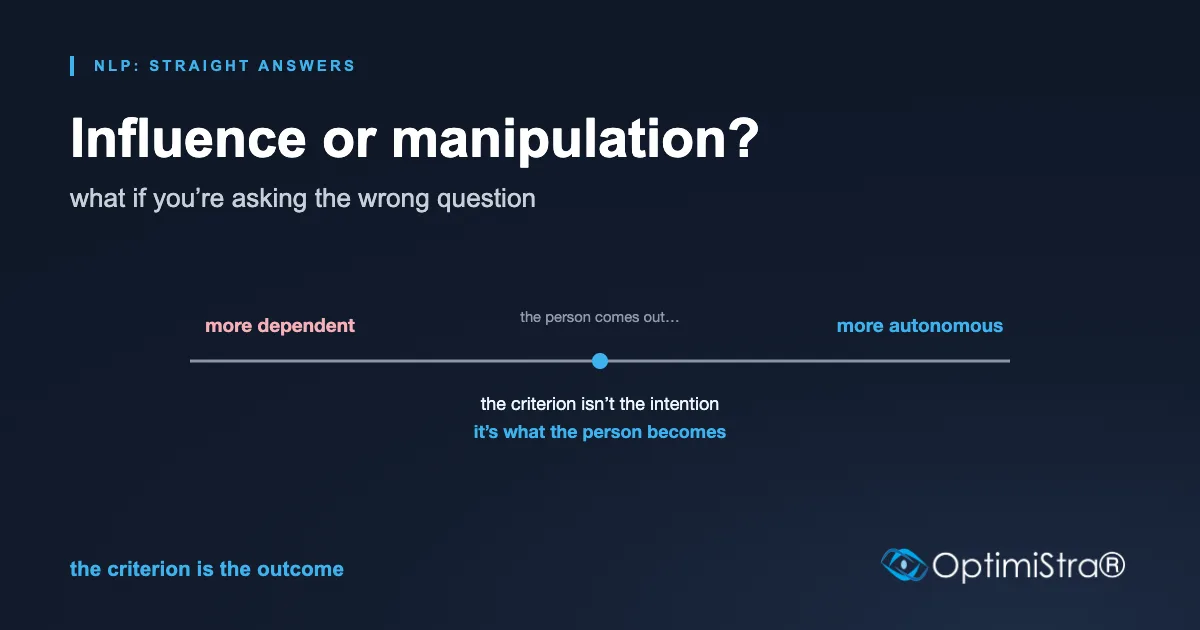
Framing the question in terms of intention leads to a dead end, because nobody describes themselves as a manipulator. The useful test is the result: does the other person come away more autonomous, or more dependent? That is a question you can check rather than simply assert.
The first lie we tell ourselves is that we can communicate without influencing anyone. The reality is less comfortable: all communication is influence, silence included. So the useful question is not whether we influence, but what that influence leaves behind, and that is something Slemp, Kern, Patrick and Ryan measured across nearly 33,000 people. Watch a child who has just done something they shouldn’t have. Sometimes a well-placed silence says more than the sternest reprimand. If everything is influence, then “am I influencing?” is not the real question. That lies elsewhere, and most people look for the answer in the wrong place.
If you’re wondering whether Neuro-Linguistic Programming (NLP) is manipulation, it’s probably for one of two reasons. Either you’re afraid of being manipulated, by a salesperson, someone close to you or a colleague who is a little too skillful, and you want to understand at last how it works so that it stops happening to you. Or, the other way round, you’re afraid of manipulating others without meaning to, because you’ve been told that understanding communication already amounts to “playing” with people.
In both cases you’re circling the same intuition: there is a line between influencing and manipulating, and nobody quite manages to tell you where it runs. You hear about intention, which leads nowhere: nobody describes themselves as a manipulator, and Witkowski has shown how much the field of NLP suffers from promises that nothing verifies. You hear about kindness and respect. It all sounds right, and it stops holding up as soon as you look closely. So let’s look closely.
The first lie: believing we can communicate without influencing
Let’s start from one clear idea: you cannot not influence. We often picture influence as something added to communication: a technique, an effort, a maneuver. As if we could communicate “normally” and then decide, as an optional extra, to put some influence in. That isn’t how it works. Influence is not a layer you add. It is woven into the exchange itself.
Silence proves it better than anything. We tend to see it as an absence, a moment when nothing is happening. Ask a child who has misbehaved how it feels when their parent says nothing and simply looks at them. That silence weighs a ton, and it influences more than shouting would. If even an absence influences, then trying to communicate “without influencing” is like trying to walk without leaving footprints. It can’t be done.
This first realization is uncomfortable, and that is exactly what makes it valuable. As long as we believe neutral communication exists, we believe ourselves innocent, and so we never look at the real effect of what we say.
The mistake almost everyone makes: judging by intention
Once we accept that everything is influence, the question becomes: where does influence end and manipulation begin? Ryan and Deci offer a marker that can be checked: a relationship that supports autonomy and one that constrains it do not produce the same effects, and the difference can be measured.
The classic answer, the one you find everywhere, comes down to one word: intention. If I mean well, it’s influence. If I mean harm, it’s manipulation. It’s tidy, it’s reassuring, and it isn’t enough.
Take a parent who keeps telling their child that they’re useless, that they’ll never manage it. This parent has no intention of doing harm. They don’t want a child who has lost their spark and their confidence and keeps failing. In their mind they are doing the opposite: they believe they are giving a helpful “kick up the backside,” the jolt that will wake up the child’s motivation and get them moving. The intention is good, and sincerely so.
Except that, statistically, we know it almost never works. The child doesn’t pick themselves up: they slowly collapse. The intention was excellent and the result is disastrous. That is exactly where judging by intention cracks. If we stop at the intention, this parent is “influencing with kindness.” If we look at the child, we see something quite different.
The real measure: the result, not the intention
Here is the reversal. What separates influence from manipulation isn’t the intention. It’s the result.
Does what I say have a positive, beneficial effect on the person in front of me? Then I’m influencing. Does it make them defensive, hurt them, shut them in, put them in a poor state or push them toward something that works against them? Then, whatever my intention was, I have manipulated.
Go back to the parent. If, by some miracle, their child is one of those who respond to the “kick up the backside” and it sends them upwards, then yes, it was a beneficial influence. If the child collapses, then the parent, without wanting it for a second, will have manipulated them into becoming useless. Same sentence, same intention, two opposite verdicts, and it’s the result that decides.
This angle can seem harsh, because it takes away the comfort of good intentions. We love to let ourselves off with “I meant well.” Looking at the result means taking responsibility. It means no longer judging our communication by our intentions, and starting to judge it by its real effect on the other person.
And what if we took this criterion to the place where it is easiest to measure? A leader or a manager most often judges their communication by what they meant to say. The reversal is to judge it by what the team did with it: what was understood, what was acted on, what went unsaid. An instruction that is perfectly clear in the mind of the person giving it and has no effect in the minds of those receiving it has simply failed, whatever the intention. The criterion is uncomfortable, and that is what makes it useful: it is the only one that can be checked. It is also the one that teaches most, because it turns every meeting into information about your own way of communicating, and that is the starting point of what we teach people who lead others.
When frightening someone becomes an act of love
One last example, because it overturns our moral reflexes. In some parts of Mexico, child abduction is an everyday reality. There, the healthiest strategy parents can adopt is to frighten their children, quite literally: to explain that the outside world is dangerous and to instill a fear of going out alone. A child naturally wants to break the rules, to go out, to explore, and once is enough. One time, and the child disappears for good.
Seen from outside, frightening a child looks like manipulation. And the result? It saves the child’s life. Then the day comes when that child has grown up and no longer interests the traffickers. Those beliefs are changed, the fear is undone, and that, once again, is benevolent influence.
The same act, two opposite verdicts depending on the moment and the result. Frightening someone can be an act of love, and reassuring them can be a crime. As long as we judge by the intention or by how the act looks, we understand nothing. As soon as we judge by the result, it all becomes readable.
One question for everyday use
Once you have this measure in mind, something shifts. You stop sorting behavior into “nice” and “nasty,” and you ask yourself one question, simple and remarkably effective: what is the result of what I’m communicating?
It works in both directions. Toward other people, it lets you put things in perspective, filter, and notice what does you good and what works against you, and so protect yourself from manipulators far more reliably than any list of “techniques to spot.” And above all toward yourself, because the most constant communication in your life is the one you have with yourself. What could be more useful than learning to influence yourself? Not in order to manipulate anyone. Simply to produce, in your own head, results that lift you rather than pull you down.
That is where things change. You are no longer simply on the receiving end of influence, other people’s or your own. You become someone who reads, filters and chooses.
Where to go next
If this speaks to you, the next steps are ethics and responsibility in NLP, what NLP is and its limits, risks and misuses.
Article designed and written by Michel Wozniak, and optimized by artificial intelligence. Illustration created by artificial intelligence.
Sources
- Slemp, Kern, Patrick & Ryan (2018), Leader autonomy support in the workplace: A meta-analytic review, Motivation and Emotion
- Ryan & Deci (2000), Self-determination theory and the facilitation of intrinsic motivation, social development, and well-being, American Psychologist
- Witkowski (2010), Thirty-Five Years of Research on Neuro-Linguistic Programming. NLP Research Data Base. State of the Art or Pseudoscientific Decoration?, Polish Psychological Bulletin
Frequently asked questions
What is the difference between influence and manipulation?
The most common answer separates them by intention: a good intention means influence, a bad one means manipulation. That isn’t enough. The reliable test is the result: if your communication has a beneficial effect on the person, it’s influence; if it works against them, it’s manipulation, even if you meant well.
Can you communicate without influencing anyone?
No. All communication is influence, including silence, which can weigh more than words. Believing in neutral communication is a comfortable illusion, and a misleading one.
Is Neuro-Linguistic Programming (NLP) used to manipulate people?
Understanding how influence works is, first of all, a way to stop being on the receiving end of it. Knowing how influence operates in communication is the best protection against people who misuse it, and a way of learning to influence yourself better.
Is frightening someone always manipulation?
Not necessarily. It all depends on the result. A fear instilled to protect a life, such as warning a child of a real danger, can be deeply benevolent influence. It is the effect produced, not the act itself, that determines what kind of act it was.
Can you learn NLP without wanting to influence anyone?
That is in fact the most common case. Three quarters of the people who follow the program come for themselves, not to act on others. The most useful skill they gain is still that of speaking to themselves better.
NLP: Straight Answers
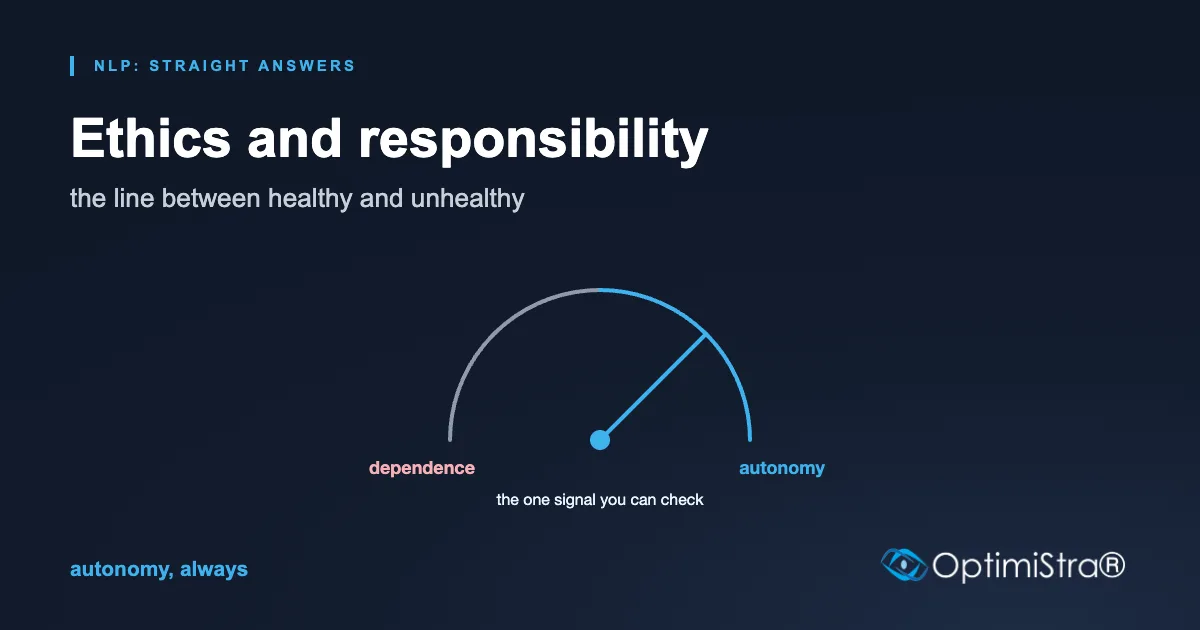
Ethics and responsibility in NLP: the one line between healthy and unhealthy practice
The most reliable signal of a healthy practice is autonomy. A practitioner who keeps adding sessions without ever making the person able to act alone should put you on your guard. And the practitioner is not responsible for the results: taking the credit for them is already the first step in the wrong direction.
November 18, 2026 · 5 min read
NLP: Straight Answers
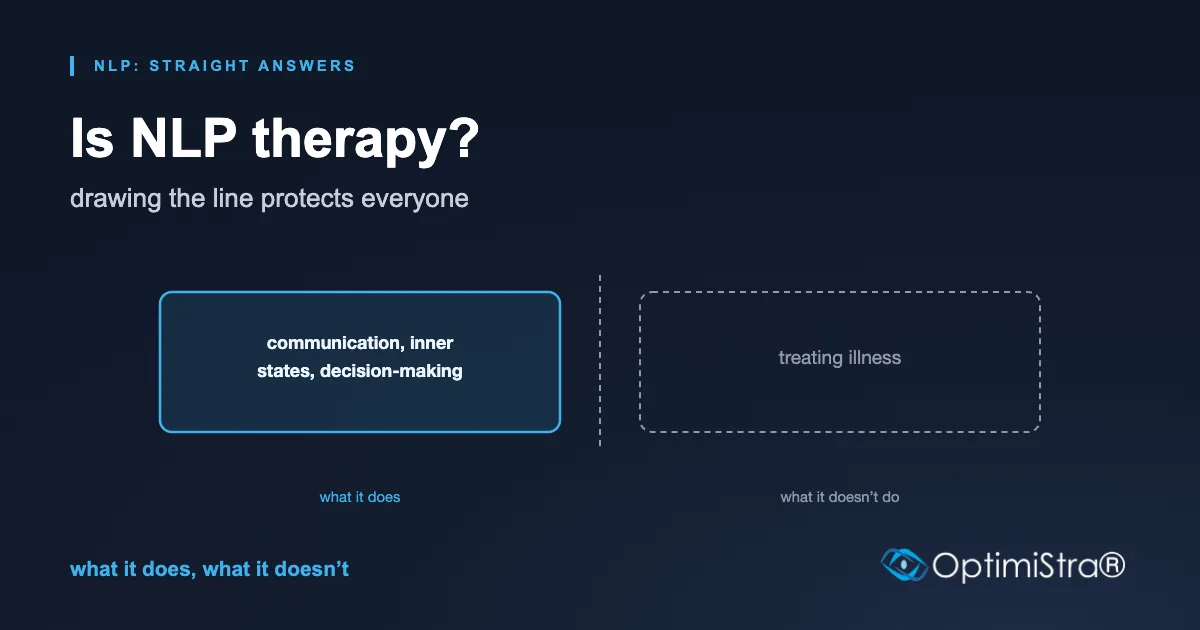
Is NLP therapy?
Neuro-Linguistic Programming (NLP) is not therapy and is no substitute for it. It works on communication, inner states and the way you make decisions, in the here and now, with no claim to treat anything. Stating that limit plainly, from the outset, protects people as much as it protects the discipline.
November 18, 2026 · 6 min read
NLP: Straight Answers
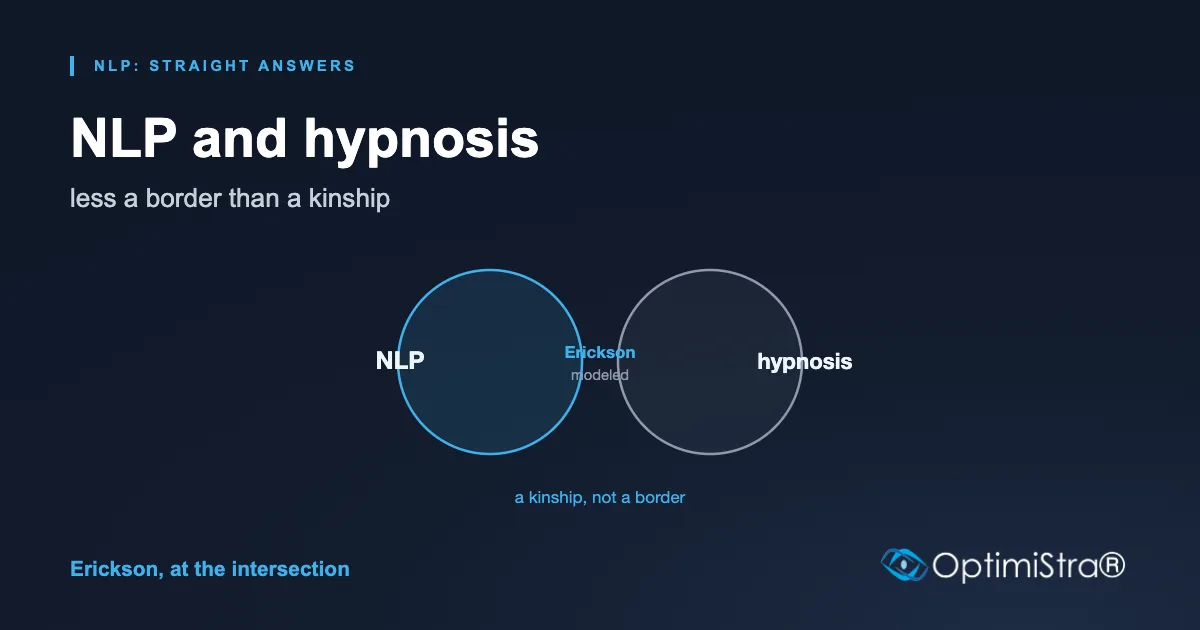
NLP vs hypnosis: what’s the difference?
Neuro-Linguistic Programming (NLP) and hypnosis share a root: NLP was built by modeling remarkable practitioners, among them Milton Erickson, the father of Ericksonian hypnosis. The version taught in the French-speaking world has often cut that root, which leaves an NLP shorter than the original and markedly less effective.
November 18, 2026 · 5 min read