
In brief
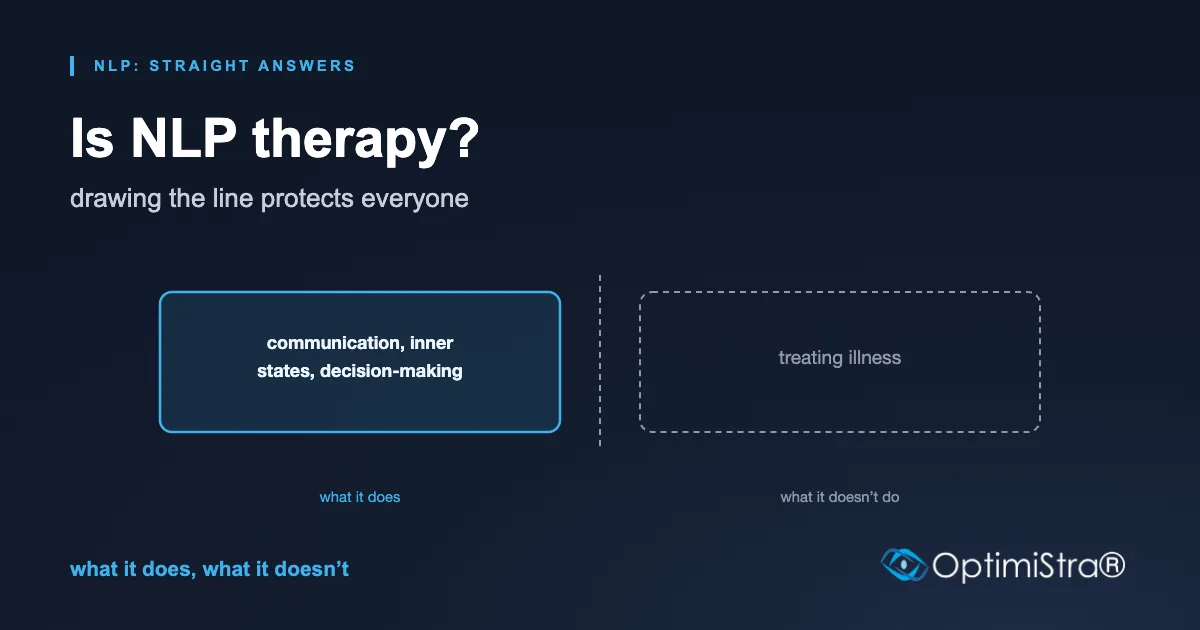
Neuro-Linguistic Programming (NLP) is not therapy and is no substitute for it. It works on communication, inner states and the way you make decisions, in the here and now, with no claim to treat anything. Stating that limit plainly, from the outset, protects people as much as it protects the discipline.
You’re asking the question, and that’s a healthy thing to do. Before you trust an approach with your mind, your stress or your mental blocks, you want to know who, and what, you’re dealing with.
It’s also a question that is usually framed badly: “Is Neuro-Linguistic Programming (NLP) a therapy?” As long as it’s put that way, the answers stay vague. You’ve probably noticed while searching: half the websites assure you that yes, it’s a “brief therapy,” and the other half warn you off. You come away with more doubt than you arrived with.
I’m going to give you a clear answer, and I’ll start not with mine but with that of the man who co-created NLP.
The clearest answer comes from NLP’s co-creator
To find out whether NLP is a therapy, the simplest route isn’t to ask a practitioners’ website that has every reason to sell you sessions. It’s to go and see what Richard Bandler, co-creator of Neuro-Linguistic Programming, thinks about it.
Go to his website. The very first article featured on his blog is titled “NLP is not therapy.”
That is the whole statement, full stop. Sturt and colleagues, who reviewed the available trials on health outcomes, do not conclude otherwise.
It would be hard to be clearer. The man who has spent his life building this discipline takes the trouble to put it up front, in large letters, like a sign at the entrance. This isn’t a fine distinction; he is setting the record straight.
So why do so many people, and even some schools, go on presenting NLP as a form of care? Because there’s a misunderstanding at the root, and it’s worth understanding.
Where the misunderstanding comes from
To develop NLP, Bandler and Grinder did indeed draw on therapists. What matters is why.
Their aim wasn’t to treat people. It was to understand change: how a person moves from one state to another, how a way of functioning shifts. And who are the specialists in change? The great therapists. So it made sense to observe them, take their work apart and model what they did best.
They didn’t stop there. They also modeled elite athletes. They modeled people who work with the body, such as Moshe Feldenkrais, and they modeled anthropologists.
Nobody thinks of calling NLP a sporting discipline. Nobody says it’s a massage technique, and nobody claims it’s anthropology.
It’s the same shortcut every time. Because therapists were modeled, people conclude that NLP “is” therapy. That is as false as concluding that, because you’ve watched a baker at work, you’ve become a bakery.
Bandler and Grinder looked at what works among people who are good at bringing about change, and they kept what works. That’s all. It doesn’t hand down the original profession; it draws a mechanism out of it.
An image that settles the question for good
Take a simple example. Many therapists use breathing to help their patients work on their emotions. Breathing is therefore a tool in the service of care.
Should we conclude that breathing is practicing medicine? That as soon as you take a deep breath to steady yourself before a meeting, you’re illegally practicing a health profession? Obviously not; it would be absurd.
NLP is no different. Therapists use words to do their work, and that doesn’t make communication therapeutic. Language remains language. Strategy remains strategy. The fact that a health professional uses them doesn’t turn them into care, any more than that professional’s breathing turns air into medicine.
NLP can be used in a therapeutic setting. When it is, it’s the therapist behind it who does the therapy, with their own responsibility, their framework and their profession. And what weighs most when one person is supporting another was established by Flückiger, Del Re, Wampold and Horvath across almost 300 studies: the quality of the relationship. NLP itself is not the care. It’s the tool a health professional may choose to pick up.
If it isn’t therapy, what is it?
That’s the real question, and the answer comes down to two words: communication and strategy.
NLP is about learning to handle language, with other people and with yourself. It’s about understanding how a decision is built, how a goal is reached and how what succeeds can be reproduced. These are skills, not a treatment.
When it touches on emotions, it does so in a very particular way: purely strategically. Take that knot in the stomach you may know, the feeling of your insides tightening in tense moments. NLP isn’t going to dig through your past in search of a deep cause. That isn’t its role, and it doesn’t claim it is. It simply works on your perception of that inner movement: its shape, its direction, its intensity. You act on the feeling as it is now, not on the memory that gave rise to it.
That distinction is fundamental. The therapist goes back to the why. NLP works on the how: here, now, in the way you represent to yourself what you’re experiencing.
It’s less spectacular than a promise of a cure. It’s also a good deal more honest.
Why this boundary protects you
You might think that, in the end, the label hardly matters as long as it helps.
It matters a great deal, because this boundary is exactly what separates sound practice from practice that has lost its way. Witkowski, reviewing 35 years of research on NLP, shows what the field looks like when that boundary is no longer held.
When someone sells you NLP as a therapy, be wary: they’re promising something it has never claimed to offer. When a practitioner tells you that NLP will “treat” your depression, your trauma or your condition, they’re stepping outside their role and putting your safety at stake. Let everyone do their own job. Psychiatrists, psychologists and therapists do theirs. And the person who practices NLP does theirs: strategy, language, communication.
These worlds aren’t enemies; they complement each other perfectly well. I have myself accepted people under psychiatric care onto courses, only ever with the written agreement of their psychiatrist, who then took responsibility for the framework. That is what clean practice looks like: knowing exactly where the limit of your work lies, and respecting it.
Knowing that NLP isn’t therapy doesn’t diminish it. It gives NLP back its real strength, that of a remarkably useful tool for communication and for steering yourself, provided you don’t ask of it what it wasn’t made for.
Going further
If this kind of clarity appeals to you, you’re probably looking for something solid rather than promises, and you’re in the right place.
NLP isn’t therapy. Properly understood, it does change, quite deeply, the way you communicate, manage your inner states and make your decisions. Find out what NLP really is and how it works in practice.
Keep reading
If what you’ve just read speaks to you, the next steps are whether NLP is scientifically validated, what NLP is, how it works and its limits and risks. You can also write to us.
And if you’d like to learn these communication and strategy skills, take a look at the NLP Practitioner course.
Article designed and written by Michel Wozniak, and optimized by artificial intelligence. Illustration created by artificial intelligence.
Sources
- Sturt, Ali, Robertson, Metcalfe, Grove, Bourne & Bridle (2012), Neurolinguistic programming: a systematic review of the effects on health outcomes, British Journal of General Practice
- Flückiger, Del Re, Wampold & Horvath (2018), The alliance in adult psychotherapy: A meta-analytic synthesis, Psychotherapy
- Witkowski (2010), Thirty-Five Years of Research on Neuro-Linguistic Programming. NLP Research Data Base. State of the Art or Pseudoscientific Decoration?, Polish Psychological Bulletin
Frequently asked questions
Can NLP still help with stress or mental blocks?
Yes, it can, as a strategic and communication approach rather than as a form of care. It works on perception and on the way you represent a situation to yourself, in the here and now. It doesn’t treat a condition: it gives you practical levers on the way you function.
Why do so many websites describe NLP as a “brief therapy”?
Often as a shortcut, because NLP modeled great therapists in its early days. It also modeled athletes and anthropologists, without becoming a sporting or anthropological discipline. Richard Bandler, co-creator of Neuro-Linguistic Programming (NLP), leaves no room for doubt: “NLP is not therapy.”
Do you need to be a therapist to practice NLP?
No. NLP is an approach to communication and strategy, open to anyone who wants to develop those skills. When the aim is therapeutic, a therapist has to be in charge: the responsibility for care is then theirs.
NLP or psychotherapy: which should I choose?
It isn’t an either/or. If you’re living with a mental health condition or trauma, a health professional is the person to see. If you want to communicate better, manage your inner states and think more strategically, that is what NLP is for. The two can sit side by side perfectly well.
Is NLP dangerous?
Not in itself. The risk arises when a practitioner oversteps their role and starts acting as a health professional. Sound practice knows its limit, refers people to the right professionals when needed and always aims to leave you autonomous.
NLP: Straight Answers
The limits, risks and misuses of NLP
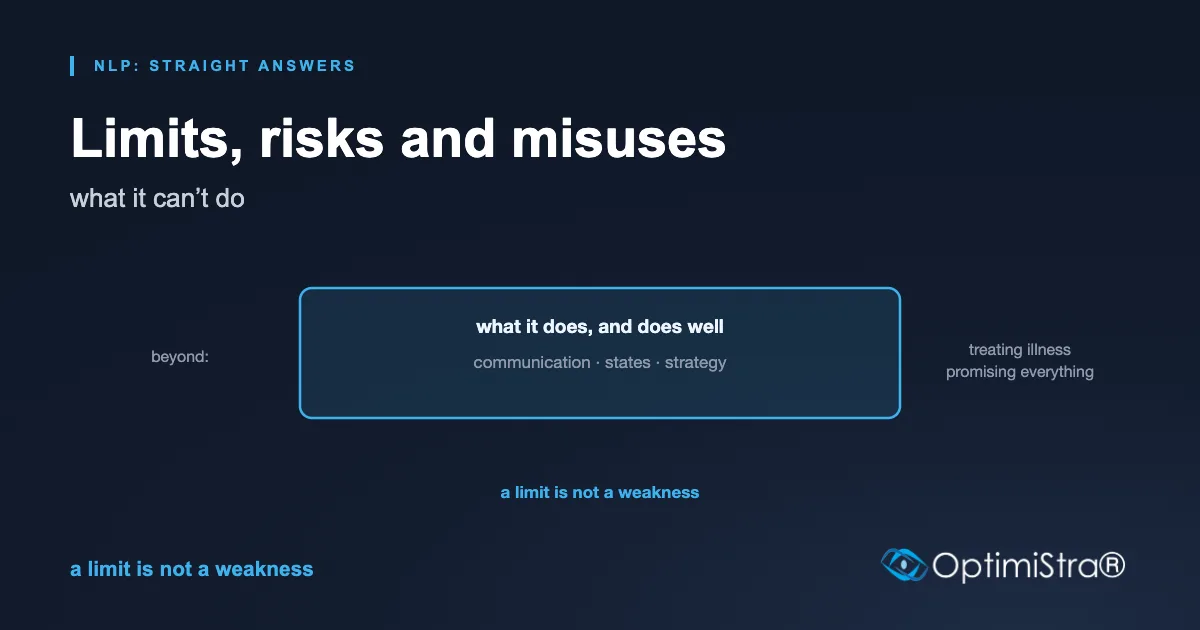
Neuro-Linguistic Programming (NLP) is not a panacea, and its limits are not a weakness: they are what makes it usable. Some claims attributed to NLP have been tested and do not hold up. Detecting lies from eye movements is the best-documented example.
November 18, 2026 · 6 min read
NLP: Straight Answers
Influence or manipulation: are you asking the wrong question?
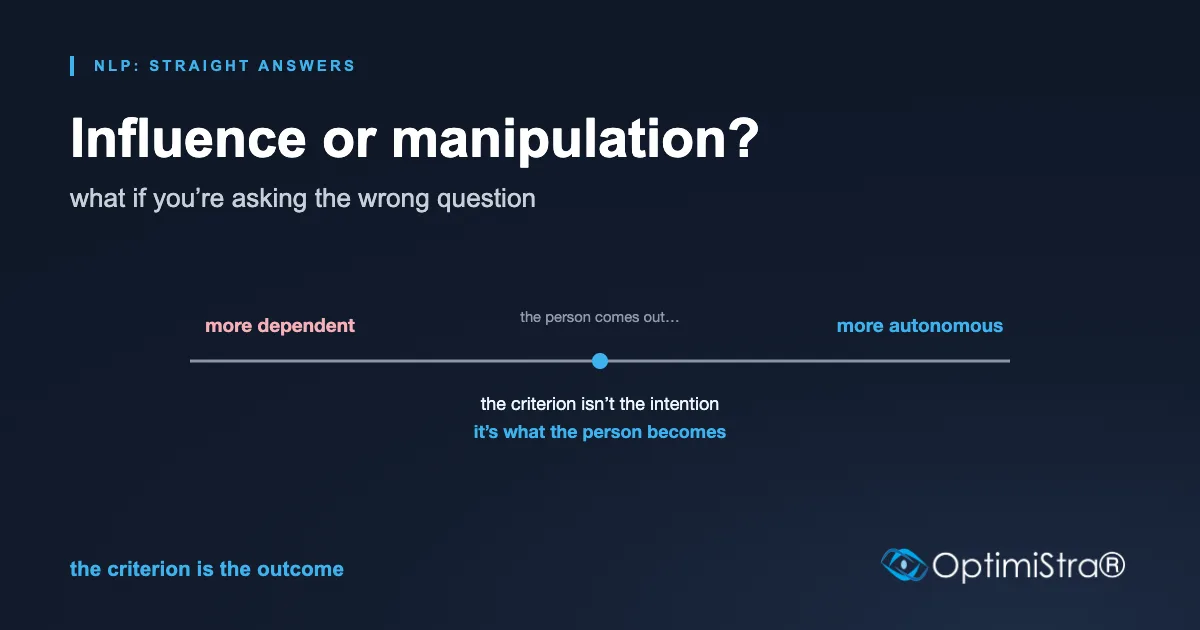
Framing the question in terms of intention leads to a dead end, because nobody describes themselves as a manipulator. The useful test is the result: does the other person come away more autonomous, or more dependent? That is a question you can check rather than simply assert.
November 18, 2026 · 7 min read
NLP: Straight Answers
Ethics and responsibility in NLP: the one line between healthy and unhealthy practice
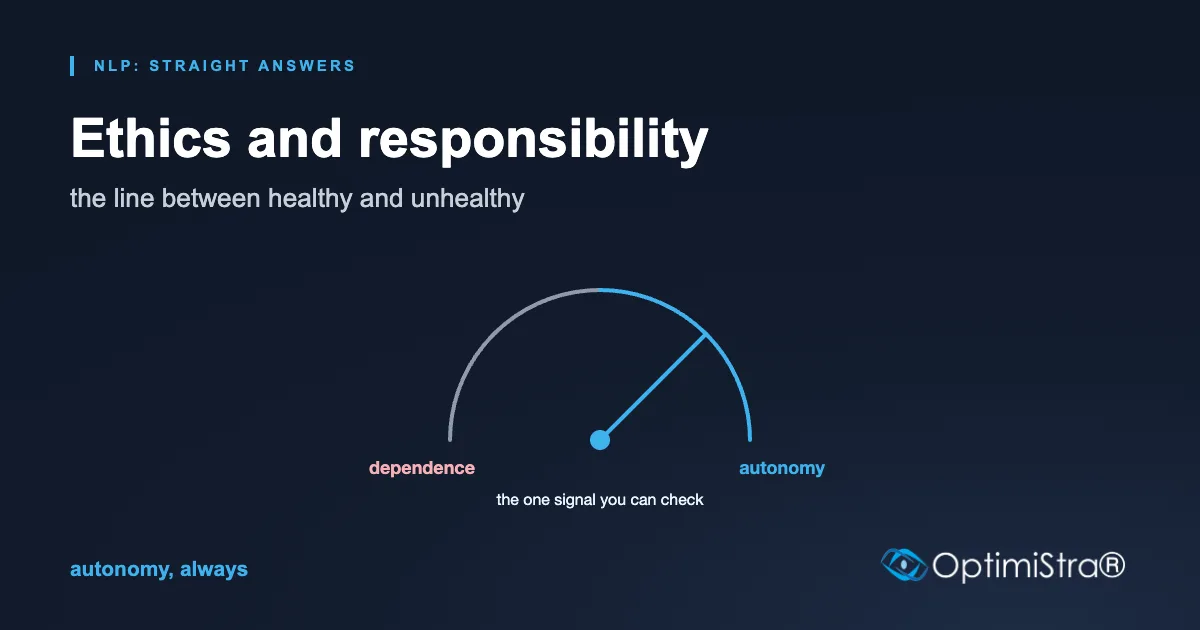
The most reliable signal of a healthy practice is autonomy. A practitioner who keeps adding sessions without ever making the person able to act alone should put you on your guard. And the practitioner is not responsible for the results: taking the credit for them is already the first step in the wrong direction.
November 18, 2026 · 5 min read