
In brief
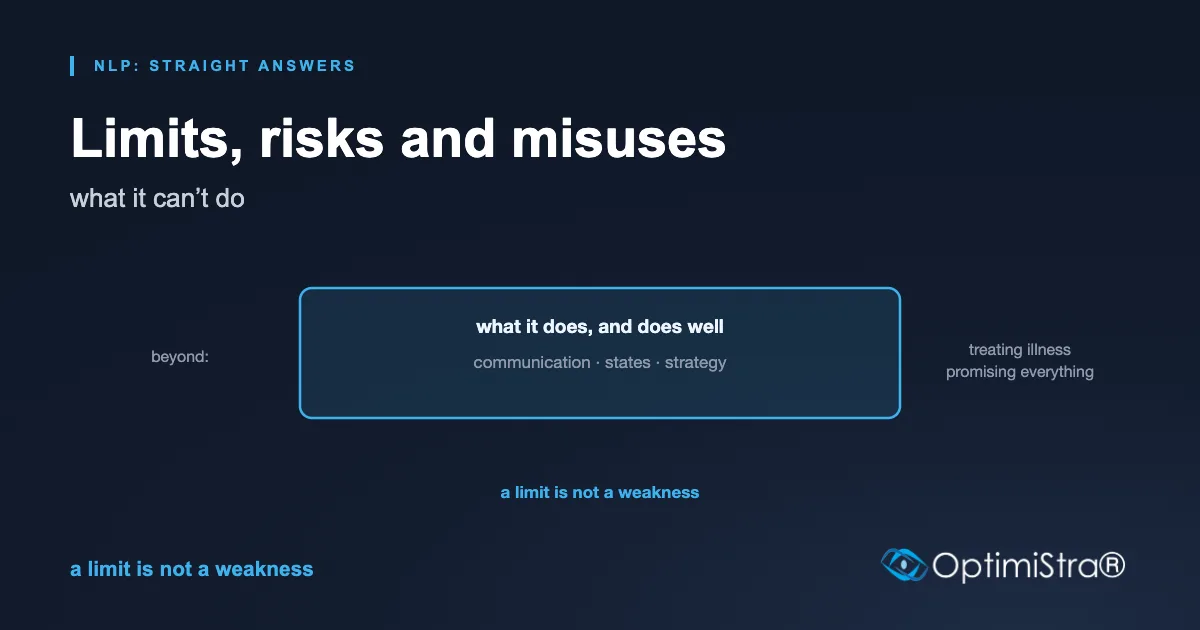
Neuro-Linguistic Programming (NLP) is not a panacea, and its limits are not a weakness: they are what makes it usable. Some claims attributed to NLP have been tested and do not hold up. Detecting lies from eye movements is the best-documented example.
There is one question most Neuro-Linguistic Programming (NLP) trainers carefully avoid, and I’m going to start with it: what can’t NLP do?
I start there because a discipline that claims to solve everything generally solves nothing. And if you have read this far, you have probably sensed something already: that slight unease at promises that sound too good, at people who tell you that with “the right technique” your life will turn around in a weekend.
You’re right to be skeptical. Keep that skepticism: it will serve you all the way down this page, and well beyond it.
NLP is not a panacea. Reviewing the available trials, Sturt and colleagues concluded that there is little evidence that NLP interventions improve health-related outcomes, and they made a point of adding that this reflects the limited quantity and quality of the research, not robust evidence of no effect. I’m not saying this to sound modest. It is something I have seen from the inside, after years of practicing NLP at the highest level: there are a great many things NLP will never be able to do. And it is by knowing where a discipline stops that you discover the full power of what it really does.
The first limit is knowing where your own field ends
Let’s begin with the simplest part: what NLP doesn’t do.
NLP isn’t recommended for everyone, or in every situation. Some approaches at the heart of the discipline, such as seeing yourself from the outside, which is called dissociation, don’t suit people who find that kind of mechanism difficult to handle. Nor would we offer NLP to someone with a severe psychiatric disorder.
Why? For a very simple reason, and one that is routinely forgotten: NLP is not therapy.
The real limit fits in one sentence: everyone should do their own job. Witkowski, surveying 35 years of publications on NLP, shows what happens when that rule isn’t kept. Therapists should do their job, psychologists theirs and psychiatrists theirs. And those who practice NLP, which means strategy and communication, should do theirs.
That boundary is not a weakness of NLP. It is its backbone. The day someone offers to treat your trauma with an NLP technique, you now know they have crossed a line they should not have crossed.
When the boundary can open, and on what condition
Does that make these worlds incompatible? Not at all, and this is where it gets interesting.
On our courses I have sometimes welcomed people I would normally never have accepted, because they had a psychiatric history. My rule on this is strict. There is one door, though, and only one.
When the person’s psychiatrist confirms to me in writing that they can handle dissociative approaches and can follow the course, responsibility sits where it should: with the health professional. From that point there is no longer a problem. We can go ahead with peace of mind, because everyone has played their part.
Keep this mechanism in mind, because it says everything about the spirit in which I work. NLP does not work against other disciplines, or in their place. It works with them, provided everyone stays clear-sighted about what falls within their competence. That clear-sightedness is what separates sound practice from dangerous practice.
The real danger doesn’t come from NLP. It comes from the person practicing it.
This brings us to the heart of the matter, and to the only risk that really concerns me.
When you practice NLP, you can do remarkable things, some of them hard to believe. I have seen change take place in a few minutes where years had produced nothing. And that is exactly where the trap lies.
After producing spectacular results again and again, some practitioners gradually develop a feeling of omnipotence. It creeps in without their even noticing, and they end up believing that they are the ones doing the work for the client.
That is not what NLP is, not at all. NLP is about making people autonomous: you teach the person to do it for themselves. From there, everything is turned round. If the work succeeds, the credit belongs to the person and not to the practitioner. And if it doesn’t, the person is not “a hopeless case”: the right angle simply hasn’t been found yet.
This simple shift of responsibility changes almost everything. It separates those who help people grow from those who make them dependent.
How to recognize a practitioner to avoid
I’ll be very practical here, because it may spare you some unfortunate encounters.
Be wary of people who keep adding sessions, who explain that you need a lot of them, then more, then more again. Above all, be wary of those who never make you autonomous.
To my mind, every NLP session should include a moment that builds autonomy: a specific point at which the person leaves able to reuse, on their own, what has just been done. More than any other, this is the criterion that tells sound practice from the unhealthy kind.
A good practitioner works at becoming unnecessary; a poor one works at becoming indispensable. That is the whole difference.
So where does that leave us?
As you will have gathered, NLP has its limits, as it has its risks and its misuses. None of the three comes from the discipline itself. They all come from the same source: a lack of clear-sightedness, forgetting where each person’s role lies, an ego that takes precedence over the service given.
Two claims show this well. The first is that you can read lying in eye movements: Wiseman and colleagues tested it in 2012, and it does not hold up. The second is the idea that teaching someone in their preferred sensory channel improves their learning: Pashler and colleagues found no evidence for it. Yet neither claim comes from Richard Bandler and John Grinder, the co-creators of Neuro-Linguistic Programming. On eye movements, all they described was a cue to the sensory channel in use at the moment someone is thinking, never a lie detector. It was trainers in a hurry who turned it into a certainty.
The result is a rather comical situation: some studies announce that they have refuted “NLP” by testing claims it never made, and NLP is the one that pays for it. This sleight of hand has a name, and it is as old as rhetoric. Once you have seen it at work you will recognize it everywhere, well beyond NLP: it is the straw man, taken apart using the example most often cited against us.
This is exactly why, in the way I see NLP and teach it, I spend so much time on what lies outside technique. A discipline this powerful demands, in return, standards to match from whoever uses it.
And that is where another, deeper question begins: the question of ethics and responsibility.
Where to go next
If what you have just read speaks to you, the next steps are ethics and responsibility in NLP, what the research says, why NLP is not therapy and observing without jumping to conclusions.
And if you would like to learn NLP taught in this spirit, the NLP Practitioner course is the place to start.
Article designed and written by Michel Wozniak, and optimized by artificial intelligence. Illustration created by artificial intelligence.
Sources
- Wiseman, Watt, ten Brinke, Porter, Couper & Rankin (2012), The Eyes Don't Have It: Lie Detection and Neuro-Linguistic Programming, PLoS ONE
- Witkowski (2010), Thirty-Five Years of Research on Neuro-Linguistic Programming. NLP Research Data Base. State of the Art or Pseudoscientific Decoration?, Polish Psychological Bulletin
- Sturt, Ali, Robertson, Metcalfe, Grove, Bourne & Bridle (2012), Neurolinguistic programming: a systematic review of the effects on health outcomes, British Journal of General Practice
- Pashler, McDaniel, Rohrer & Bjork (2008), Learning Styles: Concepts and Evidence, Psychological Science in the Public Interest
- Bandler & Grinder (1979), Frogs into Princes: Neuro Linguistic Programming, Real People Press
Frequently asked questions
Can Neuro-Linguistic Programming (NLP) solve everything?
No, and this is the first trap to avoid. NLP is not a panacea: there are a great many situations it cannot deal with. A discipline that claims to solve everything should make you wary. NLP’s strength lies in knowing exactly where it stops.
Is there anyone NLP is not suitable for?
Yes. NLP is not recommended for people who find dissociative approaches difficult to handle, meaning approaches where you see yourself from the outside. Nor is it offered to people with severe psychiatric disorders, simply because NLP is not therapy and everyone should keep to their own profession.
Can someone with a psychiatric history train in NLP?
It is possible, on one strict condition: their psychiatrist confirms in writing that they can handle dissociative approaches and follow the course. Responsibility then rests with the health professional, where it belongs, and the work can go ahead with peace of mind.
What are the dangers of NLP?
The main danger does not come from NLP itself, but from the person practicing it. After producing spectacular results again and again, some practitioners develop a feeling of omnipotence and end up believing that they are the ones doing the work for the client. NLP is about making people autonomous: when it works, the credit belongs to the person, never to the practitioner.
How do you spot an NLP practitioner to avoid?
Be wary of those who keep adding sessions, who explain that you always need more and who never make you autonomous. Every session should include a moment that builds autonomy, where you leave able to reuse on your own what has just been done. A good practitioner works at becoming unnecessary; a poor one works at becoming indispensable.
NLP: Straight Answers
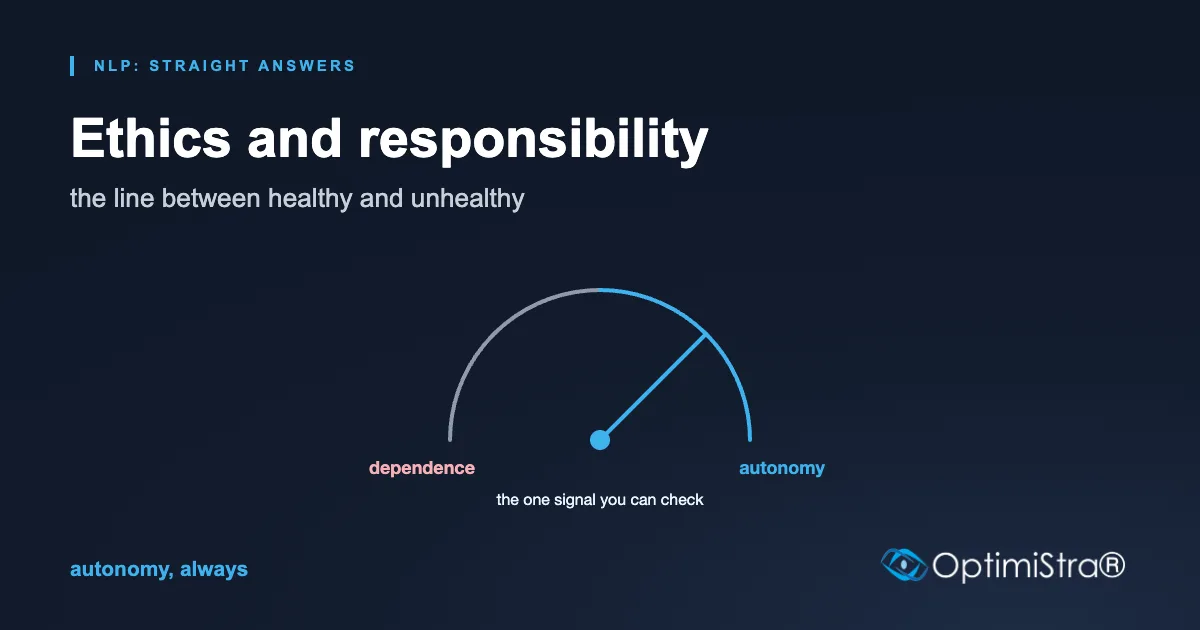
Ethics and responsibility in NLP: the one line between healthy and unhealthy practice
The most reliable signal of a healthy practice is autonomy. A practitioner who keeps adding sessions without ever making the person able to act alone should put you on your guard. And the practitioner is not responsible for the results: taking the credit for them is already the first step in the wrong direction.
November 18, 2026 · 5 min read
NLP: Straight Answers
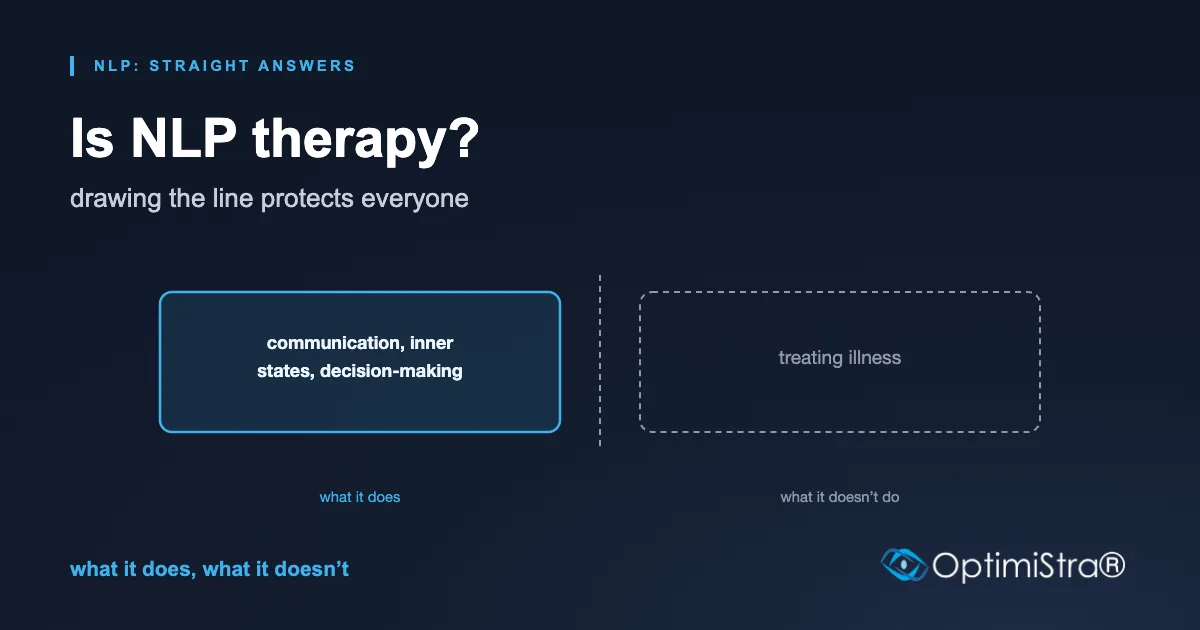
Is NLP therapy?
Neuro-Linguistic Programming (NLP) is not therapy and is no substitute for it. It works on communication, inner states and the way you make decisions, in the here and now, with no claim to treat anything. Stating that limit plainly, from the outset, protects people as much as it protects the discipline.
November 18, 2026 · 6 min read
NLP: Straight Answers
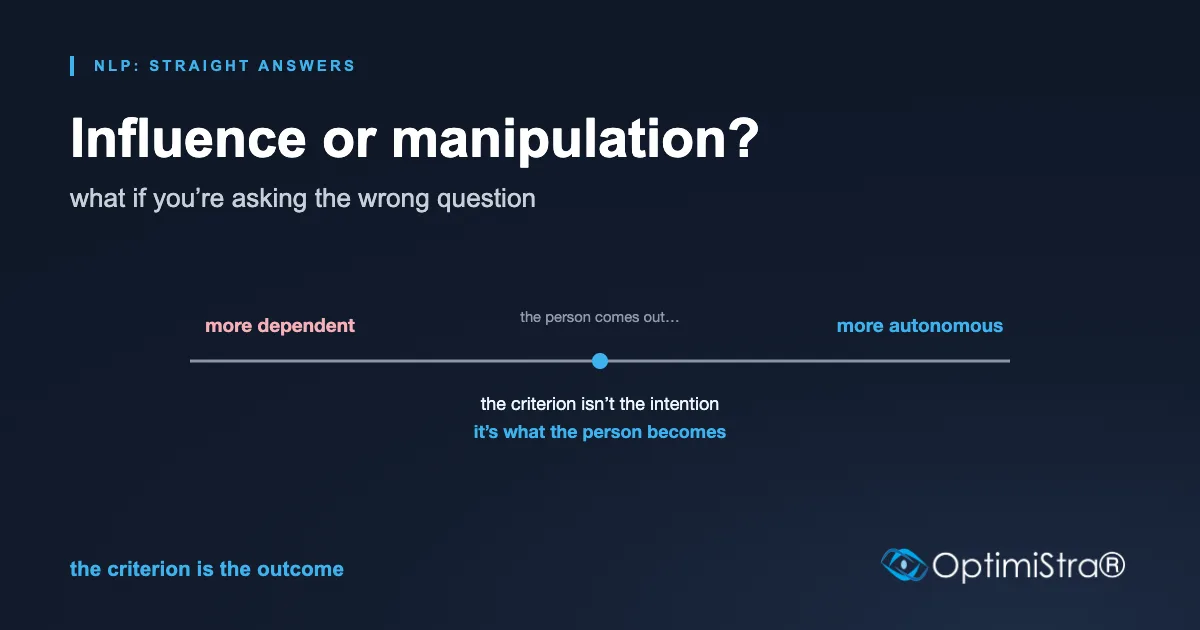
Influence or manipulation: are you asking the wrong question?
Framing the question in terms of intention leads to a dead end, because nobody describes themselves as a manipulator. The useful test is the result: does the other person come away more autonomous, or more dependent? That is a question you can check rather than simply assert.
November 18, 2026 · 7 min read