Observing without jumping to conclusions

Published November 18, 2026 · 5 min read
Read by an AI-generated voice.
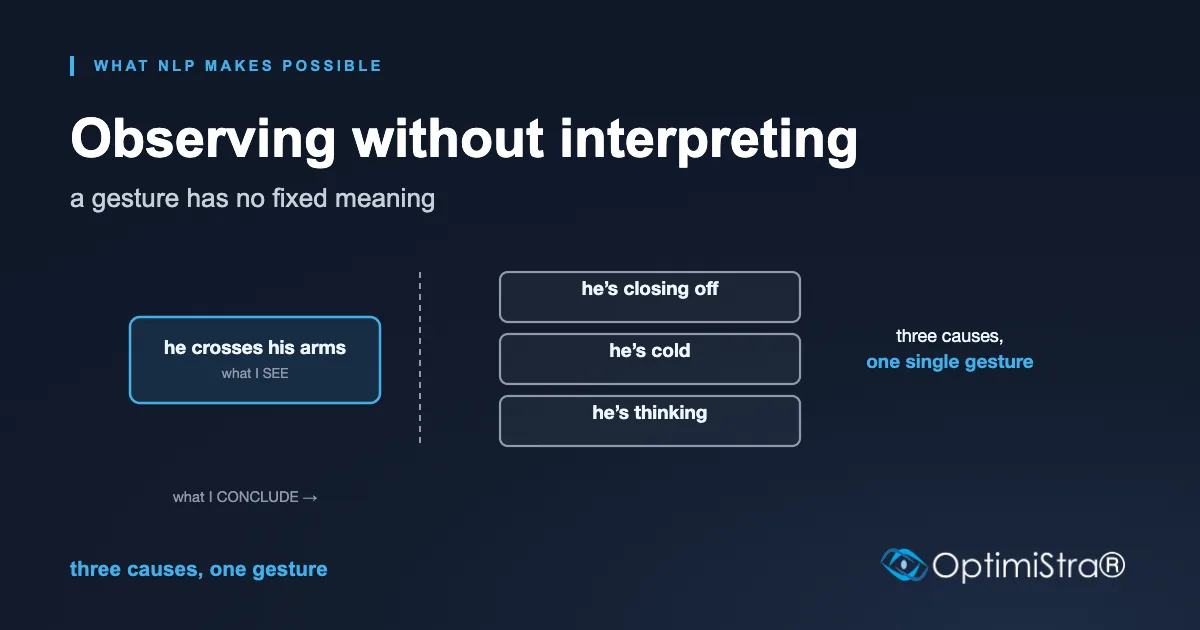
In brief
Someone crosses their arms and we have already reached a verdict. The brain would rather have a wrong answer than the gap left by an open question. Separating what you observe from what you infer can be learned, and the test is simple: if your reading confirms a fear you already had, be wary of it.
Someone is talking to you. And suddenly they cross their arms.
What happens in your head at that exact moment? For many people the answer comes of its own accord, almost in spite of themselves: “They’re closing off. They don’t like what I’m saying.”
It’s quick, it’s automatic and it feels obvious. That is exactly where the trap lies.
What if those crossed arms weren’t about the person in front of you at all… but about you?
It’s one of the first things Neuro-Linguistic Programming (NLP) taught me, and one of the most unsettling: most of the time, when we think we are observing someone, we are projecting ourselves onto them. We aren’t reading the other person. We are reading ourselves.
The trap of automatic interpretation
Back to those crossed arms. The standard interpretation is a comfortable one: the person is closing off. That is one option, among many others. Wiseman, Watt, ten Brinke and Porter tested the best known of these ready-made readings, the eye movements said to give a liar away, and it does not hold up. One point while we’re here, because the confusion is stubborn: that particular reading is not NLP. Richard Bandler and John Grinder, the co-creators of NLP, described only a clue to the sensory channel a person is using at the moment they think, never a lie detector; it was trainers in a hurry who turned it into a certainty. I come back to this in detail in Is NLP scientific?
It is just as possible that this person is simply cold. Or that their back hurts and this position eases the tension a little – that’s often true of me. Or that they have noticed a stain on their shirt and are hiding it without thinking.
Anything is possible, and that is precisely the problem. For any one gesture we have ten or so plausible explanations to hand, and our brain keeps only one. Always the same one: its own.
Why our brain makes up answers
The real question is not “What does this gesture mean?” It is: why am I choosing this interpretation, and not another?
The answer is rarely to be found in the other person. It lies in our own emotions.
Take a concrete example. If I’m short of self-confidence and the person opposite me crosses their arms, my brain will want to believe, automatically and quite naturally, that they are closing off. Why? Because that interpretation confirms what I already fear: that I’m not at ease, that I’m not doing a good job, that I don’t speak well.
The interpretation doesn’t describe reality. It confirms my fear. That is what a projection is: taking what is happening inside me and pinning it onto someone else’s body.
That is why I go further than the usual formula. People often say “observe without interpreting too quickly.” I would simply say: observe without interpreting. An interpretation is never a reading of the other person. It is a projection of ourselves, and it speaks about us.
Observing is a discipline, not a gift
We often imagine that “reading people well” is a kind of inborn talent, an intuition that some have and others don’t. That’s wrong. It is a skill, and like any skill it can be learned.
NLP relies a great deal on this ability to observe, the other person and yourself too, not in order to interpret but to search, clarify and understand. It is also what separates NLP from its caricatures, which Witkowski reviewed one by one.
It is at the heart of everything to do with success as well. When you set out to reproduce someone’s winning strategy, a great deal of the work is observation. And at every moment it is observation with no interpretation in it at all. That is where the whole difficulty of the exercise lies: not in looking more, but in looking without adding anything, without laying your own map of the world over the other person’s.
Ask rather than hallucinate
Here, in the end, is the whole principle reduced to a single move.
When you don’t know, instead of imagining an answer, instead of hallucinating a meaning… ask. Put the question.
It is almost insultingly simple, and it is also one of the hardest things to do, because it first requires you to accept one thing: I don’t know. It means giving up the ready-made answer, and accepting a moment’s emptiness rather than filling it with a story that comes from me.
So, those crossed arms? We think we are doing the right thing by asking “Are you cold?” And that is already a projection: by choosing the hypothesis, we have simply dressed up our own as a question.
The right move is plainer. State what you saw, adding nothing, with just enough of a question in your voice: “You’ve just crossed your arms.” It is a statement, and it carries a question – the one you leave the other person to hear.
They will respond to it. If they’re cold, they’ll tell you. If something did close, they’ll dispute what you’ve just said, and that tells you something more. Either way, the meaning comes from them and not from you. You will have gained something better than an interpretation: reality, given by the person who is living it. Kluger and colleagues brought together 664 measures: feeling listened to changes working relationships, and not just at the margins.
What struck me for a long time was how much of our lives we spend confusing our fears with facts. We turn a movement of the arms into a verdict on ourselves, and tell ourselves stories that we then take for truths.
Learning to observe without interpreting doesn’t mean becoming a body-language detective. It is quite the opposite. It means no longer believing that you can read other people’s minds, so that you can at last begin to see what is really there, in them and in yourself.
It is one of the simplest ways into everything NLP makes possible, and one of those that goes furthest.
Where to go next
If what you’ve just read speaks to you, the next steps are communicating with more precision, what NLP is and the limits and misuses of NLP.
And if you’d rather learn NLP by practicing it than by reading about it, the NLP Practitioner course is where the program begins.
Article designed and written by Michel Wozniak, and optimized by artificial intelligence. Illustration created by artificial intelligence.
Sources
- Wiseman, Watt, ten Brinke, Porter, Couper & Rankin (2012), The Eyes Don't Have It: Lie Detection and Neuro-Linguistic Programming, PLoS ONE
- Witkowski (2010), Thirty-Five Years of Research on Neuro-Linguistic Programming. NLP Research Data Base. State of the Art or Pseudoscientific Decoration?, Polish Psychological Bulletin
- Kluger, Lehmann, Aguinis, Itzchakov, Gordoni, Zyberaj & Bakaç (2023), A Meta-analytic Systematic Review and Theory of the Effects of Perceived Listening on Work Outcomes, Journal of Business and Psychology
- Bandler & Grinder (1979), Frogs into Princes: Neuro Linguistic Programming, Real People Press
Frequently asked questions
Does observing without interpreting mean feeling nothing about other people?
No. The aim isn’t to switch off what you feel, only to stop mistaking it for fact. You can perfectly well feel something when you see a gesture. What matters is not turning that feeling into a conclusion about the other person.
Doesn’t NLP say that crossed arms mean someone is closed off?
That is the most widespread misreading. NLP gives gestures no fixed table of meanings. One gesture can have many causes. The principle is to observe, then check, not to decode from a ready-made dictionary. And checking doesn’t mean offering a hypothesis, which would amount to projecting your own in the form of a question: you simply state the fact you observed, “You’ve just crossed your arms,” in a slightly questioning tone, and let the person supply the meaning.
How can I tell whether I’m interpreting rather than observing?
There is a simple test: if your reading of a gesture confirms a fear or a belief you already held about yourself, be wary of it. There is a good chance you are projecting rather than observing.
Why are we so quick to interpret?
Because uncertainty is uncomfortable. Our brain would rather have a wrong answer than the gap left by an open question. Observing without interpreting means learning to tolerate that gap long enough to go and find the real answer.
So should I give up reading body language altogether?
No. Observing non-verbal behavior remains valuable, provided you treat it as a question and not as an answer. A gesture signals that something is going on; it doesn’t say what. The next step is to ask, not to guess, and that is often the question that was missing.
What NLP Makes Possible
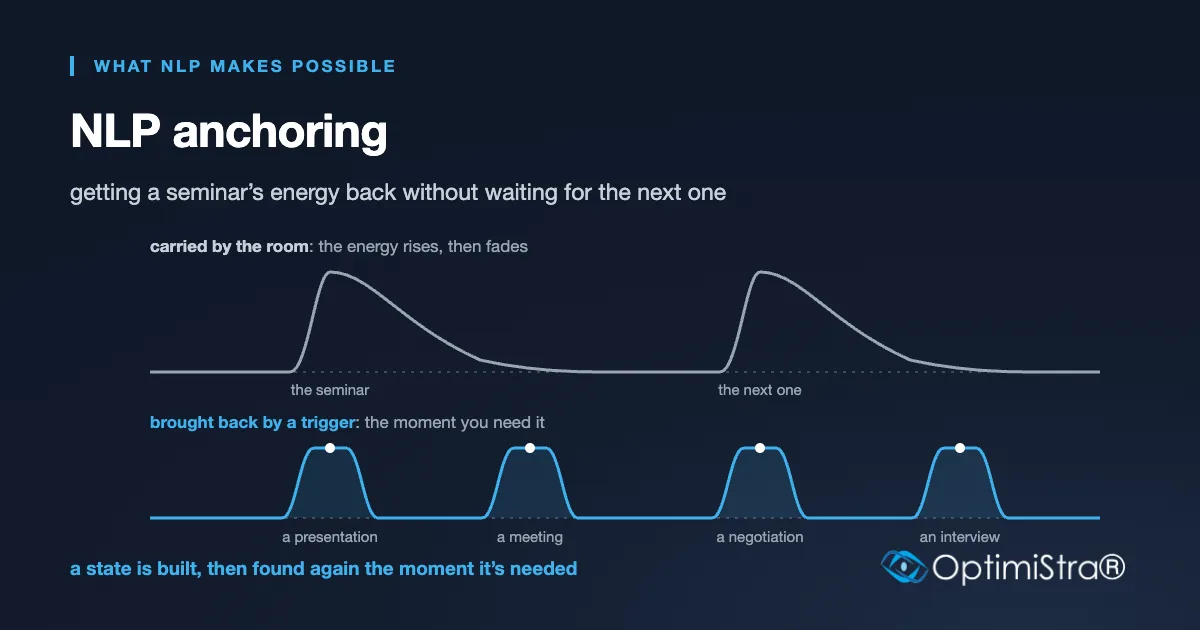
After a motivational seminar, the energy fades: what NLP anchoring changes
A motivational seminar produces real energy, and it often fades within a few weeks because it stays attached to the room. Elite athletes learn to bring back the state they need on their own, with a chosen trigger such as Florent Manaudou’s word “puissance.” NLP calls this an anchor, and it can be learned.
November 18, 2026 · 14 min read
What NLP Makes Possible
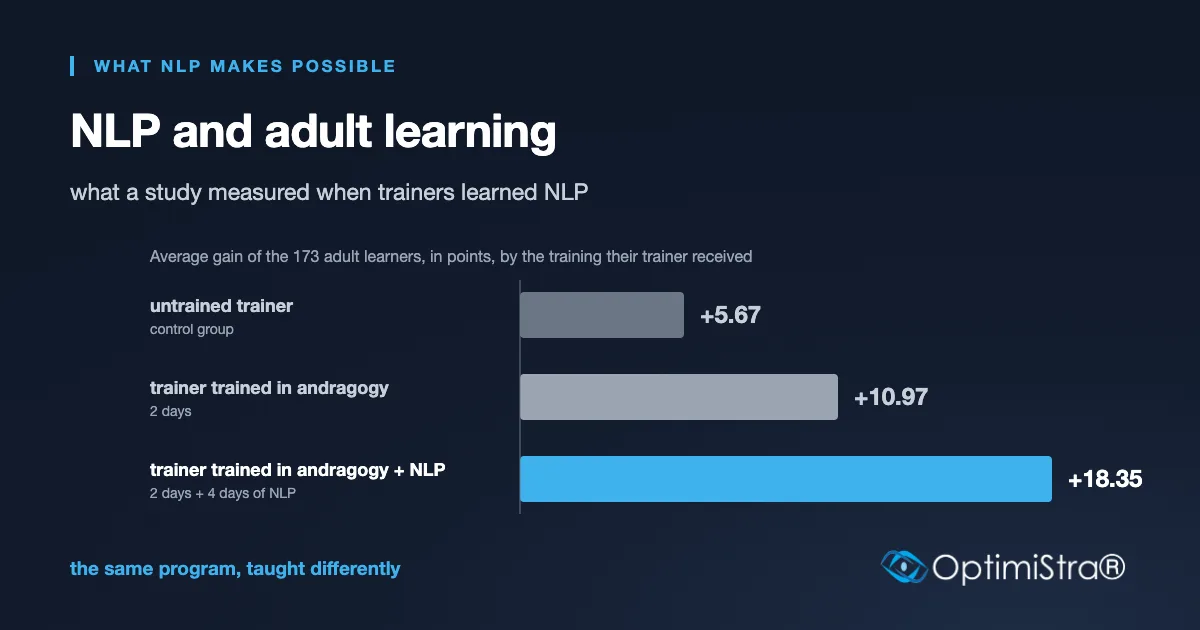
NLP and adult learning: what a study measured in 173 adult learners
In 2012, a study in England randomly assigned 24 trainers of adults to three groups. Learners whose trainer had taken 4 days of Neuro-Linguistic Programming (NLP) on top of a course in andragogy improved by 18.35 points, compared with 10.97 when the trainer had taken andragogy alone. Research on expectations, relationships, and stress helps explain the gap.
November 18, 2026 · 15 min read
What NLP Makes Possible
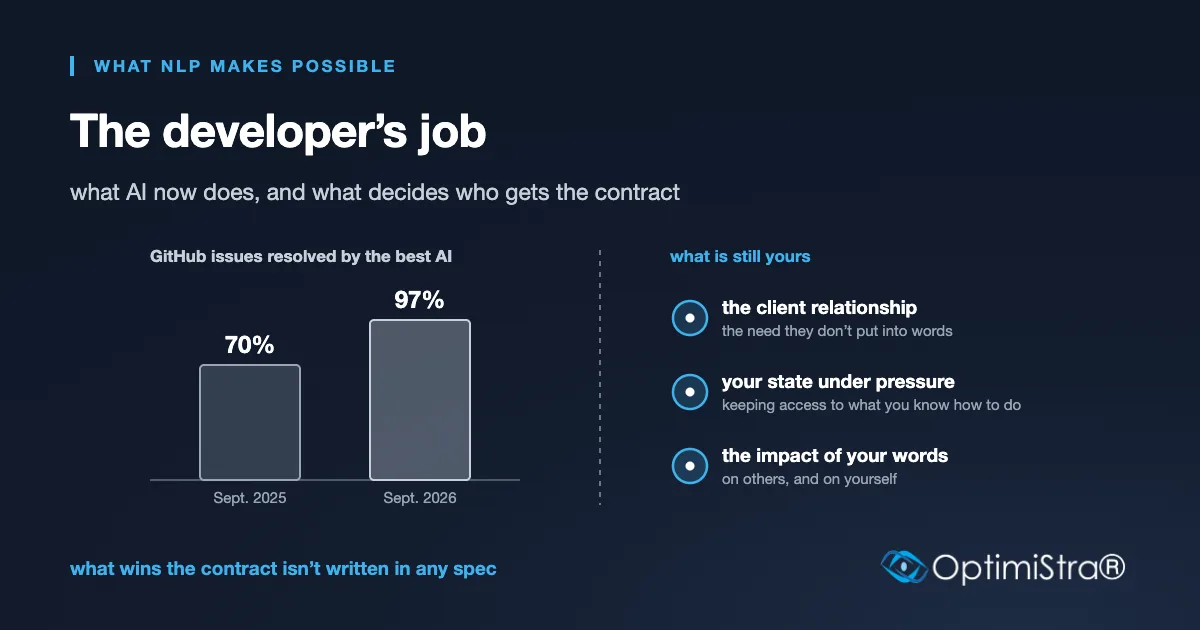
Developers in the age of AI: what decides who gets the contract
AI now resolves almost all the tickets in a benchmark test, and the market for developers has tightened. What decides who gets the contract increasingly lies in the relationship with the client and in the state you are in under pressure. These human skills can be trained, and Neuro-Linguistic Programming (NLP) works on them through three pillars.
November 18, 2026 · 11 min read