After a motivational seminar, the energy fades: what NLP anchoring changes

Published November 18, 2026 · 14 min read
In brief
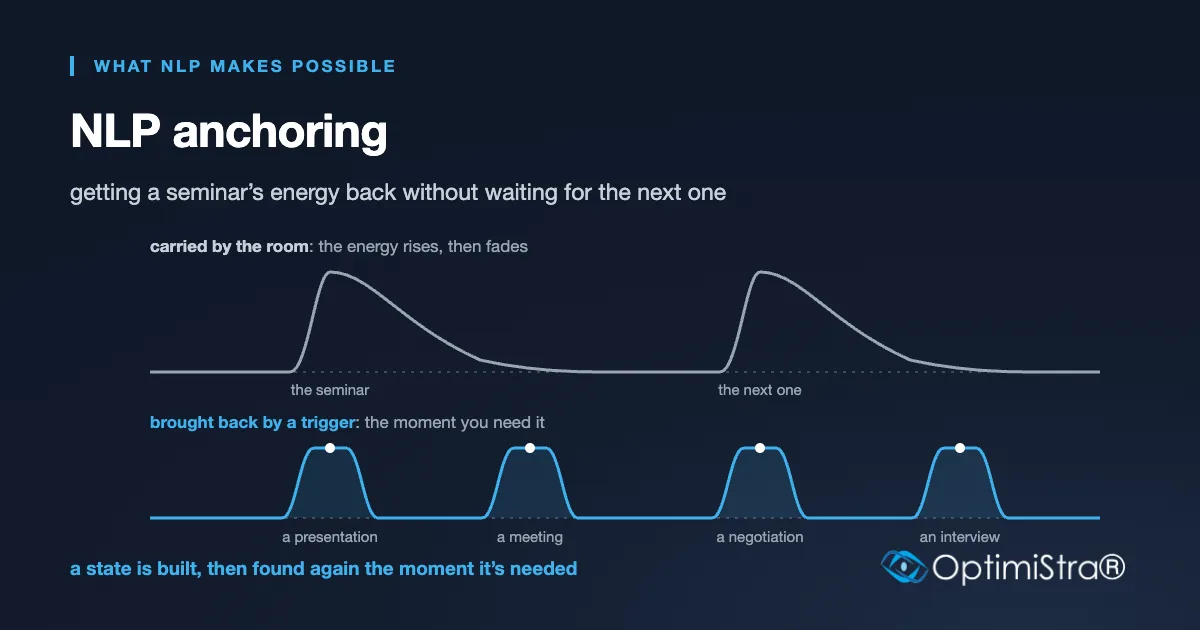
A motivational seminar produces real energy, and it often fades within a few weeks because it stays attached to the room. Elite athletes learn to bring back the state they need on their own, with a chosen trigger such as Florent Manaudou’s word “puissance.” NLP calls this an anchor, and it can be learned.
Anyone who has attended a two- or three-day motivational seminar knows the moment. You arrive tired, sometimes doubting yourself, and you leave fully charged. The music, the group, and the speaker all push in the same direction, and the gap between before and after is striking. That energy is real, and I don’t underestimate it.
When I get the chance, I ask people coming back from these events one question: how long did the effect last? The answers are much alike. One to two weeks most often, sometimes three, rarely more. After that the energy fades, and many people wait for the next event to find it again.
An elite athlete doesn’t have a three-day seminar ahead of a final. They have a few minutes, and they have learned to put themselves in the state they need. Neuro-Linguistic Programming (NLP) calls this an anchor, and it is what Nathalie de Marcé and I have been teaching together for about 10 years. I suggest we cover the ground in six stages:
- what a motivational seminar produces, and how long it lasts;
- why the energy fades;
- what elite athletes do;
- how an anchor is built;
- why nobody does it naturally;
- how to learn it.
1. What a motivational seminar produces, and how long it lasts
As far as I know, no published study has measured, week after week, the energy of participants after a two- or three-day motivational seminar. What I reported above is an observation from the field. Research has, on the other hand, looked closely at another intense break from which people also come back changed: vacation.
A Dutch team followed 96 employees before, during, and after a ski vacation (de Bloom et al., 2010). Their health, mood, and energy improved during the stay. By the first week back at work, their health and well-being had generally returned to the level they were at before leaving. The researchers titled their paper “Lots of fun, quickly gone.” After short vacations of 4 to 5 days, the same team found that the gain had disappeared entirely 3 days after the return to work (de Bloom et al., 2012). A meta-analysis of 13 studies reaches the same finding: one week after the return, well-being is no longer significantly different from what it was before the vacation (Speth, Wendsche, and Wegge, 2023).
Research is not unanimous on the speed. A larger meta-analysis, of 32 studies, finds a stronger effect that fades less quickly than was thought (Grant, Buchanan, and Shockley, 2025). On the direction, though, the studies agree: what a break gives you wears off once you are back in daily life.
Large personal development seminars have been studied far less. One controlled study followed 135 participants in one of them for more than a year, comparing them with 73 people who had not attended (Fisher et al., 1989). Four to six weeks after the seminar, only their sense of control had changed, and no long-term effect was observed.
So the peak of energy exists, and it fades. The next question is why.
2. Why the energy fades
During a seminar, your state is carried by what surrounds you: the music, the speaker’s voice, a whole group resonating with you. In our courses, we teach that a state becomes associated with whatever is present at the moment you experience it. In a seminar room, the energy therefore attaches itself to the room, and that is where it is easiest to find again. On Monday morning, at the office, none of those triggers is there.
In 1977, the psychologist Albert Bandura described the four sources of the confidence a person has in their ability to act: what they have accomplished themselves, what they see others accomplish, what they are told, and what they feel in their body. The more a source rests on lived experience, the stronger the change (Bandura, 1977). Confidence that comes from other people’s words, he writes, is weaker than confidence that comes from your own achievements, and a contrary experience can extinguish it. A seminar mostly supplies the last three sources. The first, what you accomplish yourself, begins once you are back home.
There is also what happens in the brain. Dopamine neurons, first studied in monkeys, fire in response to what is better than expected, and do not react to what arrives exactly as expected (Schultz, 1998). As learning progresses, their response shifts from the reward itself to whatever announces it. Applied cautiously to our subject, this means that an experience surprises less the second time than the first, and that the brain learns to react to the signals that come before it. This shift toward a signal is a learned association, and it is precisely the mechanism that athletes put to work for themselves.
3. What elite athletes do
In March 2012, at the French national championships in Dunkirk, Florent Manaudou has to qualify for the London Olympic Games. To do so, he must beat three of the four 50-meter freestyle specialists he has admired for years. His mental coach asks him in what way he is stronger than they are. His answer: in the weight room. One day, on the bench press, he lifted 155 kilos, far more than his fellow swimmers.
A France 2 report, broadcast in the program Les pouvoirs extraordinaires du corps humain, tells the rest and names the method his mental coach uses: NLP. The report describes it in three steps. First, identify the state in which Florent delivers his best performances: for him, the feeling of being stronger than everyone else. Next, find a memory in which he experienced that emotion, the 155-kilo session. Finally, associate a word with that emotion: “puissance,” French for “power.” With practice, the report explains, the word ends up triggering the emotion directly, without even going back through the memory.
Manaudou finishes second in Dunkirk and qualifies. As he tells it in the report, the work helped him tell himself that he was capable of doing it, and that even though these were all men who had swum faster than he had, he had no reason to feel inferior to them. On August 3, 2012, he becomes Olympic champion in the 50-meter freestyle in London.
The Arte documentary Dans la tête des champions (Jean-Yves Cauchard, 2021) returns to the same technique and gives the floor to the neuroscientist Antonio Damasio, director of the Brain and Creativity Institute at the University of Southern California. In the French version of the film, he says that the idea of using a word or a phrase to trigger a particular process is entirely legitimate from a scientific point of view. The film can be rented on ARTE VOD.
Manaudou is not an exception. Research in sport psychology studies the same practices under other names.
- Pre-performance routines. A meta-analysis shows that they improve performance, including under pressure, and that their effect does not vary with the type of routine or with the athlete’s age, sex, or level (Rupprecht, Tran, and Gröpel, 2021).
- The words you say to yourself. Across 32 studies, self-talk improves performance to a moderate degree, and programs that train people to do it produce better results than those that do not include this training (Hatzigeorgiadis et al., 2011).
- Mental imagery. Reliving or anticipating a movement in your mind improves performance, motivation, and emotions, and the effect grows with the intensity of the training (Simonsmeier et al., 2021).
These three results have one thing in common: training. A cue word, a routine, or a mental image is built, and then it is worked on.
4. How an anchor is built
You already have some
Before building an anchor, take a moment to notice the ones you already have. A song on the radio takes you back to one particular summer, and the mood of that summer comes back with it. A perfume in the street reminds you of someone before you have even thought of that person. A place is enough to tighten your shoulders, or to loosen them. Nobody asked your opinion before creating these associations: they formed on their own, because an image, a sound, or a smell was present while you were experiencing a strong state.
Find two or three of your own, one pleasant and one less pleasant. You have just observed what NLP calls an anchor. In our courses, we use the image of a switch and a lamp: the switch is the trigger, something you see, hear, smell, or touch; the lamp is the state that lights up.
Psychology studies this mechanism under the name of conditioning. A meta-analysis of 214 studies shows that pairing a neutral element with a pleasant or unpleasant experience changes how people feel about it, with a medium effect (Hofmann et al., 2010). Two of its results matter here: the association is stronger when the person is aware of it, and it weakens when it stops being maintained. According to Antonio Damasio’s somatic marker hypothesis, simply recalling an emotionally charged memory reactivates the bodily state associated with it, more faintly than the experience itself (Bechara and Damasio, 2005).
Building an anchor means doing deliberately, and with precision, what life does at random. This is what we teach under the name of NLP anchoring.
The six steps of a well-set anchor
Here is how we practice it in our courses.
- Choose the resource state. Behind every goal there is a state. To run a marathon, the useful state is called endurance, more than “being in shape.” For Florent Manaudou, it was the feeling of being stronger than the others.
- Choose a precise and rare trigger. An exact point on the body, or an uncommon word. “Puissance” works well for a French speaker, because you seldom hear it by chance. An everyday word like “bread” would work poorly: you come across it every day, and each ordinary use would dilute the association.
- Relive a memory, and set the trigger while the state is rising. You find a specific moment when you experienced that state, you relive it from the inside, eyes closed, with what you saw, heard, and felt, and you let the sensation build. The trigger is set quickly, during the rise, close to the peak, never at the peak itself. Set too late or held too long, it would become associated with the phase when the emotion is coming back down.
- Break the state, then start again. An unrelated question, such as your favorite color, brings you back to a neutral state. You then start again with other memories of the same state, stacked on the same trigger, which grows stronger each time.
- Test. After breaking the state, you fire the trigger and observe honestly whether the state comes back. Nathalie puts it this way in class: anchors have to be earned. Only what you can actually observe counts.
- Maintain. An anchor that is not used wears off, which we sum up as “use it or lose it.” You reactivate it by reproducing the gesture identically, in the same place and with the same intensity, and you feed it with new experiences of the same state.
These six steps fit in a few lines, and it is carrying them out that takes learning, starting with the timing. On your own, it is hard to spot the peak of your own emotion, and the tendency is to set the trigger too late. A trained practitioner sees it from the outside, through small signs they learn to observe, such as the fluttering of the eyelids that stops in some people at the moment of the peak. They also know how to judge a test honestly, without going easy on it. This is why we learn this skill by practicing in pairs, each person taking both roles in turn.
5. Why nobody does it naturally
If the mechanism is so simple, why don’t we all make our own triggers? Because nobody taught us. School teaches many things, and rarely how to put yourself in the state a situation calls for. Elite athletes did not pick it up by osmosis either: Florent Manaudou learned it from his mental coach, at a moment when the stakes required it.
The studies on how vacation benefits fade show this in another way. In a randomized trial published in 2026, with 190 people, a short daily exercise guided by an app after returning from vacation reduced work-related rumination after 2 weeks. The authors conclude that the rapid fading of vacation benefits is not inevitable (Thomsen et al., 2026). In sports, a meta-analysis of randomized trials finds that the effect of psychological training on performance is still visible at follow-up, and that it may last at least a month after the intervention ends. The authors remain cautious, since only eight studies measured it (Brown and Fletcher, 2017).
The difference between the energy of a seminar and the energy of an anchor therefore comes down to who is holding the switch. In the room, the event holds it. With an anchor, you do, at the moment you need it: before a meeting that matters, an oral exam, or a negotiation.
A motivational seminar remains a fine experience, and nothing stops you from enjoying one. What changes, once you know how to set an anchor, is that you no longer need to wait for the next one to find that state again.
6. Learning it with us
Nathalie de Marcé and I were both named Master Trainer by Richard Bandler, co-creator of Neuro-Linguistic Programming: we are the world’s first two French-speaking Master Trainers named by Richard Bandler himself. We teach with a team of trainers and assistants. Over several years, we had our course reviewed and validated by more than 20 brain and health professionals, among them doctors of neuroscience, biology, and biophysics, physicians, and psychologists, and we reworked it with them until it agreed with what they know.
The NLP Practitioner course, 8 days in person
The NLP Practitioner course runs over 8 days, in Switzerland, in a group. Scheduled sessions are taught in French, and the course is given in English on request. Anchors have a large place in it: you set them, test them, stack them, and learn to undo them, first on yourself, then with others, while assistants who are NLP Master Practitioners move between the groups to supervise the exercises.
- The certificate is signed by Richard Bandler himself.
- After the course, twelve live group sessions on Zoom, one hour a month for a year.
- A WhatsApp group, where the trainers and assistants stay for at least a year.
- The OptimiStra® Platform: practice apps, one for each skill worked on in the course, on your phone or your computer, with nothing to install. Among other things, they help you settle yourself in the few minutes before a difficult meeting, and turn down the intensity of what weighs on you while turning up the intensity of what serves you.
- Admission starts with a 30-minute admission call on Zoom, so we can make sure together that the timing and the format are right for you.
When it is not the right moment
The course asks for real commitment: you work on yourself, and you will be led to question yourself. It is not therapy, and it does not replace therapy. If you are going through a truly difficult period, this is not the right time, and we will be glad to welcome you later. We bring the method, the practice, and the support; the results come from practice, and everything is built around it.
If you can free up 8 days and you want the practitioner certification, the NLP Practitioner page describes how the course runs and how to apply.
Keep reading
To read further: managing your inner state, or how to take back control in the heat of the moment, moving to change your mood, and what the studies measure, and forming a habit: how long does it really take?
And if you would rather follow a thread than browse at random, our complete path to understanding NLP puts our articles in order.
Article designed and written by Michel Wozniak, and optimized by artificial intelligence.
Sources
- France 2, Les pouvoirs extraordinaires du corps humain, « Quelle est l'arme fatale des meilleurs nageurs du monde ? » (2016), extrait sur Florent Manaudou mis en ligne sur YouTube (in French)
- Cauchard (2021), Dans la tête des champions, Kino Presse et ARTE France, ARTE VOD (in French)
- de Bloom, Geurts, Taris, Sonnentag, de Weerth et Kompier (2010), Effects of vacation from work on health and well-being: Lots of fun, quickly gone, Work & Stress
- de Bloom, Geurts et Kompier (2012), Effects of short vacations, vacation activities and experiences on employee health and well-being, Stress and Health
- Speth, Wendsche et Wegge (2023), We Continue to Recover Through Vacation!, European Psychologist
- Grant, Buchanan et Shockley (2025), I need a vacation: A meta-analysis of vacation and employee well-being, Journal of Applied Psychology
- Fisher, Silver, Chinsky, Goff, Klar et Zagieboylo (1989), Psychological effects of participation in a large group awareness training, Journal of Consulting and Clinical Psychology
- Bandura (1977), Self-efficacy: Toward a unifying theory of behavioral change, Psychological Review
- Schultz (1998), Predictive reward signal of dopamine neurons, Journal of Neurophysiology
- Rupprecht, Tran et Gröpel (2021), The effectiveness of pre-performance routines in sports: a meta-analysis, International Review of Sport and Exercise Psychology
- Hatzigeorgiadis, Zourbanos, Galanis et Theodorakis (2011), Self-Talk and Sports Performance: A Meta-Analysis, Perspectives on Psychological Science
- Simonsmeier, Andronie, Buecker et Frank (2021), The effects of imagery interventions in sports: a meta-analysis, International Review of Sport and Exercise Psychology
- Hofmann, De Houwer, Perugini, Baeyens et Crombez (2010), Evaluative conditioning in humans: a meta-analysis, Psychological Bulletin
- Bechara et Damasio (2005), The somatic marker hypothesis: A neural theory of economic decision, Games and Economic Behavior
- Thomsen, Syrek, Brückner, de Bloom, Janneck, Domin, Reins et Lehr (2026), Effectiveness of the mobile application Holidaily in reducing work-related rumination when returning to work after vacation: a randomized controlled trial, Frontiers in Digital Health
- Brown et Fletcher (2017), Effects of Psychological and Psychosocial Interventions on Sport Performance: A Meta-Analysis, Sports Medicine
Frequently asked questions
What is an anchor in NLP?
An anchor is the association between a trigger and an inner state. The trigger can be a word, a gesture, a precise point on the body, an image, or a sound. Once the association is built, the trigger is enough to reactivate the state. We all have anchors that formed by chance, like a song that brings back the mood of a summer. Neuro-Linguistic Programming (NLP) teaches you to build them deliberately and precisely, so you can find a useful state again when you need it.
How long does the effect of a motivational seminar last?
No published study has measured it week after week for a two- or three-day seminar. The people I ask most often say one to two weeks, sometimes three. Studies on vacation, another intense break, find that well-being generally returns to its starting level within the week after going back to work, although a 2025 meta-analysis concludes that the fade is slower.
How do you set an anchor correctly?
You choose the useful state and a precise, rare trigger. You relive a memory in which you experienced that state, and you set the trigger while the sensation is rising, close to the peak and never at the peak, otherwise it would become associated with the phase when the emotion comes back down. You break the state, start again with other memories, then test. An anchor is maintained by using it.
Do you have to be an athlete to use an anchor?
No. Athletes use it before a competition, and the same skill works just as well before an oral exam, a negotiation, an interview that matters, or a difficult conversation. Only the state you are looking for changes: calm, confidence, concentration, or energy. The principle stays the same: a chosen trigger, linked to a state you have already experienced.
Can you learn to set an anchor on your own?
You can understand the principle on your own, and notice the anchors you already have. The skill itself takes practice: the moment you set the trigger decides what gets associated, and it is hard to spot the peak of your own emotion. In sports, programs that train people in these techniques produce better results than those that only present them. This is why we learn them in pairs, under a trainer’s eye.
What NLP Makes Possible
NLP and adult learning: what a study measured in 173 adult learners
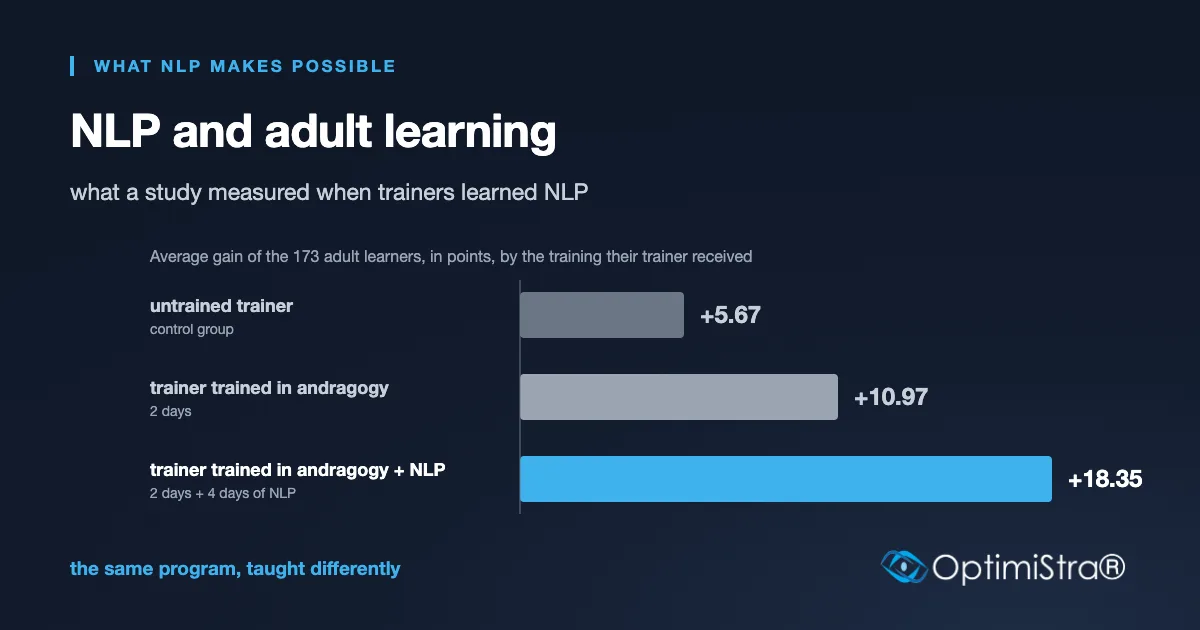
In 2012, a study in England randomly assigned 24 trainers of adults to three groups. Learners whose trainer had taken 4 days of Neuro-Linguistic Programming (NLP) on top of a course in andragogy improved by 18.35 points, compared with 10.97 when the trainer had taken andragogy alone. Research on expectations, relationships, and stress helps explain the gap.
November 18, 2026 · 15 min read
What NLP Makes Possible
Developers in the age of AI: what decides who gets the contract
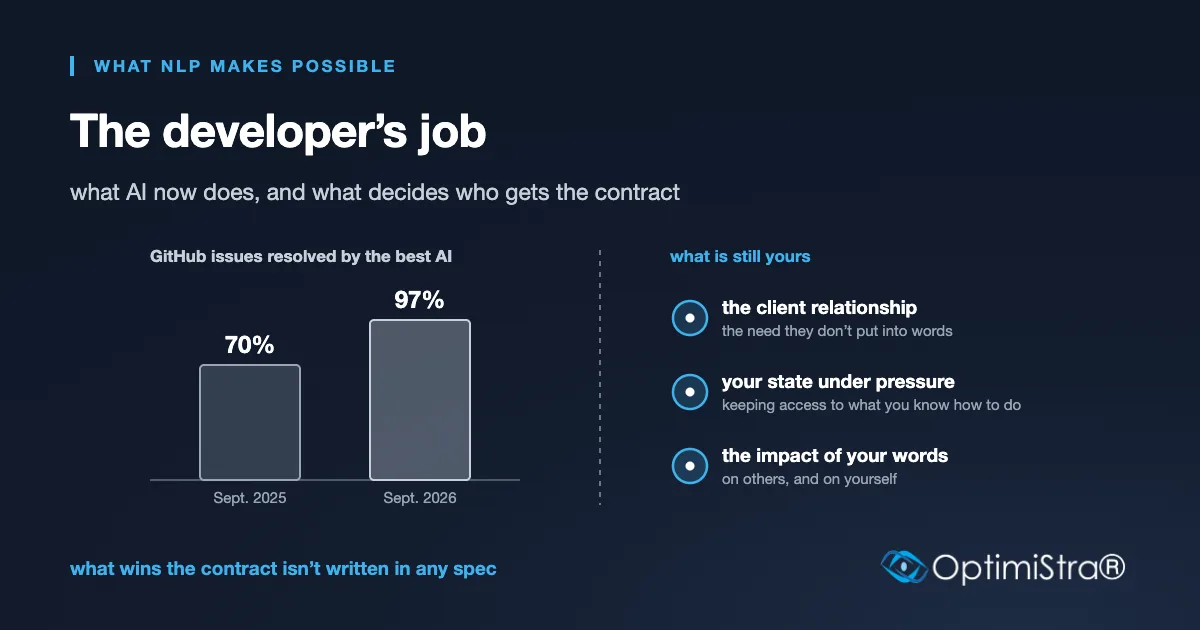
AI now resolves almost all the tickets in a benchmark test, and the market for developers has tightened. What decides who gets the contract increasingly lies in the relationship with the client and in the state you are in under pressure. These human skills can be trained, and Neuro-Linguistic Programming (NLP) works on them through three pillars.
November 18, 2026 · 11 min read
What NLP Makes Possible
Observing without jumping to conclusions
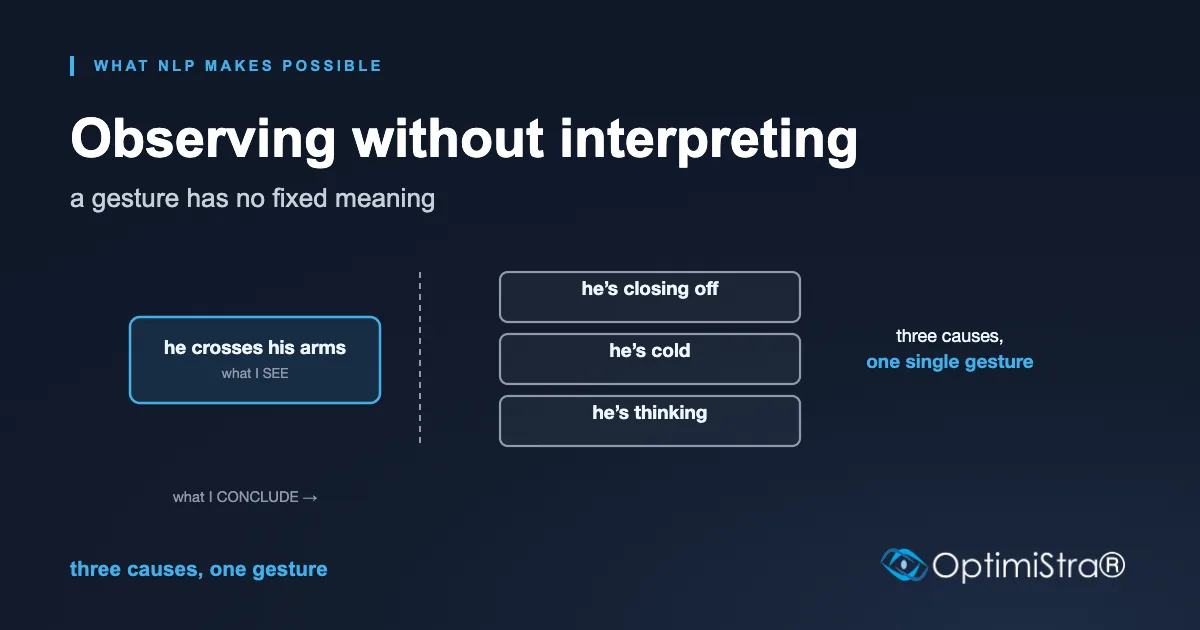
Someone crosses their arms and we have already reached a verdict. The brain would rather have a wrong answer than the gap left by an open question. Separating what you observe from what you infer can be learned, and the test is simple: if your reading confirms a fear you already had, be wary of it.
November 18, 2026 · 5 min read