How long does it really take to form a habit?


Michel Wozniak and Nathalie de Marcé
Published November 18, 2026 · 8 min read
In brief
Repeating what you learn changes the connections between neurons, as Eric Kandel showed. In people, an action repeated every day takes a median of 66 days to approach its highest level of automaticity, with a range of 18 to 254 days. The 21-day rule does not hold up, and one missed day does no harm.
An action you repeat every day, at the same moment, ends up happening almost by itself. That is good news for anyone who wants to make a practice stick, and it raises a very practical question: how long does it take?
The most common answer, 21 days to form a habit, does not hold up against the measurements. Studies that followed volunteers day by day find a median closer to 2 months, with very wide differences from one person to the next. Here is what repetition changes in the nervous system, what those studies measure, and how we use them: keep a single practice for 14 days before you judge it.
What researchers mean by a habit
In psychology, a habit is an action triggered automatically by a context it has become associated with: washing your hands after using the toilet, putting on your seat belt when you get into a car. Both examples come from Benjamin Gardner, Phillippa Lally, and Jane Wardle of University College London, in an article written for general practitioners and published in 2012.
Their definition has a practical consequence. According to the decades of research they summarize, simply repeating a simple action in a stable context ends up tying it to that context, which is then enough to set it off. The action depends far less on attention and motivation, and it is very likely to last when the initial enthusiasm fades. Hence their advice, in one sentence: repeat a chosen action in the same context until it becomes automatic and effortless.
What repetition changes in the nervous system
Eric Kandel received the Nobel Prize in Physiology or Medicine in 2000, with Arvid Carlsson and Paul Greengard, for their discoveries on how signals are transmitted in the nervous system. Much of his work on memory concerns a marine invertebrate, Aplysia, and a very simple protective reflex: the withdrawal of its gill.
In a review published in 2009 in The Journal of Neuroscience, Kandel looks back at what this reflex taught researchers. A single training trial produces a memory that lasts a few minutes; repeated, spaced training produces one that lasts from several days to several weeks. And that lasting memory leaves a physical trace.
In 1988, Craig Bailey and Mary Chen counted the terminals through which a sensory neuron in Aplysia passes on its signal. In animals trained to react more strongly, these neurons carried twice as many as in control animals. In animals that had become used to a repeated touch and no longer reacted to it, they carried 35% fewer. For Kandel, this confirms an intuition of Ramón y Cajal’s: the connections between neurons are not fixed, and learning changes them.
The two researchers then followed these changes over time. From 1 to 2 days after training ended, the extra terminals and active zones, the points where the signal crosses, were clearly there. A week later, they were intact. After 3 weeks, the increase in active zones had only partly faded.
These results concern a reflex in an invertebrate. They establish a principle, and they give no timeline for our own habits.
In humans: the brain of a beginner juggler
Nobody counts nerve terminals in a human being, but imaging makes it possible to follow broader changes. In 2008, Joenna Driemeyer and her colleagues taught 20 adults to juggle and scanned them six times with MRI: before they started, during the weeks of training, and then 2 and 4 months after they stopped.
Gray matter in an area that processes visual motion increased during the training period, then decreased once training stopped, even though the participants could still juggle. The authors read this as a sign that, for the brain, learning a new task matters more than continuing to train.
Three reservations are in order. The change measured after a single week is only a statistical trend. MRI measures a volume of gray matter, which can reflect many things and does not point to neurons as such. And the authors could not control for mental rehearsal of the movements, which might matter as much as the physical practice itself.
Where the 21-day rule comes from
The idea that it takes 21 days to form a habit is everywhere. According to Gardner and his colleagues, it seems to come from anecdotal observations reported in 1960 in Psycho-Cybernetics, the book by Maxwell Maltz: plastic surgery patients adjusted psychologically to their new appearance in about 21 days.
Getting used to a new appearance and settling into a daily action are two very different things. The 2024 review discussed below concludes that a 21-day challenge is unlikely to be enough to anchor a new habit.
What habit studies actually measure
In a study published in 2010, Phillippa Lally and her colleagues at University College London asked 96 volunteers to choose an action related to eating, drinking, or physical activity, and to repeat it every day in the same context, for example after breakfast, for 12 weeks. Each day, participants reported whether they had done it and answered questions about how automatic it felt.
Of the 82 participants whose data could be used, a curve could be fitted for 62, and it described the progress of 39 of them well. For those 39 people, it took a median of 66 days to reach 95% of their highest level of automaticity, with times ranging from 18 to 254 days. Physical activity took one and a half times longer than the other actions to reach its plateau.
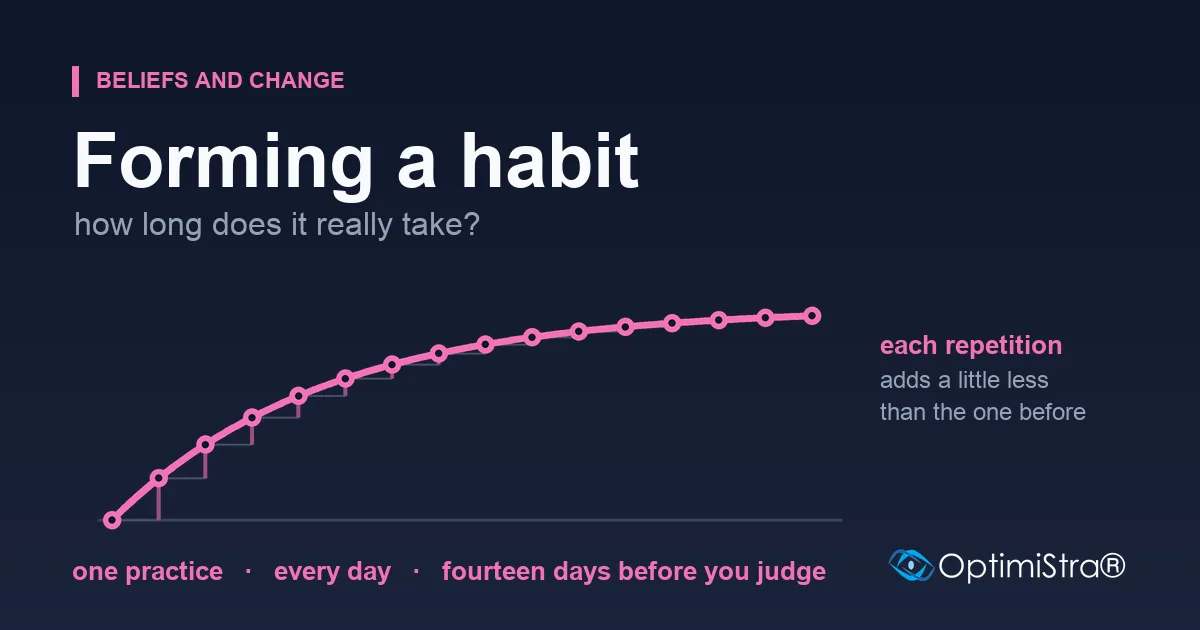
The shape of the progress matters as much as its length. For each person, automaticity rose along a curve that flattens out: every repetition moves it forward, each a little less than the one before, up to a plateau. And a missed day put nothing at risk: the score dipped very slightly the next day, the difference was not significant, and there was no visible cost afterward.
In 2024, Ben Singh and his colleagues brought together 20 studies and 2,601 participants. Four of those studies measured the time a habit takes to form: medians ranged from 59 to 66 days, means from 106 to 154 days, and individual times from 4 to 335 days. The review also notes two favorable conditions. In a study on stretching, the morning practice took hold better than the evening one. And a habit people chose for themselves took hold better than one assigned to them.
What the research does not establish
Four limitations are worth keeping in mind before you put any of this to use.
Nobody has tested our 14-day rule. None of these studies tested the value of judging a practice after 2 weeks. The rule is a choice we make as trainers. These results make it reasonable; they do not prove it.
Automaticity is reported by the participants themselves. Lally and her colleagues measured it with a questionnaire that had never before been filled out daily in this way, and they themselves point out days with no data.
The studies mostly cover simple health behaviors: drinking water, eating a piece of fruit, walking, flossing. In the 2024 review, 11 of the 20 studies carried a high risk of bias, and only four measured a duration.
The changes observed in the nervous system come from an invertebrate or from small groups. The terminals of Aplysia do not carry over directly to humans, and the juggling study involved 20 people.
Why we ask for 14 days
In our courses, we ask participants to keep a practice for 14 days before judging it. According to the measurements above, that is rarely long enough to make it automatic. Its purpose is to let you judge the practice on something other than a first try.
Two findings make it reasonable. In the model fitted by Lally and her colleagues, each repetition adds a little less than the one before: the first weeks are when automaticity grows fastest, which is why we compare the effort required on day 1 and on day 14. Gardner and his colleagues also note that unrealistic expectations about how long it takes lead some people to give up partway through, and that people are reassured to learn that an action gradually becomes easier.
Hence the second half of the rule: if the effort has dropped by day 14, you keep going, because forming a habit often takes 2 months or more.
The full protocol
- Choose one practice only. For example, one of the five in our progression: breathing 5 seconds in, 5 seconds out, naming the sensation before the emotion, going through the body before the discussion, adjusting your level of stress, or placing a return to calm between two demands.
- Attach it to a fixed moment that is already part of every day: after breakfast, when you arrive at work. For a practice that has to wait for an occasion, review your day every evening at the same time.
- One check mark a day.
- If you miss a day, pick it up again the next day.
- Rate the effort the practice takes, out of 10, on day 1 and on day 14.
- On day 14, compare. If the effort has dropped, continue. If it has not moved, you will have given the practice a real try, and you can choose another.
One last reservation. These practices are meant for ordinary moments. If a breathing practice appeals to you and you are under medical care for a heart rhythm or breathing condition, ask your doctor before making it a daily habit. And if you are going through a difficult time, no article takes the place of proper support: talk to a professional.
Where this exercise fits
The first five steps of our progression each give you one practice for acting on your own state: breathing, reading the sensation, going through the body, adjusting your energy, returning to calm. This one teaches you how to use them: keep one, and give it time to settle in.
The articles in this progression are collected on the blog.
Article written by Michel Wozniak and Nathalie de Marcé, and optimized by artificial intelligence.
Sources
- Kandel (2009), The Biology of Memory: A Forty-Year Perspective, The Journal of Neuroscience
- Bailey & Chen (1988), Long-term memory in Aplysia modulates the total number of varicosities of single identified sensory neurons, Proceedings of the National Academy of Sciences
- Bailey & Chen (1989), Time course of structural changes at identified sensory neuron synapses during long-term sensitization in Aplysia, The Journal of Neuroscience
- Driemeyer, Boyke, Gaser, Büchel & May (2008), Changes in Gray Matter Induced by Learning — Revisited, PLoS ONE
- Lally, van Jaarsveld, Potts & Wardle (2010), How are habits formed: Modelling habit formation in the real world, European Journal of Social Psychology
- Gardner, Lally & Wardle (2012), Making health habitual: the psychology of ‘habit-formation’ and general practice, British Journal of General Practice
- Singh, Murphy, Maher & Smith (2024), Time to Form a Habit: A Systematic Review and Meta-Analysis of Health Behaviour Habit Formation and Its Determinants, Healthcare
Frequently asked questions
How long does it take to form a habit?
In the study by Lally and her colleagues at University College London, it took a median of 66 days for an action repeated every day to approach its highest level of automaticity, with a range of 18 to 254 days depending on the person. A 2024 review finds medians of 59 to 66 days, and individual times that vary even more. A simple action, such as drinking a glass of water, settles in sooner than physical exercise.
Is the 21-day habit rule true?
Studies that have measured habit formation do not confirm it. The rule seems to come from observations reported in 1960 in Psycho-Cybernetics, the book by Maxwell Maltz: plastic surgery patients got used to their new appearance in about 3 weeks. The times measured since then are clearly longer, and they vary a great deal from one person to the next.
What happens if you miss a day?
A single missed day does not undo a habit in the making. In the study by Lally and her colleagues, the automaticity score dipped very slightly the day after a miss, the difference was not significant, and there was no visible cost afterward. What matters is picking it up again.
What did Eric Kandel discover about memory?
By studying a reflex in a marine invertebrate, Aplysia, Eric Kandel and other researchers showed that a single trial leaves a memory lasting a few minutes, and that repeated, spaced training leaves one lasting from several days to several weeks. This lasting memory comes with visible changes in the neurons. Kandel received the Nobel Prize in Physiology or Medicine in 2000, with Arvid Carlsson and Paul Greengard.
Why keep a practice for 14 days before judging it?
Fourteen days are rarely enough to make a practice automatic. They let you judge it on facts instead of on a first try. In the model fitted by Lally and her colleagues, each repetition adds a little less than the one before: automaticity grows fastest at the start. Comparing the effort required on day 1 and on day 14 gives you a simple measure.
Beliefs and Change
Optical illusions: what your brain still sees, even when you know better
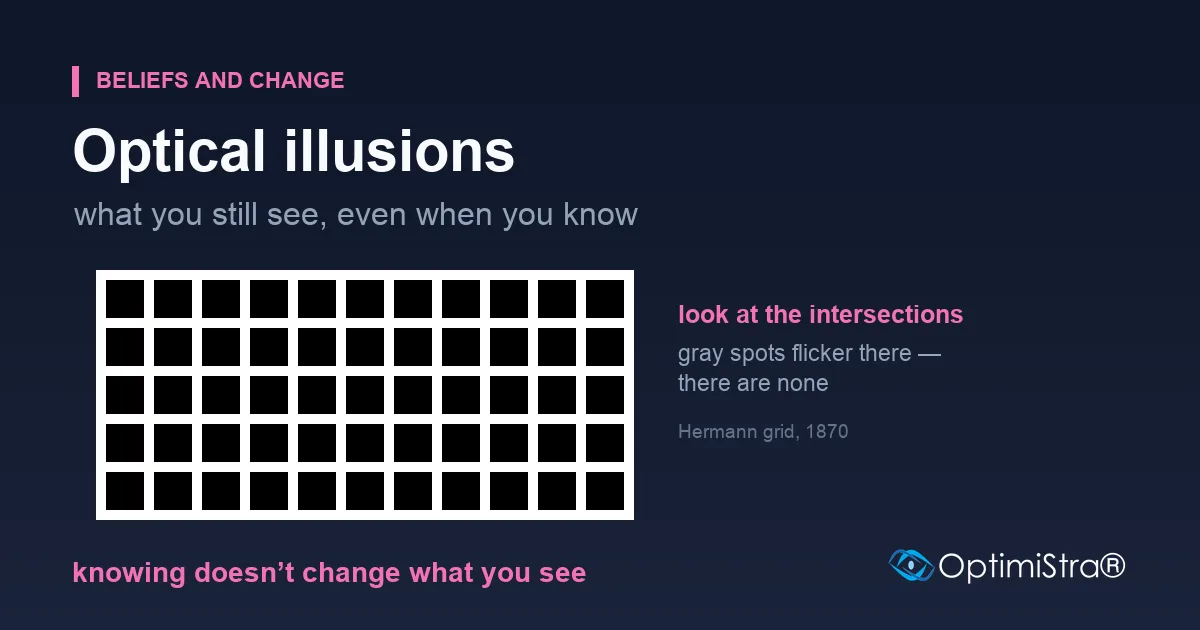
An optical illusion isn’t a malfunction: it is the brain interpreting what it sees, correcting for shadows or filling in what’s missing. The most striking part is that the illusion holds even once you know how it works. Three famous illusions show this, and research explains why.
November 18, 2026 · 8 min read
Beliefs and Change
The invisible gorilla: what the brain sees, and what it adds
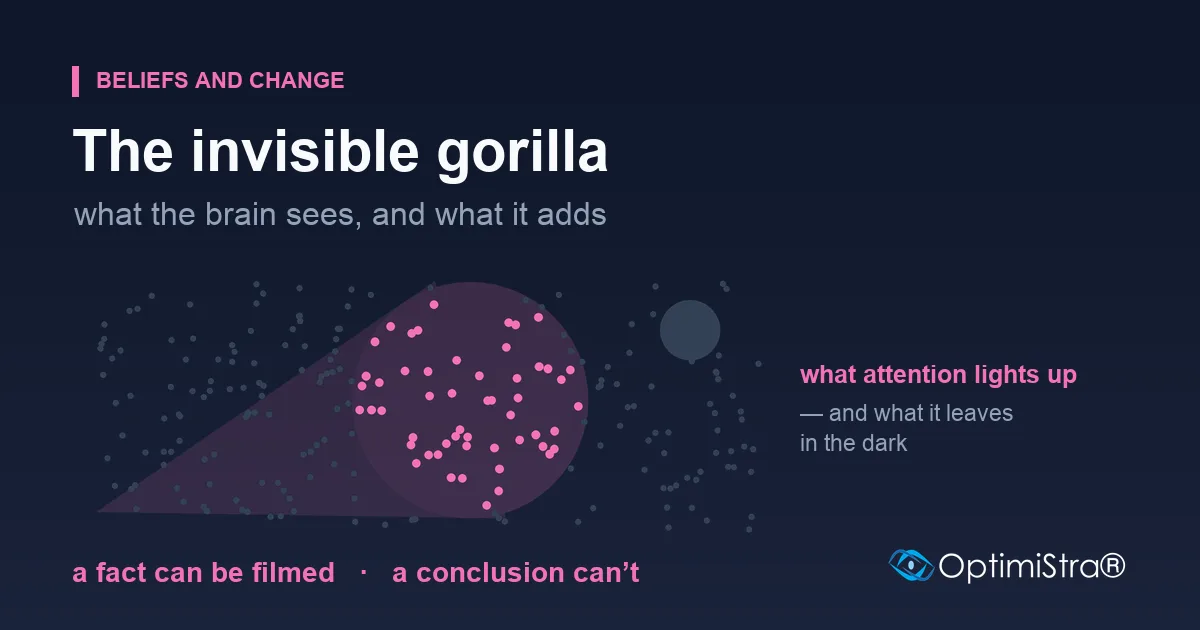
Attention works like a flashlight: it lights one spot at a time, and you can miss a gorilla while looking straight at it. Whatever it does light, the brain fills in with interpretations it never announces. You can observe both in yourself in a few minutes.
November 18, 2026 · 6 min read
Beliefs and Change
The imagined lemon: what your body does with what you imagine
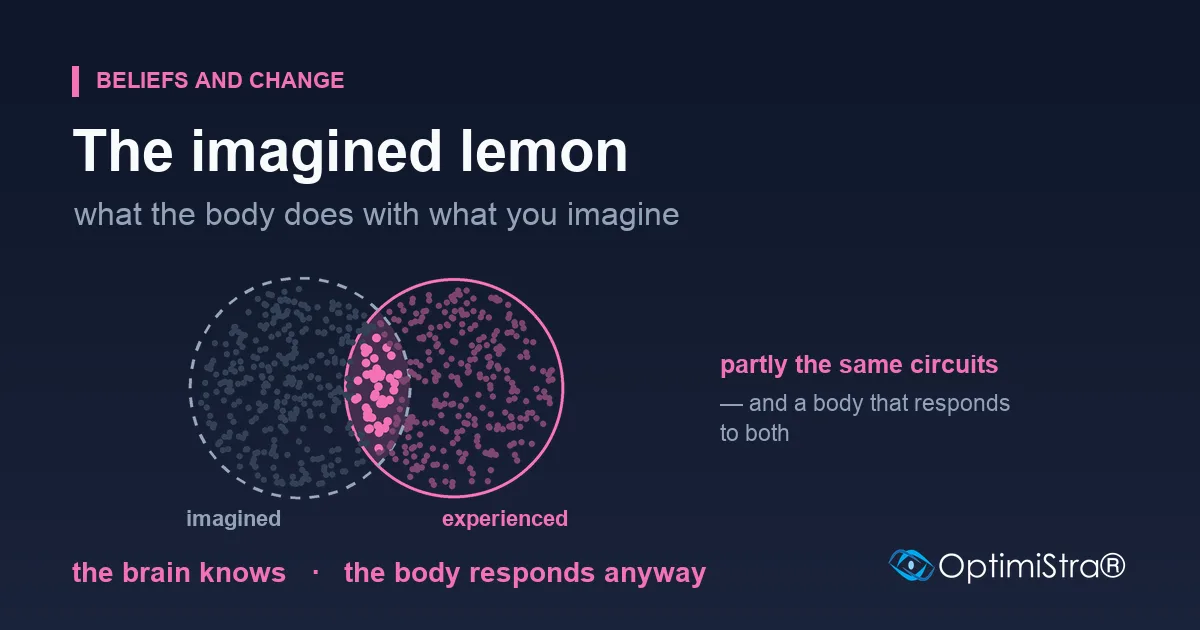
Imagining a lemon makes you salivate, and imagining a movement activates some of the circuits that control it. Even so, the brain does not confuse real and imagined: it tells them apart, except when the inner image becomes strong enough. That is what makes mental rehearsal useful, to a modest degree.
November 18, 2026 · 8 min read