The imagined lemon: what your body does with what you imagine


Michel Wozniak and Nathalie de Marcé
Published November 18, 2026 · 8 min read
In brief
Imagining a lemon makes you salivate, and imagining a movement activates some of the circuits that control it. Even so, the brain does not confuse real and imagined: it tells them apart, except when the inner image becomes strong enough. That is what makes mental rehearsal useful, to a modest degree.
Before you read on, try this. Close your eyes and imagine a lemon. Hold it in your hand, feel its slightly oily skin, cut it in half, and bring one half to your mouth. Bite into it. Then notice what your mouth does.
For most people, something happens. There is no lemon, and yet the body gets ready to receive one. A striking claim is often drawn from this: the brain can’t tell the difference between what is real and what is imagined. Taken literally, it is false; in spirit, it is right. Here is what the research says.
What “real and imagined” means to the brain
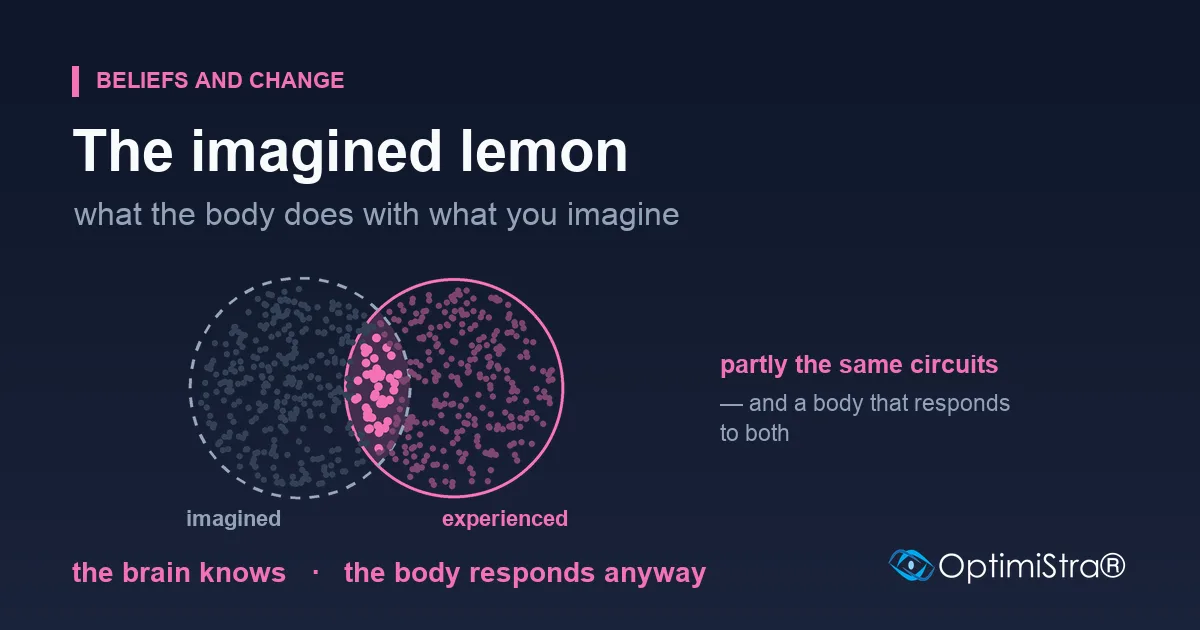
When you imagine something in enough detail, part of the circuits you would use to perceive it or to do it become active. The body, for its part, reacts to what it anticipates: it salivates for food and tenses for an effort. But imagining is not perceiving. What we imagine is usually paler and less sharp, and the brain uses that to tell the two apart. A more accurate way to put it would be: the brain has trouble telling them apart when the imagination is precise. That is what we say in our courses, and it is what recent studies spell out.
The Utrecht lemon, in exact figures
In 2016, a team at Utrecht University led by Mike Keesman measured the saliva people produced in front of four objects: a bag of chips, a slice of bread with cheese, a slice of lemon, and a block of wood. The lemon was cut in front of each participant and placed on a plate. Nobody ate anything. After 1 minute, each person spat their saliva into a cup, which was weighed to the hundredth of a gram.
In the second experiment, 60 students were split into two groups. One group simply had to look at each object. The other had to imagine eating it: “Pick up the object. How does it feel? How does the object smell? How would the object taste?” For the lemon, those who imagined produced clearly more saliva than those who looked (d = 0.76). For the chips, the gap was larger still (d = 1.03). For the block of wood, it was not significant. So imagining does not add saliva to everything: only to things you can eat.
The authors point out their own limits. There was a single sample per food, which rules out generalizing to other foods, and there was no way to separate what came from sight and what came from smell. Above all, the food was on the table: the study measures what imagination adds to a lemon you are looking at, not the effect of a purely imagined lemon. They do cite earlier work in which imagining a favorite food, with nothing in front of you, increases salivation, “especially when participants have vivid mental imagery.” It is the detail that does the work.
The imagined movement, and the hand that feels it
The mouth is not a special case. In the introduction to a study published in 2018 in Nature Communications, Konstantina Kilteni and her colleagues at the Karolinska Institute sum up what decades of research have established: an imagined movement takes about as long as the real one, it can raise the heart rate in proportion to the imagined effort, and it activates a brain network that partly overlaps the network for real movement. Imagining that you move a finger activates the area of the motor cortex that controls that finger.
Their own experiment goes further. When you touch your own skin, the sensation is dampened: the brain predicted it, and turns the volume down. The researchers showed that simply imagining touching your finger dampens, in the same way, a very real pressure applied at the same moment. The brain predicts the consequences of an imagined movement just as it does for one you actually make. The limit: 12 volunteers per experiment, which is not many.
So does the brain confuse real and imagined?
Not under normal conditions, and that is a good thing. In 2023, Nadine Dijkstra and Stephen Fleming, of University College London, asked the question directly. They started from a famous experiment from 1910: Mary Cheves West Perky asked volunteers to imagine an object on a wall while she projected onto it, without their knowing, a very faint image of the same object. None of them noticed the projection: they all took it for their own mental image.
Dijkstra and Fleming ran the experiment again online, with a single critical trial per person so that nobody would become suspicious, first with nearly 300 participants and then with 339. Their finding: the imagined and the perceived are not kept separate; they add up into a single signal. The brain judges something to be real when that signal crosses a reality threshold. Ordinarily, the imagined on its own stays below it, which is why we do not mistake our daydreams for the room we are sitting in. But, they write, “when virtual or imagined signals are strong enough, they become subjectively indistinguishable from reality.”
So the brain does tell the difference, and it does so on the basis of intensity. It stops telling the difference when the inner image becomes strong enough. This echoes an idea we explored when writing about the map and the territory and about the invisible gorilla: what we experience is a construction, not a copy of the world.
What mental rehearsal gives you, and what it doesn’t
If imagining a movement engages part of the circuits that produce it, then practicing in your imagination should be useful. That is what athletes do, and what fighter pilots do when they rehearse on the ground, gestures included, what they will do in the air.
A meta-analysis by Bianca Simonsmeier and her colleagues, published in 2020, which we read in its preprint version, brought together 55 studies in sports, for a total of 1,438 participants. The average effect of imagery is medium-sized (d = 0.43), and smaller when only randomized trials are counted (d = 0.25). Imagery does better than doing nothing, better than another activity, and combined with real training, it does slightly better than training alone (d = 0.16). The authors note that another meta-analysis, in 2020, found a comparable effect, which came down to d = 0.26 once publication bias was corrected.
These effects are real, and they are modest. Mental rehearsal prepares you; it does not replace practice. The myths around it resemble the one about 21 days to form a habit: a sound idea, simplified along the way until it became false.
What we do with it in our courses
We, Michel Wozniak and Nathalie de Marcé, are the world’s first two French-speaking Master Trainers named by Richard Bandler himself, co-creator of Neuro-Linguistic Programming (NLP). We have participants do the lemon test on the second day of the NLP Practitioner course, and for a precise reason: every technique in the Practitioner ends with a projection into the future, in which you imagine yourself in the situations ahead with what you have just learned. That projection rests on what you have just read.
For those who think they can’t “visualize,” our advice is simple: don’t try to see, describe it to yourself. Tell yourself, in your head, what you would see if you could see it. A pink elephant in a tutu above the Eiffel Tower does not need to be sharp to be there.
Take a moment. Think of something that matters to you in the coming days: a presentation, a meeting, a conversation you have been waiting for. You are there, and it is going well. You walk into the room. You hear your own voice, steady. The first sentence comes without your having to look for it, and you see someone across from you nod. How do you feel, right then? And what would you like to take with you from this scene when the day comes?
That kind of preparation, modest and real, is exactly what the studies measure. Moving also changes the state you arrive in, as we wrote in our article on the physical decisions that change your mood.
This week’s experiment
The most convincing thing is still to observe it in yourself, in 30 seconds:
- Close your eyes and imagine a lemon. Hold it in your hand, cut it in half, bring one half to your mouth, and bite into it.
- Describe the scene to yourself if no image comes: the skin under your fingers, the knife going in, the juice on the cutting board.
- Notice what your mouth does, without expecting a result. If you don’t like sour tastes, pick a food you enjoy.
This is not a test. Your brain knows the lemon does not exist. Your body gets ready for it anyway, and that is the starting point for everything we can do with imagination.
Article written by Michel Wozniak and Nathalie de Marcé, and optimized by artificial intelligence.
Sources
- Keesman, Aarts, Vermeent, Häfner & Papies (2016), Consumption simulations induce salivation to food cues, PLoS ONE
- Dijkstra & Fleming (2023), Subjective signal strength distinguishes reality from imagination, Nature Communications
- Kilteni, Andersson, Houborg & Ehrsson (2018), Motor imagery involves predicting the sensory consequences of the imagined movement, Nature Communications
- Simonsmeier, Andronie, Buecker & Frank (2020), The effects of imagery interventions in sports: a meta-analysis (prépublication, PsyArXiv)
Frequently asked questions
Is it true that the brain can’t tell the difference between real and imagined?
Not quite. Imagining and perceiving engage partly the same circuits, but what we imagine is usually weaker, and that is how the brain recognizes it. Dijkstra and Fleming (2023) show that the line only blurs when the inner image becomes strong enough to cross a reality threshold.
Why does my mouth water when I imagine a lemon?
Because the body prepares for what it anticipates. Keesman et al. (2016) showed that students who imagined eating a slice of lemon placed in front of them salivated clearly more than those who only looked at it. The effect also exists with a food you like.
Does mental rehearsal really improve performance?
Yes, to a modest degree. A meta-analysis of 55 studies in sports (Simonsmeier et al., 2020) finds a medium effect (d = 0.43), smaller in randomized trials (d = 0.25). Combined with real training, it does slightly better than training alone; it does not replace it.
Can you mistake something you imagine for something real?
Yes, when the inner image is strong enough. In 1910, Mary Cheves West Perky projected, without her volunteers knowing, a faint image of the object they were imagining: none of them noticed the projection. Dijkstra and Fleming (2023) found the same thing with more than 600 people, and explain it by a reality threshold.
What can I do if I can’t see mental images?
Describe the scene to yourself instead of trying to see it. Telling yourself in your head what you would see if you could see it is enough, and it takes away the pressure of comparing yourself with others. It is the advice we give in our courses, and it works for the lemon test too.
Beliefs and Change
Submodalities: what separates a good memory from a very good one
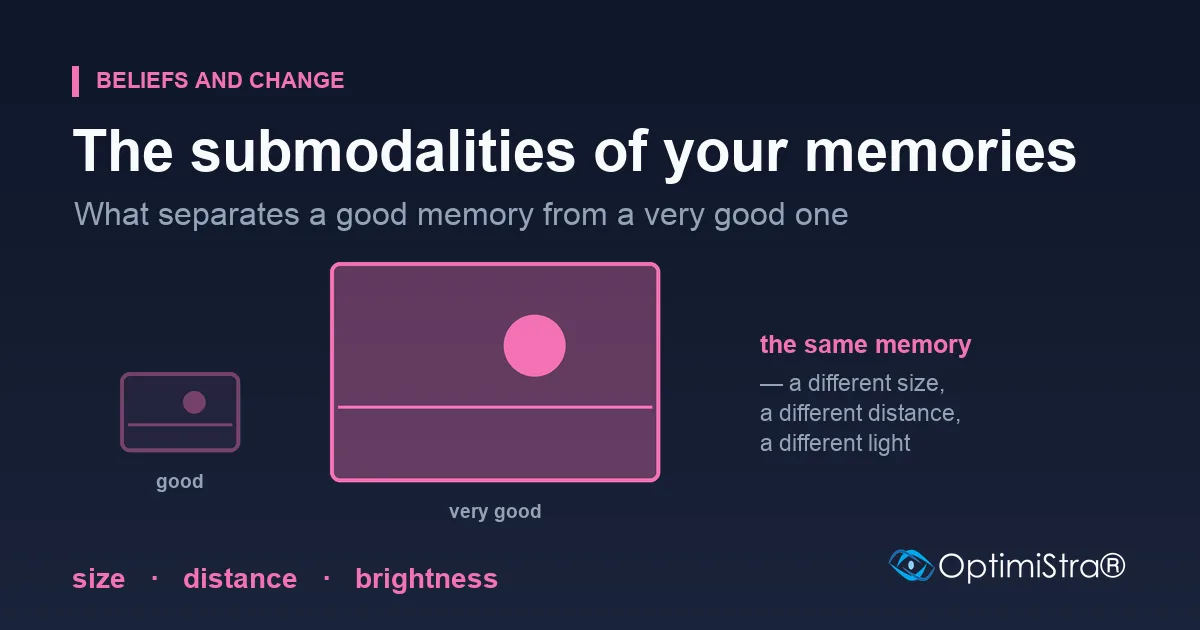
Submodalities are the fine qualities of a mental representation: the size, distance, and brightness of an image, the volume of a sound, the warmth of a sensation. Studies show that the intensity of a memory goes hand in hand with its vividness, though the notion itself has never been tested as such.
November 18, 2026 · 5 min read
Beliefs and Change
VAKOG: the five senses of your memories, and what we really know about them
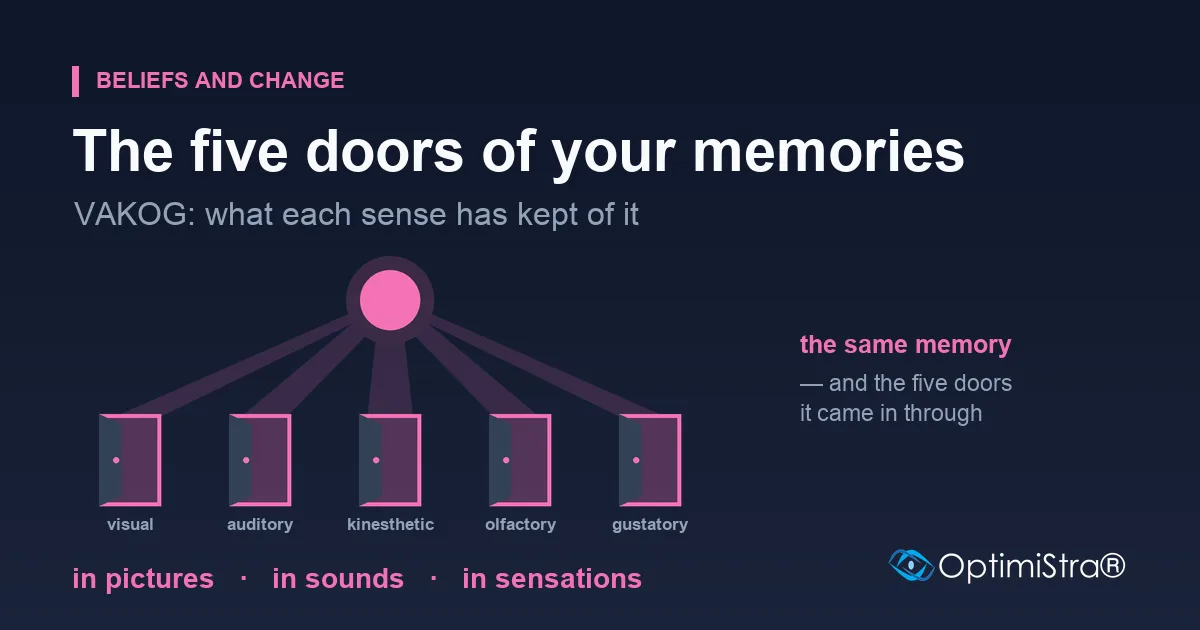
VAKOG stands for the five senses through which we live and recall an experience: visual, auditory, kinesthetic (the body and emotions), olfactory, and gustatory. Imagining draws partly on the same brain regions as perceiving, and each person does it differently. The idea of a dominant channel, however, has not been confirmed by research.
November 18, 2026 · 7 min read
Beliefs and Change
The driver submodality: the one detail that moves all the others
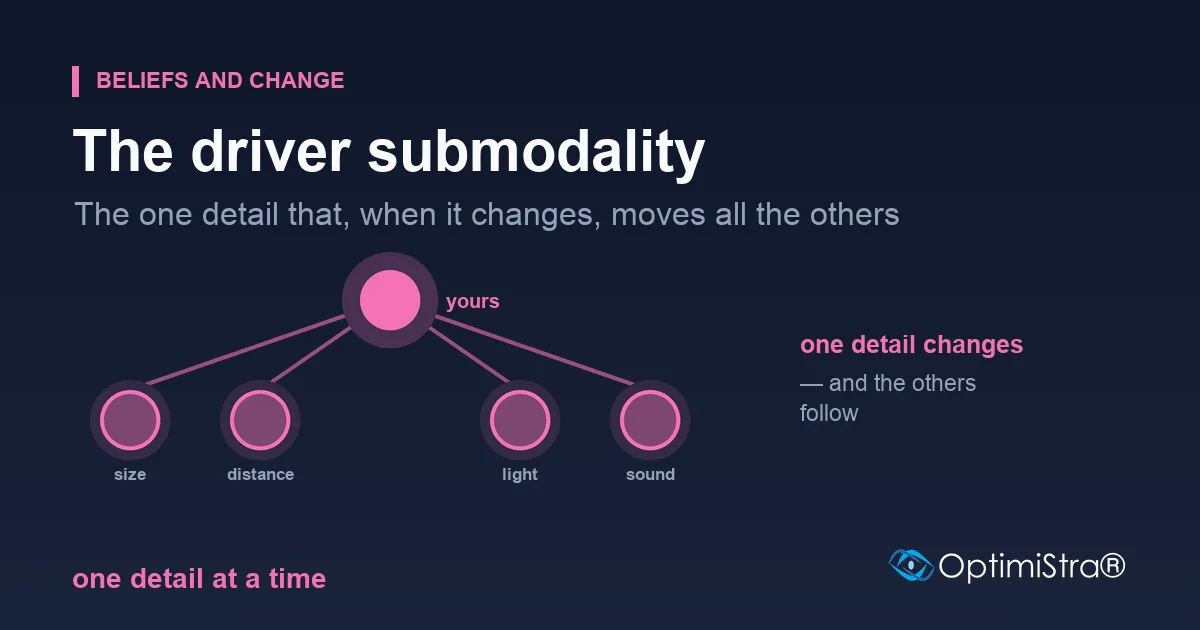
In NLP, the driver submodality is the quality of a mental image that carries the others with it when you change it: size, distance, brightness, or color, depending on the person. Studies show that a single visual detail can change what we feel, but none has tested this ripple effect.
November 18, 2026 · 5 min read