How movement changes your mood: what the studies actually measure


Michel Wozniak and Nathalie de Marcé
Published November 18, 2026 · 10 min read
In brief
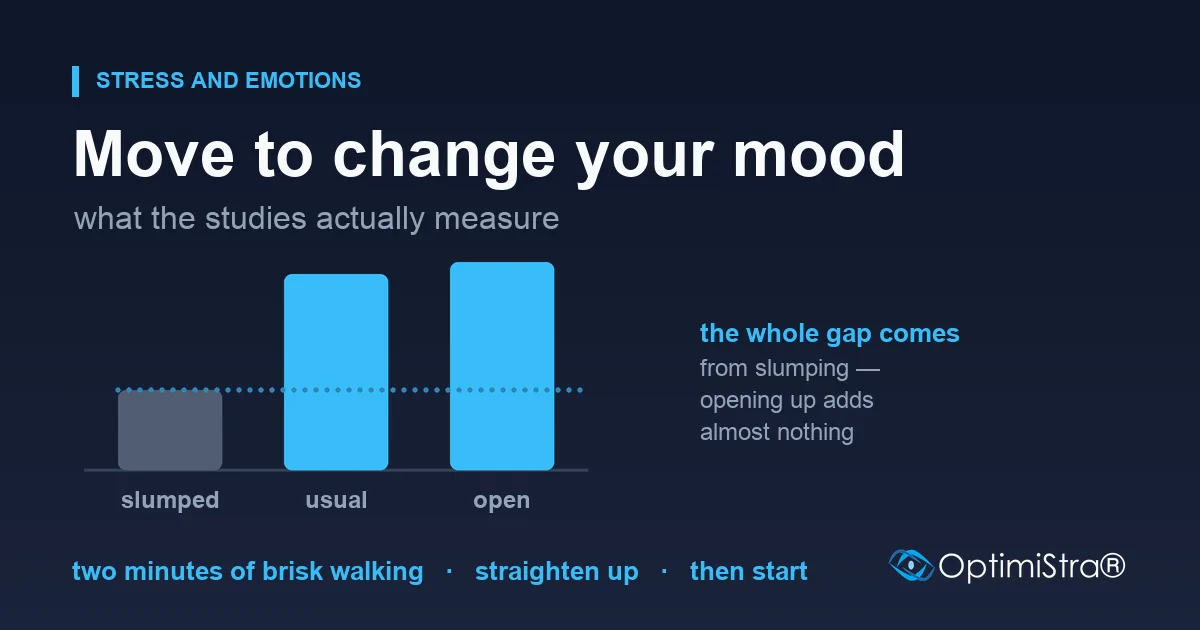
Five minutes of moderate walking is enough to improve self-reported mood, and six 5-minute breaks do more across a day than a single 30-minute block. On posture, a synthesis of 73 experiments gives an unexpected result: the cost comes from the contracted position, and an open position adds almost nothing.
You can change your inner state by working through your head: reasoning with yourself, motivating yourself, telling yourself it will go well. You can also work through your body: stand up, walk for a few minutes, straighten up. That second route has a practical advantage, because it doesn’t require you to be convinced of anything, and it has been measured more often than most people realize.
So the idea that movement changes your mood is more than a word of encouragement. It is a hypothesis that has been tested in the lab, with control groups and timed durations. Here is what those measurements find, what they don’t find, and how we put them to use: a 2-minute brisk walk before something you would gladly have put off.
What we mean here by a physical decision
A physical decision is a concrete choice made with the body in order to change your inner state: walking, climbing a flight of stairs, getting out of a slumped position. It differs from a mental decision (persuading yourself, encouraging yourself, setting a goal) in the route it takes more than in its aim.
That route is far from obvious. Common intuition holds that the body expresses the inner state: we slump because we’re discouraged, we walk briskly because we’re in a hurry. Half a century of research on what is called embodied cognition has explored the opposite direction, and that is the one that interests us here: what the body’s position and movement do to what we feel next.
5 minutes of walking, measured hour by hour
The trial closest to our exercise comes from a team at the University of Colorado and was published in 2016. Thirty sedentary adults spent three days in the lab, in random order, at least a week apart:
- 6 hours of sitting, without interruption;
- the same seated day, plus 30 minutes of treadmill walking early in the morning;
- the same seated day, plus six 5-minute walking breaks, one per hour.
The two active days involved the same total walking time and the same energy expenditure. The pace was set individually and corresponded to a perceived effort of “somewhat hard.”
Both raised self-reported energy across the day, by about 15%, as well as vigor measured at the end of the day. But the detail matters. A single 5-minute break was enough to improve reported mood; for the feeling of energy, it took two. The 30-minute morning block lifted mood too – for one hour. And only the six breaks lowered the fatigue reported at the end of the day.
In other words, over a whole day, how the walking was spread out counted for more than how much of it there was.
10 minutes of stairs versus 50 milligrams of caffeine
An experiment at the University of Georgia, published in 2017, compared three ways of restoring energy in 18 chronically sleep-deprived female students: 10 minutes of stair walking at low to moderate intensity, a capsule containing 50 milligrams of caffeine, or a capsule of flour.
The stairs produced the largest increase in vigor measured right afterward, ahead of both the caffeine and the placebo. The other measures (working memory, sustained attention, reaction time, motivation to do the tests) did not change significantly.
The authors themselves describe the effect as transient. The sample is small, and it includes only physically active young women. The result is still worth knowing: on felt energy alone, a staircase did better than half a cup of coffee.
Posture: what held up, and what didn’t
In 2010, a study published in Psychological Science reported that holding a “power pose” for 2 minutes raised testosterone, lowered cortisol, and increased both the feeling of power and risk-taking. The talk that made it famous has passed 50 million views.
Replication attempts produced a clear and widely shared result: the hormonal effect was not found again. The feeling of power, for its part, does replicate. On behavioral effects, the reviews disagree.
To settle the question, five researchers from the universities of Aarhus, Witten/Herdecke, and Columbia went back through the entire body of work. Out of 5,819 records, they kept 73 experiments that manipulated whole-body position or movement and measured what this changed in affect, hormones, or observed behavior. Their meta-analysis appeared in 2022 in Perspectives on Psychological Science.
Here are the results, expressed as standardized effect sizes, the usual measure, where 0.2 is small, 0.5 medium, and 0.8 large:
- Open versus contracted position, all measures combined: an effect of 0.40, across 40 studies.
- On how people felt: 0.45, across 33 studies.
- On observed behavior: 0.36, across 22 studies.
- On hormones: 0.14, and not significant, across only four studies. In detail, testosterone does not move at all (−0.02, three studies) and cortisol sits right at the threshold of significance (0.23, four studies).
So body position does act on what we feel and on what we do. On hormones, the 2010 claim does not hold.
The surprise: it’s the contracted position that costs you
The most useful result of this meta-analysis lies elsewhere, and it overturns the practical conclusion everyone had drawn.
Comparing an open position with a contracted one does not tell you which of the two produces the gap. To find out, you need a third condition: a neutral position, neither one nor the other. Few studies had included it. Pooling those that did, the authors find this:
- contracted position versus neutral position: an effect of 0.45;
- open position versus neutral position: an effect of 0.06, not significant.
The whole gap therefore comes from the contracted position. Once it is compared with an everyday position, the dominant pose adds next to nothing. The practical conclusion becomes simpler: straightening up is enough.
The authors add a caveat that we gladly repeat: these two comparisons rest on only eight and six studies, and they need to be replicated before anyone turns them into a rule.
They also add a word of caution. Several studies suggest that adopting an expansive position when you feel bad creates a mismatch between the stance and the state, and does not help. They write that simply striking a power pose when you are upset would not be beneficial. That is one more reason to prefer the modest gesture to the spectacular one.
How you walk, and not only for how long
One last piece, because it shows that the body is more than a dose. In 2015, Johannes Michalak, Katharina Rohde, and Nikolaus Troje asked 39 students to walk while their gait was subtly modified through visual feedback: some adopted a “happy” gait, the others a gait described in the literature as characteristic of low mood. Walking speed was identical in both groups.
While they walked, the participants memorized a list of emotionally charged words, then had to recall them. The gap between the positive and negative words recalled was markedly smaller among those who had walked the second way.
The authors themselves point out that the experiment was run with students who had no diagnosed disorder, on a laboratory task. It says nothing about treating anything. What it does say is that the way you move, at equal effort, feeds back into what you feel, which matches exactly what the meta-analysis found about the contracted position.
What about endorphins?
The most common explanation for the effect of exercise on mood points to endorphins. The research of the past decade points instead to another family of molecules, the endocannabinoids, which activate the same receptors as cannabis.
In 2015, a team from Mannheim and Mainz showed in mice that the anxiety-reducing and pain-relieving effects of running depend on cannabinoid receptors, and not on opioid receptors. In 2021, the same team ran the experiment in humans: 63 volunteers ran for 45 minutes at moderate intensity, on naltrexone (an opioid blocker) or on a placebo, double-blind. The blockade prevented neither the euphoria nor the drop in anxiety, and endocannabinoid levels had risen in both groups.
One detail determines how much of this applies to us. In 2012, David Raichlen and his colleagues had trained runners run at four different intensities. The rise in endocannabinoids appears only at moderate intensities: neither below nor above.
So a 2-minute walk is not covered. What explains an effect after 45 minutes of running does not explain what happens after 2 minutes of walking down a hallway, and it is more honest to say so than to name a molecule in order to sound serious.
What these studies don’t say
This is often the most useful part.
Nobody has measured 2 minutes. The shortest duration measured here is 5 minutes. Our 2 minutes is a practical choice, made because you can really take 2 minutes before a call, and not because a trial validated it.
Almost everything is self-reported. Energy, mood, vigor, fatigue, feeling of power: these are questionnaires. And a walking experiment cannot be blinded, since the volunteers know which day they walked. The authors of the 2016 trial point this out themselves, and add that media coverage of the harms of sedentary behavior may have influenced the answers.
The samples are small and the populations narrow: 18 female students, 30 sedentary, non-obese adults, 39 students, 63 volunteers. The posture studies were almost all run in the lab, and their authors write that it remains uncertain how well the findings carry over to real life.
None of this makes you perform better. In the 2016 trial, neither the 30 morning minutes nor the six breaks changed the results on the two cognitive tests taken at the end of the day, and urinary catecholamines and cortisol did not move either. What changed was how people felt. That is already a lot, and it is all there is.
That is exactly what it means, in the sense of this research, to say that movement changes your mood: it changes the state in which you approach the task, and promises nothing about the task itself.
How we use it
The exercise we suggest takes three steps, and it produces its own evidence:
- Pick two moments in your week that you would gladly have put off: a call about paperwork, a report, a round of proofreading. Ordinary moments.
- Before the first one, do what you usually do, and just before you start, rate out of 10 how much you feel like getting down to it.
- Before the second one, take a 2-minute brisk walk right beforehand, briskly enough that your breathing changes, shoulders back, head up. Then note the same rating and begin.
All that remains is to compare the two numbers. The order biases the measurement a little, since you know what you are testing the second time. That is the flaw of any experiment you run on yourself, and it doesn’t stop the difference from being instructive.
One caveat to finish. Brisk walking suits almost everyone. If a health condition limits your walking or your effort, go at the pace that works for you, or simply stand up and straighten up, which is the best-measured part. And if you are going through a difficult time, no article replaces proper support: talk to a professional.
Where this exercise fits
This series moves forward one practice at a time. Breathing in for 5 seconds and out for 5 gives you a tool for bringing a surge back down. The article on what happens under strong emotion explains why the useful move at that moment is physical and not verbal. The one on stress hormones is a reminder that available energy is a matter of dose, and the one on returning to calm shows that a surge with no recovery wears you down more than the surge itself.
This practice takes the opposite route from the earlier ones: it doesn’t bring you back down afterward, it prepares you beforehand. And like all of them, it needs to be kept up long enough to be judged, which is the subject of our article on how long a habit takes to form.
The articles in this series are gathered on the blog. Choosing the state in which you approach something that matters, and finding it again when you need it, is part of what we teach in Neuro-Linguistic Programming (NLP), starting with the NLP Practitioner course.
Article written by Michel Wozniak and Nathalie de Marcé, and optimized by artificial intelligence.
Sources
- Elkjær, Mikkelsen, Michalak, Mennin & O'Toole (2022), Expansive and Contractive Postures and Movement — A Systematic Review and Meta-Analysis of the Effect of Motor Displays on Affective and Behavioral Responses, Perspectives on Psychological Science
- Bergouignan et al. (2016), Effect of frequent interruptions of prolonged sitting on self-perceived levels of energy, mood, food cravings and cognitive function, International Journal of Behavioral Nutrition and Physical Activity
- Randolph & O'Connor (2017), Stair walking is more energizing than low dose caffeine in sleep deprived young women, Physiology & Behavior (résumé)
- Michalak, Rohde & Troje (2015), How we walk affects what we remember: gait modifications through biofeedback change negative affective memory bias, Journal of Behavior Therapy and Experimental Psychiatry (résumé)
- Fuss et al. (2015), A runner's high depends on cannabinoid receptors in mice, Proceedings of the National Academy of Sciences
- Siebers, Biedermann, Bindila, Lutz & Fuss (2021), Exercise-induced euphoria and anxiolysis do not depend on endogenous opioids in humans, Psychoneuroendocrinology (résumé)
- Raichlen, Foster, Seillier, Giuffrida & Gerdeman (2012), Exercise-induced endocannabinoid signaling is modulated by intensity, European Journal of Applied Physiology (résumé)
Frequently asked questions
How long do you need to move to improve your mood?
In the trial by Audrey Bergouignan and her colleagues, a single 5-minute break of moderate-intensity walking was enough to improve reported mood compared with a day spent entirely seated. For the feeling of energy, it took two breaks. No published study has tested a shorter duration, so nobody has measured 2 minutes.
Does posture really affect your state of mind?
Yes, for how people feel and for observed behavior: the meta-analysis by Emma Elkjær and her colleagues, covering 73 experiments, finds robust differences between an open position and a contracted one. It finds no clear difference for hormones. And the comparison with a neutral position shows that the effect comes from the absence of a contracted position, not from the presence of an open one.
Does power posing work?
Not in the way announced in 2010. The original study reported a rise in testosterone and a drop in cortisol after 2 minutes of power posing. Replication attempts did not find that hormonal effect again. What does replicate is the feeling of power and, according to the 2022 meta-analysis, part of the effects on behavior. The practical conclusion changes: there is more to gain from leaving a contracted position than from adopting a dominant one.
Does exercise release endorphins?
Recent research points instead to endocannabinoids, the molecules that activate the same receptors as cannabis. In mice, the calming effect of running depends on cannabinoid receptors and not on opioid receptors. In 63 human volunteers, blocking opioids prevented neither the euphoria nor the drop in anxiety after 45 minutes of running. That effect requires a duration and an intensity that a 2-minute walk does not reach.
Does walking make you perform better?
That is not what these studies show. In the Bergouignan trial, neither the 30 minutes of morning walking nor the six 5-minute breaks changed performance on the two cognitive tests taken at the end of the day. What changed was felt energy, mood, and reported fatigue. The distinction is useful: this is about the state you start from, not about an increase in ability.
Stress and Emotions
An emotion starts in the body: naming the sensation before the emotion
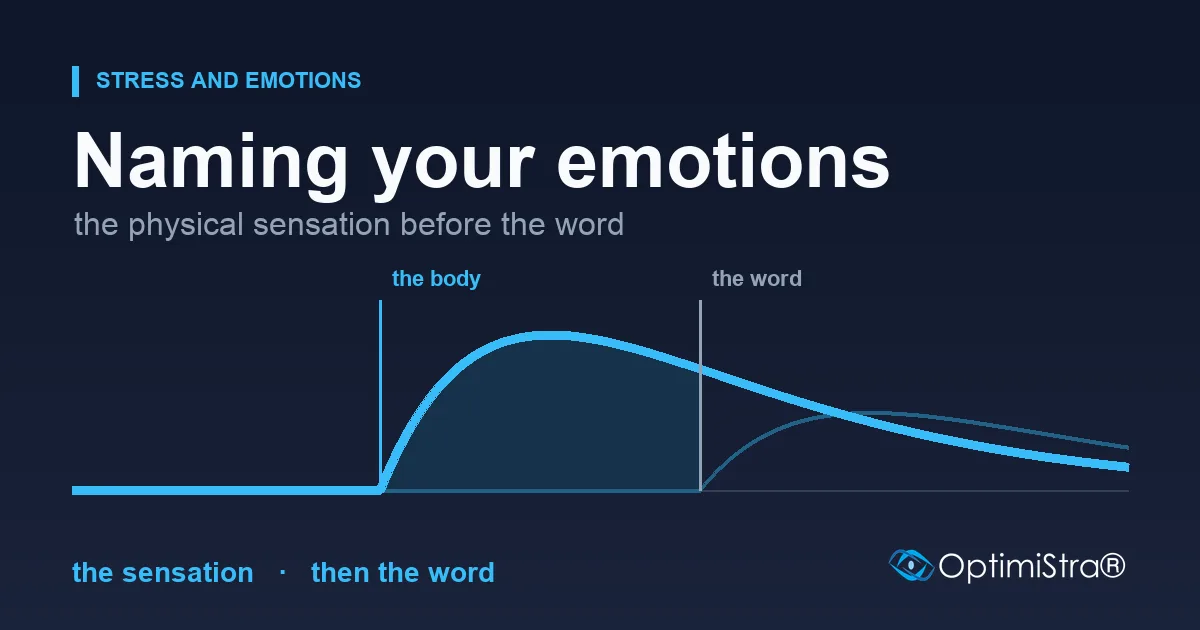
An emotion is a physical reaction set off by how you interpret an event, not by the event itself. The body moves first and the word comes later. Naming the sensation before the emotion takes 10 seconds. Here is what the research establishes, and the three precise points where it stops.
November 18, 2026 · 8 min read
Stress and Emotions
Physical signs of stress: what the body shows, and how much of it we notice
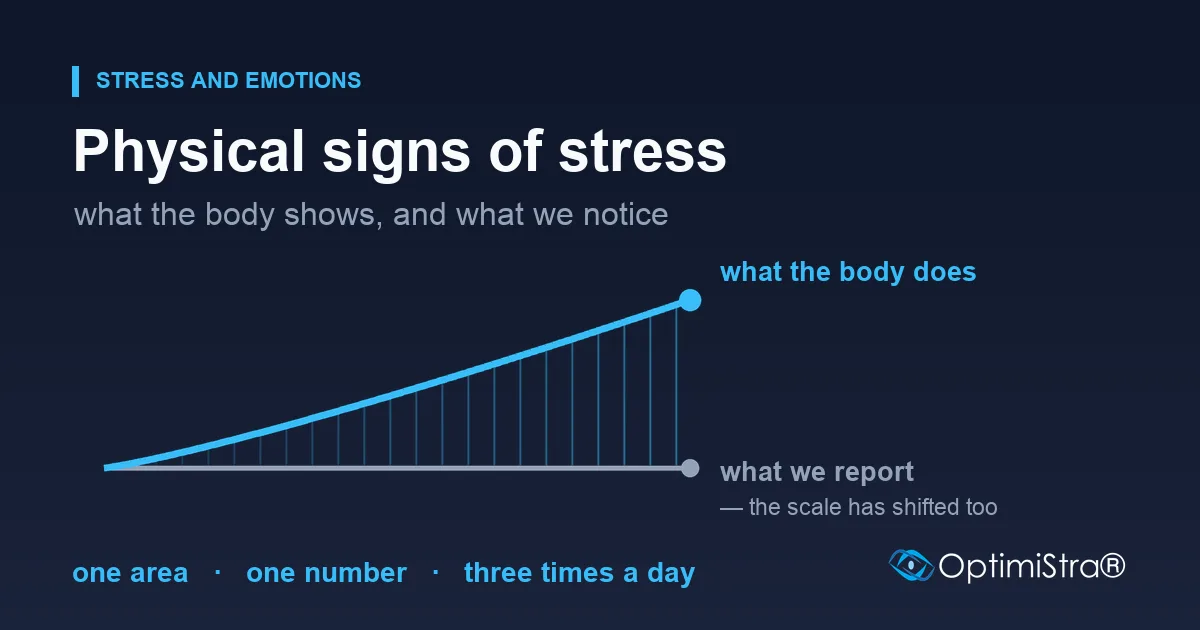
Under stress, the jaw muscles work harder: 38 studies show it. Yet what people report about their own tension from memory has almost nothing to do with what they notice when asked in the moment. And their point of comparison shifts along with them.
November 18, 2026 · 9 min read
Stress and Emotions
Evening routine: what the night does with your last 10 minutes
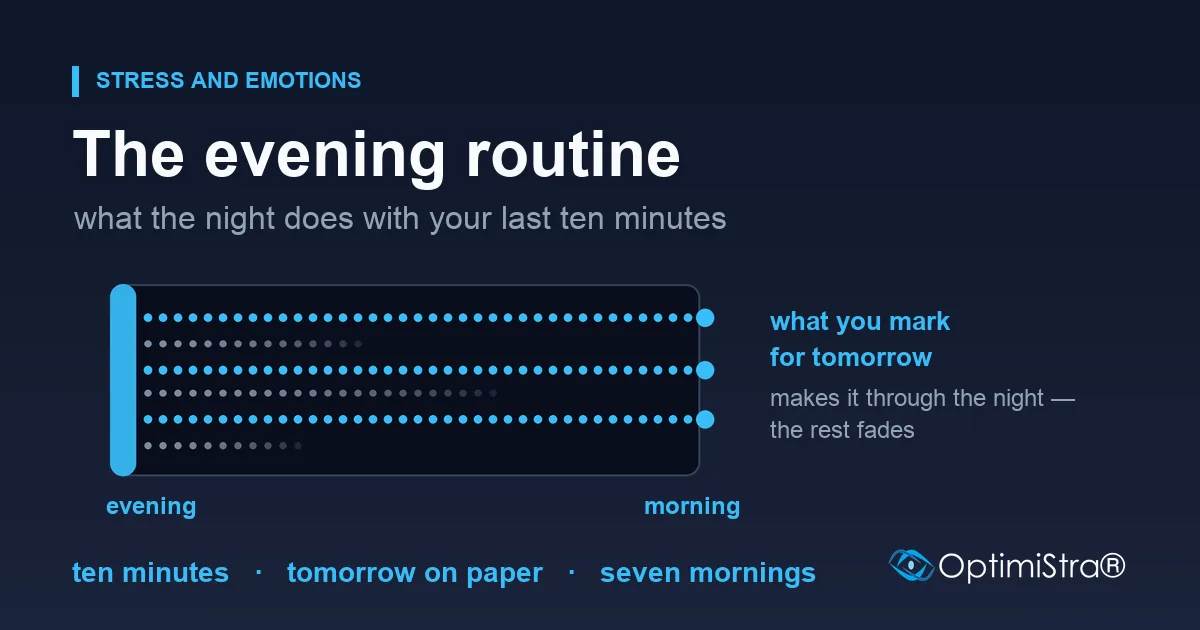
During sleep, the brain replays and consolidates what the day left behind, and it is selective: what has been marked as useful for tomorrow gets through, the rest far less. The best-measured evening habit is not positive thinking. It is writing tomorrow’s to-do list, in detail.
November 18, 2026 · 10 min read