The invisible gorilla: what the brain sees, and what it adds


Michel Wozniak and Nathalie de Marcé
Published November 18, 2026 · 6 min read
In brief
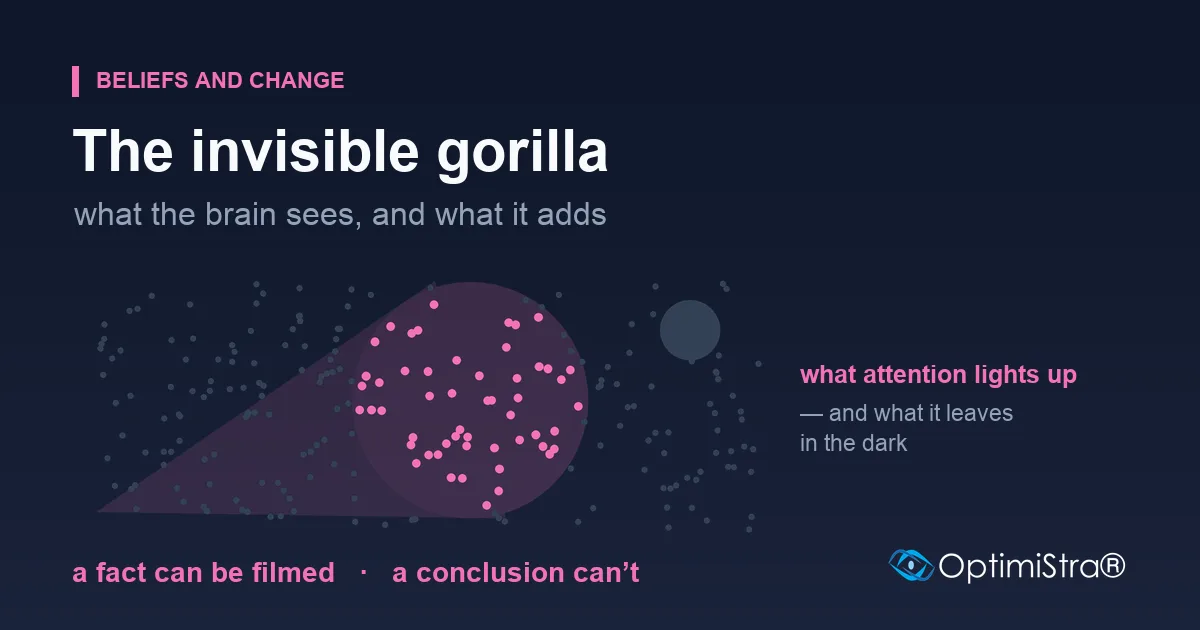
Attention works like a flashlight: it lights one spot at a time, and you can miss a gorilla while looking straight at it. Whatever it does light, the brain fills in with interpretations it never announces. You can observe both in yourself in a few minutes.
Before you read on, if you’ve never seen it, watch a 1-minute video: The Monkey Business Illusion, on Daniel Simons’s channel. Count the passes made by the players in white. What you experience there sheds light on everything that follows.
What you see at any given moment is not a photograph of the world. It is a construction: a small part of the scene, lit by your attention and filled in with what your brain expects and already knows. Research has measured both mechanisms, what we miss and what we add. You can observe both in yourself, and that is what makes them interesting.
What inattentional blindness means
Inattentional blindness is the failure to see an object or event that is in plain view, because attention is busy elsewhere. The image does reach the eye; it is attention that never lands on it.
In our courses, we describe it with an image: attention is a flashlight in a dark room. It lights one spot at a time, and whatever it leaves in the dark does not exist for us, even when it is enormous.
The invisible gorilla, in exact figures
The best-known experiment dates from 1999. Daniel Simons and Christopher Chabris, writing in the journal Perception, showed 192 observers a 75-second video. Two teams of three players, one in white and one in black, pass a ball around. The instruction: count the passes made by one team. Partway through, for 5 seconds, a woman walks across the scene, carrying an umbrella in some versions and wearing a gorilla suit in others.
The figure quoted everywhere, “one in two,” deserves a closer look. Across all the unexpected events, 46% of observers saw nothing. The proportion varies a great deal from one condition to the next, though: anywhere from 8% to 83% of people saw the gorilla. The task mattered (a harder counting task meant more people missed it), and so did similarity: the gorilla, which was black, was noticed more often by those following the team in black. The famous scene, in which the gorilla stops and thumps its chest, was shown to only 12 people; half of them saw it.
The authors sum it up: “Approximately half of observers fail to notice an ongoing and highly salient but unexpected event while they are engaged in a primary monitoring task.”
Experts are not immune
You might think training offers protection. A 2013 study published in Psychological Science by Trafton Drew, Melissa Võ, and Jeremy Wolfe shows the opposite, in a striking way.
Twenty-four radiologists examined lung CT scans, looking for nodules, which appear as small spots. In the final case, the researchers had inserted a gorilla “the size of a matchbook” and “48 times the size of the average nodule.” The result: “Twenty of 24 radiologists failed to report seeing a gorilla.” And thanks to the eye-tracking equipment that followed their gaze, we know that 12 of the 20 who missed it had looked directly at the place where it was.
The authors warn against the wrong reading: “It would be a mistake to regard these results as an indictment of radiologists.” The gorilla looked nothing like what they were searching for, and that is exactly the point: attention that is highly trained for a task does not see what falls outside the task.
Knowing about one trap doesn’t protect you from the next
This is where the video from the beginning comes in. In 2010, in i-Perception, Daniel Simons set out to learn what the gorilla’s fame had changed. He shot a new video, the one we suggested you watch, in which the gorilla still walks through, and in which, meanwhile, the curtain in the background changes color and one player leaves the scene.
Of 64 people, those who already knew the 1999 video all saw the gorilla. They were no better at noticing the other two changes: 17% of them did, compared with 29% of the others, a difference the author considers not significant. His conclusion: “Foreknowledge that unexpected events might occur does not enhance the ability to detect other such events.” Knowing that a trap exists does not make the beam any wider.
Believing you control your attention predicts nothing
Believing you are in command of your attention offers no more protection. A 2013 study published in PLoS ONE by David Sanbonmatsu and his colleagues measured it.
Among 277 students, the ability they credited themselves with for doing two things at once had no relationship to their measured ability (r = 0.08, not significant). And those who did it most often, including using a cell phone while driving, were on average the ones who did it least well. The authors write that the people most inclined to multitask are “those with the most inflated views of their abilities,” while stressing that their results are “entirely correlational.”
The practical consequence is simple: the flashlight cannot be shared. You don’t read a message while driving, and you don’t really listen to someone while looking at your phone.
What the brain adds without being asked
The second mechanism is more discreet. Whatever the flashlight lights, the brain fills in, and it does so without being asked.
Read this sentence: “The secretary solved the mystery halfway through the book.” You probably thought she was clever. Nothing in the sentence says so. The example comes from a 1984 experiment by Leonard Winter and James Uleman, described by Rim, Uleman, and Trope in 2009: “upon reading the sentence […] people spontaneously inferred the trait, ‘clever.’” Researchers call this spontaneous trait inference, and its main feature is that it is involuntary: these inferences “do not require conscious awareness […] or explicit intentions.”
A 1995 review by Daniel Gilbert and Patrick Malone draws the general lesson: we have no choice but to infer what is invisible, such as intentions and character, from what can be observed, such as words and gestures. “When one infers the invisible from the visible, one risks making a mistake.” We have also published an article on observing without jumping to conclusions, which looks at what this means in our dealings with other people.
An exercise to see it for yourself
The most convincing evidence is what you observe in yourself. On three evenings this week:
- Choose a scene from your day: a meeting, a meal, a commute.
- Describe it in facts alone. A fact is something a camera could film: “He looked at his watch twice” can be filmed; “he was bored” cannot, because it is a conclusion.
- Read it back, and underline everything a camera would not have recorded: an intention, a mood, a character trait.
The number of underlined passages is not a score. It shows the work the brain does in silence, work that serves us well most of the time. It is impossible to stop interpreting; what matters is being able to tell what you saw from what you concluded.
This exercise builds on the one in our article on the map and the territory: there, you compared your map with someone else’s; here, you watch your own map being drawn. It also ties in with what we wrote about the physical signs of stress: we remember poorly what we have lived through, and we reconstruct it.
To work on your attention
If you want to learn to place your attention where it matters, and to tell what you see from what you conclude from it, you can work on it in professional coaching with Michel Wozniak, an expert in mind strategies.
Article written by Michel Wozniak and Nathalie de Marcé, and optimized by artificial intelligence.
Sources
- Simons & Chabris (1999), Gorillas in our midst: sustained inattentional blindness for dynamic events, Perception
- Simons (2010), Monkeying around with the gorillas in our midst: familiarity with an inattentional-blindness task does not improve the detection of unexpected events, i-Perception
- Drew, Võ & Wolfe (2013), The invisible gorilla strikes again: sustained inattentional blindness in expert observers, Psychological Science
- Sanbonmatsu, Strayer, Medeiros-Ward & Watson (2013), Who multi-tasks and why? Multi-tasking ability, perceived multi-tasking ability, impulsivity, and sensation seeking, PLoS ONE
- Rim, Uleman & Trope (2009), Spontaneous trait inference and construal level theory: psychological distance increases nonconscious trait thinking, Journal of Experimental Social Psychology
- Gilbert & Malone (1995), The correspondence bias, Psychological Bulletin
Frequently asked questions
What is inattentional blindness?
It is the failure to see an object or event that is in plain view, because attention is busy elsewhere. The image reaches the eye; it is attention that never lands on it. The invisible gorilla experiment by Simons and Chabris (1999) is the best-known example.
Is it true that half of people miss the gorilla?
On average, roughly: 46% of the 192 observers in the 1999 study did not see the unexpected event. Depending on the task and the conditions, though, anywhere from 8% to 83% of people saw the gorilla. The famous scene in which it thumps its chest was shown to only 12 people.
Are experts less prone to inattentional blindness?
Not necessarily. Drew, Võ, and Wolfe (2013) inserted a gorilla into a lung CT scan: 20 of the 24 radiologists did not report it, and 12 of those who missed it had looked at the place where it was. Attention trained for one task is poor at seeing what falls outside it.
If I think I’m good at multitasking, does that mean I am?
No. Among 277 students, Sanbonmatsu et al. (2013) found no relationship between the ability people credited themselves with and their measured ability, and those who did two things at once most often were, on average, the least good at it. The result is correlational.
How can I tell what I observe from what I interpret?
By a simple test: a fact can be filmed. “He looked at his watch twice” can be filmed; “he was bored” cannot, because it is a conclusion. Describe a scene from your day in facts alone, then read it back and underline everything a camera would not have recorded. In a few minutes, you see what the mind adds without telling you.
Beliefs and Change
Optical illusions: what your brain still sees, even when you know better
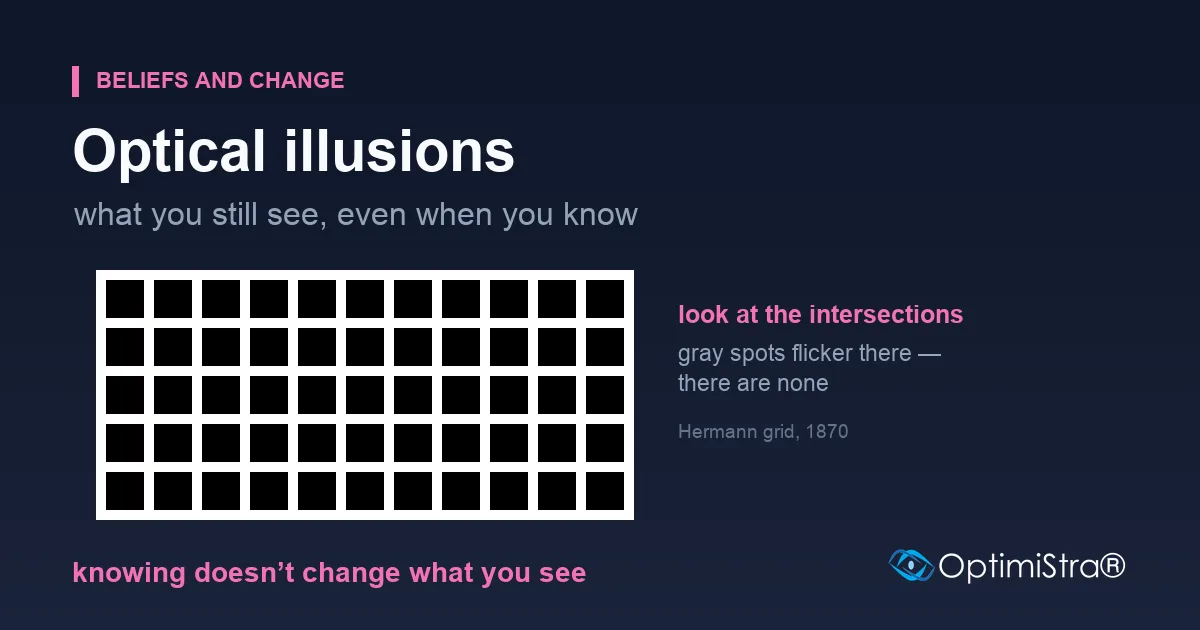
An optical illusion isn’t a malfunction: it is the brain interpreting what it sees, correcting for shadows or filling in what’s missing. The most striking part is that the illusion holds even once you know how it works. Three famous illusions show this, and research explains why.
November 18, 2026 · 8 min read
Beliefs and Change
The imagined lemon: what your body does with what you imagine
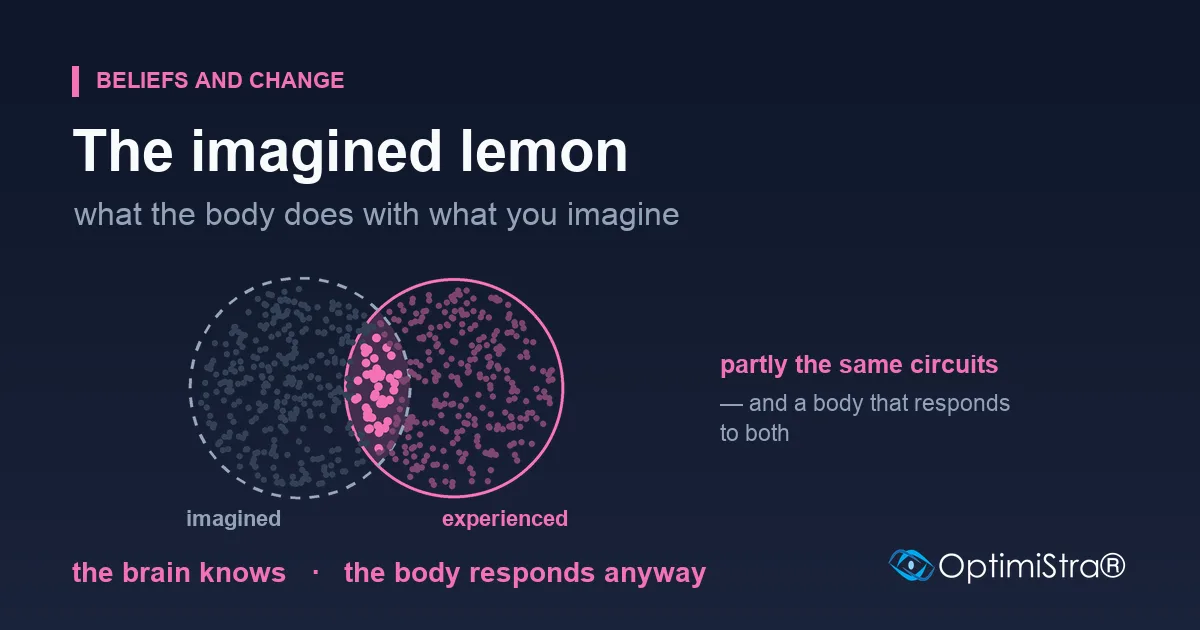
Imagining a lemon makes you salivate, and imagining a movement activates some of the circuits that control it. Even so, the brain does not confuse real and imagined: it tells them apart, except when the inner image becomes strong enough. That is what makes mental rehearsal useful, to a modest degree.
November 18, 2026 · 8 min read
Beliefs and Change
False memories: why we remember things that never happened
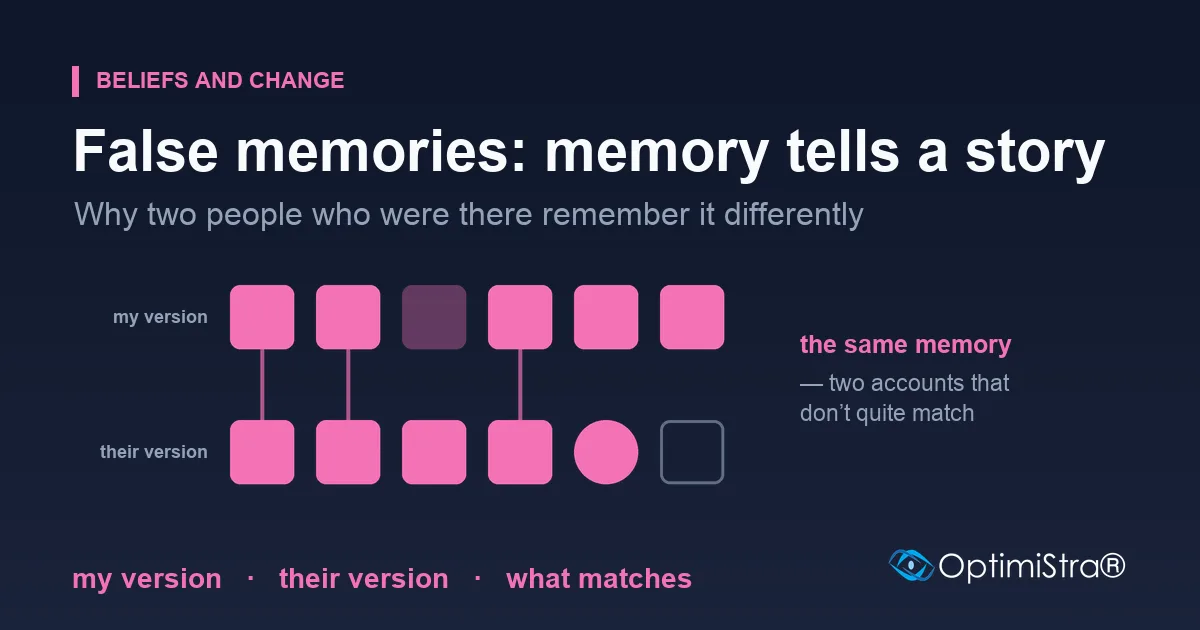
A false memory is one you’re sure of that didn’t happen the way you believe, in part or sometimes entirely. Studies show that a photo, a word, or a conversation is enough to alter an ordinary memory, and that confidence doesn’t guarantee accuracy. False memories are rarely false all the way through.
November 18, 2026 · 6 min read