False memories: why we remember things that never happened


Michel Wozniak and Nathalie de Marcé
Published November 18, 2026 · 6 min read
In brief
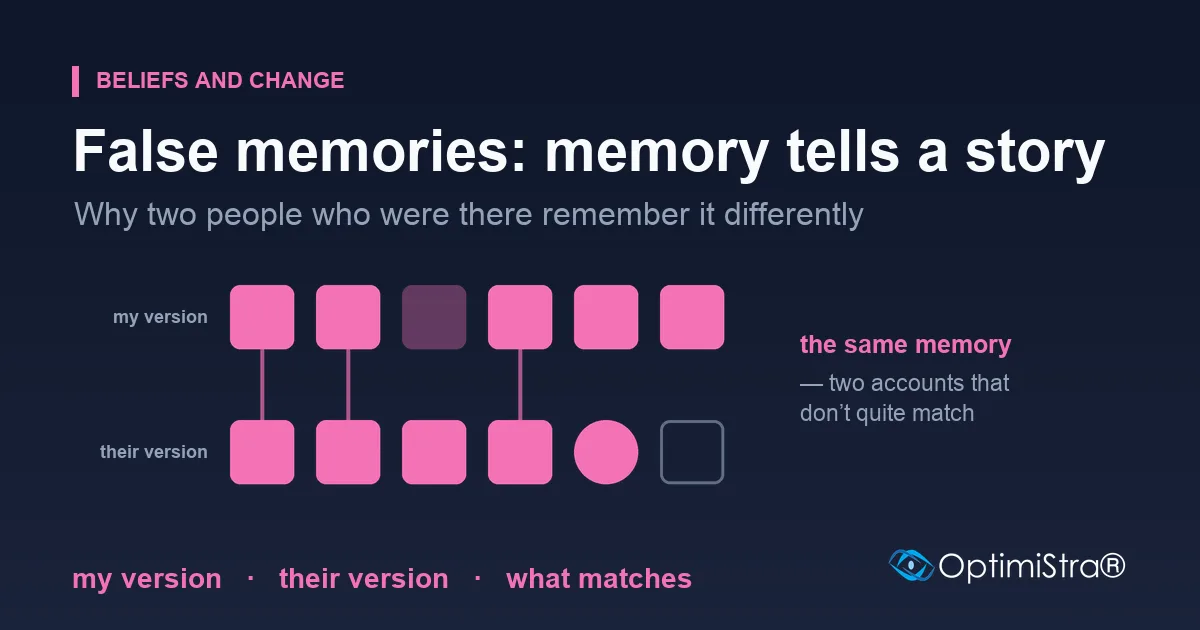
A false memory is one you’re sure of that didn’t happen the way you believe, in part or sometimes entirely. Studies show that a photo, a word, or a conversation is enough to alter an ordinary memory, and that confidence doesn’t guarantee accuracy. False memories are rarely false all the way through.
In 14 of 20 pairs of twins, researchers found at least one childhood memory that both twins claimed as their own. Each was sure of being the one who won that spelling contest, or the one who found those hidden presents. One of the two had to be wrong, and neither suspected it.
What these twins show is something each of us lives through without knowing it. A memory you’re sure of may not have happened the way you believe. This article sets out what research has established about false memories, what it hasn’t, and how to observe the effect in yourself without starting an argument with anyone.
What a false memory is
A false memory is a memory that is sincere and inaccurate: you aren’t lying, you are remembering, and what you recall didn’t happen that way. Most often the error concerns a detail: the color of an object, who was there, what was said. More rarely, it concerns an entire episode.
The reason is easy to state. Memory doesn’t store a film and play it back: it reconstructs the memory each time, from fragments, from what you know, and from what you’ve heard since. We’ve written about this in connection with perception, which is already a construction: the brain interprets more than it sees, and the map is not the territory. A memory is one more map, redrawn every time it’s used. The mechanism is the same as in optical illusions: the brain fills in what’s missing with what’s likely.
Lost in the mall
In 1995, Elizabeth Loftus and Jacqueline Pickrell published the experiment that launched this field of research. They gave 24 adults a booklet describing four episodes from their childhood, supplied by a relative. Three were true. The fourth was invented: getting lost in a shopping mall at around age five, then being found. Over two interviews, six of the 24 participants remembered all or part of that episode, less clearly than the true ones.
The authors drew no general percentage from this: they were showing that it was possible. In 2023, an Irish team ran the experiment again with 123 people, following a preregistered protocol. By the researchers’ coding, 35% had at least a partial memory of the invented episode. But a reanalysis published the following year shows how much that figure depends on the definition: once accounts that were too vague, or close to something the person had really experienced, are set aside, it drops as low as 4%. And if you count everyone who believes the episode happened without remembering it, it rises to 66%. The finding is solid; the figure, much less so.
The hot air balloon photo
Another team, led by Kimberley Wade, replaced the story with a picture. The researchers showed 20 adults three real photos from their childhood and one doctored photo: themselves as children, in the basket of a hot air balloon. By the third interview, half were describing at least fragments of a ride that had never taken place, often with details the photo didn’t show.
This experiment has the merit of being a pleasant one: the invented episode is a happy memory. It shows that memory doesn’t only add what is sad or worrying; it fills the gaps with whatever seems plausible.
A single word can change what you saw
Loftus’s first famous study, with John Palmer in 1974, used films of car accidents. People were asked how fast the cars were going when they “smashed into” each other, or when they “hit” each other. With the stronger verb, the estimates went up. A week later, 32% of those who had heard “smashed” said they had seen broken glass, compared with 14% of those who had heard “hit.” There was no broken glass in the film. Even so, two-thirds did not “see” any: the effect is real, not massive.
Certain, and yet
On September 12, 2001, Jennifer Talarico and David Rubin asked 54 students to write down how they had learned of the previous day’s attacks, and to describe an ordinary memory from the same week as well. They questioned them again weeks or months later. Both memories lost consistency at the same rate. But vividness and confidence declined only for the ordinary memory. What set the striking memory apart wasn’t its accuracy; it was the trust people placed in it.
Comparing without contaminating each other
Comparing your memory with someone who was there is the best way to observe all this. With one precaution. Fiona Gabbert and her colleagues showed 120 people, in pairs, two slightly different versions of the same video. Among those who then discussed it with their partner, 71% reported at least one detail they could not have seen; among those who didn’t discuss it, none did. Hence our advice, which is our own deduction: write down your version before you talk about it.
What these studies don’t say
They don’t say your memories are false. A mega-analysis of eight implantation studies, led in 2017 by Alan Scoboria and his colleagues, points out that “it is simply incorrect to state that false memories are entirely false”: most are built from elements the person really experienced. And all of these studies deal with ordinary memories, obtained in a laboratory; they give no grounds for doubting any particular memory, and still less for doubting the hard things a person has lived through.
What they do allow is holding your certainties a little more lightly. It’s also something we teach in Neuro-Linguistic Programming (NLP), in the NLP Practitioner course: the map each person keeps of the same scene is their own, and there is more to learn from comparing it than from defending it. The Practitioner course also includes twelve live group sessions on Zoom, one hour a month for a year.
An exercise for two
Choose a light, pleasant childhood memory that you tell with certainty: a party, a vacation, a bit of mischief that makes everyone laugh today.
- Write down your version: where, when, who was there, what happened, and one detail you have no doubt about at all.
- Ask someone who was there to tell theirs.
- Note what matches, what differs, and how certain you are before and after.
If your accounts differ, nobody lied. Memory did its job, for both of you.
At the next family gathering
Try this. Think of the next meal where you’ll see someone from your childhood. Picture the table, the voices, the moment one of you starts telling that story you know by heart. This time, you listen to their version all the way through, with curiosity, and you discover a detail you had forgotten, or never knew.
Which of your memories would you like to hear someone else tell?
Article written by Michel Wozniak and Nathalie de Marcé, and optimized by artificial intelligence.
Sources
- Loftus & Pickrell (1995), The formation of false memories, Psychiatric Annals
- Murphy et al. (2023), Lost in the mall again. A preregistered replication and extension of Loftus & Pickrell (1995), Memory
- Andrews & Brewin (2024), Lost in the Mall? Interrogating Judgements of False Memory, Applied Cognitive Psychology
- Wade, Garry, Read & Lindsay (2002), A picture is worth a thousand lies, Psychonomic Bulletin & Review
- Sheen, Kemp & Rubin (2001), Twins dispute memory ownership. A new false memory phenomenon, Memory & Cognition
- Talarico & Rubin (2003), Confidence, not consistency, characterizes flashbulb memories, Psychological Science
- Loftus & Palmer (1974), Reconstruction of automobile destruction, Journal of Verbal Learning and Verbal Behavior
- Gabbert, Memon & Allan (2003), Memory conformity. Can eyewitnesses influence each other's memories for an event?, Applied Cognitive Psychology
- Scoboria et al. (2017), A mega-analysis of memory reports from eight peer-reviewed false memory implantation studies, Memory
Frequently asked questions
What is a false memory?
A memory you’re sure of that didn’t happen the way you believe. It can concern a detail, such as the color of an object or who was present, or more rarely an entire episode. Studies show it almost always mixes what really happened with what was added.
Can you implant a false memory in someone?
In the laboratory, yes, for ordinary episodes. Elizabeth Loftus led adults to partly remember an invented childhood episode, and another team obtained partial memories of a hot air balloon ride that never took place, using a doctored photo. The rates vary a great deal depending on what counts as a memory.
Does being sure of a memory mean it’s accurate?
No. Talarico and Rubin (2003) followed memories over several months. The details changed just as much for a striking memory as for an everyday one, but confidence stayed high for the striking memory.
What should you do when two people remember the same event differently?
Don’t try to work out who is right. Each person reconstructs the memory from what they lived through and what they’ve heard since. Comparing the two versions often teaches more than defending them.
How can you check a childhood memory?
By comparing it with someone who was there, after writing down your own version first. When two people talk, each picks up details from the other. Then compare what matches and what differs, without trying to decide who is right.
Beliefs and Change
Optical illusions: what your brain still sees, even when you know better
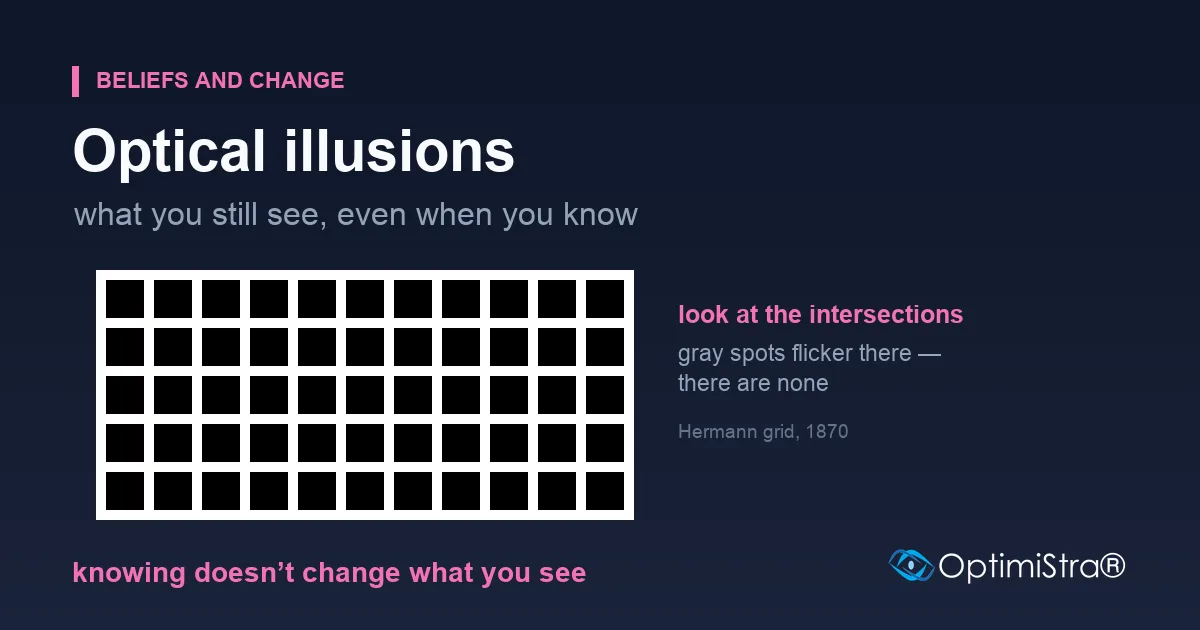
An optical illusion isn’t a malfunction: it is the brain interpreting what it sees, correcting for shadows or filling in what’s missing. The most striking part is that the illusion holds even once you know how it works. Three famous illusions show this, and research explains why.
November 18, 2026 · 8 min read
Beliefs and Change
The invisible gorilla: what the brain sees, and what it adds
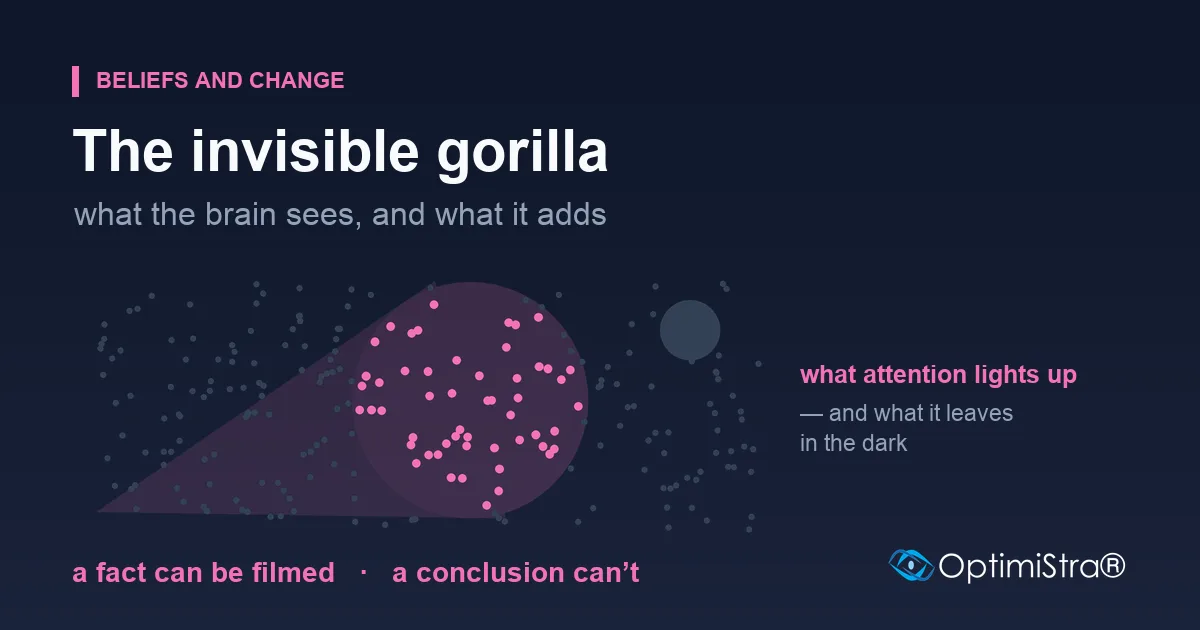
Attention works like a flashlight: it lights one spot at a time, and you can miss a gorilla while looking straight at it. Whatever it does light, the brain fills in with interpretations it never announces. You can observe both in yourself in a few minutes.
November 18, 2026 · 6 min read
Beliefs and Change
The imagined lemon: what your body does with what you imagine
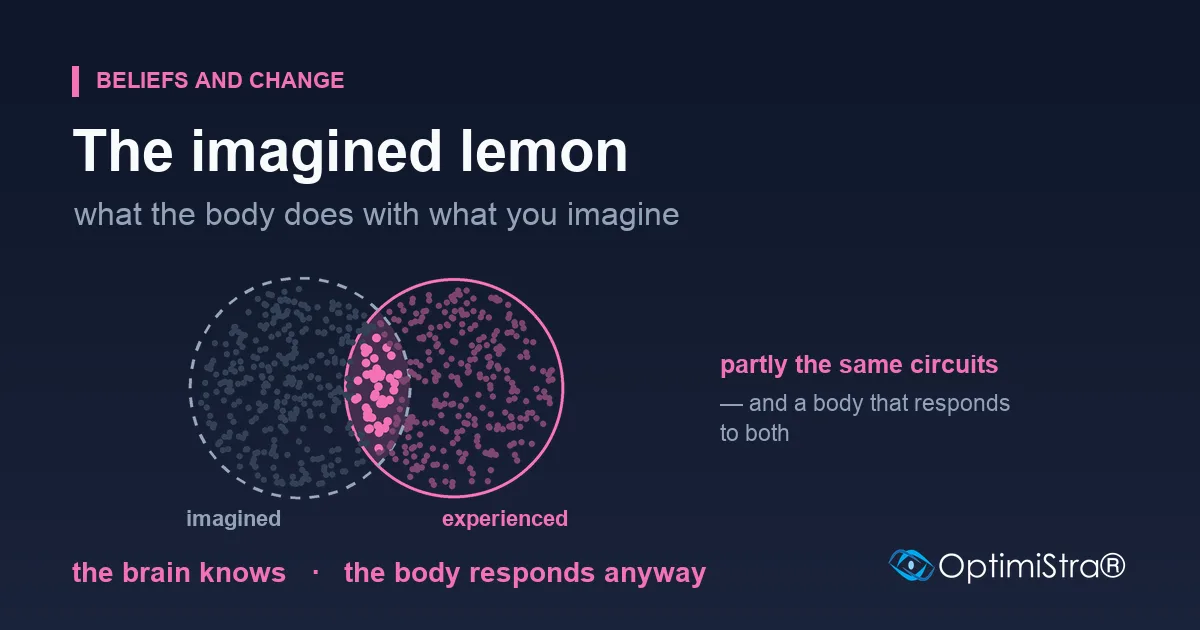
Imagining a lemon makes you salivate, and imagining a movement activates some of the circuits that control it. Even so, the brain does not confuse real and imagined: it tells them apart, except when the inner image becomes strong enough. That is what makes mental rehearsal useful, to a modest degree.
November 18, 2026 · 8 min read