NLP and adult learning: what a study measured in 173 adult learners


Michel Wozniak and Nathalie de Marcé
Published November 18, 2026 · 15 min read
In brief
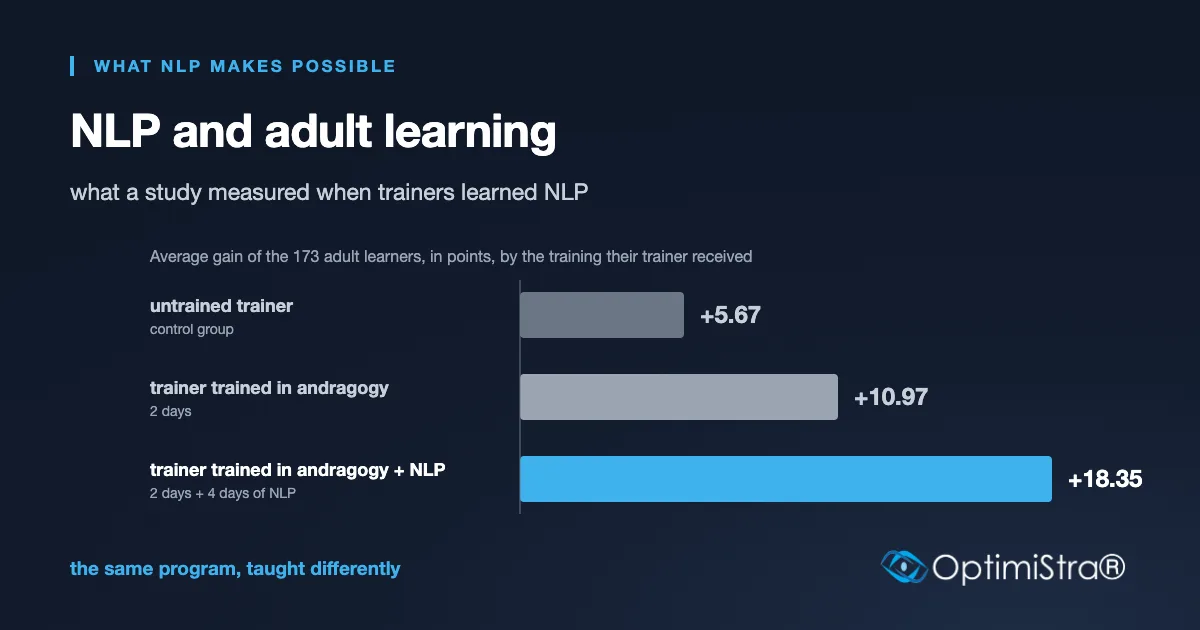
In 2012, a study in England randomly assigned 24 trainers of adults to three groups. Learners whose trainer had taken 4 days of Neuro-Linguistic Programming (NLP) on top of a course in andragogy improved by 18.35 points, compared with 10.97 when the trainer had taken andragogy alone. Research on expectations, relationships, and stress helps explain the gap.
Anyone who trains adults knows this moment. The content is solid, the exercise is ready, and as soon as a slope calculation or a quantity takeoff goes up on the board, part of the group pulls back. Some left school with a bad memory of math. Others are learning in a language that is not their own, or are returning to training after years of work.
The figures confirm what trainers see. In France, according to the 2023 Programme for the International Assessment of Adult Competencies (PIAAC), 49% of people holding a CAP or a BEP, two vocational qualifications, have low literacy skills, and 43% have low numeracy skills (DARES, the French directorate for research, studies, and statistics, 2024). In Switzerland, the same survey finds that about 30% of people aged 16 to 65, some 1.67 million people, have low skills in at least one of the three areas measured (Federal Statistical Office and State Secretariat for Education, Research and Innovation, 2024).
With the same content, does the way a trainer communicates change what these learners retain? A British team measured it in 2012: it trained trainers of adults in Neuro-Linguistic Programming (NLP), then compared their learners’ progress. We suggest covering the ground in five steps:
- what this study measured;
- what research says about the skills these trainers learned;
- the difference the relationship makes in the construction trades;
- a demonstration to try in your next class;
- how to learn these skills.
1. The study: 24 randomly assigned trainers, 173 adult learners
The study was conducted in England by CfBT Education Trust, a British education research organization, with funding from the Learning and Skills Improvement Service, which at the time supported the improvement of further education in England. It was presented in July 2012 at the Third International NLP Research Conference, at the University of Hertfordshire (Allan et al., 2012).
Its participants look a lot like those of a vocational training center. They were 173 adults aged 16 to 70, 31 on average, taking basic math classes in further education colleges, in adult learning settings, and with workplace training providers. The authors point out that many of these learners carry an anxiety about numbers that often goes back to childhood, that it can last a long time, and that it weakens memory and the ability to work methodically.
Twenty-four trainers were randomly assigned to three groups, after being balanced by qualification and length of experience. Only the trainers were trained; their learners simply went on attending their classes:
- the trainers in the first group received no training;
- those in the second took 2 days of training in andragogy, the art of teaching adults, applied to math: more questions that make learners think, more problem solving, and more group work;
- those in the third took the same 2 days, then 4 days of NLP training.
The 4 days of NLP covered three skills, which the trainers then used with their learners:
- the language of influence, to phrase positive suggestions about success, motivation, and behavior;
- body language and posture matching, based on close observation of the other person, which create what NLP calls rapport;
- spatial anchoring, to manage emotional states during class.
The learners did not know the purpose of the study or what their trainer had learned: the trainers never mentioned it to their group, they simply adapted the way they taught. The trainers in the third group themselves found out that the subject was NLP only when they arrived on the first day of their training. Every learner took the same math test in the fall, then again at the end of spring.
What the results show
| Training received by the trainer | Learners’ average score, before | Learners’ average score, after | Learners’ average progress |
|---|---|---|---|
| None | 60.37 | 66.05 | +5.67 points |
| Andragogy (2 days) | 54.61 | 65.58 | +10.97 points |
| Andragogy (2 days) and NLP (4 days) | 56.49 | 74.84 | +18.35 points |
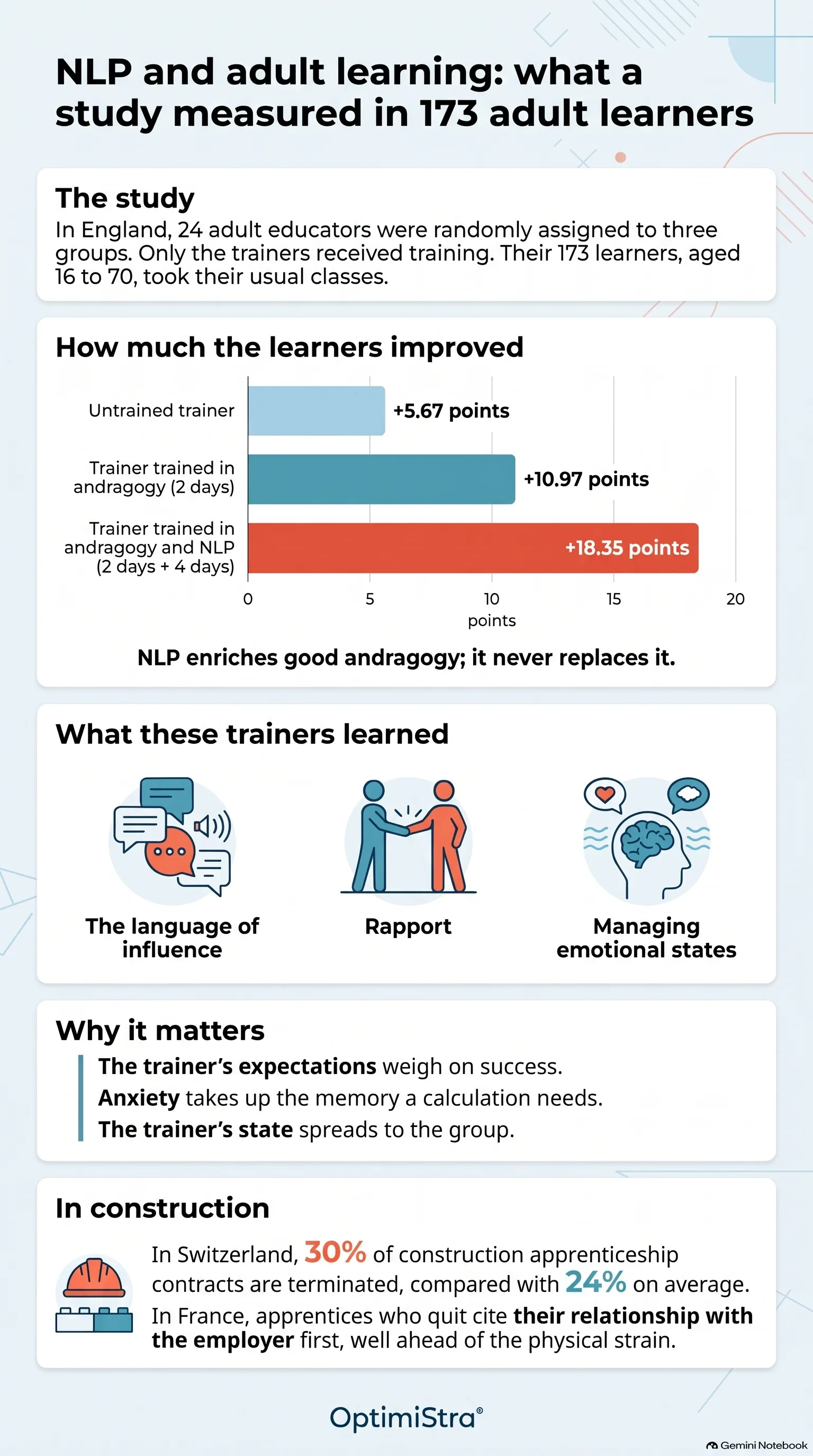
All three groups improve, and andragogy alone already does better than no training. The most telling comparison, though, is between the two groups of trained trainers. All of them had received the same 2 days of andragogy, and those in the third group had added 4 days of NLP. Learner by learner, the people taught by these trainers improved by 7.38 points more, a gap very unlikely to be due to chance (p = 0.002). They improved about one and two-thirds times as much as the learners of trainers trained in andragogy alone, and more than three times as much as those whose trainers had received no training.
The authors draw a conclusion that will make sense to any head of training. NLP, they write, can improve results when it enriches andragogy and command of the subject, never in their place. They add that, without effective communication, good subject knowledge may not be enough. So they do not ask anyone to choose between NLP and andragogy: content remains the foundation, and the way it is taught decides what the learner does with it.
2. What research says about the skills these trainers learned
NLP is not alone in taking an interest in these skills. Research in education and psychology has studied them for decades under other names, and on very large numbers of people.
The trainer’s words, and the expectations they carry
The positive suggestions of the language of influence convey an expectation: you can do this. Psychology calls the influence of a trainer’s expectations on the success of the people they train the Pygmalion effect, and it is especially marked in adult training. A meta-analysis of 17 studies, covering 2,874 participants, most of them in training, finds an average effect of 1.13, whereas statisticians already consider an effect of 0.8 large. The effect is strongest among people of whom little was expected at the start (McNatt, 2000). A second meta-analysis, carried out in work organizations, arrives at 0.81, again with a stronger effect when the starting level is low (Kierein and Gold, 2000).
The sentence that carries this expectation can be measured too. In two experiments in the United States with seventh-grade students aged 12 to 13, critical feedback on an essay came with, or without, a sentence saying, in essence, that the comments reflected high standards and the conviction that the student could meet them. In the first experiment, among African American students, 71% of those who received that sentence revised their essay, compared with 17% of the others. The effect was strongest among those who mistrusted school the most (Yeager et al., 2014). Many adults who return to training also have difficult memories of school. That is our reading: no study has yet measured it in them.
The instruction that makes a movement stick
In manual trades, the wording of an instruction changes what the learner retains. A meta-analysis of 73 studies, covering 1,824 participants, compares two ways of guiding a movement: directing attention to the effect of the movement, or to the body producing it. Directing attention to the effect improves performance, and above all what remains later and what transfers to other situations, whatever the age or level of the participants (Chua et al., 2021). On a training site, that means choosing “follow the string line” over “keep your elbow up.”
Rapport, or the relationship that opens the way to learning
Rapport corresponds to what research calls the relationship between trainer and learner, one of the best-measured subjects in education science. Across 119 studies and more than 355,000 students, a learner-centered relationship is associated with better results, at a level above the average for educational innovations (Cornelius-White, 2007). Of everything that makes a teacher credible, the sense that the teacher cares about the people being taught is the most closely linked to what they learn (Finn et al., 2009).
This relationship can be worked on, and its effect can be measured. In a trial published in the journal Science, teachers received coaching on the quality of their interactions with students. The following year, the average student in their classes moved from the 50th to the 59th percentile on achievement tests (Allen et al., 2011). Neuroscience shows signs of it too: when the brain activity of a trainer and of learners is recorded at the same time, the degree of synchronization between their brains is associated with what the learners learn, and the link is stronger when trainer and learners often take turns speaking (Zhang et al., 2022).
The learner’s inner states, and the trainer’s
The spatial anchoring taught in the study was aimed at emotional states, and this may be where the stakes are most concrete. Anxiety takes up part of working memory, the memory that holds the steps of a calculation while you carry it out: worrying about your fear uses the resources the calculation needs (Ashcraft, 2002). A meta-analysis of 177 samples, more than 22,000 people, confirms this link between anxiety and reduced working memory (Moran, 2016). And adults who return to training report more math anxiety, and less confidence in their abilities, than younger students (Jameson and Fusco, 2014). Timing matters as well: stress felt just before or during a test gets in the way of recalling what has been learned (Shields et al., 2017).
In our courses, we teach that opening with “relax, everything is fine” to someone who is tense often produces the opposite effect. Research confirms it in its own way. In a trial in the United States with 93 students in a remedial math course, a short instruction presented the signs of stress, a faster heartbeat for example, as the body preparing for effort. That group was less anxious about tests and earned better grades on the real exams, while the group advised to ignore its stress did less well (Jamieson et al., 2016). A meta-analysis of randomized trials confirms the value for performance of reinterpreting stress in this way (Bosshard and Gomez, 2024), and another, across 306 comparisons, finds that trying not to feel an emotion does not regulate it (Webb, Miles, and Sheeran, 2012).
Finally, the trainer’s state is passed on. In 71 classes and among 1,542 students, the enjoyment a teacher takes in teaching shows up in the enjoyment of the students, through the enthusiasm they perceive in the teacher (Frenzel et al., 2009). Another study, among 406 students, links teacher burnout to the level of cortisol, the stress hormone, measured in the morning in their students (Oberle and Schonert-Reichl, 2016). In our courses, we put it this way: if you want to put someone in a state, put yourself in that state first. A sentence we often address to people who lead also holds for people who train: “A trainer (like anyone who deals with other people) can delegate almost everything. But there are two things they cannot delegate: managing their own inner state, and the impact their words will have on others – and on themselves.”
3. The difference the relationship makes in the construction trades
In Switzerland, the Federal Statistical Office (FSO) followed all the young people who entered a dual apprenticeship in 2018. In construction and civil engineering, 30% had their contract terminated before its end, compared with 24% on average, and 62% of terminations, across all occupations, came in the first year. Across all fields, nearly four in five young people then resume training, most often in another company or another occupation (FSO, 2023).
In France, 36% of apprentices who started in 2018, across all sectors, broke off a contract within the first 18 months, and 42% at CAP level. The reason cited by far the most often is a problem with the employer or the job itself: how well the apprentice gets along with the employer or colleagues, tasks seen as unsuitable, unsatisfactory working conditions. It is cited by 81% of the apprentices who found another contract, and by 56% of the others. By contrast, the authors note, physical constraints such as arduous work, noise, or temperature do not seem to raise the risk of breaking off a contract in the middle of an apprenticeship. The training center plays its part: an apprentice who can rely neither on a teacher nor on the center’s administration is more likely to give up the apprenticeship (DARES, 2024).
A study carried out in the Swiss canton of Vaud gave a voice to 44 young people who had left their apprenticeship in the first year. Twenty-one of them express only negative feelings toward their trainer. One former apprentice says she was so afraid of that person that she hardly said anything, and lost all her composure. The researchers conclude that good relationships do seem to be a necessary condition for passing on knowledge (Masdonati and Lamamra, 2009).
On construction sites, the way knowledge is passed on shows up even in accidents. A meta-analysis of 95 studies on workplace safety training shows that formats in which the learner practices, observes a model, and takes part in dialogue increase knowledge far more than a lecture, a pamphlet, or a video, and that only these engaging formats are associated with a drop in accidents and injuries (Burke et al., 2006).
These figures do not say that construction trainers communicate poorly. They say that the relationship and the way of teaching weigh on what happens in training, on safety and persistence alike, and that this is a lever a training center can act on.
4. A demonstration to try in your next class
Take a situation you have probably been in. A learner stalls on a slope calculation in front of the group, and you feel the tension rise. The sentence that comes naturally is “don’t stress, it’s easy.” It is well meant, and it often produces the opposite: it asks the person not to feel what they already feel, and “it’s easy” can suggest that, if they freeze, the difficulty lies with them.
In our courses, we use the image of a moving train: to get on, you first have to run at its speed, and only once on board can you act on where it goes. The first step, which NLP calls pacing, meets the person where they are, with a sentence they can confirm: “This calculation trips up a lot of people the first time.” The second step, leading, takes them toward what comes next: “Let’s set it out together. What do we already know?” When the time comes to correct, the instruction is about the result to reach rather than the move that went wrong, and the feedback states clearly both the standard and your confidence.
Try it the next time a learner freezes, and watch what the learner’s shoulders do at the moment you let them find the first step.
Now take a moment to imagine the scene a few weeks later. It is Monday morning, in your classroom. You announce the quantity takeoff exercise, and at the back of the room, the learner who went quiet whenever numbers came up at the start of the year raises a hand to suggest a method. You hear that voice, steady, explaining the steps to a neighbor. You sense that the group has relaxed, and that you are calmer too, because the right words come without your having to search for them. What difference does it make to you, knowing what to say at that moment? And how many learners in your group would see their training through, if these moments became the rule?
5. Learning these skills with us
We, Nathalie de Marcé and Michel Wozniak, are the world’s first two French-speaking Master Trainers named by Richard Bandler himself, the co-creator of Neuro-Linguistic Programming, in the entire history of NLP. We are also among the only eight trainers in the world authorized to teach Teaching Excellence, the program by Richard Bandler and Kate Benson devoted to teaching, and the only two French speakers among them. Michel holds the Brevet Fédéral de Formateur (Federal Trainer), awarded by the Swiss Confederation. He himself left school before finishing, and it was as an adult, on discovering effective learning strategies, that he earned his degrees, up to an engineering degree and then a Master of Business Administration (MBA).
We have been teaching together for about 10 years, with a team of trainers and assistants. Over several years, we had our course validated by more than 20 brain and health professionals (holders of doctorates in neuroscience, biology, and biophysics, physicians, and psychologists), reworking it with them until it agreed with what they know.
The NLP Practitioner course, 8 days in person
The NLP Practitioner course runs over 8 days, in Switzerland, in a group. You leave knowing how to phrase your instructions and your encouragement so that they are heard, how to build rapport with a group that arrives on its guard, and how to recover your calm, then help a learner recover theirs, at the moment they freeze. Scheduled sessions are held in French; the course is given in English on request.
- The certificate is signed by Richard Bandler himself.
- After the course, twelve live group sessions on Zoom, one hour a month for a year.
- A WhatsApp group, where the trainers and assistants stay for at least a year.
- The OptimiStra® Platform: practice apps, one for each skill worked on in the course, on your phone or your computer, with nothing to install.
- Admission starts with a 30-minute admission call on Zoom, to check together that the timing and the format suit you.
This course asks for real commitment, and the work starts with yourself. It is not therapy, and if you are going through a truly difficult period, this is not the right moment: we will be glad to welcome you later.
If you train adults, or if you run a training center and are thinking of your team, we offer a 30-minute video call with Michel. Together you will look at how these skills apply to your learners, and at the format that suits you.
Keep reading
For further reading: why we stop thinking clearly in the grip of emotion, taking back control of your states and reactions, and influence or manipulation: what if you were asking the wrong question?
And if you would rather follow a thread than pick at random, our complete path to understanding NLP puts our articles in order.
Article designed and written by Michel Wozniak and Nathalie de Marcé, and optimized by artificial intelligence.
Sources
- Allan, Bourne, Bouch, Churches et al. (2012), Training in influencing skills from neuro-linguistic programming (modelled from hypnosis and family therapy), in combination with innovative maths pedagogy, raises maths attainment in adult numeracy learners, Third International NLP Research Conference, University of Hertfordshire, CfBT Education Trust (ERIC ED532354)
- DARES (2024), Compétences des adultes en 2023 : quelle maîtrise de la recherche et de l'utilisation des informations à l'ère du numérique ?, Dares Analyses n° 73 (in French)
- Office fédéral de la statistique et SEFRI (2024), communiqué du 10 décembre 2024 sur les résultats suisses de l'enquête PIAAC sur les compétences des adultes (in French)
- McNatt (2000), Ancient Pygmalion joins contemporary management: A meta-analysis of the result, Journal of Applied Psychology
- Kierein et Gold (2000), Pygmalion in work organizations: a meta-analysis, Journal of Organizational Behavior
- Yeager, Purdie-Vaughns, Garcia, Apfel et al. (2014), Breaking the cycle of mistrust: Wise interventions to provide critical feedback across the racial divide, Journal of Experimental Psychology: General
- Chua, Jimenez-Diaz, Lewthwaite, Kim et Wulf (2021), Superiority of external attentional focus for motor performance and learning: Systematic reviews and meta-analyses, Psychological Bulletin
- Cornelius-White (2007), Learner-Centered Teacher-Student Relationships Are Effective: A Meta-Analysis, Review of Educational Research
- Finn, Schrodt, Witt, Elledge et al. (2009), A Meta-Analytical Review of Teacher Credibility and its Associations with Teacher Behaviors and Student Outcomes, Communication Education
- Allen, Pianta, Gregory, Mikami et Lun (2011), An Interaction-Based Approach to Enhancing Secondary School Instruction and Student Achievement, Science
- Zhang, Xu, Li, Chen et al. (2022), Interpersonal Neural Synchronization Predicting Learning Outcomes From Teaching-Learning Interaction: A Meta-Analysis, Frontiers in Psychology
- Ashcraft (2002), Math Anxiety: Personal, Educational, and Cognitive Consequences, Current Directions in Psychological Science
- Moran (2016), Anxiety and working memory capacity: A meta-analysis and narrative review, Psychological Bulletin
- Jameson et Fusco (2014), Math Anxiety, Math Self-Concept, and Math Self-Efficacy in Adult Learners Compared to Traditional Undergraduate Students, Adult Education Quarterly
- Shields, Sazma, McCullough et Yonelinas (2017), The effects of acute stress on episodic memory: A meta-analysis and integrative review, Psychological Bulletin
- Jamieson, Peters, Greenwood et Altose (2016), Reappraising Stress Arousal Improves Performance and Reduces Evaluation Anxiety in Classroom Exam Situations, Social Psychological and Personality Science
- Bosshard et Gomez (2024), Effectiveness of stress arousal reappraisal and stress-is-enhancing mindset interventions on task performance outcomes: a meta-analysis of randomized controlled trials, Scientific Reports
- Webb, Miles et Sheeran (2012), Dealing with feeling: A meta-analysis of the effectiveness of strategies derived from the process model of emotion regulation, Psychological Bulletin
- Brooks (2014), Get excited: Reappraising pre-performance anxiety as excitement, Journal of Experimental Psychology: General
- Frenzel, Goetz, Lüdtke, Pekrun et Sutton (2009), Emotional transmission in the classroom: Exploring the relationship between teacher and student enjoyment, Journal of Educational Psychology
- Oberle et Schonert-Reichl (2016), Stress contagion in the classroom? The link between classroom teacher burnout and morning cortisol in elementary school students, Social Science & Medicine
- Office fédéral de la statistique (2023), Résiliation du contrat d'apprentissage, réentrée, statut de certification : résultats pour la formation professionnelle (in French)
- DARES (2024), Quelles causes aux ruptures des contrats d'apprentissage ?, Dares Analyses n° 63 (in French)
- Masdonati et Lamamra (2009), La relation entre apprenti-e et personne formatrice au cœur de la transmission des savoirs en formation professionnelle, Revue suisse des sciences de l'éducation (in French)
- Burke, Sarpy, Smith-Crowe, Chan-Serafin, Salvador et Islam (2006), Relative effectiveness of worker safety and health training methods, American Journal of Public Health
Frequently asked questions
Does NLP help people who train adults?
In a study carried out in England in 2012, 24 trainers of adults were randomly assigned to three groups. Only the trainers were trained. Learners whose trainer had taken 4 days of Neuro-Linguistic Programming (NLP) on top of 2 days of andragogy, the art of teaching adults, improved by 18.35 points on a math test, compared with 10.97 when the trainer had taken andragogy alone, and 5.67 when the trainer had received no training (Allan et al., 2012). The authors make clear that NLP enriches good andragogy and does not replace it.
Why does anxiety get in the way of adult learning?
Anxiety takes up part of working memory, the memory that holds the steps of a calculation or an instruction while you apply them: worrying about your fear uses the resources the task needs (Ashcraft, 2002). A meta-analysis of 177 samples confirms the link (Moran, 2016). Adults who return to training also report more math anxiety than younger students (Jameson and Fusco, 2014).
What should you say to a stressed learner before a test?
Asking the learner to calm down or to ignore the stress does little to help. In a trial with students in a remedial math course, presenting the signs of stress as the body preparing for effort reduced anxiety and improved grades on the real exams, while the instruction to ignore stress did less well (Jamieson et al., 2016). Saying “I am excited” rather than trying to calm down also improved performance in public speaking and in math (Brooks, 2014).
How do you phrase an instruction for a technical skill?
By directing attention to the effect of the movement rather than to the body producing it. A meta-analysis of 73 studies shows that guiding in this way improves performance, and above all retention and transfer of the movement, whatever the age and level of the participants (Chua et al., 2021). On a training site, that means saying “follow the string line” rather than “keep your elbow up.”
Why do so many construction apprentices drop out?
In Switzerland, 30% of the construction and civil engineering apprentices who started in 2018 had their contract terminated early, compared with 24% on average (FSO, 2023). In France, among apprentices as a whole, the reason cited by far the most often is a problem with the employer or the job, including how well people get along, cited by 56% to 81% of those who broke off a contract, while physical constraints do not seem to raise the risk (DARES, 2024).
What NLP Makes Possible
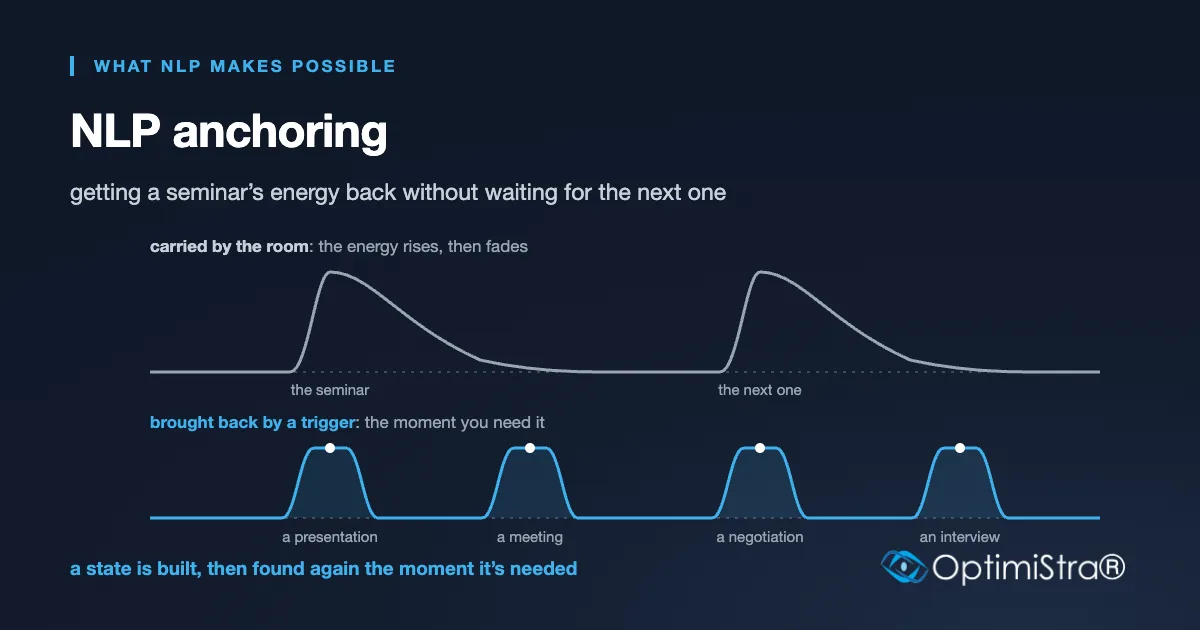
After a motivational seminar, the energy fades: what NLP anchoring changes
A motivational seminar produces real energy, and it often fades within a few weeks because it stays attached to the room. Elite athletes learn to bring back the state they need on their own, with a chosen trigger such as Florent Manaudou’s word “puissance.” NLP calls this an anchor, and it can be learned.
November 18, 2026 · 14 min read

What NLP Makes Possible
Developers in the age of AI: what decides who gets the contract
AI now resolves almost all the tickets in a benchmark test, and the market for developers has tightened. What decides who gets the contract increasingly lies in the relationship with the client and in the state you are in under pressure. These human skills can be trained, and Neuro-Linguistic Programming (NLP) works on them through three pillars.
November 18, 2026 · 11 min read
What NLP Makes Possible
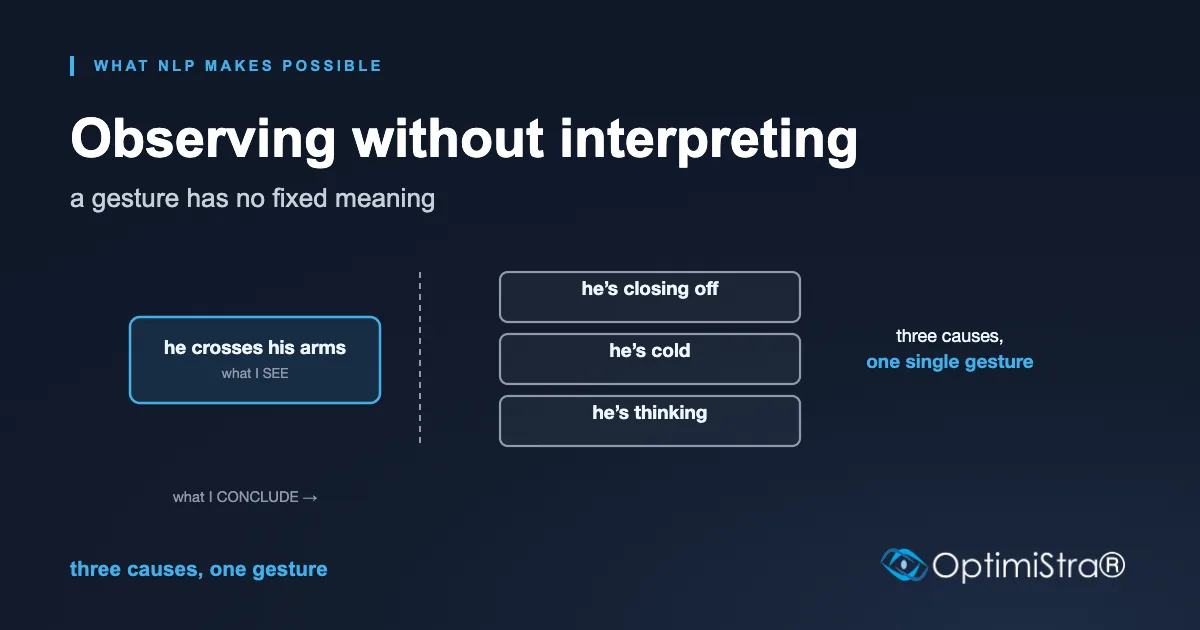
Observing without jumping to conclusions
Someone crosses their arms and we have already reached a verdict. The brain would rather have a wrong answer than the gap left by an open question. Separating what you observe from what you infer can be learned, and the test is simple: if your reading confirms a fear you already had, be wary of it.
November 18, 2026 · 5 min read