
In brief
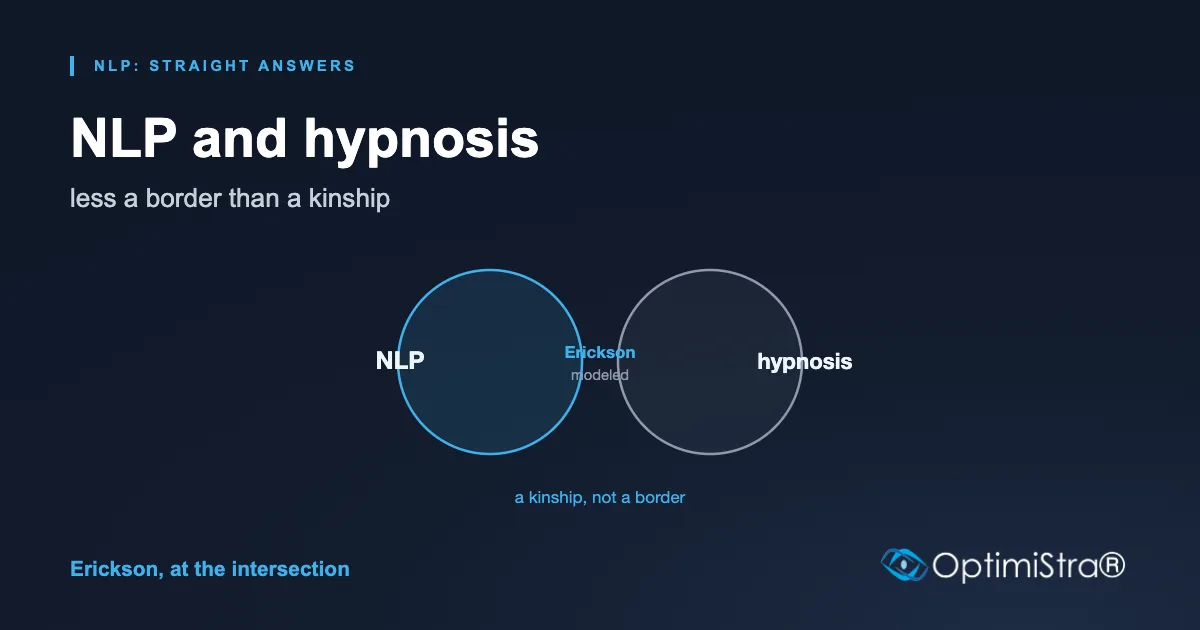
Neuro-Linguistic Programming (NLP) and hypnosis share a root: NLP was built by modeling remarkable practitioners, among them Milton Erickson, the father of Ericksonian hypnosis. The version taught in the French-speaking world has often cut that root, which leaves an NLP shorter than the original and markedly less effective.
People often ask me this question as if they were comparing two rival disciplines, two territories with a line to be drawn between them. And each time I have to disappoint them a little: the real answer isn’t a border. It’s a family tie that almost nobody talks about.
If you’re looking for what separates Neuro-Linguistic Programming (NLP) from hypnosis, you’re already starting from the wrong place. The interesting question, the one that changes the whole picture, is this: where does NLP actually come from? And that leads to a name, a single one: a man to whom NLP owes part of its backbone, and whom most courses taught in French have carefully erased.
The blur almost everyone notices
If you’ve ever tried to work out where NLP ends and hypnosis begins, you’ve probably felt uneasy. The explanations contradict one another. Some people tell you the two are the same thing, others that they have nothing to do with each other. Research, for its part, treats hypnotic suggestion as a tool for studying the brain: that is the position Oakley and Halligan set out in Nature Reviews Neuroscience. And you’re left with the uncomfortable impression that nobody really has a grip on the subject.
This confusion isn’t your fault. It comes from a real gap in the way NLP has been passed on, particularly in the French-speaking world. Once you see what was taken out, everything becomes clear.
Milton Erickson, the missing piece
To understand the link between NLP and hypnosis, you have to go back to one of the key people NLP modeled: Milton Erickson, the father of Ericksonian hypnosis. The modeling work that NLP’s co-creators, Richard Bandler and John Grinder, drew from him was reviewed as early as 1976 by John Weakland in the American Journal of Clinical Hypnosis.
Why him? Because Erickson was a true master of language, and more precisely of the language of change. He was a psychiatrist, and professionals from all over the United States sent him their hardest cases, often secretly hoping he would fail where they themselves had given up. He almost always succeeded. He resolved problems nobody else could reach, simply by using hypnotic language.
NLP was built to a very large extent on that language. It isn’t a side detail: it is one of the parts that give the approach its structure.
The NLP taught in the French-speaking world is a cut-down version
This is where I become a little uncomfortable to listen to. That body of work, one of the foundations of NLP, was almost entirely set aside in the French-speaking world. Not by chance: out of a kind of modesty, a rationalist reflex, as if the word “hypnotic” were frightening, as if NLP had to be made presentable to a Cartesian eye. Yet the subject left the realm of belief long ago: Landry, Lifshitz and Raz have brought together what brain imaging establishes about hypnosis.
The result is that French-speaking NLP mostly kept the very rational parts. And those parts are only a tiny fraction of real NLP, an almost negligible portion. In other words, thousands of people believe they know NLP when what they were handed was the shell, with the core thrown away.
When I say the link with hypnosis is strong, I’m choosing my words carefully: the central person modeled to build NLP was, quite literally, the father of Ericksonian hypnosis. A family tie doesn’t come much closer than that.
Today, hypnosis draws on NLP
There’s a fine irony in this story. All the modeling done from Milton Erickson was later taken up by the hypnosis schools themselves. Today, in almost every hypnosis course, you hear about the Meta Model, the Milton Model and meta programs: all concepts that NLP extracted, structured and formalized from Erickson’s work.
Which means that hypnosis schools now rely on concepts that came out of NLP to explain the very discipline they are supposed to teach. The circle is complete. What is often presented as two opposing worlds turns out to be one and the same inheritance, traveling in both directions.
So what is the difference between NLP and hypnosis?
If a line had to be drawn all the same, this is where I’d draw it. Hypnosis refers first to an altered state of consciousness, a trance, and to the art of guiding someone into it, by voice and by language, to help them change. NLP studies how an experience is put together, yours or someone else’s, so that it can be reproduced, passed on or changed. Erickson’s hypnotic language is one of its tools, alongside the language of precision, anchoring and strategies.
That’s why we recommend starting with NLP: it gives you the keys to understanding what happens when you go into hypnosis. The same technique can, in fact, be practiced in a very conscious state or in a hypnotic state, and we invite our participants to try both. That’s how you feel for yourself the difference between NLP and hypnosis, and everything that links them.
Going further
If this kinship between NLP and hypnosis surprised you, it’s probably because you had only ever come across the lighter version of NLP, the one people dare to teach. There is another: fuller, more alive, closer to what its creators really had in mind. That is the NLP I chose to explore and to pass on.
Where to go next
If you’d like to read on, the next steps are what NLP is, how it differs from therapy and the question of influence. And the place where we teach this NLP is the NLP Practitioner course.
Article designed and written by Michel Wozniak, and optimized by artificial intelligence. Illustration created by artificial intelligence.
Sources
- Weakland (1976), recension de Bandler & Grinder, Patterns of the Hypnotic Techniques of Milton H. Erickson, M.D., American Journal of Clinical Hypnosis
- Landry, Lifshitz & Raz (2017), Brain correlates of hypnosis: A systematic review and meta-analytic exploration, Neuroscience & Biobehavioral Reviews
- Oakley & Halligan (2013), Hypnotic suggestion: opportunities for cognitive neuroscience, Nature Reviews Neuroscience
Frequently asked questions
Are NLP and hypnosis the same thing?
No, but they share a common root. NLP modeled Milton Erickson, the father of Ericksonian hypnosis, and drew much of its language of change from him. The two are deeply linked without being identical.
Who was Milton Erickson, and what does he have to do with NLP?
He is one of the figures NLP modeled first. A psychiatrist and a master of hypnotic language, he was sent the most difficult cases in the United States and resolved them through language. The Milton Model, which is central to NLP, bears his name.
Why is hypnosis so rarely mentioned in NLP as it is taught in French?
Because of a rationalist reflex that belongs to French-speaking culture. The hypnotic dimension, although it gives NLP much of its structure, was largely set aside, to the point where what is taught often represents only a fraction of the original NLP.
Do the Milton Model and the Meta Model come from hypnosis?
NLP drew them from the work of Milton Erickson, and the hypnosis schools then took them back into their own teaching. That is why you find them on both sides today.
Do I need to know hypnosis before learning NLP?
No, it isn’t a prerequisite. Knowing this lineage does change how you understand what you learn: several language patterns come from it, and using them without knowing where they come from means applying them without grasping their logic.
NLP: Straight Answers
Influence or manipulation: are you asking the wrong question?
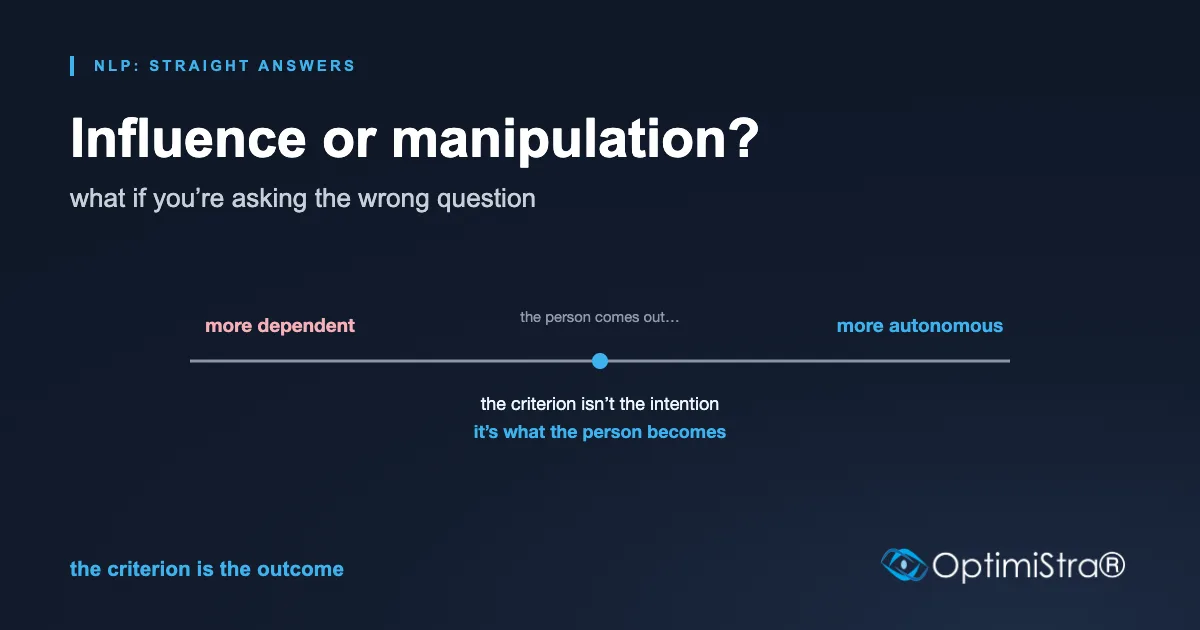
Framing the question in terms of intention leads to a dead end, because nobody describes themselves as a manipulator. The useful test is the result: does the other person come away more autonomous, or more dependent? That is a question you can check rather than simply assert.
November 18, 2026 · 7 min read
NLP: Straight Answers
Ethics and responsibility in NLP: the one line between healthy and unhealthy practice
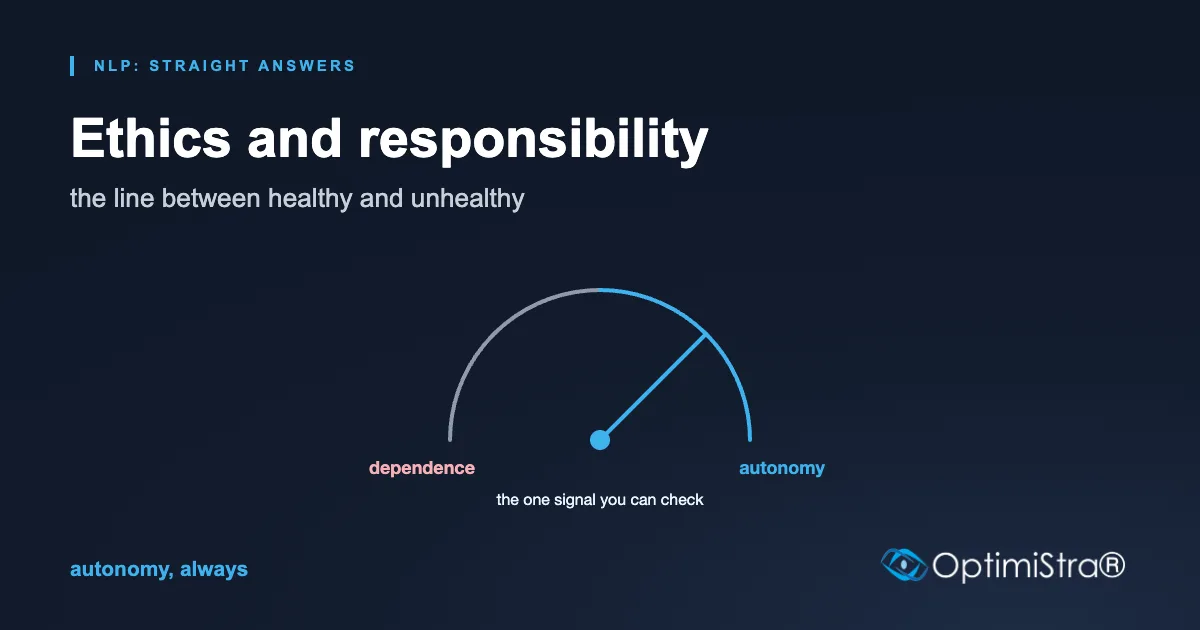
The most reliable signal of a healthy practice is autonomy. A practitioner who keeps adding sessions without ever making the person able to act alone should put you on your guard. And the practitioner is not responsible for the results: taking the credit for them is already the first step in the wrong direction.
November 18, 2026 · 5 min read
NLP: Straight Answers
Is NLP therapy?
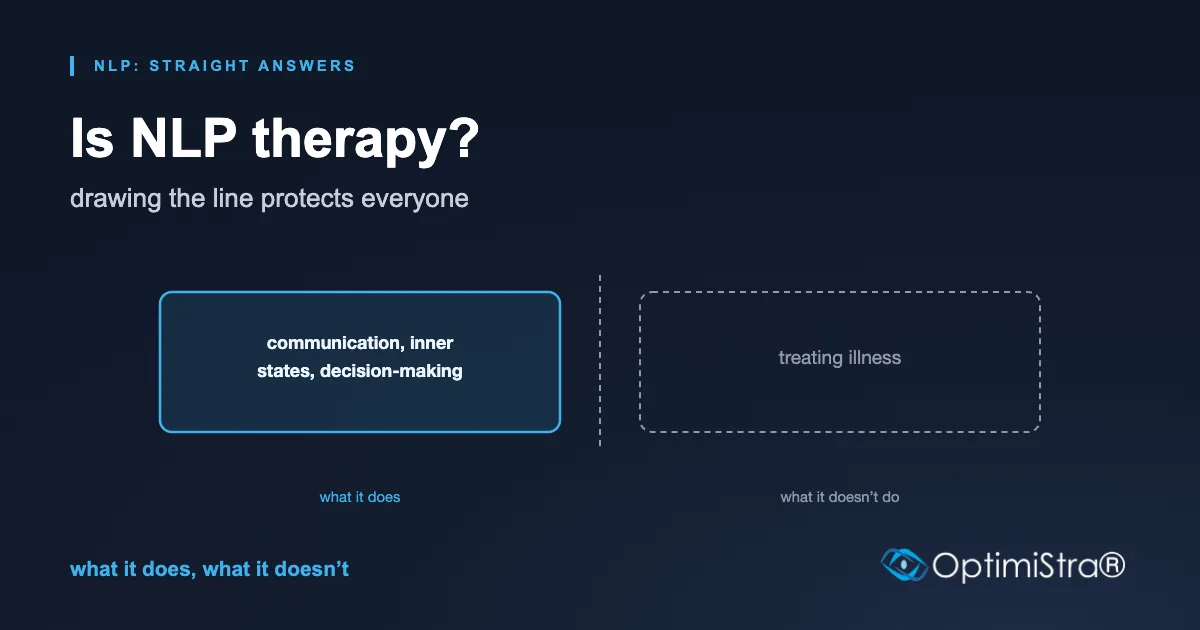
Neuro-Linguistic Programming (NLP) is not therapy and is no substitute for it. It works on communication, inner states and the way you make decisions, in the here and now, with no claim to treat anything. Stating that limit plainly, from the outset, protects people as much as it protects the discipline.
November 18, 2026 · 6 min read