Changing a thought pattern: what if you were never condemned to live with it?

Published November 18, 2026 · 6 min read
Read by an AI-generated voice.
In brief
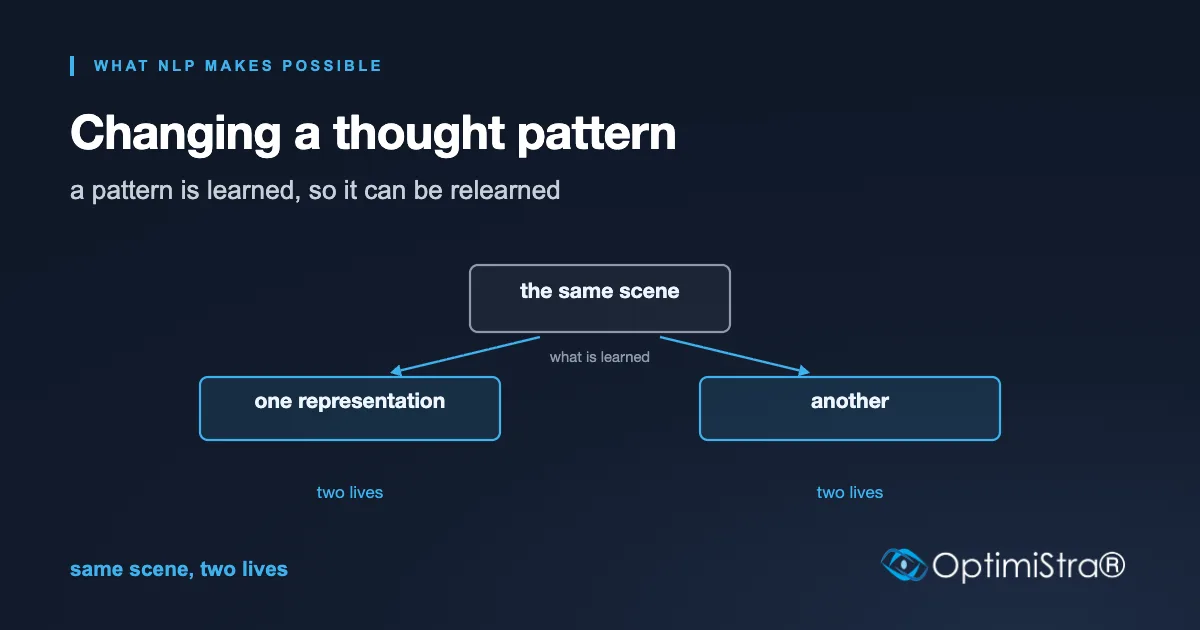
A thought pattern is learned, not inherited: two brothers from the same household can draw opposite conclusions from the same childhood. Because it is learned, it can be relearned, even after decades. An old pattern is no more permanent than a recent one. It is simply better rehearsed, and that is a difference of degree.
Two people live through exactly the same scene. One comes out of it broken, the other stronger. The facts are identical. Everything turned on one thing: the representation each of them formed of it. This article is about that one thing, and about the fact that it is learned and can therefore be relearned. Changing a thought pattern is, at bottom, a matter of learning.
There is a sentence many people repeat to themselves without even noticing: “If you knew where I come from, you’d understand why I am where I am.”
It sounds logical. It even sounds like common sense. The trouble is that it rests on a false idea: that what you are living through today is the direct and inevitable consequence of what happened to you yesterday.
The reality is more unsettling, and far more liberating: what you see of your story is not your story. It is a representation you have built of it. And a representation, unlike a fact, can be changed.
Two brothers, one house, two lives
Take two brothers who grow up in the same family, under the same roof. The family is dysfunctional: communication problems, perhaps even violence. They see the same scenes and hear the same shouting. It is the same childhood. One fails in life. The other succeeds.
Ask the first what explains his failure. He will tell you, sincerely: “If you only knew… our family was so dysfunctional. I had no choice. I was bound to fail.” And he is right: on his own map of the world, it is strictly true.
Now put the same question to his brother. He will say: “You know, my family was so dysfunctional that I had to learn to fight. I had to learn to defend myself against all of it. And that is exactly what gave me the strength and resilience to succeed.”
The house is the same, and so are the facts. The only difference here between a life of failure and a life of success is the representation each brother formed of the situation. A different thought pattern, and nothing else.
Pause for a second on what that implies for you.
“It’s innate, I was just unlucky”: the costliest lie
When we tell this story, one objection almost always comes up, and it is a fair one: “All right, but perhaps the brother who succeeded simply had a better temperament to begin with. Perhaps it’s innate. Perhaps some people are lucky enough to have thought patterns that work, and others unlucky enough to have negative ones.”
This is exactly where everything is decided. Because if you believe that, you have just passed sentence on yourself. You place yourself among the “unlucky” and close the door before you have even tried to open it. And that is not what happens at all.
Thought patterns are not a genetic lottery. They are things we learn. The two brothers did not inherit two different brains. Each learned differently, from everything life put in front of him. This is what Eric Kandel spent 40 years establishing: learning leaves a physical trace, and that trace can be modified. One brother learned “I am a victim.” The other learned “I am a fighter.” Two pieces of learning, built scene after scene, year after year.
And anything that is learned can be relearned. Schwabe, Nader and Pruessner have described the mechanism that makes this possible: a memory that is recalled becomes modifiable again before it is stabilized once more.
A pattern can be relearned (even after years)
This is where the story stops being a neat moral and becomes a practical lever.
If your thought patterns were innate, set in stone, there would be nothing to do but put up with them. But since they are learned, they obey the same rule as any other learning: they can be changed, or replaced altogether. Even when you have carried them for years and years.
You can see it happen spontaneously in life. Some people one day experience this kind of shift, an epiphany. Often it comes with the birth of a child: all at once, a whole section of the patterns they run on collapses and is rebuilt differently. Overnight, what seemed set in stone turns out to be changeable.
The proof is in front of us: if a pattern can change in an instant because of an outside event, then there was never anything permanent about it. So the question is not “Can my patterns change?” They can. The real question is: are you going to leave that change to chance, to an event you don’t control?
Stop waiting for life to decide for you
This is the heart of it. Most people wait. They wait for the epiphany or the turning point, for an event that will overturn everything. Sometimes it comes. More often it never does, and they spend a whole life carrying a pattern they learned at the age of six.
The principle is simple: stop leaving these things to chance. Not all methods are equal: Webb, Miles and Sheeran show that working on how you represent a situation has an effect, where forbidding yourself to feel does not. Since these patterns are the result of learning, they can be worked on deliberately and methodically, without waiting for a tragedy or a joy to do it for you.
This is the most important inner shift there is: moving from “This is who I am, that’s just how it is” to “This is what I learned to believe, and I can learn something else.”
It is not a change of personality. It is taking back the controls.
If you are the down-to-earth type
If part of you finds all this too good to be true, that is healthy. Hold on to that instinct.
And look coolly at the mechanism: a thought pattern is nothing more than a route your brain has taken so many times that it has become a motorway. The “victim” brother and the “fighter” brother each reinforced his route by taking it again and again. This is neither magic nor positive thinking: it is learning, in the most literal sense of the word.
And what is built by repetition can be taken apart by method. Driemeyer and colleagues measured this remodeling of gray matter in adults, after only a few days. Nobody is asking you to believe that you are the brother who succeeded. We are showing you that the line between the two is not drawn at birth. It is drawn by learning, and so it is a line that moves.
Further reading
If what you have just read rings true, you can read on with how success is built, why Neuro-Linguistic Programming (NLP) speaks of “programming”, how long a habit takes to form and managing your inner state.
And if you would rather work on your own patterns deliberately than wait for chance to do it, that is part of what you learn on the NLP Practitioner course.
Article designed and written by Michel Wozniak, and optimized by artificial intelligence. Illustration created by artificial intelligence.
Sources
- Schwabe, Nader & Pruessner (2014), Reconsolidation of Human Memory: Brain Mechanisms and Clinical Relevance, Biological Psychiatry
- Kandel (2009), The Biology of Memory: A Forty-Year Perspective, The Journal of Neuroscience
- Driemeyer, Boyke, Gaser, Büchel & May (2008), Changes in Gray Matter Induced by Learning — Revisited, PLoS ONE
- Webb, Miles & Sheeran (2012), Dealing with feeling: A meta-analysis of the effectiveness of strategies derived from the process model of emotion regulation, Psychological Bulletin
Frequently asked questions
Can you really change a thought pattern you’ve had since childhood?
Yes. An old pattern is no more “permanent” than a recent one. It is simply better rehearsed. Because it is something you learned, it can still be changed, even after decades. Time strengthens the habit; it does not make it irreversible.
Are thought patterns innate or learned?
Learned. Two people who live through the same situation can draw opposite patterns from it, which would be impossible if this were wiring you are born with. The way you represent an event is learned. It is not handed down.
What’s the difference between changing a thought pattern and positive thinking?
Positive thinking means forcing yourself to look on the bright side. Changing a pattern works further upstream, on the representation itself: on how the event is encoded and told on the inside. It is not a constant effort of will. It is relearning.
Do you have to wait for a turning point before you can change?
No, and that is precisely the trap. Turning points do happen, but letting one decide for you amounts to handing your life over to chance. A pattern can be worked on deliberately, without waiting for an outside event to do it.
Do you have to go back over the past to change a thought pattern?
Not necessarily. What keeps a pattern going today is the way the episode is encoded and told now, not the episode itself. So the work is on the present representation, which explains why an old memory can change its effect without anyone digging into it.
What NLP Makes Possible
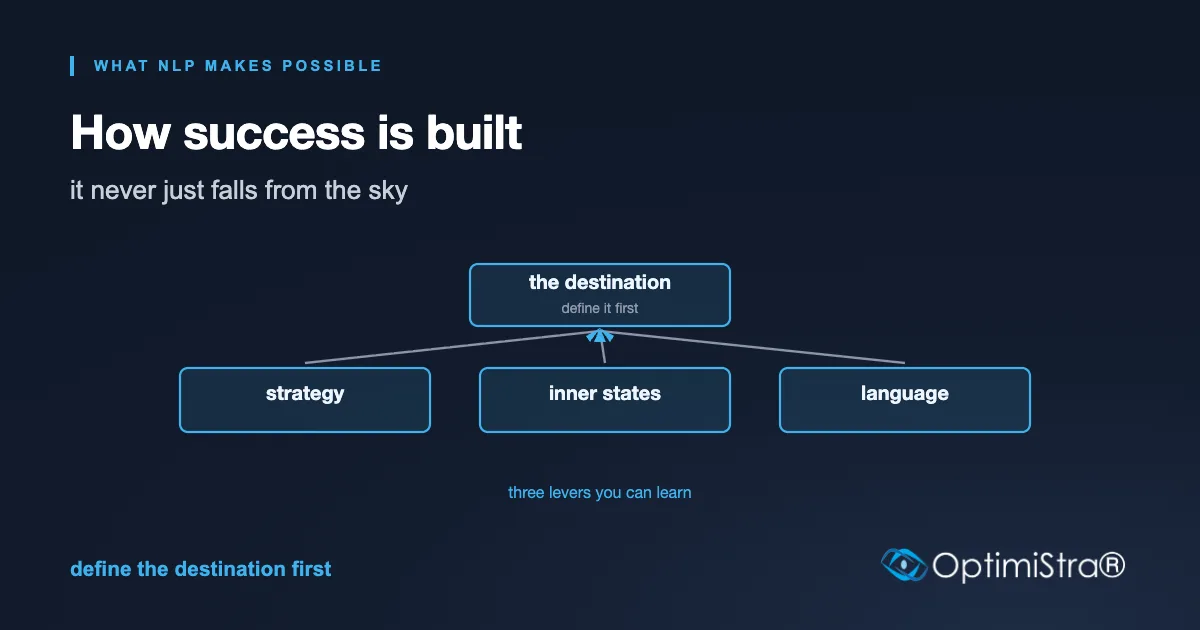
How success is built (and why it never just happens)
Success starts with knowing what the word means to you, a step that is almost always skipped. After that comes the assembly, and it can be learned: a strategy that holds up when the unexpected happens, inner states you can return to at will and language that builds rather than tears down.
November 18, 2026 · 4 min read
What NLP Makes Possible
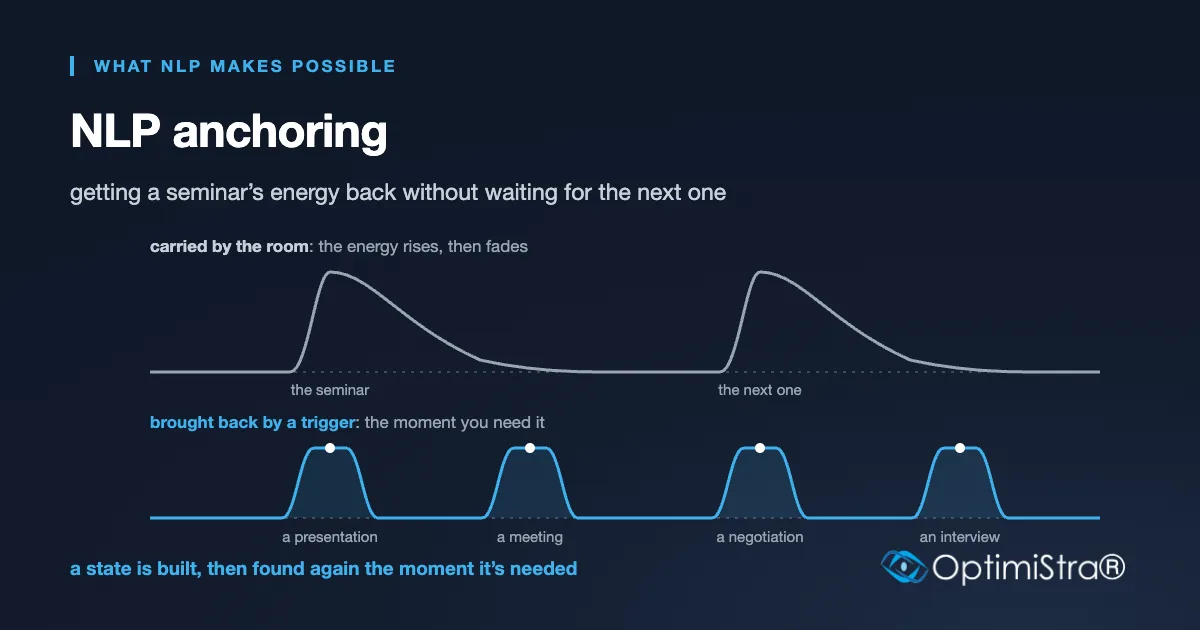
After a motivational seminar, the energy fades: what NLP anchoring changes
A motivational seminar produces real energy, and it often fades within a few weeks because it stays attached to the room. Elite athletes learn to bring back the state they need on their own, with a chosen trigger such as Florent Manaudou’s word “puissance.” NLP calls this an anchor, and it can be learned.
November 18, 2026 · 14 min read

What NLP Makes Possible
NLP and adult learning: what a study measured in 173 adult learners
In 2012, a study in England randomly assigned 24 trainers of adults to three groups. Learners whose trainer had taken 4 days of Neuro-Linguistic Programming (NLP) on top of a course in andragogy improved by 18.35 points, compared with 10.97 when the trainer had taken andragogy alone. Research on expectations, relationships, and stress helps explain the gap.
November 18, 2026 · 15 min read