Rumination and inner dialogue: what your beliefs about your emotions change

Published November 18, 2026 · 14 min read
In brief
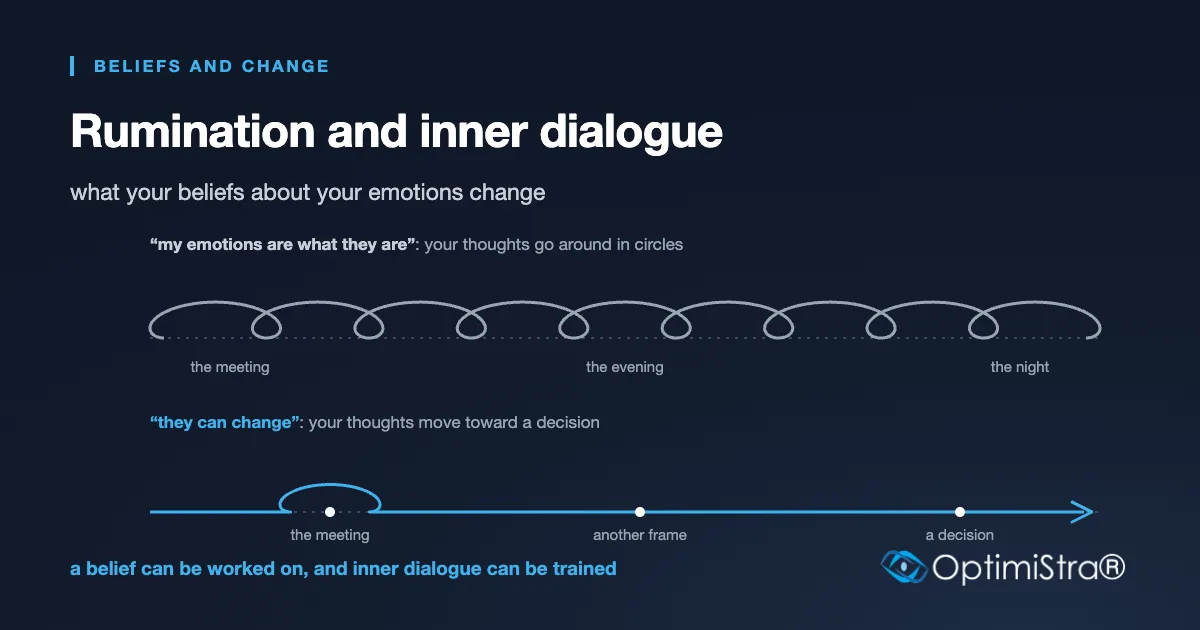
Rumination, the inner dialogue that replays what went wrong on a loop, leaves you tired and costs you sleep and effectiveness at work. A Yale study of 3,282 professionals suggests it depends in part on one belief: that your emotions can change. That belief can be worked on, and inner dialogue can be trained.
There are evenings when an afternoon meeting sits down at the dinner table with you. You replay the sentence that slipped out, you look for the one you should have said, and the conversation starts up again just as you’re falling asleep. I know that moment too: at bedtime, I sometimes have an inner dialogue that won’t be quiet.
We all talk to ourselves. Most of the time, this inner dialogue serves us: it prepares a sentence, reminds us of an instruction, encourages us before an effort. Sometimes it also goes around in a loop on what went wrong, and produces nothing except fatigue. Psychology calls this rumination.
Why do some people leave that loop sooner than others? A study conducted at Yale, released as a preprint in September 2026, offers an unexpected answer: part of the difference lies in what you believe about your own emotions. I suggest we cover the ground in six steps:
- ruminating and reflecting, two ways of thinking about a problem;
- what rumination costs, at work and outside it;
- what you believe about your emotions;
- a belief can change, and inner dialogue can be trained;
- what Neuro-Linguistic Programming (NLP) brings to it;
- how to learn it.
1. Ruminating or reflecting: two ways of thinking about a problem
Ruminating, in the sense psychology studies it, means going back again and again over what is wrong, its causes, and its consequences, without taking action (Nolen-Hoeksema, Wisco, and Lyubomirsky, 2008).
Thinking about work in the evening is not a problem in itself. A study of 719 employees in a range of occupations distinguishes two ways of returning to it (Querstret and Cropley, 2012). The first goes back over what the day made you feel, the irritation or the worry. The researchers call it affective rumination, and it was the strongest predictor of work-related fatigue, both the fatigue of the day and the kind that settles in. The second consists of thinking about how to solve a problem, and it went, by contrast, with less fatigue.
So what matters is the direction the thought takes. Reflection moves toward a decision. Rumination returns to its starting point, and begins again.
2. What rumination costs, at work and outside it
At work
Rumination is hard to see, because the person is there. They attend the meeting, they answer their messages, and part of their attention has stayed with yesterday’s conversation. The research review by Susan Nolen-Hoeksema and her colleagues describes what this costs: rumination strengthens negative thinking, gets in the way of problem solving, and holds back action (Nolen-Hoeksema et al., 2008).
A study of 458 employees in the Tokyo area followed that path all the way to the work itself. People who ruminated more reported more cognitive difficulties, with concentration and memory in particular, and more presenteeism, meaning work that suffers while you are present. These two difficulties explained part of the link between rumination and lower well-being (Toyoshima et al., 2021).
Presenteeism has a cost that absence records don’t show. In Switzerland, the Job Stress Index estimates the lost economic potential at CHF 6.5 billion a year; of the productivity losses, about CHF 2 billion, 77% come from presenteeism (Promotion Santé Suisse, 2022). That figure covers workplace stress as a whole, and rumination is only one of its routes.
Outside work
In the evening, rumination comes home with us. In the study of 719 employees, sleep quality explained part of the link between affective rumination and fatigue (Querstret and Cropley, 2012). Conversely, a meta-analysis covering more than 38,000 employees shows that detaching from work once the day is over goes with less exhaustion, better sleep, and more satisfaction with life (Wendsche and Lohmann-Haislah, 2017). We have written an article on the last 10 minutes before sleep, which matter a great deal here.
The body follows. A meta-analysis of 60 studies measured what happens while people ruminate about the past or worry about the future: higher blood pressure and heart rate, more cortisol, lower heart rate variability (Ottaviani et al., 2016). The body stays mobilized for an event that is no longer happening. Rumination also wears down the support we receive from the people around us, and, over time, it is associated with depression and anxiety (Nolen-Hoeksema et al., 2008).
All these costs have one thing in common: they play out after the event, in what we do with it. That is where we can do something. What remains is to understand why some people detach more easily than others.
3. What you believe about your emotions
Before you read on, answer one question for yourself. In your view, can your emotions change when you work at it? Or are they what they are, leaving you only to live with them?
Most of us have never thought about it, and have an answer all the same. Researchers speak of implicit beliefs about emotions: some people see them as fixed, others as malleable. One team followed students through their first year of college. Even before the year began, those who saw their emotions as fixed felt less able to regulate them, and made less use of reappraisal, which consists of looking at a situation from another angle to change its effect. By the end of the year, they were doing less well, had more depressive symptoms, and had settled in less well socially (Tamir et al., 2007). Another study adds that the belief about your own emotions is the one that counts most, more than the belief about emotions in general (De Castella et al., 2013).
What the Yale study shows
The study I mentioned at the start carries the question into the workplace. Peihao Luo, James Floman, Marc Brackett, and Annette Ponnock, of the Yale Center for Emotional Intelligence, surveyed 3,282 education professionals in the United States, from kindergarten through high school, in two national studies. The profession was chosen for its emotional load: all day long, you manage your own emotions and other people’s.
In the first study, people who saw their emotions as malleable used reappraisal more at the next measurement, ruminated less, disengaged less, and were doing better at work: less emotional exhaustion and more job satisfaction, after accounting for where they started. Among the strategies studied, lower rumination was the one that most clearly explained this link, because rumination prevents recovery after work. The second study finds the same pattern (Luo et al., 2026).
It adds a nuance that particularly interests me. The belief helped more for people who also knew, in practice, how to manage their emotions, which the researchers measured with a test. The authors sum it up in two words, will and skill. Believing that your emotions can change gives you the desire to attend to them, and knowing how to go about it lets you do so.
This study is a preprint: it has not yet been reviewed by other researchers, and it is under review at a journal. It shows that the belief predicts what follows, without proving on its own that the belief is the cause. It is nonetheless consistent with nearly 20 years of work on the subject (Ford and Gross, 2019).
The loop that closes on itself
In 2011, after a burnout, I could no longer manage the slightest emotion. Among the beliefs people then tried to impose on me was this one: “You’ll never be able to manage your stress again.” In the book I wrote afterward, I noted that a common belief these days holds that we cannot change, and that if we are negative, it is simply encoded in us.
This is how the loop closes. If my emotions are what they are, why try? I don’t try, the loop continues, and it confirms what I believed. The belief feeds the inner dialogue, and the inner dialogue feeds the belief.
4. A belief can change, and inner dialogue can be trained
If these beliefs were set in stone, the story would end there. One team recruited 86 older adolescents, chosen from the half who believed least in the malleability of their emotions, then randomly assigned them to an online intervention or a control group. The belief of those who received the intervention grew stronger, and the change still held a month later. Above all, the belief measured at one point predicted the use of reappraisal at the next point, and not the other way around: changing the belief changed the way of coping (Guo et al., 2025).
Inner dialogue, meanwhile, can be trained. In sports, a meta-analysis of 32 studies shows that talking to yourself in a chosen way improves performance, with a moderate effect. When athletes had been trained to do it, the effect was about twice as large as without training, and it held for beginners and experienced athletes alike (Hatzigeorgiadis et al., 2011).
The choice of words matters down to the smallest ones. Before speaking in public, people who talked to themselves using their own first name, or in the second person, rather than saying “I,” were rated as performing better by outside observers. They were less stressed, and they went back over their performance less once the speech was finished (Kross et al., 2014).
These results trace a path. A belief can move, and inner dialogue is learned the way an athletic movement is learned, through training.
5. What NLP brings to it
NLP is interested in the way we represent things to ourselves: an image, a sound, an inner voice each have a form, and that form largely decides the effect they have on us. The techniques we teach work on that form.
Changing the way the voice speaks
Try this. Think of a sentence your inner dialogue repeats to you when something goes wrong. Listen to it: which direction does it come from, at what volume, in what tone, at what speed? Now have it say exactly the same thing in the voice of a cartoon character, Mickey Mouse or Sylvester the Cat. Then ask yourself, from 0 to 10, how much you still believe it.
If the sentence has lost some of its weight while its words have not changed, you have just altered what NLP calls a submodality: one of the characteristics of an inner representation, such as the volume of a voice, its distance, or its tone. In our courses, we also learn to turn down the volume of a conversation replayed on a loop, as if with a remote control, or to switch it from stereo to mono. You already know how to do this, as it happens: in a noisy restaurant, you isolate the conversation that interests you and you fade out the rest.
Richard Bandler, co-creator of Neuro-Linguistic Programming, suggests an even simpler move when an inner dialogue keeps coming back: tell it, inwardly and firmly, to be quiet, as you would tell someone who talks too much. Then give it something to say next. To “you’ll never manage it,” you can add “and what does it cost me to try?” Few of us would let anyone else talk to us the way we talk to ourselves.
Reframing what the voice says
On the highway, drivers sometimes flash their headlights at me because I haven’t moved back over quickly enough. For a long time, I took it as a lack of respect. I got into the habit of telling myself, “For all I know, he has a medical emergency.” The sentence came to me after I had driven for an emergency myself one day, and found it hard when people didn’t let me through. I never know whether it’s true, and that is beside the point: the sentence keeps me from going back over the scene.
We teach this move under the name of reframing: keep the facts, and change the frame through which you look at them. It is close to what research calls reappraisal, the very strategy that people convinced they can change their emotions use more. The studies on saying “you” connect with another tool we teach, perceptual positions: looking at yourself from the outside, as an observer, to regain some distance from what you are living through.
Changing the belief itself
These techniques act on the voice. They don’t last if the belief that feeds it stays in place. We put it this way in our courses: a stress management technique doesn’t hold if the inner dialogue keeps undermining, in parallel, what has been built. Many people who try a technique found online on their own see its effect in the moment, then watch it fade after a few minutes.
That is why NLP also works at the level of beliefs. We teach a pyramid with four levels: environment, strategies, beliefs, and values. A skill contradicted by a belief located higher up doesn’t hold for long. The belief change technique we teach has one distinctive feature: it doesn’t ask you to say out loud what you believe. It works on the form the belief takes in your mind, and relies on a piece of evidence each of us carries: as children, we all believed things we no longer believe. What it brings is that a belief that was limiting you stops feeling self-evident, and the one you choose gains the solidity of a certainty.
This is what links the athlete and the person coming home from work. The belief decides what you tell yourself, what you tell yourself decides the state in which you approach what comes next, and that state largely decides what you manage to do, on a track or in a meeting.
6. Learning to do it with us
Nathalie de Marcé and I are the world’s first two French-speaking Master Trainers named by Richard Bandler himself, and we teach with a team of trainers and assistants. Over several years, we had our course validated by more than 20 brain and health professionals, including PhDs in neuroscience, biology, and biophysics, physicians, and psychologists, reworking it with them until it agreed with what they know.
The NLP Practitioner course, eight days in person
The NLP Practitioner course runs over eight days, in Switzerland, in a group. Inner dialogue, submodalities, reframing, perceptual positions, and belief change are all on the program. You practice them on yourself first, then with others, while assistants who are NLP Master Practitioners move between the groups to supervise the exercises. Scheduled sessions are taught in French, and the course is given in English on request.
- The certificate is signed by Richard Bandler himself.
- After the course, twelve live group sessions on Zoom, one hour a month for a year.
- A WhatsApp group, where the trainers and assistants stay for at least a year.
- The OptimiStra® Platform: practice apps, one for each skill worked on in the course, on your phone or your computer, with nothing to install. Among other things, they let you turn down the intensity of what weighs on you and turn up the intensity of what serves you, and practice the wording that helps a limiting belief evolve.
- Admission starts with a 30-minute admission call on Zoom, to check together that the timing and the format suit you.
When it’s not the right time
The course asks for real commitment: you work on yourself, and you will be led to question yourself. It is not therapy, and it does not replace therapy. If thoughts going around in a loop have come, for several weeks, with a persistently low mood or badly disturbed nights, talk to your doctor first. And if you are going through a truly difficult period, this is not the right time for a course: we will be glad to welcome you later. We bring the method, the practice, and the support; the results come from practice, and everything is built around it.
Keep reading
To go further: changing a thought pattern, taking back control of your states and reactions, and what NLP anchoring changes after a motivational seminar.
And if you would rather follow a thread than pick at random, our complete path to understanding NLP puts our articles in order.
Article designed and written by Michel Wozniak, and optimized by artificial intelligence.
Sources
- Luo, Floman, Brackett et Ponnock (2026), Emotion Mindsets at Work: Emotion Malleability Beliefs, Emotion Regulation, and Employee Well-Being in Two National Studies, prépublication PsyArXiv, non encore relue par les pairs
- Tamir, John, Srivastava et Gross (2007), Implicit theories of emotion: Affective and social outcomes across a major life transition, Journal of Personality and Social Psychology
- De Castella, Goldin, Jazaieri, Ziv, Dweck et Gross (2013), Beliefs About Emotion: Links to Emotion Regulation, Well-Being, and Psychological Distress, Basic and Applied Social Psychology
- Ford et Gross (2019), Why Beliefs About Emotion Matter: An Emotion-Regulation Perspective, Current Directions in Psychological Science
- Guo, Yang, Lipp et Zhang (2025), Emotion malleability beliefs prompt cognitive reappraisal: evidence from an online longitudinal intervention for adolescents, Cognition and Emotion
- Nolen-Hoeksema, Wisco et Lyubomirsky (2008), Rethinking Rumination, Perspectives on Psychological Science
- Querstret et Cropley (2012), Exploring the relationship between work-related rumination, sleep quality, and work-related fatigue, Journal of Occupational Health Psychology
- Toyoshima et al. (2021), Subjective cognitive impairment and presenteeism mediate the associations of rumination with subjective well-being and ill-being in Japanese adult workers from the community, BioPsychoSocial Medicine
- Promotion Santé Suisse (2022), Job Stress Index 2022, feuille d'information 72 (in French)
- Wendsche et Lohmann-Haislah (2017), A Meta-Analysis on Antecedents and Outcomes of Detachment from Work, Frontiers in Psychology
- Ottaviani et al. (2016), Physiological concomitants of perseverative cognition: A systematic review and meta-analysis, Psychological Bulletin
- Hatzigeorgiadis, Zourbanos, Galanis et Theodorakis (2011), Self-Talk and Sports Performance: A Meta-Analysis, Perspectives on Psychological Science
- Kross et al. (2014), Self-talk as a regulatory mechanism: How you do it matters, Journal of Personality and Social Psychology
Frequently asked questions
What is the difference between reflecting and ruminating?
Reflecting moves toward a decision or a solution. Ruminating keeps returning to what is wrong, its causes, and its consequences, without taking action. In a study of 719 employees, thinking about work in order to solve a problem went with less fatigue, while going back over what the day had made them feel was the strongest predictor of work-related fatigue (Querstret and Cropley, 2012).
Does self-talk really improve performance?
In sports, a meta-analysis of 32 studies shows a moderate effect on performance, about twice as large when athletes had been trained to talk to themselves this way (Hatzigeorgiadis et al., 2011). The choice of words matters too: before speaking in public, talking to yourself using your first name or in the second person, rather than saying “I,” improved the performance as rated by observers and reduced stress (Kross et al., 2014).
Can you change what you believe about your emotions?
Yes, and the change can last. In a trial with 86 young people who believed little in the malleability of their emotions, an online intervention strengthened that belief, and the change still held a month later; the belief then predicted more frequent use of reappraisal (Guo et al., 2025). Neuro-Linguistic Programming (NLP) teaches a belief change technique that works on the form the belief takes in the mind, without asking you to say it out loud.
How does NLP work with inner dialogue?
Neuro-Linguistic Programming (NLP) works on the form of inner dialogue as much as on its content: changing the volume, tone, or distance of a voice that repeats a sentence can change the effect it has. It also teaches you to reframe what the voice says, to gain distance by looking at yourself from the outside, and to help the beliefs that feed this dialogue evolve. You practice these techniques on yourself first, then with others.
When should I talk to a doctor about rumination?
Ruminating from time to time is common. If thoughts going around in a loop have come, for several weeks, with a persistently low mood, badly disturbed nights, or difficulty coping with daily life, talk to your doctor first. Over time, rumination is associated with depression and anxiety (Nolen-Hoeksema et al., 2008). A course is not therapy, and it does not replace it.
Understanding NLP
What is NLP? (And why it isn’t what you think)
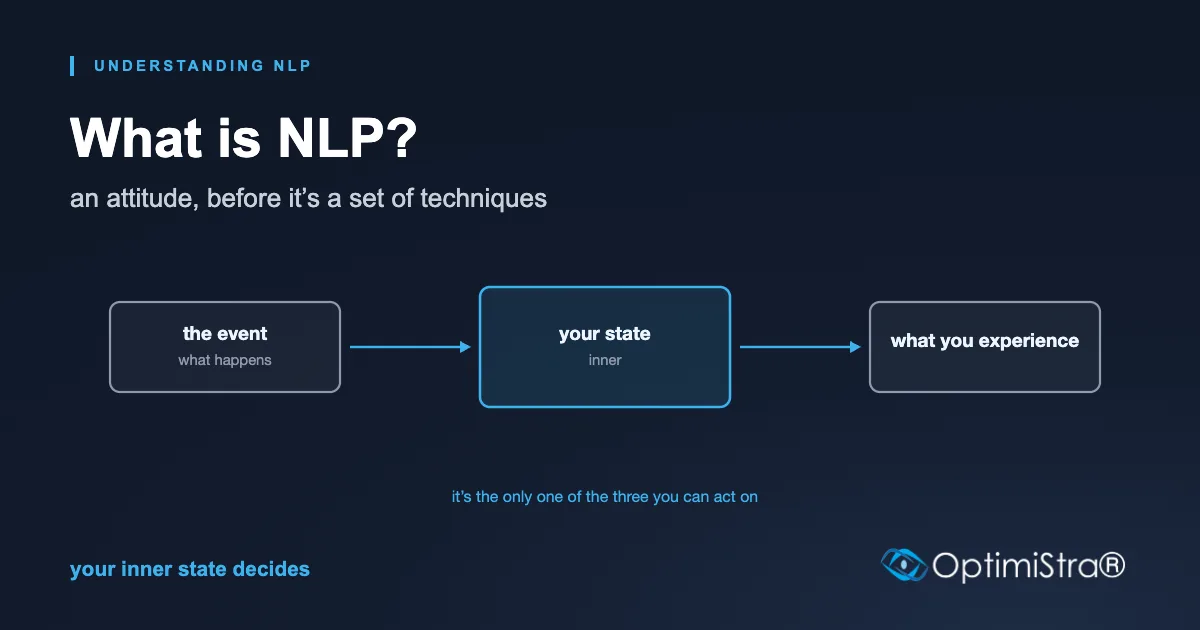
Neuro-Linguistic Programming (NLP) is passed on as an attitude, not as a catalog of techniques. It teaches you to notice the inner dialogue that runs all day, to recognize the automatic responses it sets up and to take charge of your inner state rather than being at its mercy day after day.
November 18, 2026 · 5 min read
Beliefs and Change
Optical illusions: what your brain still sees, even when you know better
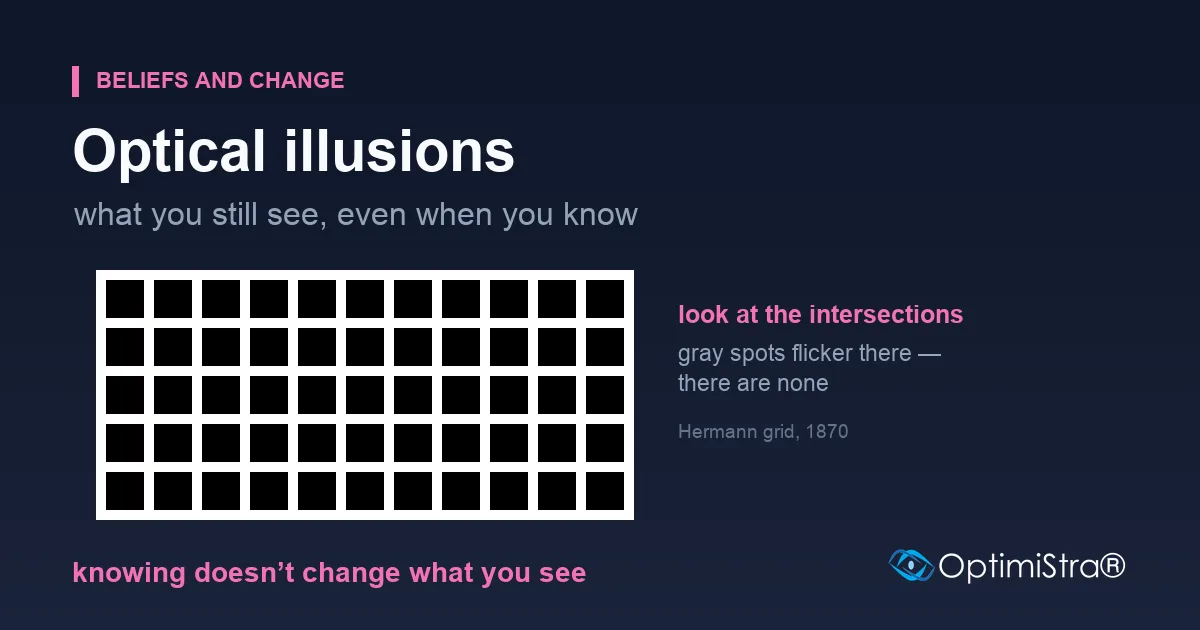
An optical illusion isn’t a malfunction: it is the brain interpreting what it sees, correcting for shadows or filling in what’s missing. The most striking part is that the illusion holds even once you know how it works. Three famous illusions show this, and research explains why.
November 18, 2026 · 8 min read
Beliefs and Change
The invisible gorilla: what the brain sees, and what it adds
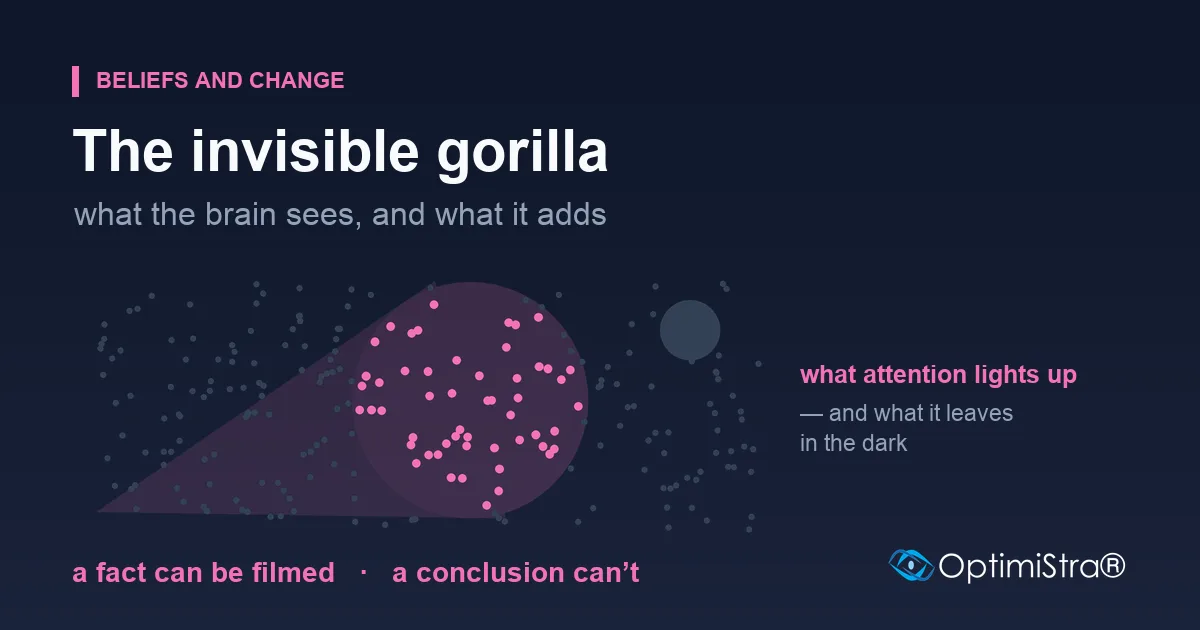
Attention works like a flashlight: it lights one spot at a time, and you can miss a gorilla while looking straight at it. Whatever it does light, the brain fills in with interpretations it never announces. You can observe both in yourself in a few minutes.
November 18, 2026 · 6 min read