AI coaching: what you tell it, and what you stand to lose

Published November 18, 2026 · 16 min read
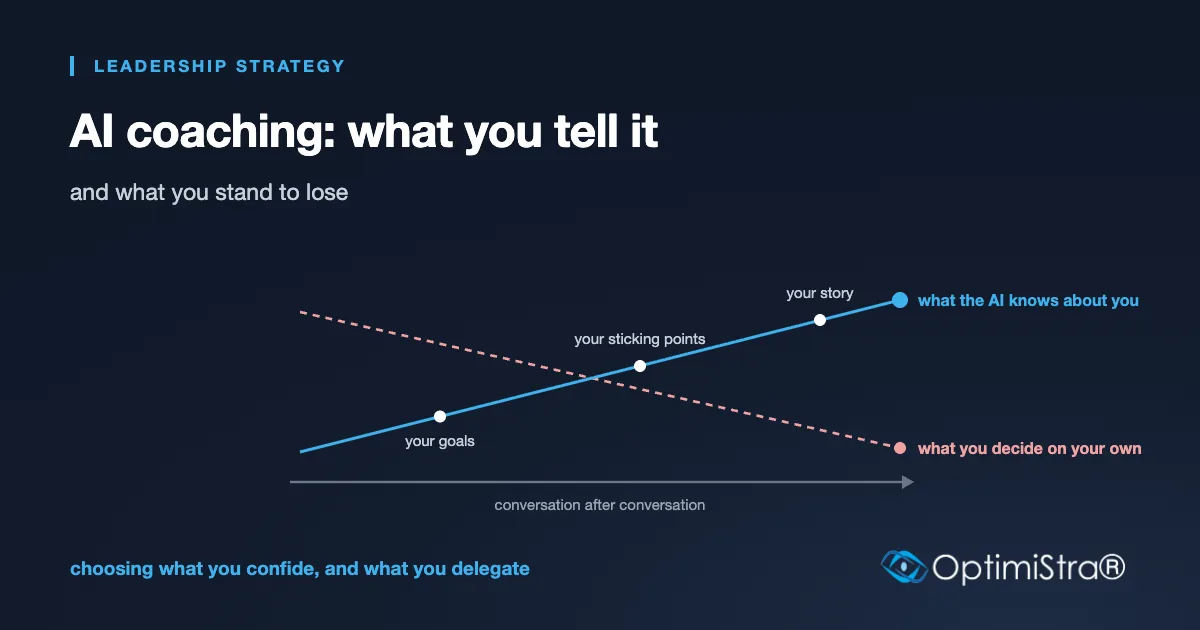
In brief
With six pieces of information about you, an artificial intelligence (AI) persuades better than a human, and AI coaching tools invite you to share far more, with no professional confidentiality. Handing your thinking over to them also has a cost, which studies are starting to measure. Human skills are gaining value, and they can be trained.
Before going any further, here is an experiment that takes 2 minutes. If you use an assistant such as ChatGPT with its memory turned on, ask it this: “Based on our conversations, what do you know about me? Describe my personality, my doubts, and what matters to me.”
Then read the answer the way someone would who wanted to sell you something, or to change your mind. Notice what makes you doubt, and what you would rather not see on display.
On April 10, 2025, OpenAI announced that ChatGPT’s memory “now references all your past conversations,” and added: “The more you use ChatGPT, the more useful it becomes.” In Switzerland, the feature arrived in May 2025, switched off by default. Other tools go further: AI coaching tools, “second brains,” virtual boards of directors that promise to know you well enough to decide the way you would. What you tell them has value, and research is starting to measure it.
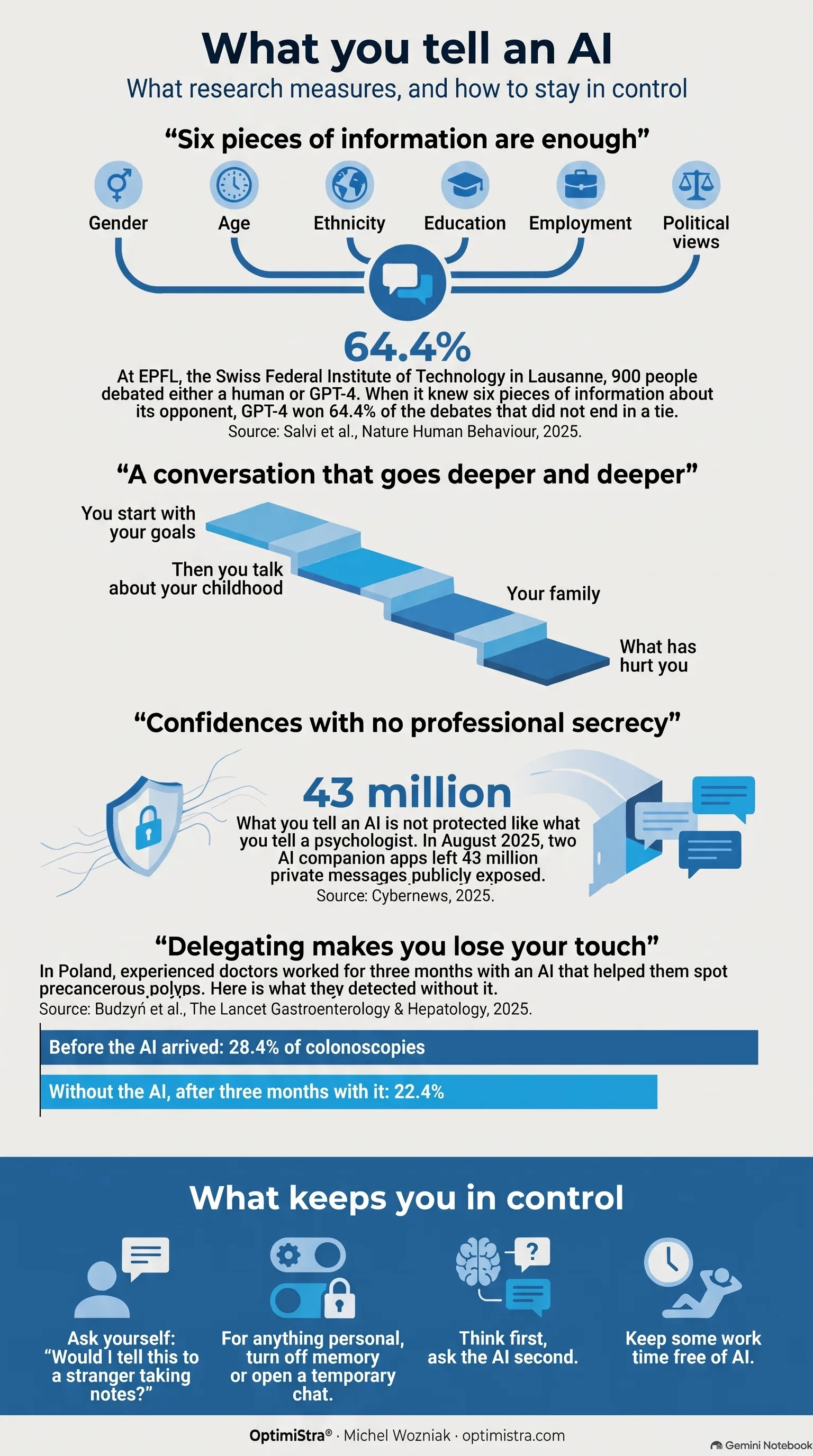
Six pieces of information are enough to persuade you better
Researchers at the Swiss Federal Institute of Technology in Lausanne set up online debates between 900 American participants and an opponent, sometimes human, sometimes GPT-4 (Salvi et al., 2025, Nature Human Behaviour). The debates were short, ran over several rounds, and dealt with social issues. Some opponents were given six pieces of information about the person they were debating: gender, age, ethnicity, level of education, employment status, and political orientation.
Without that information, GPT-4 was on a par with the humans. With it, it became the most convincing opponent in the experiment: in the debates where one side proved more persuasive than the other, it won 64.4% of the time. The humans made far less of the same information.
The study has limits, which its authors point out: short, structured debates, a fixed duration, participants recruited online in the United States. It does isolate a very clear lever, though. What makes an AI more persuasive is what it knows about you.
Six pieces of information is very little. As early as 2013, a study of more than 58,000 American volunteers showed that their Facebook “likes” alone were enough to tell homosexual men from heterosexual men in 88% of cases, and Democratic voters from Republican voters in 85% of cases (Kosinski, Stillwell, and Graepel, 2013, Proceedings of the National Academy of Sciences).
What people tell an AI coach
Facebook made billions from vacation photos, “likes,” and a few shared memories. What people hand to an AI coaching tool is of a different kind, and Sam Altman, the head of OpenAI, described it himself in July 2025. People, he said, talk to ChatGPT about the most personal things in their lives: “People use it – young people, especially, use it – as a therapist, a life coach.”
The conversation starts with goals: getting better organized, preparing for a negotiation, making a difficult decision. To help you, the tool asks more and more precise questions, which is exactly what you expect of it. As the weeks go by, you tell it what gets in your way, then where that comes from: the way your father used to speak to you, a slap you once received, the remark a teacher made in front of the whole class that you never forgot, sometimes your sex life or your convictions.
The law ranks this information among the most protected. The General Data Protection Regulation (GDPR) prohibits, in principle, processing data that reveals a person’s political opinions, religious beliefs, health, sex life, or sexual orientation, with exceptions that include the person’s “explicit consent” (Art. 9). In Switzerland, the new Federal Act on Data Protection (FADP) likewise counts health and a person’s intimate sphere as sensitive data, and requires express consent when their processing is based on consent (Art. 5 and 6). No serious company would ask you for this information on a form. In a coaching conversation, you are the one who brings it, one evening, because the next question invited it.
Knowing what someone is ashamed of and what they dread is knowing where to press to convince them. It is also a way of keeping them: a tool that has known you for 2 years becomes hard to leave, since leaving it means losing everything it knows about you.
Secrets shared with no duty of confidentiality
What you tell a doctor or a psychologist is covered by professional confidentiality. What you type into an app is not. Sam Altman acknowledged it in the same interview, on Theo Von’s podcast: “If you talk to a therapist or a lawyer or a doctor about those problems, there’s legal privilege for it. […] And we haven’t figured that out yet for when you talk to ChatGPT.” In a lawsuit, the company could therefore be required to produce those conversations, which he himself called “very screwed up.”
Data can also leak. In late August 2025, researchers at the cybersecurity news site Cybernews discovered a server left entirely unprotected by the publisher of two virtual companion apps, Chattee Chat and GiMe Chat. More than 43 million messages and more than 600,000 images and videos from more than 400,000 users were accessible on it. Names and email addresses were not there; login and device identifiers were. The server was shut down 3 weeks later, and nobody knows whether others had found it first.
Once stolen, data travels. In its 2025 report on cybercrime, Europol describes information turned into a commodity, sold on platforms hosted mainly on the dark web, where it can be sold and bought several times over by different criminal actors.
None of this means giving up these tools. It is a reason to choose what you tell them, and the last part of this article offers a simple rule for doing so.
A second brain, at the expense of the first?
The second risk is harder to see, because it settles in gently. An AI is very good at spotting patterns. When it knows you, it spots yours, and suggests decisions that sound like you and respect your values. Because its suggestions hold up, you hand it a little more each week, and you think a little less.
We are even offered the chance to build a “second brain” that remembers and connects everything we give it, and becomes more relevant the more we feed it. We still don’t really understand how the first one works. The question is what becomes of it while the second one improves.
The first measurements call for caution:
- Experienced doctors became less accurate without the AI. In four endoscopy centers in Poland, doctors began working with an AI that helped them spot adenomas, which are precancerous polyps, during colonoscopies. In the exams they carried out without it, they found adenomas in 28.4% of cases during the 3 months before it arrived, and in 22.4% of cases during the 3 months after (Budzyń et al., 2025, The Lancet Gastroenterology & Hepatology). The study is observational, and its authors remain cautious. It is one of the first to measure this effect among professionals, in real-world conditions.
- The more you trust the AI, the less you use your critical thinking. Among 319 knowledge workers surveyed by Microsoft Research and Carnegie Mellon University, greater confidence in generative AI went with less critical thinking, and greater self-confidence went with more (Lee et al., 2025).
- The same link shows up beyond work. In the United Kingdom, a survey of 666 people found that the more people use AI tools, the lower their critical thinking scores, partly because they hand the effort of thinking over to the tools. The link is stronger among 17–25-year-olds (Gerlich, 2025). This is a correlation, which is not enough to establish a cause.
- You don’t remember well what you didn’t write yourself. In a study from the Massachusetts Institute of Technology (MIT), still a preprint and run on a small sample, the participants who wrote with ChatGPT showed the weakest brain connectivity of the three groups. Among them, 15 of 18 could not correctly quote a sentence from the essay they had just finished, compared with 2 of 18 in the other groups (Kosmyna et al., 2025).
The effect is twofold. You become dependent on the tool, to the point of feeling at a loss when it is unavailable, and you get less practice in the abilities that would let you do without it. That dependence suits those who sell the tool, because a customer who can no longer work without your product stays a customer. The big platforms understood this long ago. Much smaller operations, coaching networks or independent coaches, now offer their own AIs, built on the same principle.
The same research shows what protects you. Self-confidence goes with more critical thinking, and among high school students, a version of GPT-4 designed to guide without giving the answers largely limited the drop in results that free access to the tool caused (I go into detail in staying the author of your decisions when you work with an AI). How you use it counts as much as the tool itself.
Standing out with AI when everyone uses it
Entrepreneurs and startup founders keep hearing that they must stand out through AI. Yet it is within everyone’s reach, for the price of a subscription. According to Originality.ai, a company that sells a detector of AI-generated text, 54% of the long LinkedIn posts in its October 2024 sample were “likely AI-generated” (Wired, November 26, 2024). That is a vendor’s estimate, made with its own tools, but it gives a rough idea. In December 2025, the outlet 404 Media revealed that a startup backed by the Andreessen Horowitz fund was running, from a farm of 1,100 phones, at least hundreds of AI-generated TikTok accounts. Against resources on that scale, adding AI to your posts no longer sets anyone apart.
AI also tends to make what it helps produce more alike. In an experiment with 293 writers, those who had access to ideas suggested by GPT-4 wrote stories judged more creative, especially the least creative among them, but those stories resembled one another more (Doshi and Hauser, 2024, Science Advances). Each writer gained, and the whole lost diversity.
Creativity consists in connecting things you know, sometimes things very far apart. A language model offers the most plausible continuation of what it is given, a kind of average of what humanity has already written. To have something to connect, you need to know things yourself, and to stand out, you need a way of seeing that not everyone has.
My own research points the same way: my thesis for a Master of Business Administration (MBA) in artificial intelligence looked at the human factors in the success of startups, whether or not they work in AI. The startups that had been made aware of emotional intelligence, and of the skills that let you act on your inner states, showed significantly better success rates.
Two scenarios for the future of work, one skill
There are many predictions about AI and jobs, but they come down to two broad scenarios.
If work disappears
“Probably none of us will have a job,” Elon Musk said at VivaTech on May 23, 2024. He was describing a scenario he considered favorable, with a “universal high income” and an abundance of goods and services, and he added: “The question will really be one of meaning – if the computer and robots can do everything better than you, does your life have meaning?” Not everyone shares that forecast. Laurent Alexandre, often quoted in France on AI, has opposed universal basic income for years: before the French Parliamentary Office for the Evaluation of Scientific and Technological Choices, in January 2017, he called it an absolutely suicidal idea, and urged fighting back by reforming education and vocational training.
What becomes of a person deprived of work is something research has studied for decades. A meta-analysis of 324 studies established that 34% of unemployed people show psychological problems at the threshold of screening tests, compared with 16% of employed people. The studies that follow the same people over time indicate that unemployment causes this distress, and does not merely accompany it (Paul and Moser, 2009). The psychologist Marie Jahoda gave an explanation that has remained a classic: a job provides much more than an income. It structures time, maintains contacts outside the family, connects you to goals larger than your own, gives a status and an identity, and imposes regular activity (Jahoda, 1981).
Money alone does not replace those functions. In Finland, 2,000 unemployed people chosen at random received €560 a month with no conditions in 2017 and 2018. They reported being more satisfied with their lives than the control group (7.3 out of 10 compared with 6.8), and fewer of them experienced significant psychological distress (17% compared with 24%), but the survey had a low response rate, and the researchers refrain from drawing a causal conclusion (Kangas et al., 2021). In the United States, 1,000 low-income people received $1,000 a month for 3 years: their reported well-being rose in the first year, then returned to the level of the control group (Vivalt et al., 2026).
If this scenario comes about, what will be missing is the structure, the connection, and the meaning that work provided, and each of us will need to know how to supply them. The ability to manage your inner states would then become the basic skill, the one everybody would need.
If AI remains a tool
The second scenario looks more like what we see today. AI complements human work, but the same task requires fewer people, and those who remain work under more pressure. If a team has to be cut in half, the technical genius who cannot work with others is rarely the one who stays: an AI already does part of that job, and the preference goes to someone a little less brilliant who can bring people together. The fewer the people and the greater the stress, the more human skills count.
Employers are already saying so:
- According to ManpowerGroup, which surveyed 39,063 employers in 41 countries, communication, collaboration, and teamwork top the human qualities employers look for most (39%), ahead of professionalism and work ethic (36%), then adaptability and willingness to learn (34%) (Talent Shortage 2026).
- According to the World Economic Forum, 69% of the large companies surveyed regard analytical thinking as a core skill, ahead of resilience, flexibility, and agility (67%), leadership and social influence (61%), and creative thinking (57%). In Switzerland, resilience, flexibility, and agility come first, cited by 84% of companies (Future of Jobs Report 2025).
In both scenarios, human skills are what gain value. Investing in people, yourself and your teams alike, pays off either way.
Take a moment to imagine what comes next. Your résumé is in the hands of a recruiter, or of a client hesitating between two providers. Below your experience, they read these lines: analytical thinking, resilience and agility, leadership and social influence, curiosity and lifelong learning. Just above is a course that worked on them, with a certificate to show for it.
They stop at one of the lines and ask you for an example. You have one, a precise one, and you tell it in a steady voice, looking at them.
How do you feel, at that moment? And compared with those whose résumé says nothing of the kind, how much do you think your chances improve?
Staying in charge: what you can do today
None of this is a reason to do without AI. I have worked in this field for more than 20 years, I use it every day, and some tools save me a considerable amount of time. It all comes down to how you use it.
For what you tell it:
- Before you type, one question: “Would I say this to a stranger who is taking notes?” If the answer is no, keep it for someone bound by confidentiality.
- Adjust your memory settings. Look at what your assistant has retained about you, delete what has no place there, and turn memory off if you have no use for it. For a personal question, ChatGPT offers a temporary chat, which does not feed its memory.
- Don’t speak for other people. The conflict with your business partner or a relative’s health is their data too.
- For anything that touches your personal history, choose a human bound by confidentiality. A doctor or a psychologist is; an app is not.
For what you delegate to it:
- Think first, ask second. Write down your own answer, however rough, before you ask the AI, then compare. You are the one judging its suggestion, and your reasoning stays in training.
- Keep some tasks AI-free. The Polish endoscopists lost accuracy on exams they knew perfectly well how to do. Whatever you want to keep, practice it without help too.
- Make it a challenger rather than an oracle. Ask it to tear your idea apart, to argue for the opposite option, to imagine your project failing. These strategies are set out in staying the author of your decisions when you work with an AI.
- Spot the tools that make you less capable, and keep the ones that make you more productive. The difference shows fairly soon, provided you look for it.
Understanding your brain before choosing your tools
When you understand how your emotions and your way of deciding work, you soon spot the tools that think in your place and the ones that save you hours. You also know what you do not want to share, and why.
I often put it this way: A leader (like anyone who deals with other people) can delegate almost everything. But there are two things they cannot delegate: managing their own inner state, and the impact their words will have on others – and on themselves. An AI that knows you by heart leaves that rule untouched.
I have a personal reason to care about this. In September 2011, a severe burnout left me unable to manage the slightest emotion, with a memory that seemed switched off. I had to learn how to learn again, with the help of Richard Bandler, co-creator of Neuro-Linguistic Programming (NLP), and Tony Buzan, the inventor of mind mapping. I came away with one conviction: it is hard to measure the value of a working brain while you have one, and it can be trained, at any age.
These skills can be learned. NLP works on them together: communication with others, with yourself, and with an AI; managing inner states, such as stress, fears, or the beliefs that hold you back; and strategic thinking. Its scientific validation is debated, and I discuss that openly in Is NLP scientific?. The mechanisms described in this article, on the other hand, are documented, and they can be worked on.
Next steps
If you want to take stock of the place AI has taken in your work, what it saves you and what it already decides for you, I offer a 30-minute video call.
If you want to work on these skills, the NLP Practitioner course has you practice them for 8 days, in person, in Switzerland. It includes twelve live group sessions on Zoom, one hour a month for a year.
To read on: influence or manipulation, and what if you were asking the wrong question?, and taking back control of your states and reactions.
Article designed and written by Michel Wozniak, and optimized by artificial intelligence. Illustration created by artificial intelligence.
Sources
- OpenAI (10 avril 2025), Memory and new controls for ChatGPT
- Salvi, Horta Ribeiro, Gallotti et West (2025), On the conversational persuasiveness of GPT-4, Nature Human Behaviour
- Kosinski, Stillwell et Graepel (2013), Private traits and attributes are predictable from digital records of human behavior, PNAS
- Perez (25 juillet 2025), Sam Altman warns there's no legal confidentiality when using ChatGPT as a therapist, TechCrunch
- Règlement (UE) 2016/679, règlement général sur la protection des données, art. 9, EUR-Lex (in French)
- Loi fédérale sur la protection des données (RS 235.1), art. 5 et 6, Fedlex (in French)
- Naprys (8 octobre 2025), AI girlfriend can't keep a secret: app leaks intimate conversations of 400K+ users, Cybernews
- Europol (2025), Steal, deal and repeat – How cybercriminals trade and exploit your data, IOCTA 2025
- Budzyń et al. (2025), Endoscopist deskilling after exposure to artificial intelligence in colonoscopy: a multicentre, observational study, The Lancet Gastroenterology & Hepatology
- Lee et al. (2025), The impact of generative AI on critical thinking, CHI 2025
- Gerlich (2025), AI tools in society: Impacts on cognitive offloading and the future of critical thinking, Societies
- Kosmyna et al. (2025), Your brain on ChatGPT, arXiv (préprint)
- Bastani et al. (2025), Generative AI without guardrails can harm learning: Evidence from high school mathematics, PNAS
- Knibbs (26 novembre 2024), Yes, that viral LinkedIn post you read was probably AI-generated, Wired
- Maiberg (17 décembre 2025), Hack reveals the a16z-backed phone farm flooding TikTok with AI influencers, 404 Media
- Doshi et Hauser (2024), Generative AI enhances individual creativity but reduces the collective diversity of novel content, Science Advances
- Kelly (23 mai 2024), Elon Musk says AI will take all our jobs, CNN Business
- Assemblée nationale (2017), rapport n° 4594 de l'Office parlementaire d'évaluation des choix scientifiques et technologiques, tome II, audition de Laurent Alexandre du 19 janvier 2017, p. 179-180 (in French)
- Paul et Moser (2009), Unemployment impairs mental health: Meta-analyses, Journal of Vocational Behavior
- Jahoda (1981), Work, employment, and unemployment: Values, theories, and approaches in social research, American Psychologist
- Kangas et al. (dir.) (2021), Experimenting with Unconditional Basic Income: Lessons from the Finnish BI Experiment 2017–2018, Edward Elgar
- Vivalt et al. (2026), The employment effects of a guaranteed income, Quarterly Journal of Economics
- ManpowerGroup (26 février 2026), Global Talent Shortage Reaches Turning Point as AI Skills Claim Top Spot
- World Economic Forum (2025), The Future of Jobs Report 2025
Frequently asked questions
Can you share personal information with an AI coach?
You can, as long as you know what you are doing. These conversations are not covered by professional confidentiality; they can be stored, produced in court, or exposed by a leak, and they reveal what affects you. A simple rule: tell an AI only what you would say to a stranger who is taking notes, and keep the rest for a professional bound by confidentiality.
Can an AI that knows me influence me more?
Yes. In an experiment by the Swiss Federal Institute of Technology in Lausanne, GPT-4 won 64.4% of the debates that did not end in a tie when it knew six basic pieces of information about the other person, such as their age or political orientation. Without that information, it was on a par with humans.
Does using AI make you lose skills?
The first studies point that way. Experienced endoscopists detected fewer precancerous polyps without AI after 3 months of working with it (22.4% of exams compared with 28.4%), and several surveys associate heavy use of AI with less critical thinking. These studies are still observational or correlational, but they are a reason to keep some tasks AI-free.
How can I use AI without losing my critical thinking?
By thinking first and asking it second, by asking it to argue against its own suggestion, by checking its sources, and by keeping some tasks unaided. Self-confidence plays a part too: in a survey of 319 knowledge workers, those with the most confidence in themselves used their critical thinking more.
Which skills become more valuable with AI?
Human skills: communication and collaboration, adaptability, resilience, leadership, creative thinking, and managing your inner states. The employers surveyed by ManpowerGroup and by the World Economic Forum rank them at the top, and they can be trained.
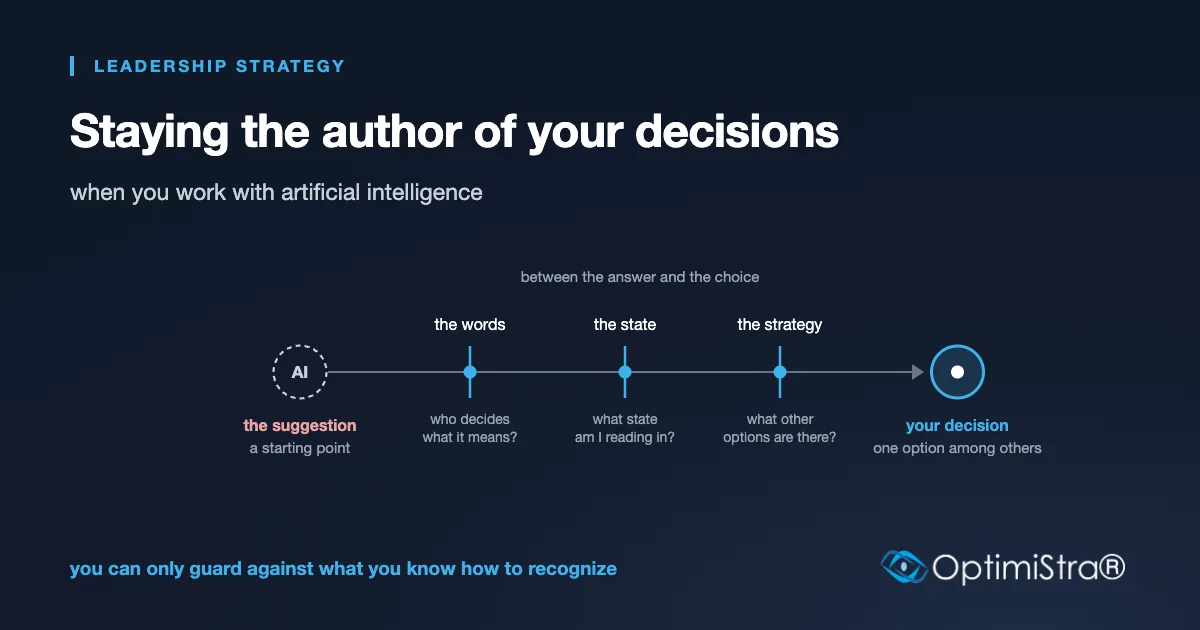
Leadership Strategy
Staying the author of your decisions when you work with AI
A language model can steer a decision with words alone: a suggested figure becomes the starting point, and the way a risk is framed changes the choice that follows. Knowing you can be influenced is not enough to protect you. What does protect you can be trained: precise language, managing your inner state, and strategic thinking.
November 18, 2026 · 14 min read
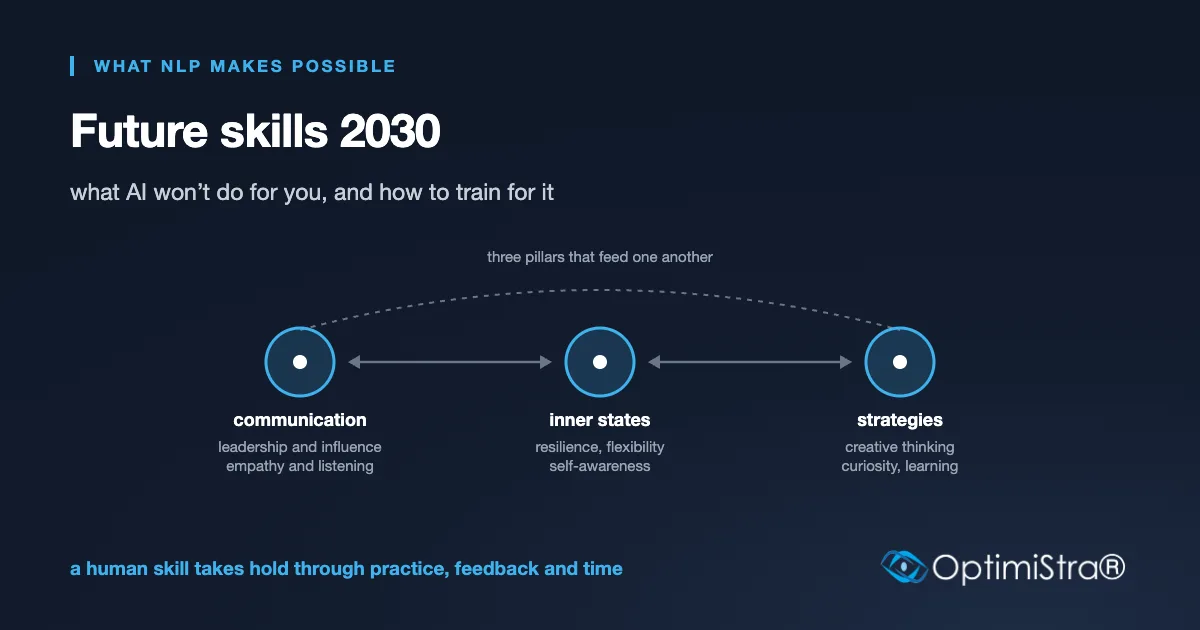
What NLP Makes Possible
Future skills 2030: what AI won’t do for you, and how NLP trains it
Employers rank resilience, leadership, self-awareness and communication among the core skills of 2030, in Switzerland even more than elsewhere. Neuro-Linguistic Programming (NLP) trains them through three pillars: communication, inner states and strategies. Research shows they are acquired through practice, feedback from a trainer and time.
November 18, 2026 · 18 min read
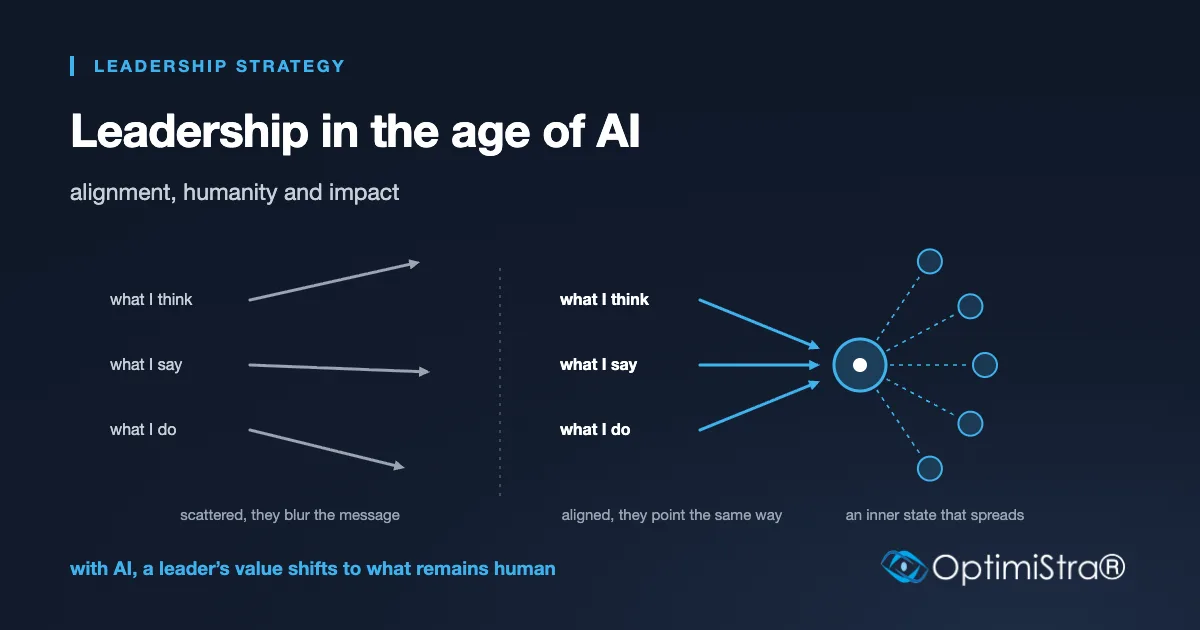
Leadership Strategy
Leadership in the age of AI: alignment, humanity and impact
As AI becomes faster and more consistent at technical work, a leader’s value moves toward what stays human: coherence between thoughts, words and actions, the quality of connection and the ability to bring out other people’s potential. This inner alignment is not improvised. It is worked on and kept up over time.
November 18, 2026 · 7 min read