Lasting change needs a coherent direction: why resolutions don’t hold, and what to do about it

Published November 18, 2026 · 7 min read
In brief
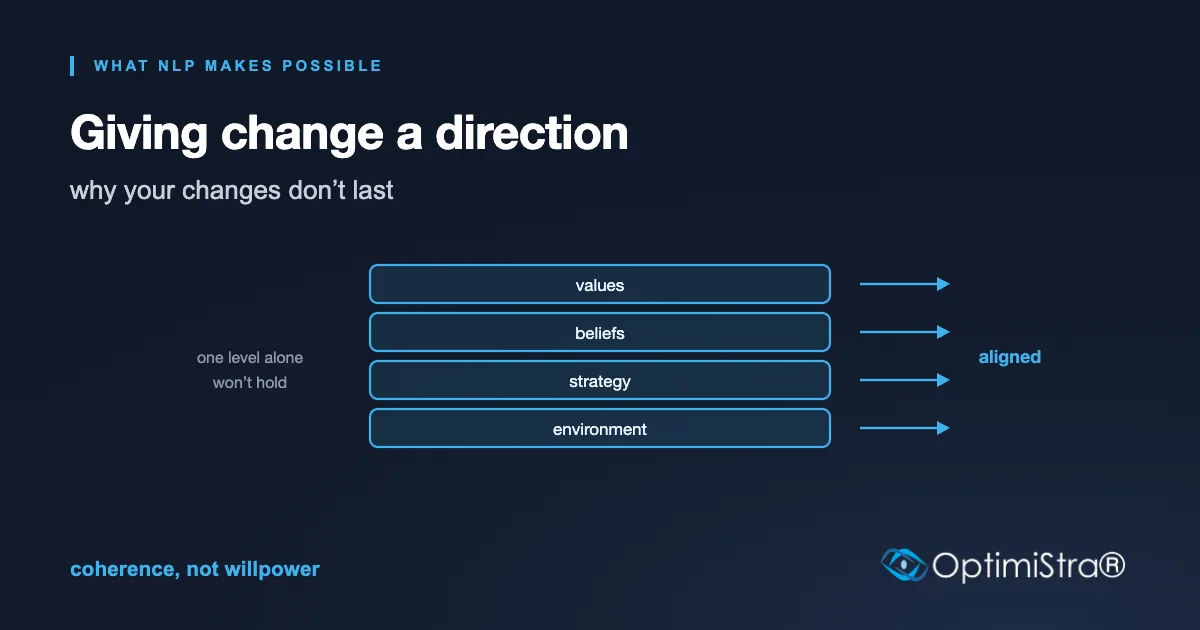
A change holds when four levels agree: the environment it happens in, the strategy that organizes it, the beliefs you hold about it and the value that gives it meaning. Decided at one level only, it gives way to the other three. The timescale is counted in weeks, and one missed day undoes nothing.
Every January 1, millions of people make a resolution. And every February, almost all of them are back where they started, with the added feeling that they lacked willpower.
I’m going to tell you something that may come as a relief: it was never a question of willpower. It was a question of coherence. A change that doesn’t last isn’t a change that failed. It’s a change that was never given a direction.
The gym you never went back to
You know how this goes, and perhaps you’ve lived it. On January 1 the decision is made: this is the year you take up exercise. The motivation is intact and the resolution is clear. The first week, you go. The second week too, perhaps forcing yourself a little. In the third week, something starts to jam. By the fourth, you’ve almost stopped thinking about it. By March, the membership card is lying forgotten at the bottom of a drawer.
Then the verdict comes in, always the same and always against yourself: “I didn’t keep it up. I lack discipline. I can’t stick to anything.”
That is untrue, and deeply so. There was a change. There was no coherence in it, and no groundwork. A change with no groundwork is a seed laid on concrete: it may sprout for a few days, and it will never take root.
Changing is not the same as making a change last
We confuse two very different things: deciding to change, and putting in place a change that holds over time.
Deciding is easy. It’s even exhilarating. The trouble is that change isn’t a switch you flip once. Nor is it change for its own sake. Real change is a trajectory, and a trajectory needs a direction.
This is where it is all decided. As long as you act on the surface (the resolution, the motivation of the moment, January’s good intentions), you’re acting on the most fragile part of the system. The slightest obstacle, one difficult week, and it all comes down, because beneath the decision nothing has moved. Gollwitzer and Sheeran showed that writing down in advance when and where you will act absorbs some of those setbacks.
Giving change a coherent direction is exactly this work below the surface: making sure that every level of you is pushing the same way. When that is the case, the change no longer asks for constant effort. It comes naturally.
Why a change decided “from the top” ends up collapsing
Let’s go back to the exercise example, because everyone knows it and it shows the whole mechanism.
For a change to persist, it needs alignment at several levels. When just one of those levels hasn’t been dealt with, that is the one that ends up derailing everything, often without your understanding why. You then believe that you gave up, when it was the system that wasn’t aligned.
Say you decide to take up exercise. The motivation is there and the intention is sincere. But getting to your gym takes 90 minutes each way. No willpower in the world holds out against 3 hours of travel a day. Your discipline isn’t in question: your environment is working against your decision.
And the environment is only the first level. There are others, deeper down, and it is the way they stack up that makes a change, or unmakes it.
The four alignments of a change that really holds
Here, in order, are the levels that need to be brought into line for a change to take root. Any one of them, if neglected, can bring the rest down on its own.
1. Environment: the ground the change will grow in
This is the most concrete level. If going to the gym costs you 3 hours of travel, the problem isn’t in your head, it’s in the geography. Before any inner effort, sort out the setting: find a gym closer to home, pack your bag the night before, remove the practical friction. You don’t fight your environment; you rearrange it so that it carries you.
2. Strategy: the practical way you put the change in place
Wanting isn’t enough; you also need a how. Which days? At what time? How often? A strategy that holds up is a way of living with the change that withstands the unexpected, instead of depending on the mood of the day. Without one, every session becomes a decision to be taken again from scratch, and that is exhausting.
3. Beliefs: what you hold to be true about the change
Here we go deeper. If you start exercising while carrying the belief that “exercise is hard”, that “it’s not for me” or that “it never lasts anyway”, then no rearranging and no strategy will hold. Your beliefs are the invisible foundations. When they work against you, they undermine the building from the inside, silently.
4. Values: the deeper reason, the one that gives the change its meaning
This is the most deeply buried level, and the most powerful. It is far easier to take up exercise when you are genuinely moved by the idea that exercise is good for my health (health as a value) than when you simply tell yourself “I exercise because it’s cool”. A value gives the change an anchor that fashion or a passing wish will never give it. It is what turns an obligation into something that goes without saying.
When these four levels are in tune, change stops being a fight. It becomes coherent, and what is coherent in a human being has considerable staying power. Lally and colleagues measured how much time that staying power takes to build, and the differences from one person to the next are very wide.
The nuance that matters most: “because it’s cool” versus “because it’s good for me”
Let’s stay with this detail for a moment, because it holds the whole point of this article.
Two people decide to take up exercise. The first thinks: “I’m starting because it’s cool, everyone’s doing it.” The second thinks: “I’m starting because my health matters to me, and exercise looks after it.” Ryan and Deci spent their careers on precisely this difference: a motivation you have made your own and a borrowed one don’t have the same lifespan.
On the surface, it’s the same decision. In reality, these are two very different changes. The first floats at the surface, at the level of a wish. The second reaches down to a value. And it is the depth of the anchor that decides how long the change lasts.
That is the whole difference between a resolution that evaporates in February and a change that becomes, almost without your noticing, a new way of being. The question is never “Do I want to change?” The real question is “At what level of me is this change anchored?”
From being at the mercy of change to steering it
As long as you’re unaware of these levels, you are at the mercy of your own attempts to change. You decide, it doesn’t hold, you blame yourself, you start again, and you wear yourself out, convinced that you are the problem.
The day you understand that lasting change is built level by level (environment, strategy, beliefs, values), something turns around. You stop counting on raw willpower. The systematic review by Singh, Murphy, Maher and Smith confirms the order of magnitude: several weeks, and one missed day undoes nothing. You stop judging yourself. You start steering your own change instead of having it happen to you.
This is what Neuro-Linguistic Programming (NLP) makes possible: not change for its own sake, but giving each change a direction coherent enough for it to last and, in the end, to become part of you.
Where to go next
If what you have just read speaks to you, there is more in how long it really takes to form a habit, how success is built, changing a thought pattern and the core principles of NLP. And if you would like to go further with NLP itself, the NLP Practitioner course is where the program begins.
Article designed and written by Michel Wozniak, and optimized by artificial intelligence. Illustration created by artificial intelligence.
Sources
- Ryan & Deci (2000), Self-determination theory and the facilitation of intrinsic motivation, social development, and well-being, American Psychologist
- Gollwitzer & Sheeran (2006), Implementation Intentions and Goal Achievement: A Meta-analysis of Effects and Processes, Advances in Experimental Social Psychology
- Lally, van Jaarsveld, Potts & Wardle (2010), How are habits formed: Modelling habit formation in the real world, European Journal of Social Psychology
- Singh, Murphy, Maher & Smith (2024), Time to Form a Habit: A Systematic Review and Meta-Analysis of Health Behaviour Habit Formation and Its Determinants, Healthcare
Frequently asked questions
Why do my New Year’s resolutions never last more than a few weeks?
Because a resolution works at the surface, on the decision and the motivation, without touching the deeper levels that support a change. When your environment, strategy, beliefs and values aren’t aligned with the new direction, the slightest obstacle is enough to send everything back to the starting point. What is missing is coherence, not willpower.
What does NLP mean by a “coherent” change?
A change in which every level of the person pushes the same way: the physical setting (environment), the way of going about it (strategy), what you hold to be true (beliefs) and the deeper reason that gives it meaning (values). When those levels are in tune, the change no longer asks for constant effort: it comes naturally.
Do you need a lot of willpower to make a change last?
Less than you might think. Willpower is useful for getting started, and it runs out quickly if it has to make up for a system that is out of alignment. A well-built change rests on inner coherence rather than on force, which is what lets it last without wearing you out.
Which level should I start with to make a change stick?
It pays to start with the most concrete one, the environment, so that the practical friction is out of the way, then to work through strategy, then beliefs and finally values. It is often at the deepest level, that of values, that a lasting change finds its real strength.
How long does it take for a change to stick?
That depends far less on time than on alignment. An action repeated every day takes, at the median, several weeks to become automatic, with very wide differences from one person to the next. And a missed day undoes nothing; what undoes a change is a system pulling in two directions.
What NLP Makes Possible
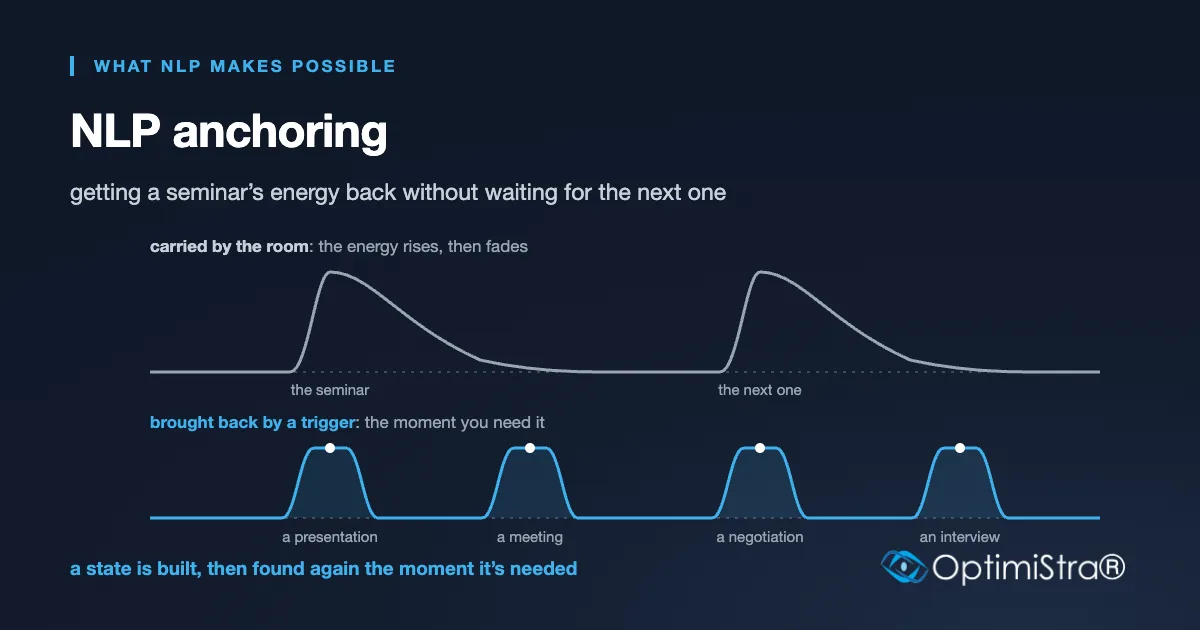
After a motivational seminar, the energy fades: what NLP anchoring changes
A motivational seminar produces real energy, and it often fades within a few weeks because it stays attached to the room. Elite athletes learn to bring back the state they need on their own, with a chosen trigger such as Florent Manaudou’s word “puissance.” NLP calls this an anchor, and it can be learned.
November 18, 2026 · 14 min read
What NLP Makes Possible
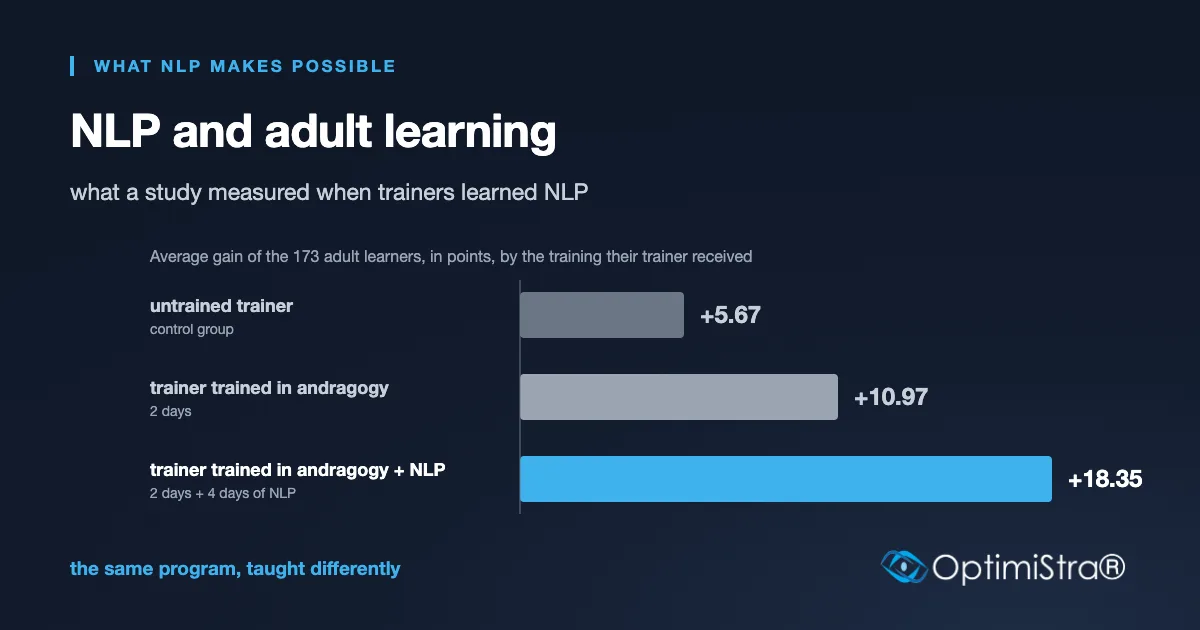
NLP and adult learning: what a study measured in 173 adult learners
In 2012, a study in England randomly assigned 24 trainers of adults to three groups. Learners whose trainer had taken 4 days of Neuro-Linguistic Programming (NLP) on top of a course in andragogy improved by 18.35 points, compared with 10.97 when the trainer had taken andragogy alone. Research on expectations, relationships, and stress helps explain the gap.
November 18, 2026 · 15 min read
What NLP Makes Possible
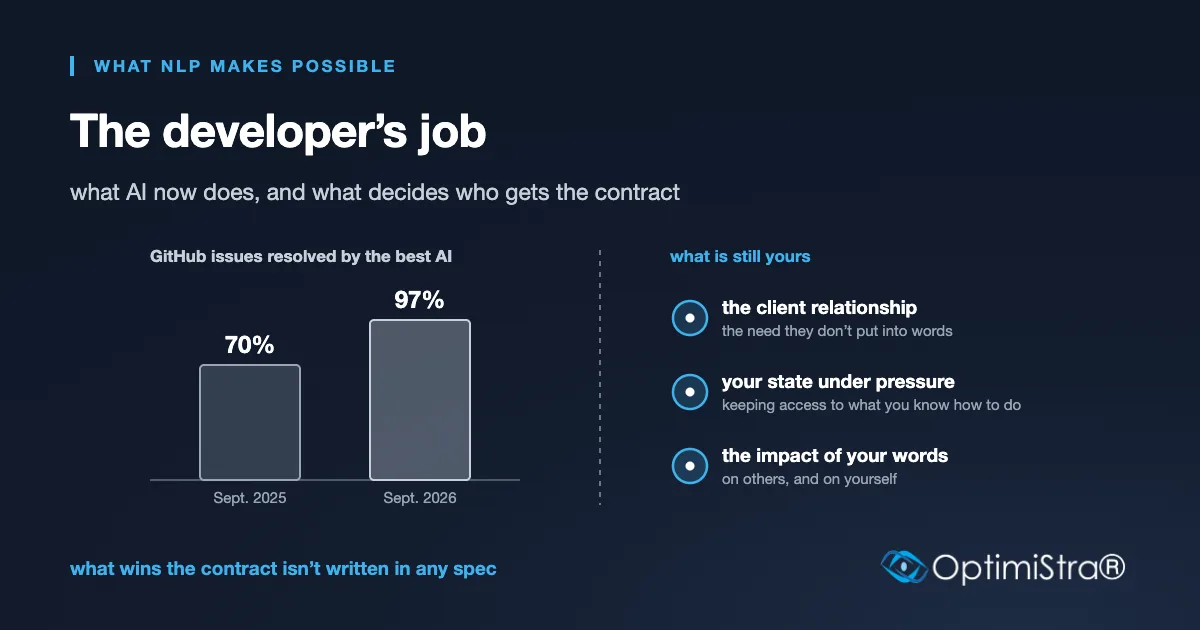
Developers in the age of AI: what decides who gets the contract
AI now resolves almost all the tickets in a benchmark test, and the market for developers has tightened. What decides who gets the contract increasingly lies in the relationship with the client and in the state you are in under pressure. These human skills can be trained, and Neuro-Linguistic Programming (NLP) works on them through three pillars.
November 18, 2026 · 11 min read